

Survivorship life insurance, also called second-to-die coverage, is a single permanent policy insuring two people that pays out only after both have died. It exists almost exclusively to solve one problem: giving an estate cash on hand right when taxes, debts, and settlement costs come due. If your estate plan depends on liquidity rather than income replacement, this is the tool built for it.
TL;DR:
- Survivorship policies are generally cheaper than two individual permanent policies because pricing is based on joint life expectancy.
- Most policies are permanent with cash value accumulation, allowing borrowing or withdrawals that can affect future premiums and death benefits.
- The payout only occurs after both insured individuals have died, making it unsuitable for immediate income replacement needs.
- Proper ownership structures and beneficiary designations, such as trusts, are essential to ensure proceeds avoid probate and reach heirs efficiently.
- This coverage is best for estate liquidity and legacy transfer, not for covering short-term income gaps after the first death.
Table of Contents
- How Does Survivorship Life Insurance Work?
- What Types of Survivorship Policies Are Available?
- How Do Advisers Use Survivorship Policies in Estate Planning?
- Is Survivorship Life Insurance a Good Fit for You?
- What Drives the Cost of a Survivorship Policy?
- How Do You Decide on Coverage and Compare Alternatives?
- What Should You Ask a Licensed Agent Before Buying?
- Why We Don't Recommend Survivorship Coverage to Everyone
- Get a Survivorship Quote Modeled for Your Estate
- Sources
- FAQ
How Does Survivorship Life Insurance Work?
The payout mechanics are simple, even if the reasoning behind them isn't. One policy insures both spouses or partners, and the death benefit remains untouched until the second person dies. No benefit gets paid after the first death, no matter how far apart the two deaths occur.
Most survivorship contracts are permanent policies, meaning they build cash value over time that policyholders can borrow against or withdraw from while both insureds are alive. Term survivorship exists but is uncommon, since both people have to die within the term for a claim to pay, and outliving the term means no death benefit and no refund of premiums paid.
Here's what actually shapes the timeline and mechanics:
- The death benefit becomes payable only once both insureds have died, sometimes decades after the policy was issued.
- Permanent versions accumulate cash value that can be borrowed or withdrawn, which affects future premium obligations.
- Once the claim is filed, insurers typically release proceeds within weeks, fast enough to cover estate tax deadlines that arrive nine months after death.
- Term versions skip cash value entirely and exist mainly for shorter, defined liquidity needs.
That nine-month estate tax clock is the entire reason this product exists. Without cash ready to go, heirs sometimes sell real estate or business interests at a discount just to raise money fast.
What Types of Survivorship Policies Are Available?
Survivorship whole life is the conservative choice: fixed premiums, a guaranteed death benefit, and cash value that grows on a predictable schedule set by the insurer. Families who want zero surprises and a policy they can fund and forget tend to land here.
Survivorship universal life trades some of that predictability for flexibility. Premiums can often be adjusted within limits, and cash value growth is tied to interest crediting or, in indexed versions, partly to a market index with a floor and a cap. That flexibility can backfire if underfunded policies lapse right when a family needs them most.
- Survivorship whole life: fixed premiums, guaranteed cash value, minimal ongoing management.
- Survivorship universal life: flexible premiums, index or interest-based crediting, more moving parts to monitor.
- Term survivorship: lower initial cost, no cash value, real risk of paying in for years with no payout.
- Common riders: waiver of premium, estate tax rider, and the option to name an irrevocable life insurance trust as beneficiary instead of an individual.
Naming a trust as beneficiary rather than a person is standard practice in serious estate plans, since it keeps proceeds out of probate and can shield them from estate tax exposure altogether.
How Do Advisers Use Survivorship Policies in Estate Planning?
Survivorship life insurance earns its place in an estate plan through a handful of recurring scenarios, and each one solves a liquidity problem that would otherwise force a bad financial decision at a terrible time.
- Estate tax liquidity. A couple with a large estate, including a business or investment real estate, uses the death benefit to pay estate taxes without liquidating the business or selling property at a discount under time pressure.
- Asset equalization among heirs. One child inherits the family home; the survivorship payout gives the other children an equivalent cash inheritance instead of forcing a sale everyone resents.
- Trust and charitable funding. The policy proceeds flow into a trust that funds a charitable bequest or supports a special-needs family member long after both parents are gone.
- Preserving illiquid assets. Families with farms, ranches, or closely held businesses use the payout to avoid a forced sale to strangers just to cover a tax bill.
Design details matter as much as the concept. Ownership structure, beneficiary designations, and whether a trust holds the policy all affect how fast proceeds actually reach the people or purposes they're meant for. Get any of that wrong and the money can sit tangled in probate at the exact moment it was supposed to solve a cash crunch.
Is Survivorship Life Insurance a Good Fit for You?
The appeal is straightforward: two people, one policy, and pricing based on joint life expectancy rather than each person's individual risk. That structure usually makes survivorship coverage cheaper than buying two separate permanent policies, and it opens the door for couples where one partner has a health condition that would make an individual policy expensive or unavailable.
- Pros: lower combined cost than two separate policies, easier underwriting when one partner has health issues, strong fit for estate tax and legacy goals.
- Cons: no payout after the first death, added complexity if the couple divorces, and a payout that can be decades away.
- Best fit: couples focused on wealth transfer, business succession, or leaving a clean inheritance rather than replacing lost income.
Pro Tip: If either spouse would face a financial gap the day after the first death, survivorship insurance alone won't cover it. That's an income replacement problem, and it usually calls for an individual policy on top of, or instead of, a survivorship contract.
Financial planners consistently frame this as a wealth transfer tool, not an income replacement one, and that distinction should drive the buying decision more than the price tag does.
What Drives the Cost of a Survivorship Policy?
Premiums come down to five variables: both insureds' ages, their combined life expectancy, smoker status, health history, and the face amount requested. Because the insurer is pricing the joint mortality risk rather than two individual risks, the numbers behave differently than a standard policy quote.
- Age gap between the two insureds affects pricing more than either single age does.
- Smoker status on either policy raises the rate, though it has less impact than it would on an individual policy.
- One partner's serious health history, including a prior cancer diagnosis, often gets absorbed more easily here than on a standalone application.
- Face amount is typically sized to estate tax exposure plus settlement costs, not income replacement needs.
Underwriting usually still involves a medical exam for one or both insureds, and insurers can assign a table rating that raises premiums for the higher-risk partner without disqualifying the policy entirely. That's the real advantage over shopping two individual policies: one partner's health problems rarely sink the whole application. Borrowing against cash value later reduces the death benefit and can increase the premium needed to keep the policy in force, so any loan activity needs to be modeled against the original coverage goal.
How Do You Decide on Coverage and Compare Alternatives?
Sizing a policy starts with math, not guesswork. Add up projected estate tax exposure, expected settlement costs, and any cash bequest you want to guarantee heirs regardless of how the rest of the estate performs. That total becomes your target face amount.
- Estimate estate tax exposure and settlement costs using current thresholds and your actual asset values.
- Compare survivorship pricing against two individual permanent policies, a first-to-die policy, or annuity-based liquidity solutions.
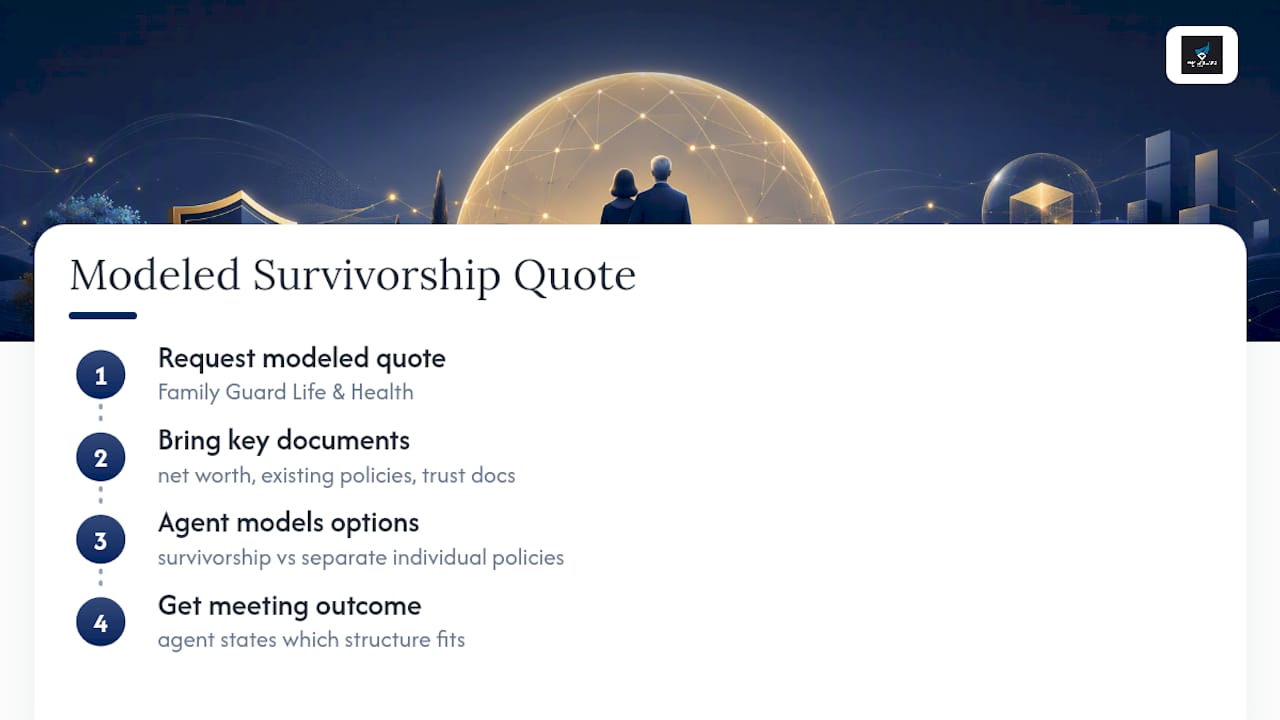
- Gather net worth statements, existing policy details, and trust documents before meeting an agent.
- Run modeled quotes across both survivorship and individual-policy structures with a licensed agent before committing.
If a family's cash need would land immediately after the first death rather than after both, a first-to-die structure or two individual policies usually fit better than survivorship coverage does.
What Should You Ask a Licensed Agent Before Buying?
A competent agent checks four things before recommending survivorship coverage: current beneficiary designations, whether a trust should own the policy instead of an individual, each partner's insurability, and whether trust funding language actually matches the estate plan's goals. Skipping any of these is how proceeds end up delayed in probate instead of reaching heirs on schedule.
Underwriting surprises are common enough to plan for. A table rating on one partner, a prior cancer diagnosis, or a controlled chronic condition can all raise premiums without killing the application, but only if the application is structured to account for them upfront.
- Verify beneficiary designations and trust language before finalizing coverage.
- Run survivorship quotes side by side with two individual policy quotes.
- Confirm both partners' insurability early, not after underwriting begins.
- Check ownership structure so proceeds bypass probate when that's the goal.
Licensed agents offering this coverage understand the rules applicable in various states, allowing most families researching this coverage to work with knowledgeable professionals.
Why We Don't Recommend Survivorship Coverage to Everyone
We recommend survivorship policies when the real goal is estate liquidity or legacy transfer for a couple with meaningful net worth, not a coverage gap after one death. When either partner needs income replacement right away, we usually steer clients toward separate individual policies instead.
— Shereka
Get a Survivorship Quote Modeled for Your Estate
Family Guard Life and Health is the alternative to guessing at coverage numbers on your own: we model survivorship pricing against separate individual policies side by side, so you see the actual cost difference before committing to either one.

This agency provides life insurance, annuities, Medicare supplement plans, and retirement income planning for individuals in multiple states. If your estate plan involves a family business, real estate, or a mix of heirs with different needs, running the numbers with someone licensed in your state matters more than it might seem. For estates complex enough to need dedicated financial modeling alongside insurance, Amplify Consults offers financial planning support that pairs well with the coverage side we handle.
Start by requesting a modeled quote through Family Guard Life and Health and bring your net worth estimate, existing policy details, and trust documents to the first conversation. That's enough for an agent to tell you within one meeting whether survivorship coverage or a different structure fits your actual numbers.
This article is general information, not a substitute for advice from a qualified financial advisor. Consult a qualified financial professional about your own circumstances before acting on anything here.
Sources
- Second-to-Die Insurance Explained: Benefits, Costs, and Estate Planning — Investopedia
- What is a survivorship life insurance policy? — U.S. News & World Report
- Second-to-Die Policy — SmartAsset
FAQ
What Are the Pros and Cons of Survivorship Life Insurance?
The main advantage is lower combined cost versus two separate permanent policies and easier qualification when one partner has health problems. The main drawback is that no benefit pays until both insureds have died, which can leave a surviving spouse without immediate liquidity.
Who Qualifies for Survivorship Life Insurance?
Most couples or partners with an insurable interest in each other qualify, and insurers often approve applicants who'd struggle to get an individual policy because one partner's health history gets weighed against the joint risk rather than judged alone.
How Much Does a Survivorship Life Insurance Policy Cost?
Cost depends on both insureds' ages, health history, smoker status, and the face amount chosen, but pricing is based on joint life expectancy, which typically makes it cheaper than two separate permanent policies with equivalent coverage.
What Are the Disadvantages of Survivorship Life Insurance?
Beyond the delayed payout, divorce can complicate ownership and beneficiary arrangements, and the policy provides zero benefit if a surviving partner needs cash immediately after the first death. Advisers generally recommend it for wealth transfer, not for filling an income gap.