

Yes, cancer survivors can get life insurance, but eligibility hinges on cancer type, treatment history, and how much time has passed since your last treatment. If you're mid-treatment or recently finished, guaranteed-issue, final-expense, or employer group life coverage are your fastest realistic paths to protection right now. For survivors further out from treatment, traditional underwriting opens up, and better rates usually follow.
TL;DR:
- Survivors over two years from treatment can qualify for standard or near-standard rates with full underwriting, depending on the cancer type and stage.
- Most applicants will face rated policies, with costs increasing based on table ratings or flat extras, rather than outright declines.
- Timing of application significantly impacts approval chances, with waiting longer after remission often leading to better rates and coverage options.
- Different carriers have highly variable underwriting guidelines for the same cancer diagnosis, making it essential to shop around through an independent broker.
- Disclosing full medical history and obtaining detailed oncology records before applying reduces delays and improves underwriting outcomes.
Table of Contents
- Life Insurance Options for Cancer Survivors, from Bridge Coverage to Long-Term Policies
- How Underwriters Evaluate a Cancer History
- What Life Insurance Actually Costs After a Cancer Diagnosis
- The Shopping and Application Process That Actually Works
- Your Next Move, Based on Where You Are Right Now
- Does Recurrence Risk Change Your Eligibility and Rate?
- How to Improve Your Approval Odds and Lower Your Premium
- Not All Cancers Underwrite the Same Way
- Do Age and Gender Change the Math?
- Contestability, Exclusions, and What Your Beneficiary Should Know
- A Broker's View on What Actually Happens After Diagnosis
- What to Expect When You Talk to Family Guard Life and Health
- Sources
Life Insurance Options for Cancer Survivors, from Bridge Coverage to Long-Term Policies
Not every policy type fits every stage of the survivorship journey, and knowing which one matches your situation saves you from wasted applications and needless denials.
Guaranteed-issue life insurance asks no health questions and requires no exam, so it's accessible during active treatment when almost nothing else is. The tradeoff: face amounts are usually capped in the low thousands, and most policies carry a graded death benefit for the first two to three years, meaning your beneficiary gets a return of premium (plus interest) rather than the full payout if you pass away early in the policy is a realistic immediate option during active treatment.
Final-expense insurance works similarly but is marketed specifically to cover burial and end-of-life costs. It's a sensible bridge, not a long-term wealth-transfer tool.
Simplified-issue policies skip the exam but ask a handful of health questions, which can disqualify recent cancer patients while still working for those a few years past treatment.
Term life insurance and whole life insurance require full underwriting, medical records, and often a paramedical exam. They're cheaper per dollar of coverage and better suited to survivors with more remission time behind them.
Group life insurance through an employer typically requires no individual underwriting for base amounts, making it worth checking immediately if you're employed, since enrolling in or increasing group coverage may be available without underwriting.
- Guaranteed-issue: fast, capped payout, graded benefit period
- Final-expense: burial-focused, low face amount, minimal questions
- Simplified-issue: moderate speed, some health screening
- Term/whole life: full underwriting, best long-term value once eligible
- Group life: often available now through your employer, highly portable only while employed
How Underwriters Evaluate a Cancer History
Underwriters don't treat "cancer" as a single risk category. They dig into specifics, and the specifics determine whether you get approved at standard rates, get rated up, or get postponed entirely.
The factors that carry the most weight:
- Cancer type and stage at diagnosis. A stage 1 basal cell carcinoma and a stage 3 colorectal cancer sit at opposite ends of the risk spectrum.
- Treatment received. Surgery alone typically underwrites more favorably than chemotherapy or radiation, which signal more aggressive disease.
- Time since treatment completion. This is the single biggest lever survivors can pull simply by waiting and reapplying later.
- Comorbidities. Diabetes, cardiovascular disease, or obesity layered on top of a cancer history compounds the rating.
- Tobacco use. Smoking after a cancer diagnosis, especially a smoking-related cancer, is a red flag underwriters weigh heavily.
Here's the part most applicants get wrong: underwriters typically calculate your disease-free interval from the date treatment ended, not the diagnosis date, so precise oncology notes showing treatment completion and follow-up surveillance matter more than people expect.
Rough outcome patterns by remission window: applicants still in treatment generally can't access fully underwritten policies at all. Those under two years post-treatment often face postponement or guaranteed-issue-only options. The two-to-five-year mark tends to open up simplified-issue and some rated term policies. Past five years, many survivors qualify for standard or near-standard pricing on lower-risk cancers, especially when SEER-reported survival rates for that cancer type and stage are favorable.
Pro Tip: Request your complete oncology summary, including the exact treatment end date, well before you apply. A vague or incomplete record is one of the most common reasons underwriting drags on for months instead of weeks.
What Life Insurance Actually Costs After a Cancer Diagnosis
Expect a rated policy, not a declined one, in most cases. Insurers use two primary tools to price cancer risk into a policy instead of turning applicants away outright.
Table ratings stack extra cost onto a standard premium in bands, often labeled Table 1 through Table 16, referred to as your carrier's chosen framework of table rating and how it affects your premium.
Flat extras work differently. Instead of a percentage, the insurer adds a fixed dollar amount per $1,000 of coverage for a defined number of years. Once that window closes, the flat extra falls away and the base policy continues at its normal rate, which makes it a genuinely temporary penalty rather than a permanent one.
- No-exam guaranteed-issue policies almost always cost more per dollar of coverage than underwritten term
- Full underwriting can end up cheaper once you clear the higher-risk window, even with a rating attached
- Carriers price the same diagnosis differently, which is why a quote from one company tells you almost nothing about what another will offer
Underwriting outcomes and pricing vary substantially by carrier for the same applicant, which is exactly why shopping around isn't optional if you want a fair price.
The Shopping and Application Process That Actually Works
Applying to one carrier and accepting whatever comes back is how survivors end up overpaying or getting declined unnecessarily. A structured approach changes the outcome.
- Keep every existing policy in force. Never cancel current coverage before new coverage is approved and issued.
- Secure temporary protection if you have a gap. Guaranteed-issue or a group life increase can cover the interim.
- Assemble your medical file. Diagnosis date, pathology report, full treatment summary, most recent oncologist notes, and recent labs or scans.
- Work with an independent broker who shops multiple carriers, rather than applying carrier by carrier on your own.
- Apply to the carrier whose underwriting guidelines actually fit your specific diagnosis and timeline.
The documentation matters as much as the strategy. Carriers want to see:
- Exact diagnosis and treatment-completion dates
- Pathology report confirming cancer type and stage
- Treatment summary (surgery, chemo, radiation, immunotherapy)
- Current oncologist follow-up notes and surveillance results
- Recent bloodwork or imaging showing no recurrence
Independent brokers earn their keep here because a decline from one company isn't the final word, and a broker familiar with each carrier's underwriting appetite can place you where your specific profile fits, rather than where you happened to apply first. That's true whether you're working with a licensed health insurance broker locally or an independent agency that shops multiple carriers on your behalf.
Your Next Move, Based on Where You Are Right Now
- In active treatment: Secure guaranteed-issue or final-expense coverage now, and check your employer's group life options.
- Under 2 years post-treatment: Gather full medical records and expect postponement on traditional policies; guaranteed-issue remains your practical option.
- 2 to 5 years post-treatment: Start shopping simplified-issue and rated term policies with a broker.
- 5+ years post-treatment: Reapply for full underwriting; standard or near-standard rates are realistic for many cancers.
Never let existing coverage lapse while waiting on a new application, and never omit medical history on an application. Misrepresentation is grounds for denial of a claim later.
Does Recurrence Risk Change Your Eligibility and Rate?
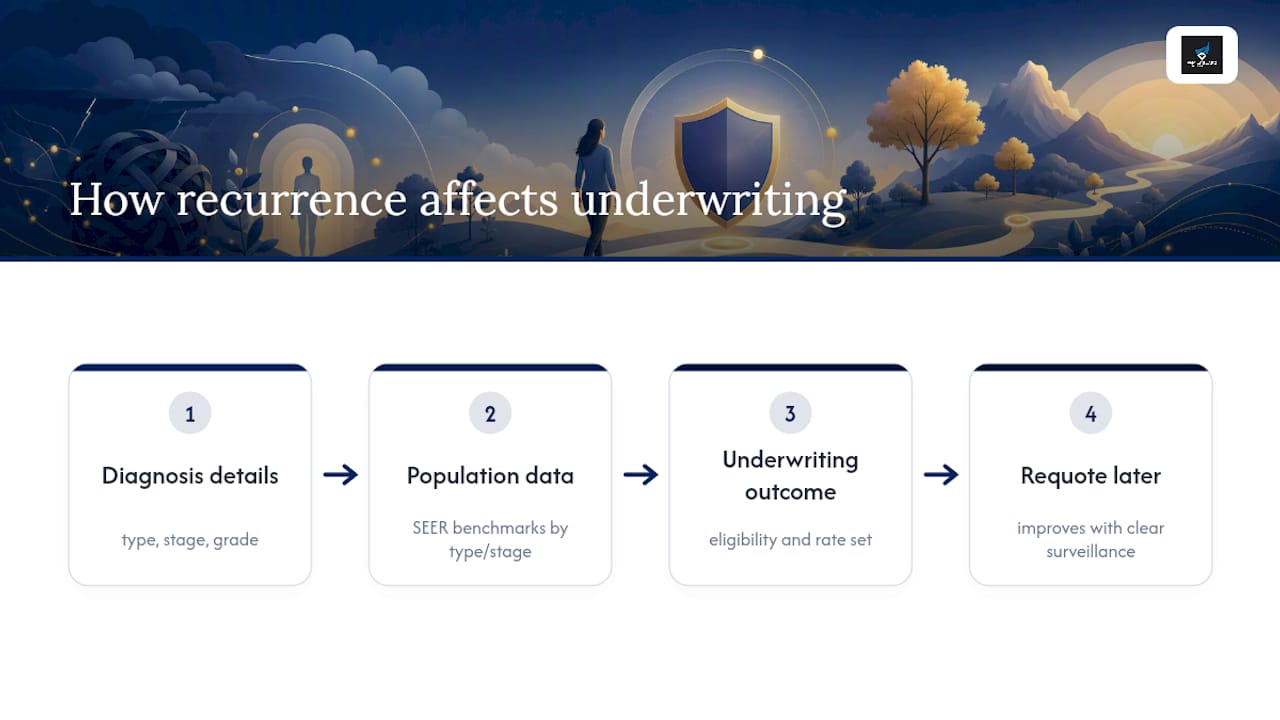
Recurrence risk is the invisible variable underneath almost every underwriting decision. Insurers aren't just pricing the cancer you had. They're pricing the statistical odds it comes back, and those odds differ enormously by cancer type and stage.
A survivor of early-stage thyroid cancer carries a very different recurrence profile than someone treated for stage 3 breast cancer, even if both are three years out from treatment. Underwriters lean on population-level data, including SEER survival statistics by cancer type and stage, to benchmark where a given diagnosis falls on the risk curve. Longer observed survival rates for your specific cancer and stage generally translate into more favorable underwriting.
This is also why the clock resets differently for different cancers. Some cancers, like certain early-stage skin cancers, have recurrence risk that drops sharply after just a couple of years. Others, like some hormone-driven breast cancers, carry a meaningful recurrence risk that extends a decade or more, which is part of why carriers sometimes ask for a longer disease-free interval before offering standard rates on those diagnoses.
Practically, this means two survivors with the "same" cancer type but different stages, grades, or receptor statuses can get very different offers from the same carrier. It also means a rating isn't permanent. As surveillance scans and follow-up appointments keep coming back clear, your recurrence risk profile improves, and so does your case for requoting later at a better rate.
How to Improve Your Approval Odds and Lower Your Premium
The single biggest strategy is timing. Waiting even six to twelve months past a key remission milestone, like the two-year or five-year mark, can shift you from a decline into an approval, or from a heavy table rating into a much lighter one.
Beyond timing, a few concrete moves help your case:
- Tighten your paperwork. Get your oncologist to document the exact treatment-completion date and confirm no evidence of disease in writing.
- Address comorbidities separately. Losing weight, controlling blood pressure, or quitting tobacco before you apply removes compounding risk factors underwriters would otherwise stack on top of your cancer rating.
- Apply through a broker, not directly to one carrier. Because underwriting appetite varies so much between insurers, the same file can be declined at one company and approved at standard rates at another.
- Consider a smaller policy now, larger later. Locking in guaranteed-issue or final-expense coverage today, then adding a fully underwritten term policy once you clear a remission milestone, beats waiting for perfect terms while going uninsured.
- Ask about riders. Accelerated death benefit and critical illness riders can add flexibility to access funds under defined conditions, though availability varies by carrier and policy.
Not All Cancers Underwrite the Same Way
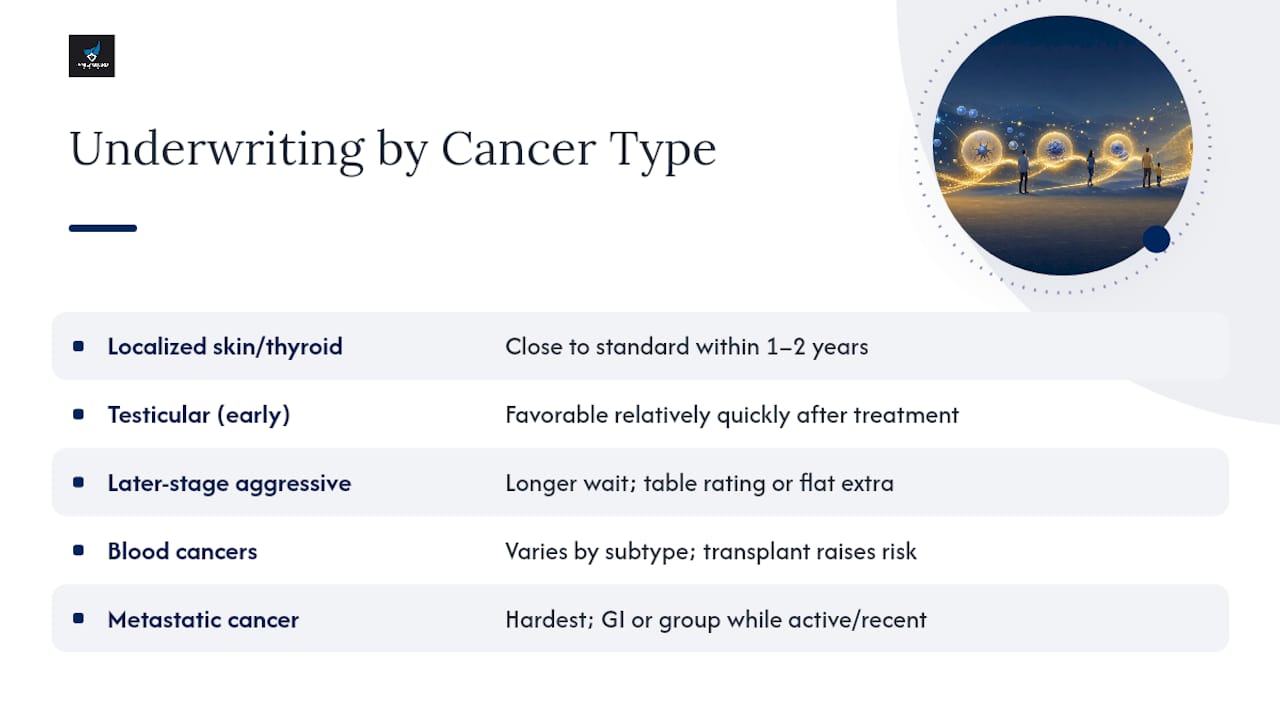
Underwriters group cancers into rough risk tiers, and the differences between tiers are substantial enough to change which policy type makes sense.
Localized, low-recurrence cancers, like early-stage basal or squamous cell skin cancer, or stage 1 thyroid cancer, often underwrite close to standard rates within a year or two of treatment. Testicular cancer, when caught early and treated successfully, also tends to underwrite favorably relatively quickly.
Cancers with higher recurrence risk or more aggressive treatment protocols, like later-stage breast, colorectal, or lung cancers, typically require a longer waiting period and carry a table rating or flat extra even after that wait. Blood cancers such as leukemia and lymphoma vary widely depending on subtype and whether the patient underwent a bone marrow transplant, which underwriters treat as a materially higher-risk event.
Metastatic cancer at any stage is the hardest case for traditional underwriting, and guaranteed-issue or group coverage is usually the only realistic path while that diagnosis is active or recent.
The practical takeaway: don't assume your cancer type follows the same rules as someone else's. A friend's experience getting standard rates two years after melanoma tells you very little about what to expect two years after ovarian cancer. Ask your broker to pull underwriting guidelines specific to your exact diagnosis.
Do Age and Gender Change the Math?
Age matters independently of cancer history, and it compounds with it. A 35-year-old survivor of a low-risk cancer will generally see a smaller premium increase, in dollar terms, than a 65-year-old survivor of the same cancer, simply because base mortality risk climbs with age regardless of cancer history. That said, older applicants sometimes have an easier time qualifying for smaller guaranteed-issue or final-expense policies, since those products are frequently marketed toward and priced for older adults.
Gender plays a smaller but real role, mostly through the cancers it correlates with. Breast cancer underwriting guidelines, for instance, are extensively documented because of case volume, while some rarer cancers have thinner actuarial data behind them, which can make underwriters more conservative by default.
Age also interacts with timing strategy. A younger survivor has more incentive to wait out a longer remission window before applying, since the eventual savings compound over decades of lower premiums. An older survivor facing a shorter time horizon might reasonably prioritize locking in coverage sooner, even at a rated premium, over waiting for a discount that matters less over a shorter policy term.
Contestability, Exclusions, and What Your Beneficiary Should Know
Every life insurance policy carries a contestability period, typically the first two years after issue, during which the insurer can investigate and deny a claim if it finds a material misrepresentation on the application. This is the single most important reason to disclose your full cancer history accurately, even when it feels tempting to omit something you assume won't come up.
If you die within that contestability window and the insurer discovers an undisclosed cancer history during its claims investigation, it can deny the payout entirely and return only the premiums paid, leaving your beneficiary with nothing close to what they expected. Once the contestability period passes, insurers generally can't deny a claim for misrepresentation except in cases of outright fraud.
Some policies, particularly guaranteed-issue products, also carry an explicit graded death benefit rather than a formal exclusion. During the first two or three years, a death from any cause, not just cancer, typically pays out only the premiums paid plus interest rather than the full face amount. After that grading period ends, the full benefit applies going forward.
Riders can complicate payouts too. An accelerated death benefit rider that pays out early due to a terminal diagnosis reduces the remaining death benefit your beneficiary eventually receives, so it's worth understanding the tradeoff before activating one.
A Broker's View on What Actually Happens After Diagnosis
Most survivors assume the first "no" is the final answer, and it almost never is. In practice, outcomes come down to matching the right diagnosis, timeline, and documentation to the right carrier, not to whether cancer history alone disqualifies someone. One client, declined outright eighteen months after treatment, requalified for a standard rated term policy less than a year later simply by waiting past the two-year mark and reapplying with updated oncology records. Timing and paperwork, more than luck, decide most cases.
— Shereka
What to Expect When You Talk to Family Guard Life and Health
Some insurance agencies specialize in matching cancer survivors with carriers whose underwriting guidelines fit their diagnosis, instead of gambling on a single application and hoping. An independent brokerage typically shops your case across multiple carriers rather than pushing one company's product, which matters given how differently insurers price the same cancer history.
A first call typically starts with a document checklist: diagnosis date, treatment summary, and current oncologist notes, followed by a realistic timeline for what quotes to expect and from which carriers. If you're weighing permanent coverage once you're fully underwritten, it's also worth asking about indexed universal life insurance or how life insurance fits into a broader retirement income plan. Reach out through Family Guard Life and Health to start the conversation and find out where you actually stand.
This article is general information, not a substitute for advice from a qualified financial advisor. Consult a qualified financial professional about your own circumstances before acting on anything here.
Sources
- Can I get life insurance if I have cancer? | American Cancer Society
- Best life insurance for cancer survivors | MoneyGeek
- SEER expected survival