

A life insurance table rating means an insurer approved you at substandard rates. You're not denied coverage, but you'll pay more than a standard applicant because your medical history, weight, or lifestyle pushed your mortality risk above the baseline.
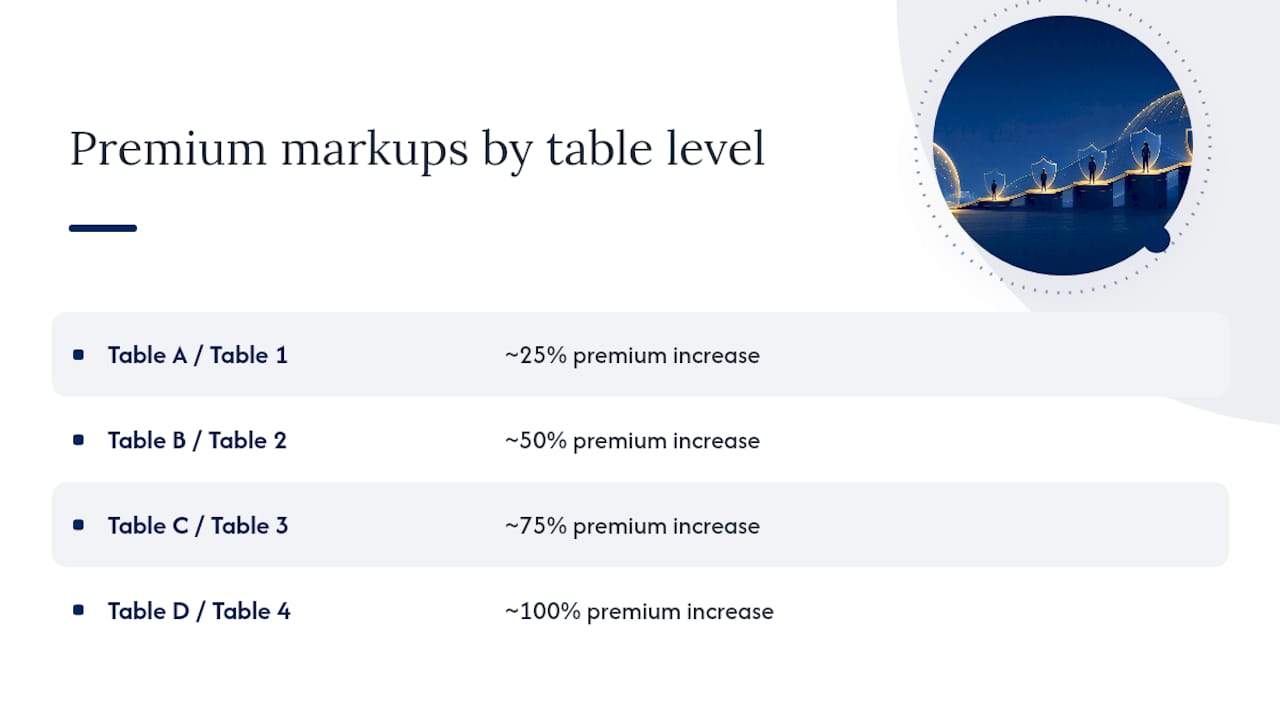
The cost isn't abstract. Most carriers add roughly 25% to your premium for each table level, so a Table 1 (also written as Table A) rating typically runs about 25% above standard rates, and a Table 2 rating lands closer to a 50% surcharge. That math compounds as the table number climbs.
Before you panic over that number, here's what actually matters for your decision:
- A table-rated policy still pays the full death benefit your beneficiaries were promised. Nothing about the payout shrinks because of the rating.
- The exact percentage varies by carrier. One insurer's Table 4 might match another's Table B, and the dollar difference between them can be significant.
- You have options. You can shop competing carriers, appeal with better documentation, or in some cases get re-underwritten later once a health issue improves.
Key Takeaways
A table rating adds roughly a quarter to your premium per level above standard, but the rating is neither permanent nor uniform across carriers, so shopping and documentation both directly affect what you end up paying.
| Point | Details |
|---|---|
| Table ratings raise cost, not coverage | Your death benefit stays intact; you just pay a percentage surcharge, often around 25% per table level. |
| Labels vary by carrier | The same health profile can earn different table numbers or letters depending on the insurer's underwriting standards. |
| Verify, then act | Check application accuracy, gather updated labs, and ask about table-shave programs before accepting a high rating. |
| Timing affects reassessment | Most carriers want a policy in force about 12 months, with documented stability, before reconsidering your table. |
| Familyguardlh compares carriers for you | The agency shops multiple insurers across 22 states and helps prepare documentation for re-underwriting or table-shave requests. |
Table of Contents
- What Is a Life Insurance Table Rating, Exactly?
- How Do Underwriters Decide on a Table Rating?
- How Much Does a Table Rating Raise Your Premium?
- Table Ratings vs. Flat Extras: What's the Difference?
- What Usually Causes a Table Rating?
- What Should You Do After Getting a Table Rating?
- Should You Accept a Rated Offer or Keep Shopping?
- How Long Does the Underwriting and Improvement Process Take?
- An Agent's View on Table Ratings
- How Familyguardlh Can Help With a Rated Offer
- Sources
What Is a Life Insurance Table Rating, Exactly?
Insurers sort applicants into risk tiers, and a table rating is the label for anyone who falls outside the "standard" or "preferred" tiers because of an identifiable, ongoing health or lifestyle risk. Carriers express this using one of two labeling conventions: letters (Table A through Table J or beyond) or numbers (Table 1 through Table 10). Some companies use both interchangeably in their paperwork, which is exactly why comparing quotes across insurers gets confusing fast.
What actually matters isn't the letter or number itself. It's the percentage markup that label represents. Table A and Table 1 both typically signal roughly a 25% premium increase over standard rates, according to MoneyGeek's breakdown of life insurance rating classifications. Table B or Table 2 usually doubles that gap to around 50%. From there, each step up the ladder tends to add another 25 percentage points, though not every carrier scales it identically.
A quick example: say a 45 year old qualifies for standard rates at $60 a month for a $500,000 term policy. If underwriting assigns Table 2, that same coverage could cost closer to $90 a month; the extra $30 reflects the roughly 50% surcharge tied to that risk class. Some carriers cap their tables at Table 8, others go to Table 16, and a few substitute flat dollar surcharges instead of percentage tables entirely for certain risks. Always check the actual equivalency table printed on your policy illustration rather than assuming the label means what it meant with a different insurer.
How Do Underwriters Decide on a Table Rating?
Underwriting isn't a single test; it's a layered review. An underwriter typically works through your application answers, a paramedical exam (blood pressure, blood and urine samples, height and weight), a records check through the Medical Information Bureau, your prescription history, and sometimes a look at your occupation, hobbies, and driving record.
The goal is to place you into a risk class that mirrors your actual mortality risk compared to a large pool of similar applicants. That's why two people with the identical diagnosis can walk away with different table ratings. An underwriter looks at the whole picture, not one data point in isolation.
- Application review: Confirms disclosed conditions, medications, and family history line up with medical records.
- Exam results: Blood pressure, cholesterol, glucose, and BMI readings feed directly into risk scoring.
- MIB and records check: Flags inconsistencies between what you reported and what your medical history actually shows.
- Occupational and lifestyle review: Considers hazardous jobs, aviation hobbies, or high-risk sports that raise mortality odds independent of health.
MIB exists to support accurate underwriting by giving insurers access to relevant coded information from past applications, but MIB itself does not set underwriting standards or assign ratings. The insurer's own underwriters make that call, weighing MIB data alongside your exam results, records, and application.
This distinction trips a lot of applicants up. People assume a "bad MIB report" caused their rating, when in reality MIB just supplies information; the carrier's underwriting team decides what that information means for your table class. It also means the accuracy of what you put on your application carries real weight. A discrepancy between your stated smoking status and what your labs or MIB record show can trigger a worse rating than the underlying health issue would have on its own.
How Much Does a Table Rating Raise Your Premium?
The industry's rough rule of thumb: expect about a 25% premium increase for each table level, stacking as you move up the scale. That's the pattern Insurance.com documents across common carrier examples, and it holds up as a reasonable planning estimate even though individual carriers can and do deviate from it.
| Table Rating | Approximate Premium Increase Over Standard |
|---|---|
| Table 1 / A | About 25% |
| Table 2 / B | About 50% |
| Table 4 / D | About 50% |
| Table 6 / F | About 75% |
| Table 8 / H | About 100% |
Here's how that plays out in real numbers. Imagine a healthy applicant qualifies for a $500,000, 20-year term policy at $75 a month in standard rates. If underwriting comes back at Table 2, the roughly 50% surcharge pushes that premium to around $112.50 a month. That's an extra $450 a year, or $9,000 over the life of the policy, purely from the rating.
- The 25%-per-table pattern is a useful planning benchmark, not a guarantee from any specific carrier.
- Some insurers compress their tables (smaller jumps between levels) or extend further than Table 10, which changes the math significantly.
- Always confirm the exact percentage on your policy's rate page rather than assuming a generic multiplier applies to your offer.
Pro Tip: Ask your agent for the carrier's specific rate class equivalency chart before you compare two quotes side by side. A Table 3 from one company and a Table 3 from another can carry noticeably different dollar impacts.
Table Ratings vs. Flat Extras: What's the Difference?
A table rating charges you a percentage on top of your base premium. A flat extra charges a fixed dollar amount per $1,000 of coverage, added on top of whatever rate class you land in. They solve different underwriting problems, and mixing them up when comparing offers can lead you to misjudge which quote is actually cheaper.
Flat extras tend to show up for activity- or occupation-related hazards rather than ongoing medical conditions, things like private pilots, scuba divers, or people in physically dangerous jobs. Table ratings, by contrast, typically apply to chronic or ongoing health risk, since a percentage scales naturally with how long that risk is expected to persist.
The math difference matters more as coverage size grows. Say two applicants both get a $2 per $1,000 flat extra on a $500,000 policy: that's a flat $1,000 a year, full stop, regardless of their base premium. Now compare that to a Table 2 rating on the same $500,000 policy with a $900 annual base premium: the 50% surcharge adds $450 a year. Bump that same base premium up to $1,500 (say, for an older applicant), and the Table 2 surcharge grows to $750, while the flat extra holds steady at $1,000. Flat extras stay predictable regardless of your base rate; table ratings scale with it.
- Flat extras are usually temporary in nature, tied to a specific activity or occupation that might change (a job switch, retiring from skydiving).
- Table ratings tend to reflect a health status that could improve over time with treatment or lifestyle change, which is part of why reassessment programs exist.
- Some applicants get both: a table rating for a health condition plus a flat extra for a hazardous hobby layered on top.
What Usually Causes a Table Rating?
Certain risk factors show up again and again in underwriting files. Knowing which ones are common lets you anticipate a rated offer before it arrives and start gathering the paperwork that might soften it.
Medical conditions top the list. Heart disease, a recent cancer diagnosis (even successfully treated), chronic kidney disease, uncontrolled diabetes, and severe sleep apnea are frequent drivers, largely because they represent ongoing or recently active mortality risk rather than a resolved, one-time event. Body mass index also matters on its own; carriers typically use BMI charts as a standalone rating factor, independent of any diagnosed condition.
Lifestyle and behavioral factors come next. Tobacco or nicotine use (including vaping) almost always triggers a rating or a separate non-tobacco rate class entirely, and inconsistent medication compliance, evident from pharmacy records, can raise flags even when the underlying condition looks stable on paper. Risky hobbies like scuba diving or private aviation more often show up as flat extras than table ratings, but some carriers fold them into the table system instead.
- Medical: recently treated cancer, heart disease, chronic kidney disease, high BMI, uncontrolled diabetes, severe sleep apnea.
- Lifestyle: tobacco or nicotine use, heavy alcohol consumption, inconsistent prescription refills, risky recreational activities.
- Nonmedical: hazardous occupations, upcoming military deployment or dangerous travel, incomplete or inconsistent application answers.
Pro Tip: If you quit smoking, lost significant weight, or got a chronic condition under control since you last applied, don't assume your old rating still applies. Underwriting reflects a snapshot in time, and a fresh application with updated labs can produce a meaningfully different result.
What Should You Do After Getting a Table Rating?
A table rating isn't the final word. It's a starting point for a conversation, and there's a specific sequence that tends to produce the best outcome.
- Read the offer paperwork carefully. Find the carrier's specific table equivalency percentage; don't assume it matches the generic 25%-per-level rule.
- Double-check your application for accuracy. An error or omission, even an innocent one, can trigger a worse rating than your actual health warrants.
- Gather recent medical records and labs. If your last A1C, cholesterol panel, or cardiology follow-up shows improvement since you applied, that documentation is your strongest lever.
- Ask specifically about table-shave or credit programs. Not every carrier offers one, and eligibility criteria are narrow, but where they exist, they can meaningfully lower your rating.
- Get quotes from multiple carriers before accepting. Underwriting philosophies genuinely differ; a condition that earns Table 4 at one company might land at Table 2 somewhere else.
Table-shave programs deserve a closer look because they're widely misunderstood. These are carrier-specific initiatives that allow a reduction in table rating if you meet defined criteria, often things like a clean driving record for a set period, documented weight loss, or lab values back in normal range for a specified stretch of time. They're not automatic, and expecting a guaranteed reduction just for asking is unrealistic; you generally need to actually document the improvement the program requires.
Here's a realistic scenario: an applicant in his mid-50s applied and came back Table 3 due to elevated A1C readings tied to borderline diabetes. Rather than accepting, he spent eight months working with his physician to get his A1C into a normal range, then resubmitted the application with updated labs. The re-underwriting review reclassified him down to Table 1, cutting his surcharge roughly in half. That kind of turnaround isn't guaranteed for every condition, but it illustrates why documentation timing matters as much as the underlying health improvement itself.

If you're not sure whether a table-shave program applies to your situation, or which of the carriers licensed in your state might underwrite your condition more favorably, that's exactly the kind of question an independent agent can walk through with you using current carrier guidelines rather than guesswork.
Should You Accept a Rated Offer or Keep Shopping?
This depends less on the table number itself and more on your personal timeline and obligations. A few factors should drive the decision.
If you have dependents relying on your income, a mortgage cosigned with a spouse, or a business loan with a personal guarantee, coverage gaps carry real cost even while you're shopping around. In those cases, accepting a reasonable rated offer now, even at Table 2 or Table 3, often beats going uninsured for months while you chase a better rate.
The depth of the rating matters too. A Table 1 or Table 2 rating is usually worth accepting if your health condition is stable and well documented, since the cost gap versus standard rates is modest. A Table 6 or higher rating is a stronger signal to shop aggressively and investigate whether documentation gaps or treatable factors are driving the number up, since the dollar stakes are considerably higher at that level.
- Get at least two to three quotes from different carriers before settling; underwriting standards for the same condition can vary widely between companies.
- Ask each carrier about contestability periods and available riders, since these affect the policy's long-term value beyond the base premium.
- Run the actual dollar difference over your policy term, not just the percentage, since a 25 percentage point gap means very different things on a $50 monthly premium versus a $300 one.
Pro Tip: If you need coverage in place now, don't let a rated offer sit unaccepted while you deliberate indefinitely. Take the best available offer to close the coverage gap, then pursue a table-shave application or re-underwriting once your health documentation supports it.
How Long Does the Underwriting and Improvement Process Take?
Initial underwriting for a fully underwritten policy typically takes two to eight weeks, depending on how quickly your medical exam, lab results, and records requests come back. Applicants who qualify for accelerated underwriting programs can sometimes skip the paramedical exam entirely, which shortens that timeline considerably for lower-risk profiles.
Re-evaluation is a different clock. Most carriers require a policy to be in force for a minimum period, often around 12 months, before they'll consider reassessing your table rating, and they'll want current documentation showing sustained improvement rather than a single good lab result. A one-time normal reading right after diagnosis usually isn't enough; carriers want to see stability over time.
Costs during this process are generally modest for the applicant. The carrier typically covers the paramedical exam itself. If you order your own copies of medical records or additional lab work outside what the carrier requires, you might face small fees from your provider's office, but working with an independent agent to shop carriers and manage the appeal process carries no direct cost to you since agents are compensated by the insurance carrier upon policy placement.
An Agent's View on Table Ratings
Working through table-rated applications day to day, the pattern that shows up most often isn't the medical condition itself, it's paperwork accuracy. A surprising share of ratings that come back higher than expected trace back to a mismatch between what someone wrote on their application and what their pharmacy or medical records actually show. Clients rarely do this on purpose; they forget a medication, round down their weight, or don't think a resolved issue from three years ago still counts. Underwriters read it differently, and it costs real money.

The other pattern worth flagging: people accept the first rated offer they get without realizing how much underwriting philosophy varies by carrier. Two companies looking at the same A1C level and the same BMI can land on genuinely different tables, because each insurer weighs its own mortality tables and risk appetite differently. Re-shopping after a rated offer isn't a hassle; it's often the single highest-value step in the entire process.
Family Guard Life & Health works with clients across 22 states to compare carrier underwriting guidelines, review application accuracy before submission, and pursue re-evaluation or table-shave options once documented health improvements are in place.
How Familyguardlh Can Help With a Rated Offer
If you've already received a table-rated quote and aren't sure whether it's competitive, the fastest way to find out is to compare it against other carriers rather than accepting the first number you see. Underwriting standards genuinely differ enough between insurers that a Table 4 offer at one company can turn into a Table 2 somewhere else for the identical health profile.

Familyguardlh works with clients across Arizona, Colorado, Florida, Georgia, Iowa, Indiana, Massachusetts, Maryland, Maine, Michigan, Mississippi, Montana, North Carolina, Nevada, Ohio, Oklahoma, Pennsylvania, South Carolina, Tennessee, Texas, Virginia, and Washington to shop multiple carriers side by side, review application paperwork for accuracy before submission, and help gather the documentation that table-shave or re-underwriting programs typically require. That last part matters more than most applicants realize: an agent who knows which carriers have flexible table-shave criteria for your specific condition can save you from re-applying blind. If you've received a rated offer and want a second opinion on whether it's actually the best available, get a personalized life insurance quote and find out what other carriers would offer for your situation before you commit.
Sources
- Life insurance health ratings & classifications (2026 Guide) - MoneyGeek
- Preferred vs. Standard: Life Insurance Rating Categories - NerdWallet
- Insurance
- Life Insurance Table Ratings: How They Work and Why - LegalClarity
Every carrier publishes its own rate class equivalency chart with the actual policy paperwork, so treat these sources as a foundation for understanding the system, then confirm the specific numbers against your own quote before making a final decision.
This article is general information, not a substitute for advice from a qualified financial advisor. Consult a qualified financial professional about your own circumstances before acting on anything here.