

The most practical long term care alternatives fall into three buckets: hybrid life insurance policies (linked benefit or life with an LTC rider), annuities with attached care riders, and a self-funded reserve built through retirement accounts. Each swaps standalone LTC insurance's "use it or lose it" risk for a different trade-off between guarantees, cost, and flexibility. There's no universal winner. The right pick depends on liquid net worth, family health history, and how soon retirement starts.
TL;DR:
- Hybrid life insurance policies typically require a single premium of $75,000 to $150,000, depending on age and health, and offer guarantees for both care benefits and residual value.
- Annuities with long-term care riders are most suitable for those prioritizing guaranteed retirement income, with interest rate fluctuations potentially improving payout rates over time.
- Self-insuring is viable mainly for individuals with at least $350,000 to $500,000 in liquid assets, but involves risk if care costs exceed the reserve.
- Underwriting for hybrid products tends to be less strict than traditional LTC insurance, especially if health conditions make standard underwriting difficult.
- A comprehensive long-term care plan should consider the interplay of hybrid products, annuities, and personal reserves, with health status and timing being critical decision drivers.
Table of Contents
- What Are the Main Alternatives to Long Term Care Insurance?
- How Do Hybrid Life Policies and LTC Riders Actually Work?
- Can an Annuity With an LTC Rider Replace Traditional Coverage?
- Is Self-Insuring for Long Term Care a Realistic Option?
- What Four Factors Should Guide Your Decision?
- What Should You Bring to a Broker Consultation?
- Why the Conventional LTC Advice Misses the Point
- Ready to Compare Your Long Term Care Funding Options?
- Sources
What Are the Main Alternatives to Long Term Care Insurance?
Before diving into mechanics, it helps to see the whole field at once. Each option below solves the same basic problem, funding care without a stand-alone LTC policy, in a fundamentally different way.
- Linked-benefit life policies: permanent life insurance built specifically to pay out LTC benefits, often at 2 to 3 times the premium paid, with a guaranteed residual death benefit.
- Life insurance with an LTC rider: a standard permanent policy that lets you accelerate the death benefit early for care, reducing what's left for heirs dollar for dollar.
- Annuities with LTC riders: retirement income contracts that boost payouts or waive surrender penalties when you qualify for care.
- Self-insuring: setting aside a dedicated investment reserve, often inside an IRA or taxable account, sized to cover realistic care costs.
- HSA-funded care: using a health savings account's tax-free withdrawals to pay qualified LTC expenses as they arise.
Hybrids fit people who want a guarantee either way. Annuities fit people already leaning on guaranteed income. Self-insuring fits people with substantial assets who'd rather control the money than hand it to an insurer. Benefit triggers, whether a policy pays for 2 missed activities of daily living or requires cognitive impairment, and inflation protection both vary by product, so the fine print matters as much as the category.
How Do Hybrid Life Policies and LTC Riders Actually Work?
Linked-benefit policies and life-with-rider policies solve the same problem with different plumbing. A linked-benefit policy is purpose-built: you fund it, usually with a single premium or a short pay schedule over 5 to 10 years, and it pays LTC benefits, typically 2 to 3 times the premium you put in, with inflation protection stretching that multiple further. If you never need care, a guaranteed death benefit remains for your heirs. A life policy with an LTC rider works differently. It's a standard permanent policy, sometimes an indexed universal life contract, where the rider lets you draw down the death benefit early, often at a rate near 4% per month, to pay for care. Use the rider and the payout to your family shrinks accordingly.
Both types typically require you to lose the ability to perform two or more activities of daily living, or show significant cognitive decline, before benefits kick in. Some pay as an indemnity, a flat monthly check with no receipts required, which is what lets you pay a family member directly for care. Others reimburse only documented expenses.
- Underwriting for hybrids tends to be less stringent than standalone LTC insurance.
- Funding is usually single-premium, short-pay, or level fixed premium, locked at issue.
- Single-premium examples in the market commonly run $75,000 to $150,000, though age, health, and benefit design swing that widely.
The upside is real: a locked premium that never rises, and something for your family either way. The downside is opportunity cost. That $100,000 sitting in a single-premium hybrid isn't compounding in the market, and hybrids generally cost more than a standalone LTC policy for equivalent daily benefits.
Pro Tip: Ask any hybrid quote for the indemnity-versus-reimbursement structure in writing. It changes who you can pay for care, including whether a family caregiver can be compensated directly.
Can an Annuity With an LTC Rider Replace Traditional Coverage?
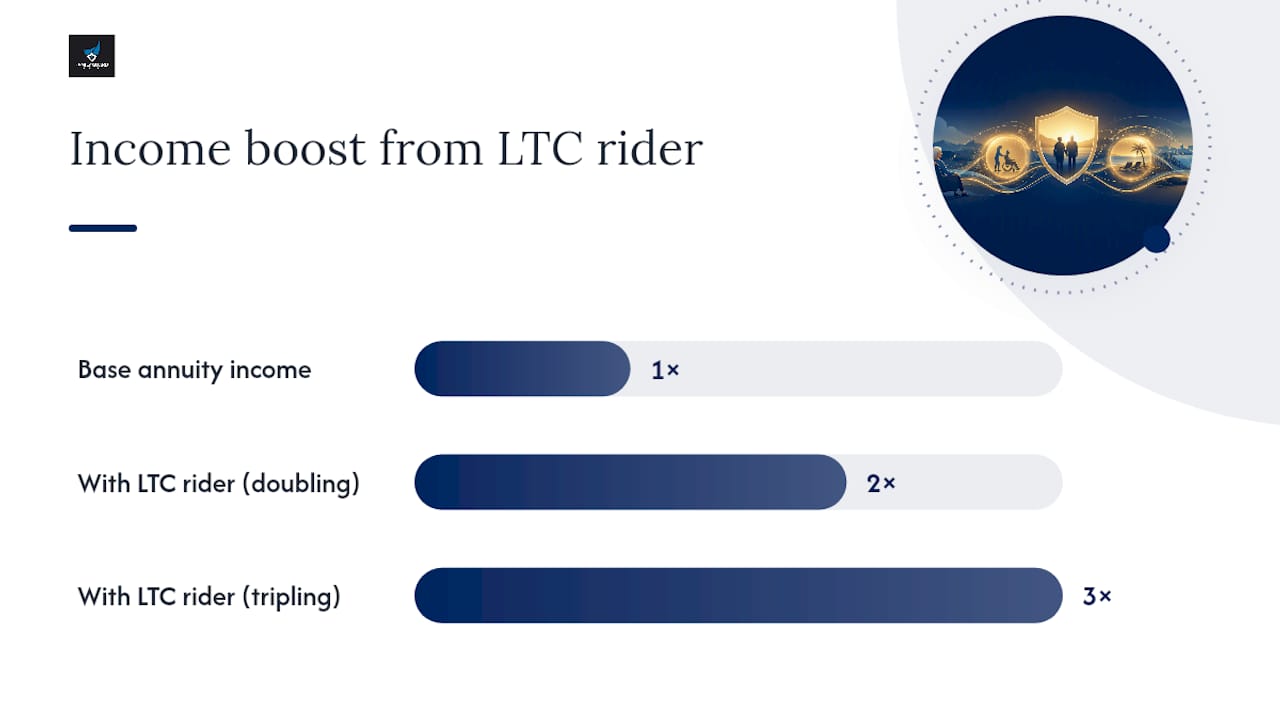
An annuity with an LTC rider works from the income side rather than the death-benefit side. Instead of accelerating a payout to heirs, the rider boosts your regular annuity income, sometimes doubling or tripling the monthly payment, once you qualify for care, or it waives early withdrawal penalties so you can access the full account value faster.
The distinction from life-based hybrids matters. A life policy hybrid protects a death benefit; an annuity rider protects a stream of guaranteed income you may already be counting on for retirement spending. That makes annuities the more natural fit if you're building your retirement plan around guaranteed income sources, including something like an annuity ladder that staggers contracts to manage interest rate risk over time.
- Enhanced income riders typically trigger on the same ADL or cognitive tests used across the industry.
- Annuity growth is generally tax-deferred, and LTC-qualified withdrawals are often more favorable than a standard taxable withdrawal.
- Rising interest rates tend to improve new annuity payout rates, which is worth watching if you're timing a purchase.
- Annuities suit people who prioritize predictable monthly cash flow over leaving a legacy.
If your retirement plan already leans on annuitized income, adding an LTC rider is often a smaller lift than building a separate hybrid life policy from scratch.
Is Self-Insuring for Long Term Care a Realistic Option?
Self-insuring means building a dedicated investment reserve instead of buying any insurance product. It works best for households with enough liquid assets to absorb a worst-case care scenario without derailing retirement.
- Size the reserve. Planning guidance commonly points to $350,000 to $500,000 per person outside the highest-cost metro areas, held separately from your primary residence.
- Match allocation to your timeline. Money earmarked for care two decades out can hold more equities; funds you might need within five years belong mostly in bonds and cash, the same bucket logic used in retirement income planning.
- Use HSA dollars first when eligible. HSA withdrawals for qualified LTC expenses are tax-free, though contribution eligibility ends once you enroll in Medicare.
- Coordinate IRA withdrawals with the medical deduction. Distributions used for care may be partly offset by the medical expense deduction once costs exceed 7.5% of adjusted gross income.
Self-insuring is often the cheaper path for households with $2 million or more in liquid assets who can absorb volatility. It's riskier for anyone whose net worth sits closer to that $350,000 to $500,000 reserve target alone, since a single extended care stay could consume the whole cushion with nothing left over.
What Four Factors Should Guide Your Decision?
Four variables drive most of this decision: liquid net worth excluding your home, family health history, whether a spouse depends on your income or care, and how close you are to the underwriting window closing (health tends to work against you after 60).
- Run a realistic care-cost estimate for your area and compare it against a hybrid quote, an annuity rider cost, and a pure self-insure reserve.
- Stress-test each scenario against a multi-year care event, not just a short one.
- Weigh the guaranteed cost of insurance-backed options against the opportunity cost of self-insured money sitting in bonds and cash.
- Many advisors recommend a mixed approach, pairing a smaller hybrid or rider purchase with a partial self-insure reserve, rather than picking one path exclusively.
The most common mistakes: waiting until your 60s to shop, which shrinks your underwriting options; skipping inflation protection because it raises the quoted premium; and assuming Medicare will cover extended custodial care, which it generally will not.
Pro Tip: If a health condition makes standalone LTC underwriting difficult, ask specifically about hybrid products, since underwriting for many hybrids is more lenient than traditional LTC insurance.
What Should You Bring to a Broker Consultation?
A useful consultation starts with paperwork: recent life insurance and annuity statements, current account balances across IRAs and HSAs, a summary of family health history, and your Medicare enrollment status.
Come prepared with direct questions: Is the premium truly guaranteed for life, or can it be reviewed? What inflation protection options exist, and what do they cost? How is the elimination period defined, and what counts as a qualifying benefit trigger? What happens to cash value if you surrender or exchange the policy later, and does that trigger tax consequences? Understanding how underwriting classifications affect pricing before you apply also saves time.
A licensed broker should walk through hybrid, rider, and self-insure math side by side, tailored to your state's rules, since eligibility and product availability shift across the 22 states where Family Guard Life and Health holds active licensing.
Why the Conventional LTC Advice Misses the Point
Most guides on this topic still treat long term care planning as a binary: buy standalone insurance or go without. That framing was already outdated years ago, and the research backs it up: hybrid and annuity-based products have outpaced standalone LTC sales precisely because they solve the "wasted premium" objection that killed so many traditional policies at the kitchen table.
What conventional advice underweights is integration. A hybrid policy or an LTC rider isn't a standalone purchase, it's a piece of a retirement income plan that should sit alongside your annuity ladder, your HSA strategy, and your IRA withdrawal sequencing. Treating LTC funding in isolation from that bigger picture is how people end up over-insured on death benefit and under-prepared on liquidity, or vice versa.
If you take one thing from this, prioritize the underwriting window first. Health changes fast after 55, and hybrid and rider pricing both depend heavily on the health class you qualify for today, not the one you had five years ago.
— Shereka
Ready to Compare Your Long Term Care Funding Options?
Family Guard Life and Health builds retirement income plans where hybrid life policies, annuity riders, and HSA-aware account strategies work together instead of competing for the same dollars. That's a different starting point than shopping a single LTC quote in isolation, and it's the reason a proper consultation looks at your annuity ladder and your care funding at the same time.

If legacy and trust planning is also part of your picture, Elite Legacy Planning offers advisory services worth exploring alongside your care funding decision. But for the insurance and annuity side of the equation specifically, licensed across 22 states, Family Guard Life and Health can walk through hybrid, rider, and self-insure numbers against your actual retirement plan. Reach out through the Family Guard Life and Health site to schedule a consultation and get quotes specific to your health class and state.
This article is general information, not a substitute for advice from a qualified financial advisor. Consult a qualified financial professional about your own circumstances before acting on anything here.
Sources
- Is hybrid life and long-term care insurance right for you? | AARP
- Long-Term Care Insurance vs. Self-Insuring in Retirement: 2026 Decision Guide for Pre-Retirees
- Best way to invest money you may need for long-term care | Morningstar