

Higher Treasury and corporate bond yields generally push fixed annuity (MYGA) and immediate annuity (SPIA) payouts up, because insurers invest your premium in those same bonds. Variable annuities barely move with rates at all, since their returns track subaccount performance instead. Fixed indexed annuities (FIAs) sit in between: rate increases don't credit you directly, but they usually mean better caps and participation rates on the index-linked upside.
The practical move right now: pull a current rate board, compare guaranteed rates across a few terms, and decide whether locking in today or laddering across maturities fits your income timeline better than waiting on a rate you can't predict.
- Fixed/MYGA and SPIA payouts move closely with bond yields
- Variable annuities are largely insulated from rate swings
- FIAs benefit indirectly through improved caps and participation rates
- Compare offers now rather than guessing where rates go next
Rates to watch: Top MYGA rates across trackers cluster roughly between 5% and 6% depending on term and carrier, often beating comparable bank CDs.
Key Takeaways
Higher bond yields raise fixed annuity and SPIA payouts directly, while FIAs gain indirectly through better caps and variable annuities barely move at all.
| Point | Details |
|---|---|
| Rates track bonds | MYGA and SPIA rates move with Treasury and corporate bond yields, minus a carrier spread of roughly 1.0% to 1.5%. |
| Products react differently | Fixed annuities move directly with rates; FIAs benefit indirectly through caps; variable annuities barely react at all. |
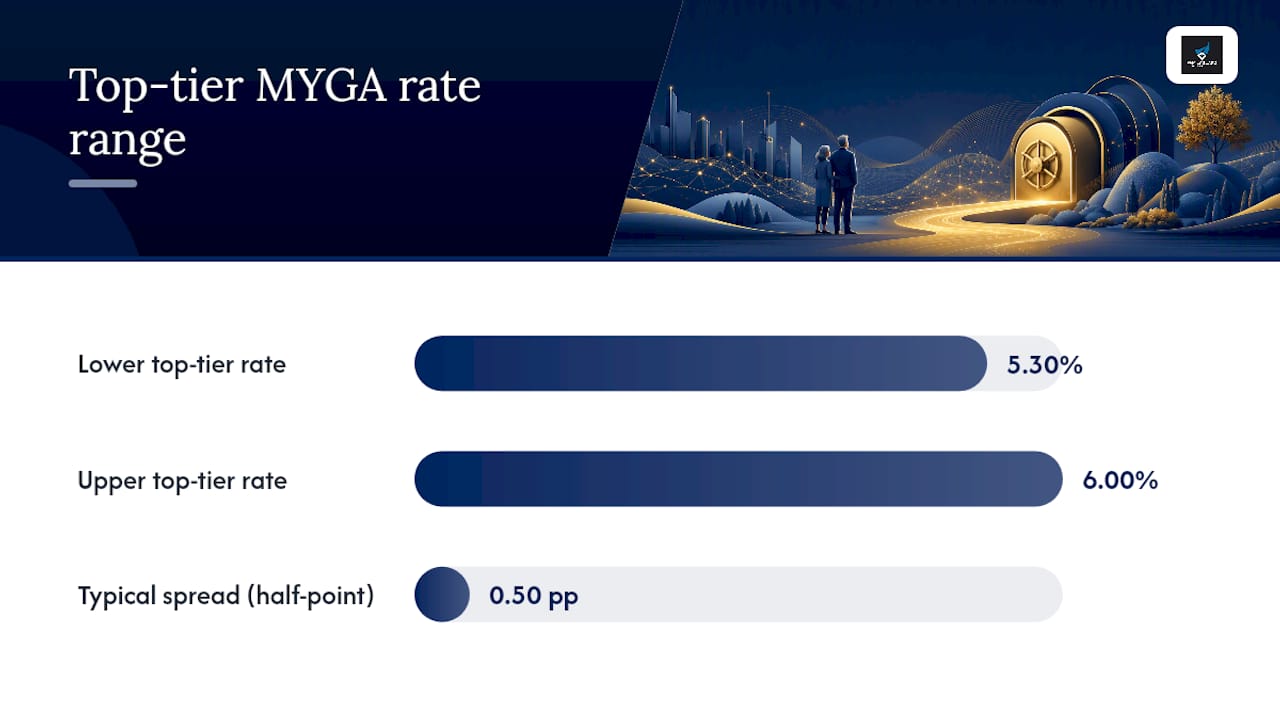
| Current benchmarks | Top MYGA rates cluster roughly 5.30% to 6.00% depending on term and carrier as of mid to late 2026. |
| Watch the fine print | Surrender charges often start at 7% to 9%, and MVAs can further reduce early withdrawal amounts. |
| Get a personalized comparison | Family Guard Life and Health cross-checks carrier ratings and current rates across 22 states before recommending a contract. |
Table of Contents
- How Interest Rates and Annuities Actually Connect
- Do Higher Rates Help Every Annuity the Same Way?
- What Do Today's Annuity Rates Actually Look Like?
- Should You Lock In Now or Wait for Higher Rates?
- What Fees and Contract Terms Erode Your Returns?
- What Would $100,000 Actually Pay You?
- Why Advisor Guidance Matters When Rates Are Moving
- My Take on Locking In Versus Waiting
- How Family Guard Life and Health Helps You Compare Rates
- Where to Verify Annuity Rates and Rules Yourself
- Sources
How Interest Rates and Annuities Actually Connect
An insurance company doesn't pull an annuity rate out of thin air. It takes your premium, buys a portfolio of mostly investment-grade bonds, holds them to fund your guarantee, and pays you a rate that sits below what that portfolio earns. The gap between the two is the carrier's margin, and it's the single biggest reason two carriers can offer wildly different rates on what looks like an identical product.
Annuity rates track Treasury yields and corporate bond returns as their primary benchmark. When the 10-year Treasury climbs, insurers earn more on new bond purchases, and competition among carriers usually forces some of that gain into higher declared rates within weeks. When yields fall, the reverse happens, often faster than most buyers expect.
Carriers typically retain a spread of roughly 1.0% to 1.5% to cover mortality reserves, administrative costs, distribution commissions, and profit. It's earning more, and pocketing the difference to guarantee your principal and pay claims.
A few mechanics worth knowing before you shop:
- The yield curve matters term by term: a 3-year MYGA and a 7-year MYGA from the same carrier can carry meaningfully different rates depending on how the curve is shaped that week.
- Occasional yield curve inversions (short rates higher than long rates) can make shorter-term annuities pay more than longer ones, which flips the usual "lock longer for more" logic.
- Most carriers offer a rate lock window, typically 30 to 60 days, between your application and funding, which protects you from a rate drop mid-process.
- Rate locks cut both ways. If rates rise while your application is pending, you're usually still stuck with the locked number.
Pro Tip: Ask your agent for the exact rate lock date in writing before you sign paperwork. A verbal "the rate is good" from a call center isn't the same as a documented lock, and disputes over which rate applied are common when yields move fast.
Do Higher Rates Help Every Annuity the Same Way?
They don't, and the differences are big enough to change which product makes sense for you right now.
-
Fixed annuities and MYGAs respond most directly. You lock a guaranteed rate for a set term (typically 3 to 10 years), and that rate is set almost entirely by where bond yields sit the day you buy. There's no ambiguity here: higher rates when you shop mean a higher locked number for the life of the contract.
-
Single premium immediate annuities (SPIAs) get a boost too, but through a different mechanism. Insurers price SPIA payments using both bond yield assumptions and mortality credits, the pooled-risk benefit of annuitants who won't live as long as actuarial tables predict. Because SPIA math combines two variables, even small yield shifts can meaningfully move your monthly check, sometimes more than a MYGA rate change of the same size would suggest.
-
Fixed indexed annuities (FIAs) don't credit interest based on bond yields directly. Instead, higher yields let carriers buy more expensive index options, which shows up as better caps, higher participation rates, or lower spread fees on your index-linked returns. The floor still protects you from negative index years, but your upside potential improves when rates rise.
-
Variable annuities track subaccount performance, essentially mutual funds inside an insurance wrapper. Rate moves affect them only indirectly, through bond fund performance inside those subaccounts, not through any direct crediting formula.
-
RILAs (registered index-linked annuities) sit closer to variable annuities in structure but use index options with a buffer instead of a floor. Rate changes affect option pricing here too, but the buffer and cap mechanics matter more than the headline interest-rate story.
What Do Today's Annuity Rates Actually Look Like?
As of mid to late 2026, top-tier fixed annuity rates from A-rated carriers cluster roughly between 5.30% and 6.00%, depending on term length and the carrier's own appetite for new business that week. That's a wide enough spread that shopping matters. A half-point difference on $200,000 compounds to real money over a 5-year term.
Rate boards aren't static. Advertised rates can shift weekly as carriers adjust to bond market moves, their own capacity, and competitive pressure. Any table you're looking at, including the one your agent hands you, is a snapshot, not a locked promise until you actually apply.
When comparing an advertised MYGA rate to alternatives, look at three things side by side:
- The 5 to 10-year Treasury yield, since MYGA rates track it with a lag and a spread.
- Top CD rates from the same period, keeping in mind annuities defer taxes on interest while CD interest is taxed annually, so a slightly lower MYGA rate can still net more after tax.
- The carrier's AM Best rating, because a headline-topping rate from a B-rated insurer carries real credit risk that a top-line number doesn't disclose.
State guaranty associations back annuity contracts up to state-specific limits if a carrier fails, but those limits vary and shouldn't be treated as a substitute for buying from a financially strong insurer in the first place.
Watch for red flags: a rate that sits far above the rest of the market with no clear explanation, unusually short lock windows, vague disclosure about surrender terms, or pressure to sign before you've seen the contract in writing.
Should You Lock In Now or Wait for Higher Rates?
Waiting for rates to climb further is a bet, and it's worth running the math before you make it. Rates would need to rise meaningfully just to break even on that delay, and nobody, including your agent, can guarantee they will.
-
Calculate the real cost of waiting. Compare a year of guaranteed income against the realistic range of where rates might move, not the best-case scenario you're hoping for.
-
Consider laddering instead of an all-or-nothing decision. Split your principal across staggered terms, say a 3-year, 5-year, and 7-year MYGA, so you're never fully exposed to one rate environment and you create rolling liquidity as each term matures.
-
Match the product to your income need. If you need income starting now, a SPIA converts principal to guaranteed monthly checks immediately. If you're still accumulating and don't need income for years, a MYGA or a ladder of MYGAs lets you capture today's rates while keeping flexibility for later.
-
Check surrender periods against your liquidity needs. Longer terms often carry better rates but lock your money up longer, which matters if health or family circumstances could force an early withdrawal.
-
Think about death benefit and succession features if leaving money to heirs matters to you. Some annuity structures pass remaining value to beneficiaries more cleanly than others.
Pro Tip: If you're within five years of needing income, don't chase the highest possible rate on the longest possible term. A slightly lower rate on a term that matures when you actually need the money beats a great rate locked up longer than your plan allows.
What Fees and Contract Terms Erode Your Returns?
The declared rate on paper isn't always the return you'll actually see, especially if life forces an early withdrawal.
Surrender charges commonly start around 7% to 9% and decline annually over the surrender period, often 5 to 10 years depending on the contract.
Market value adjustments (MVAs) add another layer. If you withdraw early and rates have risen since you bought the contract, an MVA can reduce your withdrawal amount further, because the insurer is effectively selling bonds at a loss to fund your early exit. This cuts both ways: an MVA can also work in your favor if rates have fallen since purchase.
A few more line items to check before signing:
- Non-qualified annuities grow tax-deferred, and withdrawals follow LIFO treatment, meaning gains come out first and get taxed as ordinary income before you touch principal.
- Withdrawals before age 59½ typically trigger a 10% federal penalty on the taxable portion, on top of ordinary income tax.
- FIAs and variable annuities often carry implicit costs, spread fees, or explicit rider charges for guaranteed income riders, and those can meaningfully reduce net returns even when the headline crediting rate looks attractive.
- Guaranteed living benefit riders add valuable protection but usually cost 0.5% to 1.5% annually, a fee that compounds against your account value over time.
Vetting the carrier matters as much as vetting the rate. Check AM Best ratings, and use FINRA's BrokerCheck to confirm your agent's licensing and disciplinary history before you commit six figures to any contract.
What Would $100,000 Actually Pay You?
Numbers make this concrete faster than percentages do. These are illustrative only, using representative rates from current market conditions, not a quote from any specific carrier.
SPIA example: A 65-year-old buying a single-life immediate annuity with $100,000 today might see monthly payments in the range of $650 to $750, depending on the payout option chosen and the carrier's current mortality and yield assumptions. A joint-life option covering a spouse typically lowers that monthly figure, since payments are guaranteed over two lifetimes instead of one.

MYGA example: $100,000 placed in a 5-year MYGA at a representative rate near 5.5% would grow to roughly $130,000 at maturity before any withdrawals, assuming the interest compounds and stays untouched for the full term. Annuitizing that balance afterward, or rolling it into a new MYGA or SPIA, are both common next steps at maturity.
What actually drives the differences you'll see quote to quote:
- Age at purchase, since older buyers get higher SPIA payouts due to shorter expected payout periods.
- Single life versus joint life, which can shift monthly income by 10% to 20% or more.
- Payout option selected, including life-only, period-certain, or cash-refund provisions that each trade monthly income for different guarantees.
- Gender-based assumptions, which some states allow and others restrict, affecting SPIA pricing specifically.
When you run numbers on a calculator, treat the output as a starting point:
- Use your actual birth date and state of residence, since state regulations affect available products.
- Run both single-life and joint-life scenarios if you're married.
- Ask for a firm, dated quote once you've narrowed your options, since illustrative online numbers shift with the market daily.
Why Advisor Guidance Matters When Rates Are Moving
Reading a rate board is one thing.
Family Guard Life and Health evaluates carrier ratings, rate offers, and contract terms side by side before recommending any single product, and holds active licenses across 22 states: Arizona, Colorado, Florida, Georgia, Iowa, Indiana, Massachusetts, Maryland, Maine, Michigan, Mississippi, Montana, North Carolina, Nevada, Ohio, Oklahoma, Pennsylvania, South Carolina, Tennessee, Texas, Virginia, and Washington.
That process typically includes:
- Cross-referencing AM Best ratings against advertised rates to flag carriers offering above-market yields without the financial strength to back them
- Comparing surrender schedules and MVA terms across multiple carriers for the same term length
- Mapping a client's income timeline against SPIA, MYGA, and laddering options before recommending one path
A rate on a screen tells you what a carrier is offering this week. It doesn't tell you whether that carrier will still be strong enough to pay claims in year eight of a ten-year surrender schedule, or whether the contract's fine print quietly takes back half the advantage the headline rate promised.
If you're weighing a quote you've already received or want one built around your specific timeline, that conversation starts with a licensed agent who can walk through the actual contract language with you.
My Take on Locking In Versus Waiting
I don't think there's a universal right answer here, and anyone who tells you there is hasn't looked closely at your specific timeline. My rough threshold: if you need income within three years, or if a locked rate today already meets your retirement income target, stop shopping for a better rate and lock it in. The upside of waiting rarely outweighs the guaranteed income you're giving up in the meantime.
Where waiting makes more sense is when you're five-plus years from needing the money and you can stomach some uncertainty. Laddering splits the difference nicely for people caught in between, since it hedges against guessing wrong in either direction.
None of this replaces an actual conversation with a licensed agent who can run your numbers against current offers.
— Shereka
How Family Guard Life and Health Helps You Compare Rates
Shopping annuity rates alone means calling multiple carriers, decoding surrender schedules, and hoping you're not missing a better offer sitting one phone call away. Family Guard Life and Health does that comparison work for you, cross-checking current guaranteed rates against carrier financial strength and your specific income timeline before recommending a single product.

Family Guard Life and Health's services relevant to this decision include fixed annuity and MYGA placement, SPIA income planning, Medicare supplement guidance, and broader retirement income planning that looks at how an annuity fits alongside your other assets. Coverage runs across 22 states, so most readers researching this topic are likely within the service area already. For estate or legacy considerations tied to your annuity income, resources like lifetime income and trust planning guidance can round out the bigger picture.
To move forward, request a personalized annuity quote and bring your birth date, state of residence, the amount you're considering placing, and your target income start date. That's enough for a licensed agent to pull current rates across multiple carriers and show you real numbers instead of a generic rate board.
Where to Verify Annuity Rates and Rules Yourself
Before committing to any contract, confirm the basics independently rather than relying on a single agent or website.
- Investor covers annuity fundamentals, tax deferral rules, and what to ask before buying.
- Federal Reserve and U.S. Treasury data pages publish the benchmark yields that annuity rates track.
- FINRA lets you check an agent's licensing history and file a complaint if something feels off during the sales process.
This article is general information, not a substitute for advice from a qualified financial advisor. Consult a qualified financial professional about your own circumstances before acting on anything here.
Sources
- Investor
- How Are Annuity Rates Set? Treasuries, Bonds & Timing (Annuity Journal)
- Annuity interest rates: types, tax rules, and strategies (LegalClarity)