

The fastest way to get real help is to contact a licensed Arizona broker directly or use Healthcare to find one near you. Both routes connect you to a person, not a search engine, which matters when you're comparing subsidy math against three different metal tiers.
Here's what to do in the next ten minutes:
- Search: Open HealthCare.gov's local help directory or call the Marketplace line to pull a list of agents, brokers, and navigators serving your Arizona zip code.
- Verify: Look up the broker's National Producer Number (NPN) and confirm an active Arizona license through the Arizona Department of Insurance and Financial Institutions (DIFI).
- Connect: Book a short call or in-person meeting to walk through your household income, current coverage, and whether you might qualify for AHCCCS instead of a Marketplace plan.
That's the entire process. A licensed broker doesn't charge you a fee in most individual health cases, and a 20-minute conversation usually tells you whether you're looking at a $40 monthly premium or a $400 one, depending on subsidy eligibility.
Key Takeaways
Verifying a broker's Arizona license through DIFI before your first call prevents nearly every common enrollment mistake.
| Point | Details |
|---|---|
| Start with local help | Use HealthCare.gov's local help tool to find brokers, agents, and navigators near you. |
| Verify before you meet | Confirm the broker's NPN and active Arizona license through DIFI before booking a call. |
| Know your program | Marketplace subsidies, AHCCCS, and Medicare have different eligibility rules and enrollment windows. |
| Ask direct questions | Request a written subsidy estimate and confirm current-year Marketplace certification. |
| Book with a vetted agency | Family Guard Life & Health offers licensed, no-cost broker support across 22 states, including Arizona. |
Table of Contents
- What Does a Health Insurance Broker Do in Arizona?
- Which Arizona Health Program Actually Fits Your Situation?
- How Do You Find and Verify a Licensed Arizona Broker?
- What Should You Ask a Broker, and What's a Red Flag?
- Do Brokers Charge Fees, and How Do Subsidies Work?
- Why Family Guard Life & Health Is Worth a Call
- What's the Overlooked Part of This Whole Process?
- Get Matched With a Licensed Arizona Broker
- Frequently Asked Questions
- Sources
What Does a Health Insurance Broker Do in Arizona?
A licensed broker is an insurance professional who holds an active Arizona producer license, carries appointments with specific carriers, and gets paid by those carriers, not by you, to help you enroll. That last part surprises a lot of people. You get a second set of eyes on a decision that affects your monthly budget and your access to doctors, and it typically costs nothing extra.
Brokers in Arizona generally handle:
- Comparing Marketplace plans side by side, including network differences that aren't obvious from a plan name alone
- Estimating your premium tax credit before you commit to a plan
- Flagging when you or a family member should apply for AHCCCS instead of a subsidized Marketplace plan
- Handling renewals so your coverage doesn't lapse or auto-renew into a worse plan
- Referring Medicare-eligible household members to the right enrollment window
Brokers, navigators, and captive agents aren't the same thing, even though shoppers often lump them together. An independent broker works with multiple carriers and answers to you as the client. A navigator is grant-funded, can't recommend one plan over another, and generally can't discuss off-Marketplace options. A captive agent sells for a single insurance company, which limits what they can show you even if their advice is solid.
Pro Tip: If your income situation is straightforward and you just need a walkthrough of HealthCare.gov, a navigator works fine. If you have self-employment income, a recent life change, or you're weighing AHCCCS against a subsidized plan, a broker's ability to compare across carriers is worth the ten extra minutes it takes to book a call.

Which Arizona Health Program Actually Fits Your Situation?
Arizona runs three distinct coverage systems, and mixing them up wastes weeks. Here's the quick sort:
- Marketplace (HealthCare.gov): Best for individuals and families without employer coverage who may qualify for premium subsidies based on income.
- AHCCCS: Arizona's Medicaid program, for lower-income residents and certain disability categories, with its own eligibility formula separate from the Marketplace.
- Medicare: For people 65 and older or with qualifying disabilities, run through CMS rather than the Marketplace.
- Employer coverage: If you have access to affordable employer insurance, you typically won't qualify for Marketplace subsidies.
Timing works differently across each system. Marketplace open enrollment runs on a fixed annual window, but a Special Enrollment Period (SEP) opens outside that window if you lose coverage, move, get married, or have a baby. AHCCCS, by contrast, allows enrollment year round because Medicaid eligibility isn't tied to a calendar window the same way. Medicare has its own enrollment periods tied to your 65th birthday or disability determination.
A few situations where a broker earns their keep fast:
- You just moved to Arizona and aren't sure if your SEP clock started the day you arrived or the day you signed a lease.
- Your household has mixed income sources, say, one spouse on a W-2 and one freelancing, which complicates the subsidy estimate.
- You're not sure whether your income qualifies you for AHCCCS or a subsidized Marketplace plan, and guessing wrong means reapplying later.
Check CMS's open enrollment public-use files if you want to see how enrollment volume shifts by state and month. It's a useful gut check on how many Arizonans go through this same process every year.
How Do You Find and Verify a Licensed Arizona Broker?
Finding a name is easy. Confirming that name is actually licensed, in good standing, and equipped to handle your specific case takes a few more steps. Here's the sequence.
Step 1: Build your candidate list. Start with HealthCare.gov's local help search, which filters by zip code and shows agents, brokers, and navigators with contact information. You can also check broker directories or partner comparison sites like Brandcomparisons for consumer-facing summaries of plan features, though directories aren't a substitute for license verification.
Step 2: Confirm the Arizona license. Every legitimate broker has an NPN and an active Arizona producer license. Run the name through DIFI's licensing lookup before you schedule anything. This single step filters out the handful of unlicensed operators who occasionally pop up during open enrollment season.
Step 3: Check the complaint record. DIFI also maintains complaint history. A broker with a clean record isn't a guarantee of quality, but a pattern of unresolved complaints is a reason to move to the next name on your list.
Step 4: Interview before you commit. Ask about their experience with ACA plans specifically, how many AHCCCS referrals they've made, and whether they're appointed with the carriers actually available in your county. Arizona's plan availability varies significantly between Maricopa County and more rural areas, so a broker unfamiliar with your specific market isn't much help.
Step 5: Confirm they're authorized for Marketplace assistance. Not every licensed agent is certified to help with Marketplace enrollments specifically. Ask directly whether they've completed federal Marketplace training for the current plan year.
A short verification checklist to run through before your first real conversation:
- Active Arizona license confirmed on DIFI
- NPN matches the name they gave you
- Carrier appointments cover plans sold in your county
- No unresolved complaints on file
- Certified for current-year Marketplace enrollment assistance
Save your work. Screenshot the DIFI license page, keep the broker's business card or email signature, and if they send a written engagement summary or broker-of-record agreement, file it somewhere you can find it again in March.
Pro Tip: Take the DIFI screenshot the same day you verify, not after your first meeting. Licenses occasionally lapse or transfer between renewal cycles, and having a dated record protects you if a dispute ever comes up.
What Should You Ask a Broker, and What's a Red Flag?
A ten-minute conversation reveals almost everything you need to know about whether a broker is worth your time. Come with specific questions rather than a general "tell me about your services" opener.
Questions worth asking directly:
- "What's your NPN, and can I verify your Arizona license while we're on the phone?"
- "How many ACA Marketplace enrollments have you handled this year?"
- "Which carriers are you appointed with in my county?"
- "Do you charge me anything, or are you paid entirely by carrier commission?"
- "Can you walk me through how you'd estimate my subsidy?"
- "Have you referred clients to AHCCCS before, and how do you decide who qualifies?"
- "What happens at renewal? Do you review my plan automatically or do I need to call you?"
- "Are you certified for Marketplace enrollment assistance this plan year?"
- "Can you put your subsidy estimate in writing or email?"
- "What carriers do you not work with, and why?"
- "How do you handle a mid-year income change that affects my subsidy?"
- "Do you have any conflicts of interest with a specific carrier I should know about?"
Red flags that should end the conversation:
- Refusal to provide an NPN or license number when asked directly
- Pressure to sign paperwork before you've compared at least two plans
- Wildly inconsistent subsidy numbers between calls
- Requests for payment by gift card, wire transfer, or anything outside a standard carrier-billed premium
- Vague or evasive answers about which carriers they're actually appointed with
If something feels off, you can report suspected fraud directly to DIFI, keep copies of every email and text, and simply switch brokers. Nothing locks you to one agent once you've enrolled.
Pro Tip: A simple script works: "Can you send me your NPN and a link to your DIFI license page before we schedule a call?" A legitimate broker answers this in under a minute. Hesitation is your answer.
Do Brokers Charge Fees, and How Do Subsidies Work?
Most individual health insurance brokers in Arizona are paid entirely by the insurance carrier through commission, not by you. That said, always ask directly before your first meeting, because fee structures occasionally differ for specialized products or group plans.
Premium tax credits, the subsidies that lower your monthly Marketplace premium, are calculated based on your estimated household income relative to the federal poverty line. The IRS explains the mechanics of how these credits are calculated and reconciled when you file taxes. If your actual income ends up higher than what you estimated, you may owe some of that credit back. If it's lower, you may get more back as a refund.
A few practical steps protect you here:
- Ask your broker for a written subsidy estimate, not just a verbal number
- Save that estimate along with the date and your reported income assumptions
- Report income changes to the Marketplace as soon as they happen, rather than waiting until tax season
- Keep a folder, digital or physical, with every enrollment confirmation and subsidy communication
Pro Tip: Screenshot your subsidy estimate the same day you enroll. If your income shifts mid-year and the number changes, you'll have a clear record of what you were told and when, which matters if a tax reconciliation surprises you.
Why Family Guard Life & Health Is Worth a Call
Family Guard Life & Health is a licensed independent insurance agency serving individuals in multiple states, including Arizona, with health insurance, life insurance, Medicare supplement plans, dental, vision, and annuity products. That multi-state licensing footprint means the agency has handled a wide variety of income situations, household structures, and enrollment edge cases, not just a narrow slice of them.
Services relevant to Arizona shoppers include:
- ACA Marketplace enrollment support with subsidy estimation
- Side-by-side plan comparisons across available carriers
- Referrals to AHCCCS or Medicare when that's the better fit
- Renewal management so your plan doesn't lapse
- Ongoing claim and plan-change support after enrollment
Before your consult, gather your household income estimate, current plan details if you have one, and a list of any doctors or medications you want to keep in-network. A typical first call runs through your situation, flags whether Marketplace or AHCCCS fits better, and gives you a written subsidy estimate to review before you decide anything.
Pro Tip: Bring last year's tax return or a rough income estimate to your first call. Subsidy accuracy depends entirely on that number, and a broker can't give you a reliable estimate without it.
What's the Overlooked Part of This Whole Process?
Most guidance on this topic focuses entirely on the Marketplace shopping experience, which login screen to use, which metal tier to pick, and treats broker verification as an afterthought. That's backwards. The verification step, checking a license on DIFI, confirming an NPN, reading the complaint history, takes about three minutes and prevents nearly every bad outcome I've seen discussed around this topic.
The conventional advice to "just find someone who seems knowledgeable" undersells how much variance exists between brokers. Some have handled hundreds of AHCCCS referrals; others have never touched one. Some know which Arizona carriers actually cover rural counties; others only know the Phoenix metro market. A broker who sounds confident isn't the same as a broker who's certified for the current plan year.
If you take one thing from this, prioritize verification before rapport. A friendly broker with an expired certification helps you less than a blunt one with a clean DIFI record and three years of ACA enrollment experience. Ask the uncomfortable questions first. The right broker won't flinch.
Get Matched With a Licensed Arizona Broker
Comparing plans on your own means toggling between carrier websites, guessing at subsidy math, and hoping you picked the right metal tier before the deadline. Familyguardlh skips that entirely: you talk to a licensed agent who already knows the Arizona carrier landscape, can estimate your subsidy on the call, and can point you toward AHCCCS or Medicare if that's actually the better fit for your household.

Family Guard Life & Health is licensed across 22 states, including Arizona, and works with individuals comparing Marketplace plans, weighing AHCCCS eligibility, or approaching Medicare age. If you're 45 or older and thinking about retirement income alongside your health coverage, that's exactly who this agency serves. There's no cost to you for the consultation since carrier commissions cover it, not client fees.
Book a consult through Family Guard Life & Health and bring your income estimate and current plan details. You'll walk away with a written subsidy estimate and a clear next step, not another tab to research on your own.
Frequently Asked Questions
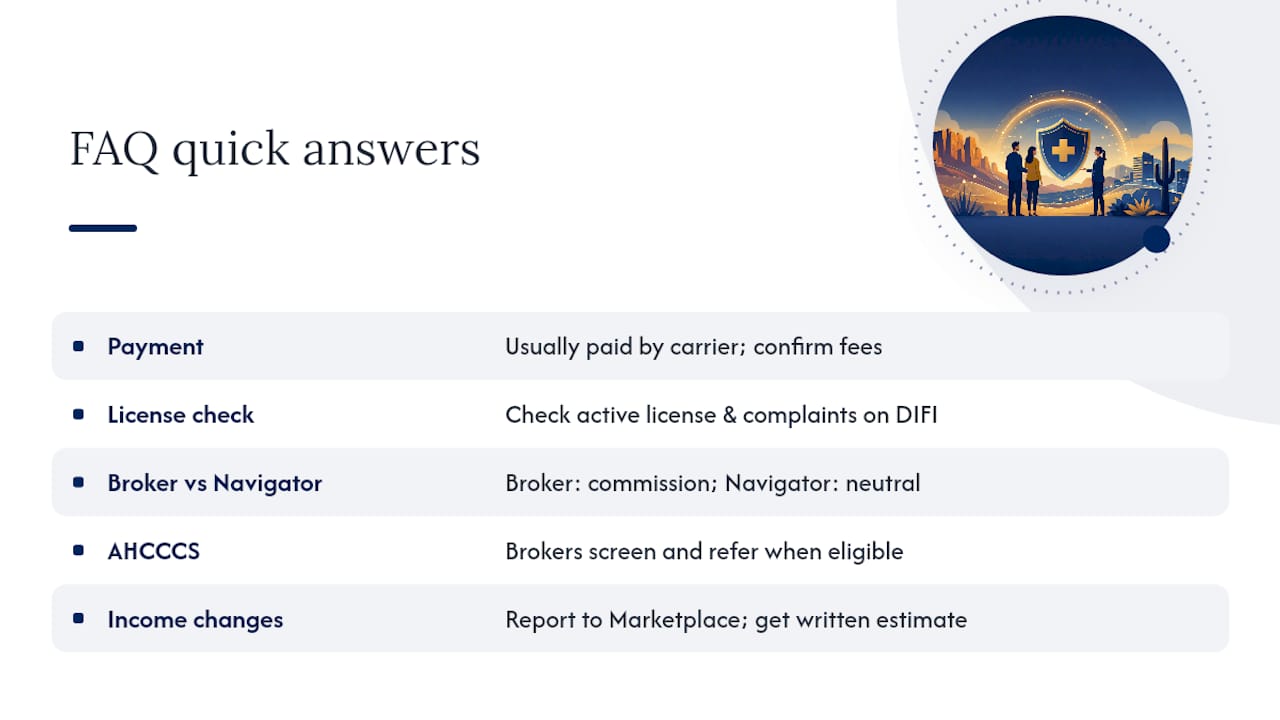
Do I have to pay a health insurance broker in Arizona? Most individual health brokers are paid by the insurance carrier through commission, not by the client. Always confirm this directly before your first meeting, since fee structures can vary for specialized products.
How do I know if a broker is actually licensed in Arizona? Search their name and NPN through the Arizona DIFI licensing lookup. An active license and clean complaint record are the two things worth confirming before you schedule anything.
What's the difference between a broker and a navigator? A broker works with multiple carriers, gets paid by commission, and can recommend specific plans. A navigator is grant-funded, must remain neutral, and generally can't compare plans or discuss off-Marketplace options.
Can a broker help me if I qualify for AHCCCS instead of a Marketplace plan? Yes. Experienced Arizona brokers routinely screen for AHCCCS eligibility and refer clients there when it's the better fit, since Medicaid enrollment works differently than Marketplace subsidies.
What happens if my income changes mid-year after I've enrolled? Report the change to the Marketplace as soon as possible, since it affects your subsidy calculation. Ask your broker for an updated written estimate and keep it for tax filing, per IRS reconciliation guidance.
This article is general information, not a substitute for advice from a qualified financial advisor. Consult a qualified financial professional about your own circumstances before acting on anything here.