

Annuities grow tax-deferred, and taxes come due the moment you take money out. How much you owe depends on whether your premiums were pre-tax or after-tax, and which method you use to withdraw the funds.
- Qualified annuities (funded with pre-tax IRA or 401(k) dollars) get taxed in full as ordinary income on every withdrawal.
- Nonqualified annuities (funded with after-tax money) only tax the earnings, not your original contribution.
- Before you file, check your Form 1099-R for the taxable amount and distribution code; remember the IRS applies an early withdrawal penalty on taxable amounts if taken before retirement age; and ask about a 1035 exchange before you cancel or replace a contract.
The IRS lays out the mechanics in Publication 575 and Publication 939, and the rules aren't optional reading if you're relying on an annuity for retirement income. Family Guard Life and Health works with clients across 22 states to apply these rules to real withdrawal decisions, not just theoretical ones.
Key Takeaways
Annuity taxes depend on three factors working together: contract type (qualified or nonqualified), withdrawal method (LIFO or exclusion ratio), and timing relative to age 59½ and RMD deadlines.
| Point | Details |
|---|---|
| Know your annuity type | Qualified annuities tax the full withdrawal; nonqualified annuities tax only the earnings portion. |
| Watch the LIFO rule | Nonqualified partial withdrawals pull out gains first, so early withdrawals often carry a bigger tax hit. |
| Mind the age-59½ penalty | Taxable withdrawals before 59½ trigger a 10% additional tax unless an exception like 72(t) applies. |
| Check RMD exposure | Qualified annuities require RMDs starting at 73; nonqualified annuities generally do not. |
| Get a professional review | Family Guard Life and Health offers tax-aware annuity reviews across 22 licensed states to plan withdrawal timing. |
Table of Contents
- How Annuity Taxes Work: Accumulation vs. Distribution
- Qualified vs. Nonqualified Annuities: Which One Do You Have?
- How Withdrawals and Annuity Payments Get Taxed
- What Penalties, RMDs, and Beneficiary Rules Should You Know?
- How Do You Report Annuity Income on Your Taxes?
- Practical Tax Strategies and Common Filing Mistakes
- Does Annuity Income Affect Social Security and Medicare Costs?
- What Are the Best Strategies to Minimize Annuity Taxes?
- A Client Scenario That Shows These Rules in Action
- Get a Tax-Aware Annuity Review With Family Guard Life and Health
- Authoritative Resources and Official Documents
- Frequently Asked Questions
- Sources
How Annuity Taxes Work: Accumulation vs. Distribution
An annuity behaves like a tax shelter until you touch it. While your money sits inside the contract, growth, interest, and gains accumulate without triggering a 1099 or a tax bill of any kind. There's no annual tax event, unlike a brokerage account where dividends and realized gains hit your return every April. IRS Topic 410 confirms this directly: annuities stay tax-deferred inside the contract and become taxable only once distributions start.
That deferral ends the moment money leaves the contract. Several events trigger taxation:
- Partial withdrawals — taking out a chunk of cash while the contract stays open.
- Full surrender — cashing out the entire annuity and closing the contract.
- Annuitization — converting the balance into a stream of guaranteed payments.
- Death benefit payouts — when a beneficiary receives the contract's value.
Here's the part most people miss: moving your money from one annuity contract to another doesn't have to trigger any of this. A 1035 exchange lets you swap an old annuity for a new one, carrier to carrier, without recognizing a dime of gain. This matters if your current contract has high fees, a weak crediting rate, or outdated riders. The catch is that the transfer has to go directly between insurance companies. If the check gets cut to you first, even briefly, the IRS treats it as a taxable distribution rather than an exchange, and you lose the deferral you were trying to protect.
Qualified vs. Nonqualified Annuities: Which One Do You Have?
The single biggest factor in your annuity tax bill is where the premiums came from. Run this test: did the money funding your annuity come from an IRA, 401(k), or other pre-tax retirement account? If yes, you have a qualified annuity. If you funded it with money you'd already paid income tax on, from a savings account or a taxable brokerage transfer, you have a nonqualified annuity.
The tax treatment diverges sharply from there.
- Qualified annuities: Every dollar you withdraw counts as ordinary income, because neither the original contribution nor the growth has ever been taxed. A $50,000 withdrawal from a qualified annuity means $50,000 added to your taxable income for the year.
- Nonqualified annuities: You already paid tax on your premiums, so only the earnings portion of a withdrawal gets taxed. If you put in $100,000 and the contract is now worth $160,000, roughly $60,000 of that represents taxable gain and $100,000 is tax-free return of basis.
The gap in outcomes can be enormous. A retiree pulling $20,000 from a qualified annuity owes ordinary income tax on the full amount. A retiree pulling the same $20,000 from a nonqualified contract, where gains make up 40% of the value, owes tax on just $8,000. Same withdrawal size, very different tax bill, purely based on which bucket the money came from.
How Withdrawals and Annuity Payments Get Taxed
Once you know which type of annuity you're dealing with, the next question is how the taxable portion actually gets calculated. Two different systems apply, depending on whether you're taking a withdrawal or converting to a payment stream.
- LIFO governs nonqualified withdrawals. The IRS assumes "last in, first out," meaning any partial withdrawal comes out of earnings first, before it touches your basis. That means withdrawals early in retirement often carry a bigger tax hit than you'd expect, since gains get taxed before principal rather than pro-rata.
- Annuitization uses the exclusion ratio. When you convert your contract into a lifetime income stream, the IRS spreads your basis evenly across your expected payments using a formula: basis ÷ expected return = exclusion ratio. Say you paid $120,000 into a nonqualified annuity, and your expected return over your life expectancy is $200,000. Your exclusion ratio is 60%, so 60% of each payment comes back tax-free and 40% is taxable, for as long as the exclusion ratio applies.
- The computation method depends on your annuity starting date. Most contracts use the Simplified Method, but older annuities or certain plan types fall under the General Rule, which requires actuarial tables from Publication 939 to calculate expected return.
Pro Tip: Don't assume your annuity statement already applies the correct exclusion ratio. Mixing up the General Rule and Simplified Method based on your actual annuity starting date can throw off your entire tax return, and the IRS won't catch the error for you.
What Penalties, RMDs, and Beneficiary Rules Should You Know?
Timing mistakes cost retirees real money with annuities, more so than with most other retirement accounts.
- The 10% additional tax applies to taxable withdrawals before age 59½, on top of your regular income tax. Exceptions exist for death, disability, and structured payment plans under IRS Code 72(t), often called Substantially Equal Periodic Payments (SEPP).
- Required minimum distributions (RMDs) apply to qualified annuities starting at age 73, the same baseline that governs traditional IRAs. Nonqualified annuities generally avoid RMDs entirely, which is one reason some retirees deliberately hold more of their savings in nonqualified contracts heading into their 70s.
- Beneficiaries face their own deadlines. Non-spouse beneficiaries typically must withdraw the full value within five or ten years, depending on the contract and inherited-account rules, and any gain still gets taxed as ordinary income when withdrawn. A surviving spouse can often roll the annuity into their own name and continue deferring tax.
One detail catches a lot of families off guard: annuities get no step-up in basis at death. Unlike a stock portfolio, where heirs reset the cost basis to the date-of-death value and can sell with little or no gain, annuity beneficiaries inherit the original basis and owe tax on the same built-in gains the original owner would have owed.
How Do You Report Annuity Income on Your Taxes?
Every taxable annuity distribution shows up on a Form 1099-R, sent by the insurance carrier by late January. Box 1 shows the gross distribution. Box 2a shows the taxable amount, the figure that actually flows onto your Form 1040 or 1040-SR. Box 7 contains a distribution code that tells the IRS (and you) what kind of payout occurred, whether it was a normal distribution, an early withdrawal, or a death benefit.
You have choices about withholding, and they matter more than most retirees realize.
- Federal withholding: insurance companies typically default to 10% withholding on taxable annuity payments unless you elect otherwise on Form W-4P.
- Estimated tax payments: if withholding alone won't cover your liability, especially with a large lump-sum withdrawal, you may need to make quarterly estimated payments to avoid an underpayment penalty.
- State taxes vary widely. Some states don't tax retirement income at all, others tax annuity distributions the same as any other income, and a handful offer partial exemptions for retirees past a certain age. Check with your state's department of revenue or a tax professional, because this is one area where a national rule of thumb simply doesn't exist.
Practical Tax Strategies and Common Filing Mistakes
Smart withdrawal ordering can keep you in a lower tax bracket for years. Many retirees draw from taxable accounts first, let tax-deferred annuities and IRAs continue compounding, and delay qualified annuity withdrawals until RMDs force the issue.
A 1035 exchange makes sense when your current contract's fees or crediting rate no longer fit your goals, but only a direct carrier-to-carrier transfer preserves the deferral. Annuitization smooths your tax bill through the exclusion ratio, though it sacrifices flexibility since you generally can't access a lump sum once payments begin.
The most common filing mistakes: misreading the 1099-R distribution code, forgetting that nonqualified withdrawals follow LIFO instead of a simple pro-rata split, and missing beneficiary deadlines that turn a tax-deferred inheritance into a rushed, expensive one.
Choosing between the General Rule and Simplified Method isn't a minor technicality. Mis-applying either one based on the wrong annuity starting date can misstate your exclusion ratio for the life of the contract.
Pro Tip: Before you take any annuity withdrawal larger than a routine payment, ask your advisor to run the numbers both with and without the withdrawal. A licensed agent with Family Guard Life and Health can walk through this with you across any of the 22 states where the agency operates.
Does Annuity Income Affect Social Security and Medicare Costs?
Annuity withdrawals can push more of your Social Security benefit into taxable territory, and that's a trap plenty of retirees don't see coming. The IRS uses a formula based on "combined income," your adjusted gross income plus nontaxable interest plus half your Social Security benefit, to determine how much of your benefit gets taxed. A large annuity withdrawal in a single year, especially from a qualified contract taxed at ordinary rates, can spike your combined income and drag more of your benefit into taxable range.

The Medicare consequence is separate but just as real. Medicare Part B and Part D premiums are based on your Modified Adjusted Gross Income (MAGI) from two years prior, through a surcharge system called IRMAA (Income-Related Monthly Adjustment Amount). A big annuity distribution this year can quietly raise your Medicare premiums two years from now, sometimes by a meaningful amount, without you connecting the dots until the notice arrives.
This is exactly why annuity withdrawals shouldn't be planned in isolation. Timing a large distribution in a year when your other income is already low can limit the ripple effect on both Social Security taxation and future Medicare premiums. Spreading withdrawals across multiple years, rather than taking one large lump sum, often keeps combined income and MAGI below the thresholds that trigger these secondary costs.
What Are the Best Strategies to Minimize Annuity Taxes?
The biggest lever is controlling when income hits your return, not just how much. Spreading a large surrender or lump-sum withdrawal across two or three tax years, instead of taking it all at once, can keep you out of a higher bracket and reduce the Social Security and Medicare ripple effects covered above.
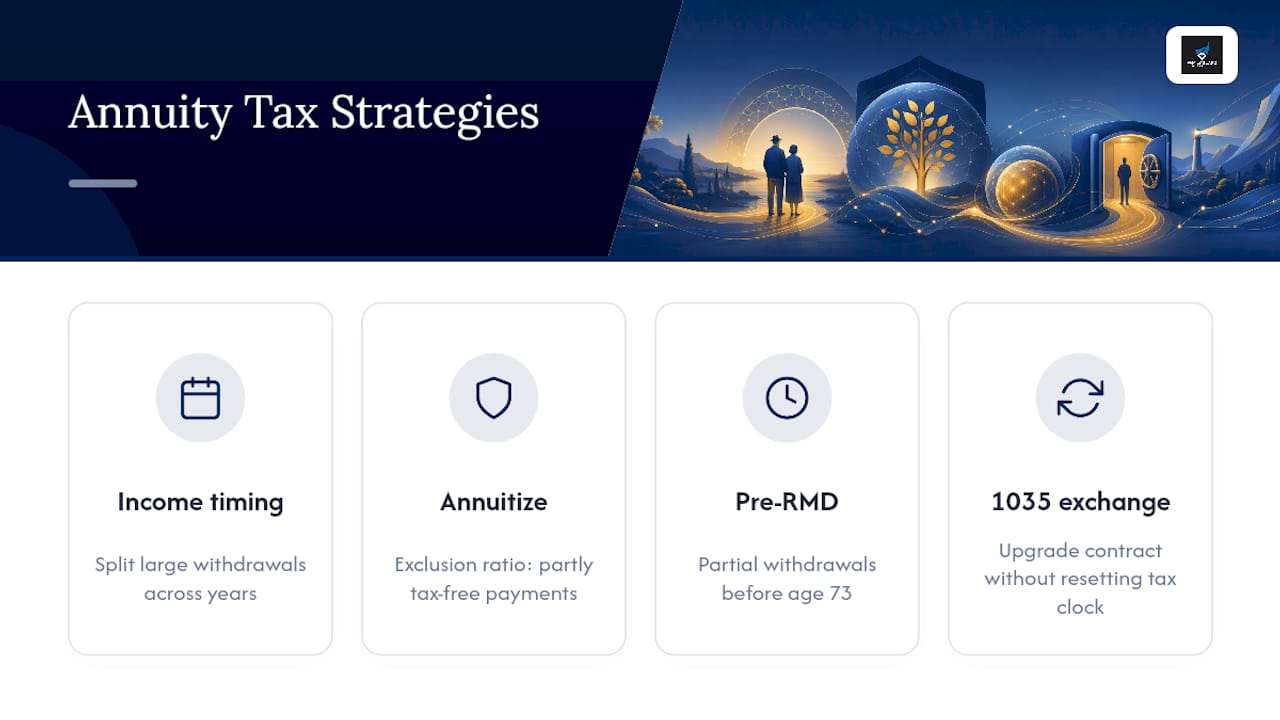
For nonqualified annuities, consider annuitizing instead of taking lump withdrawals if steady income matters more than flexibility. The exclusion ratio locks in a predictable, partly tax-free payment stream rather than exposing full gains to LIFO treatment. For qualified annuities approaching RMD age, strategic partial withdrawals in lower-income years before age 73 can reduce the eventual RMD amount and the tax bill that comes with it.
A 1035 exchange is worth exploring anytime your contract's costs outweigh its benefits, since it lets you upgrade without resetting the tax clock. And if you're naming beneficiaries, matching the payout structure to their tax situation, spreading a large inherited balance across the allowed distribution window instead of one lump sum, can meaningfully reduce what they owe.
A Client Scenario That Shows These Rules in Action
One client held a nonqualified annuity with strong embedded gains and a qualified IRA annuity approaching RMD age. Spreading withdrawals between the two, rather than draining either one first, kept them in a lower bracket for three straight years. Family Guard Life and Health builds these ordering decisions into every retirement income review across its 22 licensed states.
Get a Tax-Aware Annuity Review With Family Guard Life and Health
Most retirees find out about the LIFO rule, the exclusion ratio, or the Medicare IRMAA surcharge only after a withdrawal already triggered it. Family Guard Life and Health reviews your actual contracts, income sources, and withdrawal timing before you pull money out, not after the tax bill arrives.

Family Guard Life and Health is an independent insurance agency licensed across 22 states, including Florida, Texas, Ohio, Pennsylvania, Virginia, and Georgia, offering annuities, life insurance, health insurance, Medicare supplement plans, dental and vision coverage, and retirement income planning under one roof. That range matters here: an agent who only sells annuities has no reason to flag how a withdrawal might spike your Medicare premium two years out, but a firm that also handles your Medicare supplement conversation sees the whole picture.
A tax-aware annuity review with Family Guard Life and Health looks at your qualified and nonqualified contracts side by side, checks your annuity starting date against the correct computation method, and maps out a withdrawal order that fits your other income sources. If you're planning a withdrawal, considering a 1035 exchange, or trying to figure out how RMDs will hit your bracket, request a consultation with Family Guard Life and Health to get a plan built around your actual numbers before you file anything.
Authoritative Resources and Official Documents
- IRS Publication 575: Simplified Method and General Rule for pension and annuity income.
- IRS Publication 939: actuarial tables and expected-return computations.
- IRS Tax Topic 410: tax-deferred vs. taxable annuity events.
- IRS Tax Topic 558: Form 1099-R reporting rules.
- Investor: plain-language product basics.
Frequently Asked Questions
Do I pay taxes on annuity growth every year, even if I don't withdraw anything? No. Annuities grow tax-deferred, so no tax is owed on gains while the money stays inside the contract. Tax applies only when you take a distribution.
How are annuities taxed if I inherit one from a parent? Beneficiaries generally owe ordinary income tax on the gain portion, and there's no step-up in basis. Non-spouse beneficiaries typically must withdraw the full balance within five or ten years depending on the contract, while a surviving spouse can often roll it into their own annuity and keep deferring tax.
Can a 1035 exchange help me avoid annuity taxes entirely? It defers tax rather than eliminating it. A direct carrier-to-carrier exchange lets you move to a new contract without recognizing gain, but you'll eventually owe tax on withdrawals from the new annuity using the same rules that applied to the old one.
Will annuity income affect my Social Security taxes? It can. A large withdrawal, especially from a qualified annuity, raises your combined income and may push more of your Social Security benefit into taxable territory for that year.
What's the difference between the General Rule and the Simplified Method? Both calculate the tax-free portion of annuity payments using an exclusion ratio, but which one applies depends on your annuity starting date and whether the contract was part of a qualified plan. Most modern annuitants use the Simplified Method.
This article is general information, not a substitute for advice from a qualified financial advisor. Consult a qualified financial professional about your own circumstances before acting on anything here.
Sources
Your annuity doesn't exist in a tax vacuum. It sits alongside Social Security, pension payments, RMDs from traditional IRAs, part-time earnings, and any capital gains from taxable investments, and all of it stacks together on the same tax return.
The order in which these income sources hit your return, and the year they hit it, determines your marginal bracket. A retiree drawing $40,000 from Social Security and $30,000 from a qualified annuity in the same year faces a very different tax picture than one who spreads that annuity income across two tax years instead of one.
RMDs complicate this further. Once RMDs begin on qualified annuities and traditional IRAs alike, that income becomes mandatory, not optional, which limits your ability to control timing later in retirement. That's part of why many retirees front-load nonqualified annuity withdrawals or Roth conversions in the lower-income years before RMDs start, rather than waiting until every income source is running simultaneously.
- About Publication 575 (Pension and Annuity Income) — IRS
- Publication 939 — General Rule for Pensions and Annuities — IRS
- Tax Topic No. 410 — Annuities — IRS
- Are annuities taxable? — Investopedia