

An annuity ladder staggers annuity purchases across different maturity dates to create rolling liquidity and reduce interest-rate risk while producing predictable retirement income. Instead of locking a lump sum into one long contract at today's rate, you split it across several contracts that mature in sequence.
Risk-averse retirees and anyone wanting phased access to their savings without giving up guaranteed income tend to benefit most from this approach. If you're weighing it, here's where to start:
- Estimate what portion of your savings you can allocate to annuities without sacrificing liquidity
- Keep 3 to 6 months of expenses in cash outside the ladder
- Set calendar reminders for each rung's maturity date well before it arrives
Quick fact: A three-rung ladder built with 3-year, 5-year, and 7-year contracts creates a renewal window every two to three years. This gives you regular decision points instead of one irreversible commitment.
Key Takeaways
An annuity ladder strategy reduces interest-rate risk and improves liquidity by staggering annuity maturities instead of locking one lump sum into a single long-term contract.
| Point | Details |
|---|---|
| Use 2 to 4 rungs | A 3, 5, 7-year MYGA structure creates a renewal window roughly every two to three years. |
| Mind the minimums | Most MYGA carriers require $5,000 to $25,000 per contract, so balances under $100,000 may need fewer rungs. |
| Diversify carriers | State guaranty limits often fall between $250,000 and $500,000 per insurer, so spreading large sums across carriers matters. |
| Set maturity reminders | Mark calendars 60 to 90 days before each rung matures to avoid an uncompetitive auto-renewal. |
| Get licensed support | Family Guard Life and Health shops rates across carriers in 22 states and handles setup paperwork for clients building a ladder. |
Table of Contents
- What Is an Annuity Ladder Strategy and How Does It Work?
- What Are the Benefits and Trade-Offs of Laddering Annuities?
- How Do You Build an Annuity Ladder Step by Step?
- What Does the Math Look Like on a Real Annuity Ladder?
- What Risks and Tax Rules Should You Check Before Buying?
- How Do You Manage an Annuity Ladder Once It's Running?
- Does Inflation Erode the Value of an Annuity Ladder?
- Where Does an Annuity Ladder Fit Alongside Social Security and Other Income?
- When Does Family Guard Life and Health Recommend an Annuity Ladder?
- Get Help Building Your Annuity Ladder
- Where to Learn More About Annuity Basics and Rates
- Sources
What Is an Annuity Ladder Strategy and How Does It Work?
A "rung" is a single annuity contract with its own term and maturity date. A "ladder" is the full set of rungs, staggered so they mature at different times rather than all at once. The "renewal window" is the period, usually 60 to 90 days, when you decide whether to reinvest, cash out, or convert a maturing contract into income.
Most ladders use two to four rungs. A common template splits money evenly across 3-year, 5-year, and 7-year multi-year guaranteed annuities (MYGAs), so a third of the ladder becomes available roughly every two years once the cycle gets going. Some retirees prefer a shorter 2-year, 4-year, 6-year spread for faster access; others stretch to 5, 7, and 10 years for higher guaranteed rates.
The product type matters as much as the term:
- MYGAs work like CDs with tax deferral, ideal for the accumulation rungs of a ladder.
- Fixed immediate annuities convert a lump sum into guaranteed income right away, useful for a near-term rung when you need cash flow now.
- Deferred income annuities delay payments to a future date, often used as the "back rung" to cover late-retirement years.
Mixing these types across your ladder lets each rung do a different job instead of forcing one product to cover every need.
What Are the Benefits and Trade-Offs of Laddering Annuities?
Laddering cushions you against locking a large sum into a single rate right before rates climb. Because rungs mature on a rolling basis, you get repeated chances to capture better terms, and the staggered maturities smooth out income instead of dumping everything at one contract's end date.
The trade-offs are real, though:
- Early withdrawals before a contract matures typically trigger surrender charges
- Money committed to a rung isn't liquid the way a savings account is
- Annuities carry no FDIC-style protection; they rely on the issuing carrier's financial strength instead
- Interest credited inside the contract is taxed as ordinary income when withdrawn, not at capital-gains rates
Pro Tip: Most contracts include a free-withdrawal provision, often around 10% of the contract value per year, penalty free. Check this figure before you buy, since it varies by carrier and can rescue you if you need cash mid-term.
How Do You Build an Annuity Ladder Step by Step?
Start with allocation. Financial professionals often lean on a bucket framework aiming to replace roughly 70% of pre-retirement income across the "Go-Go," "Slow-Go," and "No-Go" phases of retirement, using annuities to cover a significant portion of that target rather than the entire number.
- Decide your allocation. Figure out how much of your portfolio goes toward guaranteed income versus growth assets and cash reserves.
- Choose your timeline. An aggressive template might use 2, 3, and 4-year rungs for fast liquidity. A moderate template runs 3, 5, and 7 years. A conservative income-focused template stretches to 5, 7, and 10 years for higher locked-in rates.
- Select products at each rung. Shop MYGA rates across multiple carriers rather than defaulting to the first quote, since rates for the same term can vary meaningfully between insurers.
- Diversify carriers. Spread larger sums across two or three A-rated insurers instead of concentrating with one.
- Document everything. Confirm beneficiary designations, funding source, and free-withdrawal terms in writing before you sign.
Before starting, know your minimums:
- Many MYGA carriers require $5,000 to $25,000 per contract
- Balances under roughly $100,000 may struggle to support a true multi-rung ladder
- A two-rung ladder or a single shorter-term contract can work as a starting point
What Does the Math Look Like on a Real Annuity Ladder?
Numbers make this concrete. Say you have $300,000 to allocate and split it evenly across a 3-year, 5-year, and 7-year MYGA at $100,000 each. As rates rise or fall over that period, each maturing rung gets reinvested at the then-current rate rather than locking your entire balance to a single snapshot in time. In several rate scenarios, this structure produces higher blended growth than a single 10-year MYGA held for the same span, because you capture upward rate movement along the way instead of missing it entirely.
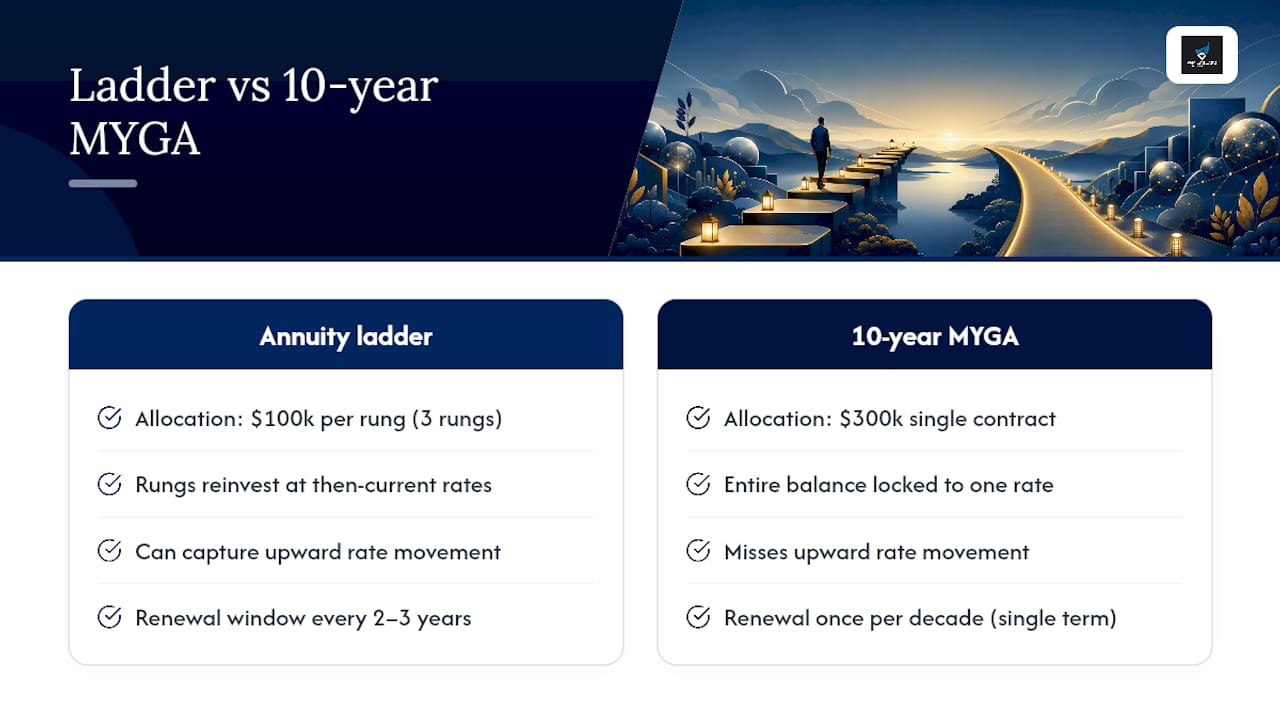
For shorter-term income needs, a smaller immediate-annuity ladder works differently: rungs are timed to start payments in sequence, say one beginning immediately and another two years later, bridging a gap before Social Security or a pension kicks in.
Quick fact: A three-rung structure typically opens a renewal window every two to three years, which is the practical rhythm you're planning around, not annually and not once a decade.
Sizing matters here too. Below roughly $100,000, per-contract minimums make three or four rungs impractical, so a two-rung approach or a single well-chosen term often makes more sense.
What Risks and Tax Rules Should You Check Before Buying?
Surrender charges are the first thing to check. Withdraw more than the free-withdrawal allowance early, and you'll typically face a penalty that starts around 7% to 10% in year one and steps down each year until the surrender period ends.
Carrier risk deserves equal attention. Annuities are backed by the insurer's claims-paying ability rather than a government guarantee, and state guaranty association coverage typically caps out somewhere between $250,000 and $500,000 per insurer, depending on your state. That's the practical argument for spreading larger allocations across multiple carriers instead of one.
On taxes, FINRA notes that annuity growth is tax-deferred until withdrawal, then taxed as ordinary income, and withdrawals before age 59½ generally trigger a 10% IRS penalty on top of regular tax. This differs from a CD, where interest is taxed annually regardless of whether you touch the money, a distinction Investopedia points out when comparing the two vehicles.
- Check each contract's surrender schedule before signing, not after
- Confirm your state's guaranty association limit and size carrier exposure accordingly
- Plan withdrawal timing around your tax bracket, not just your maturity date
How Do You Manage an Annuity Ladder Once It's Running?
The real work starts after purchase. Set a reminder 60 to 90 days before each maturity date so you have time to shop competing rates instead of letting the contract auto-renew at whatever rate the carrier posts that quarter. Missing that window is one of the most common and avoidable mistakes in laddering.
In the final 30 days, decide: reinvest into a new rung at the same term, convert the balance into income payments, or pull the funds out entirely if your needs have changed.
- Spread large allocations across two or three A-rated carriers rather than one
- Avoid over-diversifying into five or six providers, which just adds paperwork without meaningfully reducing risk
- Keep an emergency fund outside the ladder before committing new principal
- Recheck carrier financial-strength ratings periodically, not just at purchase
Pro Tip: Put maturity dates on a physical or digital calendar the day you sign each contract. A ladder only works as designed if you actually show up for each renewal window.
Does Inflation Erode the Value of an Annuity Ladder?
Fixed annuity payments lose purchasing power over time, and that's the single biggest structural weakness of a ladder built entirely on MYGAs or fixed immediate annuities. A $2,000 monthly payment feels generous today; after 15 or 20 years of even moderate inflation, it buys noticeably less.

Laddering itself provides partial protection, since each rolling renewal window lets you reinvest at current rates, which tend to rise alongside inflation over long periods. That's a meaningful edge over locking everything into one 15-year contract at today's rate. But it's a partial fix, not a complete one, because the payments from rungs already converted to income stay fixed regardless of what prices do afterward.
A few practical adjustments help close the gap. Some retirees dedicate one rung of the ladder to an inflation-adjusted annuity, which credits smaller initial payments but escalates them over time, trading upfront income for later purchasing power. Others deliberately keep later rungs shorter, so more of the ladder cycles back through renewal windows during high-inflation stretches rather than sitting locked for a decade. Pairing the ladder with growth-oriented assets outside of it, rather than annuitizing everything, also gives you a hedge that fixed contracts alone can't provide.
The honest takeaway is that an annuity ladder manages interest-rate risk far better than it manages inflation risk. Treat it as one leg of an income plan, not the entire structure, and build in a deliberate inflation offset rather than assuming the rolling renewals will handle it on their own.
Where Does an Annuity Ladder Fit Alongside Social Security and Other Income?
An annuity ladder works best as one income stream among several, not a replacement for the rest of your retirement plan. Social Security typically covers baseline fixed expenses; the ladder fills gaps, smooths timing, and adds a guaranteed layer beyond what Social Security and any pension already provide.
A practical sequencing approach: delay Social Security if you can afford to, since delayed claiming increases the monthly benefit, and use an early ladder rung or immediate annuity to bridge income during that delay period. Once Social Security starts, later-maturing rungs can supplement it during years when discretionary spending tends to run higher, the "Go-Go" years in the bucket framework retirement planners commonly use.
Layering income sources this way also gives you flexibility on withdrawal sequencing from taxable, tax-deferred, and Roth accounts. If Social Security and annuity income already cover fixed costs, you gain more control over when to pull from other accounts, which matters for managing tax brackets and required minimum distributions later in retirement.
The planning question isn't "annuity ladder versus Social Security." It's how much of your guaranteed-income need the ladder should cover once Social Security, any pension, and required minimum distributions are accounted for. Get that math right first, then size the ladder to fill what's left, rather than building the ladder in isolation and hoping it fits.
When Does Family Guard Life and Health Recommend an Annuity Ladder?
We typically recommend ladders to clients within 5 to 10 years of retirement who want guaranteed income without giving up all liquidity at once. Common requests include return-of-premium riders and naming adult children as contingent beneficiaries. Our role is straightforward: we shop rates across multiple carriers and handle the paperwork so clients aren't chasing renewal deadlines alone.
— Shereka
Get Help Building Your Annuity Ladder
Building a ladder on your own means calling several carriers, comparing rate sheets, and tracking renewal windows by yourself, which is exactly where most people lose momentum. Family Guard Life and Health gives you licensed-agent support across 22 states, with access to multiple carriers so you're comparing real rates instead of guessing.

Getting started is simple: have a rough sense of your available principal, your target timeline, and your existing income sources like Social Security or a pension ready before your first conversation. From there, we help map your allocation, shop rungs across carriers, and keep your documentation and beneficiary designations in order so nothing falls through the cracks at renewal time. If you're ready to build a ladder that fits your actual numbers rather than a generic template, start a consultation with Family Guard Life and Health and bring your questions.
Where to Learn More About Annuity Basics and Rates
For a grounded overview of investor protections and tax treatment, FINRA's annuity resource is a solid starting point before you buy anything. For rate comparisons and ladder mechanics, AnnuityJournal's laddering guide and Investopedia's annuity ladder entry cover the terminology and math in more depth, while MoneyRates tracks current guaranty limits and minimums by state.
This article is general information, not a substitute for advice from a qualified financial advisor. Consult a qualified financial professional about your own circumstances before acting on anything here.
Sources
- Annuity Laddering Strategy: Build a MYGA Ladder (2026)
- Rethinking retirement income: The role of annuity laddering - Insurance News | InsuranceNewsNet
- FINRA — Annuities (investor information)
- Annuity Ladder Strategies: Secure Your Retirement Income — Investopedia