

Three enrollment windows control when you get Medicare and what it costs: the Initial Enrollment Period (a window that begins three months before your 65th birthday month, includes that month, and ends three months after it), the Special Enrollment Period (triggered by events like losing employer coverage), and the General Enrollment Period (a fallback running January 1 through March 31). Miss all three and you're looking at gaps in coverage and penalties that can follow you for life.
Do this today: check your birthday month, confirm whether you or your spouse still have coverage through a large employer, and if you're not already collecting Social Security, call the Social Security Administration about three months before you turn 65. People already receiving Social Security benefits are usually enrolled in Part A and Part B automatically. Everyone else has to act.
- Confirm your birthday month and count backward three months. That's when your window opens.
- Check your employer coverage status. Large-group plans (20+ employees) change your timeline.
- If you're not on Social Security yet, contact SSA directly to start the process by hand.
Pro Tip: Part B carries a permanent premium penalty for late enrollment. Part A usually doesn't, since most people get it free based on work history.
TL;DR:
- Enrolling during the first three months of your Initial Enrollment Period ensures coverage starts the month you turn 65, regardless of your birthday date.
- Losing employer coverage outside of active employment triggers an 8-month Special Enrollment Period, but COBRA and retiree plans generally do not qualify as valid triggers.
- Missing all enrollment windows often results in a July 1 start date through the General Enrollment Period, with permanent late enrollment penalties for Part B and Part D.
- Retroactive Part A enrollment can be applied up to six months but never before your initial eligibility; Part B begins based on your actual filing date within the IEP.
- Keep employer-provided documentation of coverage end dates and submission proofs to avoid penalties and delays, especially when coordinating with your payroll or HR.
Table of Contents
- Understanding the Medicare Enrollment Timeline: The Initial Enrollment Period
- What Special Enrollment Periods Cover If You're Still Working
- What Happens if You Miss Your Enrollment Window?
- How Coverage Start Dates Actually Work
- How Are Medicare Late Enrollment Penalties Calculated?
- How Do You Actually Enroll in Medicare?
- When Can You Choose or Change Your Medicare Plan?
- Getting Enrollment Timing Right With Professional Help
- Key Takeaways
- Where to Verify These Medicare Rules
- What This Timeline Actually Tells You
- Get Personalized Help With Your Medicare Timeline
- Sources
Understanding the Medicare Enrollment Timeline: The Initial Enrollment Period
The Initial Enrollment Period (IEP) is the 7-month stretch that starts three months before your birthday month, includes your birthday month, and runs three more months after it. It's Medicare as the standard window for anyone turning 65, unless you qualify earlier through disability.
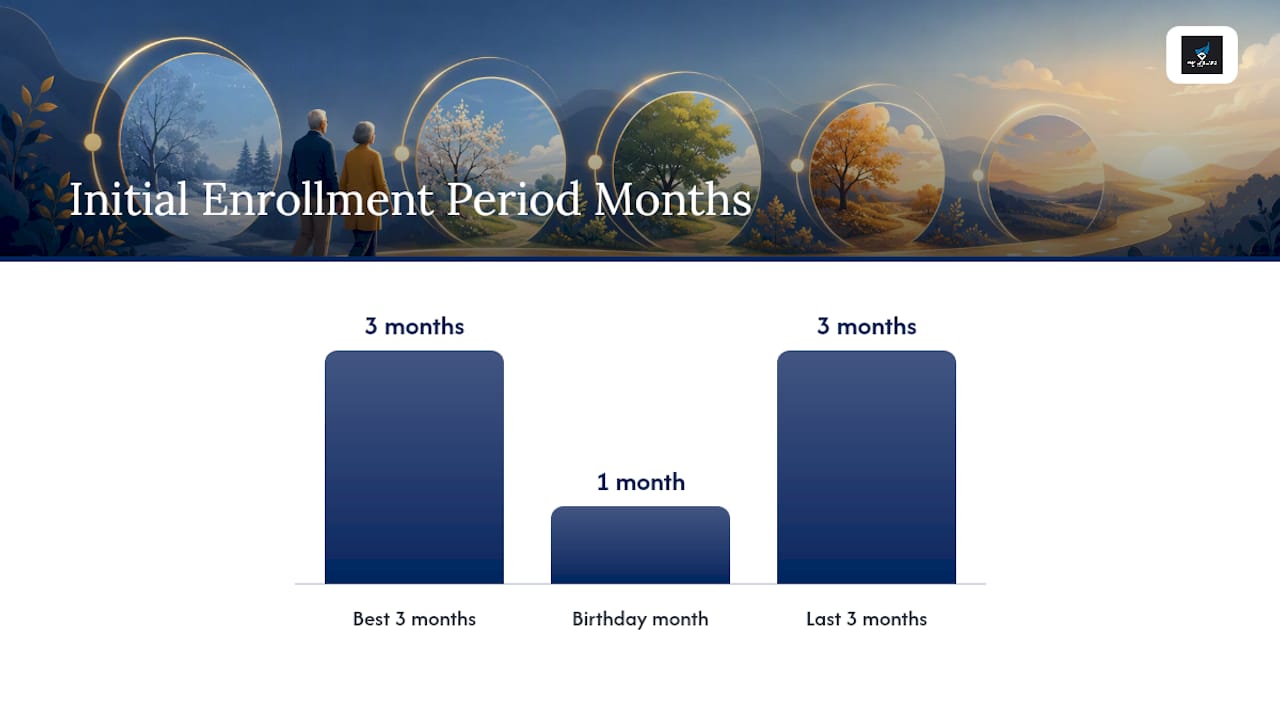
When you enroll inside this window matters more than most people realize. Sign up during the first three months and your coverage typically starts the month you turn 65. Wait until your birthday month or later, and your start date pushes back, sometimes by a month or two, depending on the year and rules in effect.
Here's how that plays out for two people with different birthdays:
- Mid-month birthday, June 15: Your IEP runs March through September. Enroll in March, April, or May, and Part A and Part B typically start June 1, the month you turn 65.
- Birthday on the 1st, June 1: Because Medicare counts eligibility as though your birthday fell in the prior month, your effective IEP shifts one month earlier. Enrolling early can get your coverage started as of May 1, even though your actual birthday is in June.
That first-of-the-month quirk trips up a surprising number of people, and it's one of the few places where a single day on the calendar changes your entire timeline.
If you want coverage to begin exactly in the month you turn 65, file with Social Security during the first three months of your IEP. Waiting until your birthday month still works, but it narrows your margin for error if paperwork gets delayed.
What Special Enrollment Periods Cover If You're Still Working
If you or your spouse are still working past 65 and covered by a large employer's group health plan, you can usually delay Part B without penalty. Once that job ends or the coverage stops, you get an 8-month Special Enrollment Period to sign up. Coverage generally starts the month after you enroll.

This is where a lot of people get burned. COBRA and retiree health plans are not the same as active employer coverage, and they generally don't extend your SEP. If you leave a job and go on COBRA thinking you've bought yourself more time, you may find out later that your 8-month clock started the day active employment ended, not the day COBRA runs out.
Other SEP triggers include:
- Losing Medicaid eligibility
- Moving out of your plan's service area
- Qualifying for Extra Help with prescription drug costs
- Release from incarceration
- Federally declared disaster or emergency exceptions
Keep every piece of paperwork your employer gives you about group coverage end dates. Social Security will typically ask for a completed Request for Employment Information form signed by your employer, so track down HR before you need it, not after.
Pro Tip: If you're planning to retire, ask HR for your coverage termination letter the same week you give notice. It's far easier to get that document while you're still on payroll.
What Happens if You Miss Your Enrollment Window?
The General Enrollment Period runs January 1 through March 31 each year, and it's your fallback if you missed both your IEP and any SEP you might have qualified for. Coverage from a GEP enrollment typically starts July 1 of that same year.
- You can apply online through Social Security in most cases, though some situations still require mailing paper forms.
- Expect a wait between filing and your effective date since GEP always lands you on the July 1 start, regardless of whether you sign up in January or March.
- Your Medicare card typically arrives a few weeks after processing, well ahead of your coverage start date.
The catch: using GEP almost always means you're paying a late enrollment penalty on top of the coverage gap you just spent months sitting in.
How Coverage Start Dates Actually Work
Part A and Part B don't always start the same way. If you're buying Part A rather than getting it premium-free, coverage can be applied retroactively up to six months, but never earlier than the month you first became eligible. Part B has no such retroactive cushion in most enrollment scenarios; your start date depends on exactly when during your IEP you filed.
The first-of-the-month birthday rule adds another wrinkle, shifting your effective eligibility one month earlier than your actual birth date. That one detail affects more than your Medicare card. It also affects whether you can keep contributing to a Health Savings Account, since HSA contributions and Medicare enrollment don't mix.
| Enrollment Timing | Typical Part A/B Start Date |
|---|---|
| Enroll 1-3 months before birthday month | First day of birthday month |
| Enroll during birthday month | Start delayed, per current rules |
| Birthday falls on the 1st of the month | Coverage can start the prior month |
| Enroll via GEP (Jan 1 to Mar 31) | Generally July 1 of that year |
Coordinate your exact Medicare start date with your payroll department if you're still contributing to an HSA. Getting the timing wrong can create a tax problem you don't discover until filing season.
How Are Medicare Late Enrollment Penalties Calculated?
Missing your window doesn't just delay coverage. It usually costs you money for as long as you're enrolled. The Part B penalty adds 10% to your monthly premium for every full 12-month period you were eligible but didn't sign up. The standard Part B premium is around $200 a month for most people, so even one missed year adds a real, permanent cost on top of that base rate.
Part D works differently but hurts just as much over time. The penalty is 1% of the national base beneficiary premium, multiplied by every full month you went without Part D or other creditable drug coverage. The national base beneficiary premium is around $39, which puts the per-month penalty below fifty cents, but it compounds across years of delay and never goes away once assessed.
Part A penalties are rarer since most people get it premium-free, but if you're buying Part A and delay, a penalty can apply for twice the number of years you could have had it and didn't.
- Keep records proving you had creditable prescription drug coverage to avoid the Part D penalty entirely.
- Ask your former employer's benefits office for a written statement confirming your coverage met Medicare's creditable coverage standard.
- Submit that documentation the moment you enroll, not months later when a penalty notice shows up.
How Do You Actually Enroll in Medicare?
You can apply through the Social Security Administration online, by phone, or in person at a local SSA office. Most people don't need to mail anything, but certain situations, like proving employer coverage for an SEP, still require paper documentation.
- Gather proof of age (birth certificate or passport) and, if applicable, proof of employer group coverage with exact termination dates.
- If you're enrolling based on an SEP, complete the CMS-40B application along with the CMS-L564 Request for Employment Information, signed by your employer.
- If you need to prove creditable drug coverage separately, CMS-10797 documentation may come into play depending on your plan history.
- Submit your application and wait for confirmation. Most people receive their Medicare card within a few weeks, though processing can stretch longer during GEP season.
- Once your card arrives, you're clear to shop for a Medicare Advantage or Part D plan if you haven't already.
Pro Tip: Photograph or scan every document before you submit it. If SSA asks you to resend something, you won't be digging through file boxes to find it again.
When Can You Choose or Change Your Medicare Plan?
Once you're enrolled in Part A and Part B, a separate set of windows governs Medicare Advantage and Part D plan choices. The Annual Election Period runs October 15 through December 7, with elections taking effect January 1 of the following year.
- The Medicare Advantage Open Enrollment Period, January 1 through March 31, lets you switch Medicare Advantage plans or drop one for Original Medicare, but it doesn't allow switching from Original Medicare into a new plan.
- Your IEP and any SEP also double as windows to pick a Part D or Medicare Advantage plan, and those elections take effect alongside your Part A and Part B start dates.
- Missing AEP means waiting nearly a full year for your next chance to change plans, barring a qualifying SEP.
Getting Enrollment Timing Right With Professional Help
Family Guard Life and Health is a licensed independent insurance brokerage serving individuals across 22 states, including Florida, Texas, Georgia, and Pennsylvania. The agency works specifically with Medicare supplement coverage, retirement income planning, and the kind of enrollment timing questions this article covers.
Licensed agent Shereka specializes in retirement income planning and helps clients coordinate SEP documentation, plan selection, and enrollment deadlines so nothing slips through the cracks.
- Medicare supplement guidance tailored to your enrollment timing
- SEP documentation support for employer coverage transitions
- Retirement income planning alongside Medicare decisions
Key Takeaways
Getting Medicare enrollment right comes down to knowing which of the three windows applies to you and acting inside it before penalties or coverage gaps set in.
| Point | Details |
|---|---|
| Know your IEP dates | The 7-month window starts 3 months before your birthday month and ends 3 months after it. |
| Watch the SEP clock | Losing employer coverage triggers an 8-month window; COBRA does not restart it. |
| Avoid GEP if possible | Using the January to March fallback usually means a July 1 start and a late penalty. |
| Penalties are permanent | Part B and Part D penalties compound the longer you delay enrollment. |
| Get help with timing | Family Guard Life and Health and agent Shereka assist with enrollment timing and SEP paperwork. |
Where to Verify These Medicare Rules
What This Timeline Actually Tells You
Most enrollment guides treat every window like it carries equal weight. It doesn't. The IEP is where nearly all the damage gets done or avoided, and the first-of-the-month birthday rule is the single most overlooked detail in the entire system. People assume their coverage lines up neatly with their actual birth date, and that assumption costs some of them a month of coverage they didn't know they were owed.
The bigger blind spot is COBRA and retiree health plans for expats. Retirees walk away from a job assuming their COBRA election buys them breathing room before dealing with Medicare. It doesn't, and by the time the Part B penalty notice arrives, the 8-month SEP clock ran out months earlier. That single misunderstanding probably generates more permanent premium penalties than any other mistake in this process.
If you take one thing from this timeline, let it be this: paperwork from your employer proving coverage end dates is worth more than any calendar reminder. Get it in writing while you're still employed, not after you need it.
— Shereka
Get Personalized Help With Your Medicare Timeline
Reading a timeline chart is one thing. Applying it to your exact birthday, your spouse's work status, and your employer's coverage rules is another. Family Guard Life and Health works through those specifics directly with clients across 22 states, translating the calendar rules above into a plan for your actual enrollment date.

Beyond enrollment timing, the agency also handles Medicare supplement plans, dental and vision coverage, and retirement income planning for people navigating the years around 65. Licensed agent Shereka can review your birthday, employer coverage status, and SEP documentation in one conversation, then map out exactly when to file and with which forms. If you're weighing whether to delay Part B or worried about a documentation gap from a recent job change, that's precisely the kind of timing question this agency handles daily.
Visit Family Guard Life and Health to schedule a consultation and get your specific enrollment dates confirmed before a deadline passes you by.
This article is general information, not a substitute for advice from a qualified doctor. Consult a qualified healthcare professional about your own circumstances before acting on anything here.