

Indexed universal life (IUL) is permanent life insurance that credits cash value based on the performance of a market index, like the S&P 500, without directly investing your money in that index. You get a death benefit that lasts your whole life, cash value growth that's protected from market losses, and upside that's capped, usually somewhere between 8% and 12% depending on the carrier and crediting method.
The trade-off is straightforward: you give up unlimited upside for a floor that protects your cash value from a bad market year. In exchange, you take on real complexity, ongoing fees, and a policy that needs attention every year, not just at purchase.
IUL tends to fit people who've already maxed out other tax-advantaged accounts and want another place to grow money with some downside protection. It rarely makes sense for someone who just wants affordable death benefit coverage or a hands-off investment.
Quick signals worth weighing before you go further:
- Good fit: high earners with maxed-out 401(k)/IRA space, long time horizons, and a tolerance for policy monitoring.
- Poor fit: anyone shopping primarily for low-cost coverage, or anyone who wants a "set it and forget it" investment.
- The core mechanic: cash value growth is linked to an index's price movement, not owned in it, and dividends are excluded from that calculation.
Key Takeaways
Indexed universal life works when the policyholder funds it above the contractual minimum and reviews credited performance against the illustration every year, not just at purchase.
| Point | Details |
|---|---|
| Crediting formula caps upside | Floor, cap, and participation rate together determine credited interest, and dividends are excluded from the calculation. |
| Illustrations aren't guarantees | Non-guaranteed elements like caps and participation rates can change after purchase, so plan around conservative scenarios. |
| Funding level drives lapse risk | Minimum-funded policies face higher lapse risk than target-funded ones if credited rates underperform. |
| No standard $500k premium | Age, health class, tobacco use, and funding strategy all change the price for identical coverage amounts. |
| Annual review prevents surprises | Compare actual credited rates to illustrated ones every policy anniversary to catch underfunding early. |
| Get a second opinion on illustrations | Family Guard Life and Health reviews IUL illustrations against current carrier offers before you commit to a policy. |
Table of Contents
- What Is Indexed Universal Life and How Does the Cash Value Actually Grow?
- Cash Value Mechanics: Reading Your Illustration Like an Underwriter
- Indexed Universal Life Pros and Cons Worth Weighing Carefully
- How Indexed Universal Life Stacks Up Against Term, Whole Life, and Retirement Accounts
- What Drives the Cost of a $500,000 Indexed Universal Life Policy?
- Managing Lapse Risk and Keeping Your Policy on Track
- How IUL Cash Value Is Taxed, and Where the Tax Traps Hide
- Who Actually Benefits From an Indexed Universal Life Policy?
- What the Research Actually Supports, and Where the Sales Pitch Overreaches
- Get an Illustration Review Before You Commit to an IUL Policy
- Frequently Asked Questions
- Sources
What Is Indexed Universal Life and How Does the Cash Value Actually Grow?
Every premium dollar you pay into an IUL policy gets split three ways: a portion covers the cost of insurance (COI), a portion covers administrative fees and policy charges, and whatever's left goes into the cash value account. That cash value account is where the "indexed" part of indexed universal life happens.
The insurer debits COI and fees from your cash value every month, whether or not you're actively paying premiums that month. This is the piece most new buyers miss. Universal life products, including IUL, allow flexible premium payments, but the policy still needs enough cash value to cover those monthly charges. If credited interest plus whatever premium you're paying isn't enough to keep pace with COI, the policy's cash value shrinks, and if it hits zero, the policy can lapse. That's the single biggest operational risk in this product category, and it's why "buy it and ignore it" is the wrong mindset.
Here's the part that trips people up conceptually: your money isn't invested in the S&P 500 or whatever index the policy tracks. The insurer holds your cash value in its general account and uses options contracts to replicate a portion of the index's price movement. Insurers structure this through options and hedging strategies, buying calls that pay off when the index rises and using the premium from those trades, plus general account earnings, to fund the crediting. That structure is also why dividends never show up in your credited return.

Statistic Callout: Because dividends are excluded from the crediting formula, credited interest on an IUL policy can lag the index's total return by a meaningful margin every single year, even in years when the index itself performs well. Over a few decades, that gap compounds.
The three numbers that determine your credited rate
Three contract terms decide how much interest actually lands in your cash value account each crediting period:
- Floor: the minimum credited rate, commonly 0%, protecting you from a losing index year.
- Cap: the maximum credited rate you can earn in a crediting period, regardless of how much the index gained.
- Participation rate: the percentage of the index's gain that counts toward your credited interest, before the cap is applied.
These three levers, floor, cap, and participation rate, are the core of how IUL crediting works, and every illustration you receive should spell out all three explicitly.
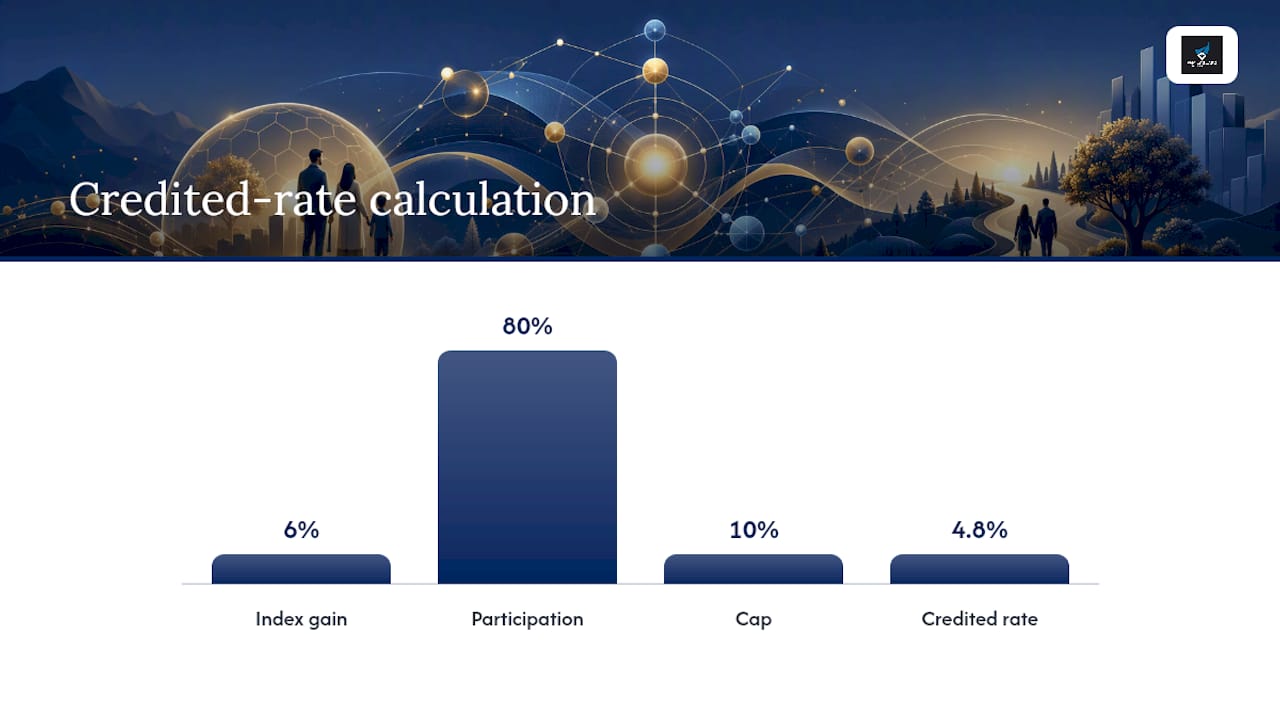
Here's how they interact in practice. Say the index gains 6% over the crediting period, your policy has an 80% participation rate, and a 10% cap. You first multiply the index gain by participation: 6% times 80% equals 4.8%. That number is below the 10% cap, so the full 4.8% gets credited. The cap is the ceiling regardless of how strong the underlying index performs.
Pro Tip: Ask your agent for the policy's cap and participation rate history over the last 10 to 15 years, not just current figures. Carriers can and do lower caps after issuing a policy, and a history of downward adjustments tells you more than a single optimistic current number.
Crediting frequency matters just as much as the formula itself. Annual point-to-point crediting compares the index value on one date to its value exactly one year later, ignoring everything that happened in between. Monthly averaging or monthly point-to-point methods smooth things out by measuring monthly changes and either averaging them or summing capped monthly gains. In a volatile, choppy market, monthly methods often credit more consistently because they don't hinge on two single snapshot dates. In a strong, steady bull run, annual point-to-point can outperform because it captures the full year's move in one measurement. Neither method is universally better; it depends entirely on what the market actually does during your specific crediting period, which nobody can predict in advance.
Cash Value Mechanics: Reading Your Illustration Like an Underwriter
An IUL illustration is a sales document dressed up as a projection, and the single most useful skill you can develop before buying is knowing which numbers in that illustration are guaranteed and which ones the insurer can change.
Everything else, cap rates, participation rates, current COI charges, and even which crediting method is offered, falls into the non-guaranteed bucket. Carriers retain the right to adjust caps, participation rates, and crediting methods over time, and they routinely do, particularly when their own hedging costs rise or interest rates shift.
The relationship between cap and participation rate is often a trade-off, not a bonus stack. Read the two numbers together, never in isolation.
Pro Tip: When comparing two illustrations, don't just compare the headline crediting assumption. Pull the specimen contract language for the "index crediting" section and check whether the insurer reserves the right to change caps at every policy anniversary or only annually on a fixed schedule. Some contracts limit how often and how far a cap can move in a single adjustment; others don't.
A short checklist worth keeping next to any illustration you're reviewing:
- Guaranteed minimum interest rate: what's the floor, and is it truly guaranteed or just currently offered?
- Guaranteed maximum COI schedule: how high could cost of insurance legally rise under the contract's worst case?
- Credited frequency: annual point-to-point, monthly averaging, or a blend, and how is it defined precisely?
- Loan interest rate wording: is it fixed or variable, and does it apply to the whole cash value or only the loaned portion?
- Cap and participation rate adjustment language: how often can the carrier change these, and is there a stated floor on the cap itself?
None of this is exotic. It's the same due diligence you'd apply to reading a mortgage's adjustable-rate terms, and it takes about twenty minutes once you know what to look for.
Indexed Universal Life Pros and Cons Worth Weighing Carefully
The honest case for IUL rests on five real advantages, and the honest case against it rests on five real limitations. Neither side should be waved away.
- Lifetime coverage that doesn't expire. Unlike term life, an in-force IUL policy pays a death benefit whenever you die, not just within a fixed window.
- Tax-deferred cash value growth. Interest credited to the policy grows without annual income tax, similar in spirit to a 401(k)'s tax treatment but under insurance rather than retirement-plan rules.
- Downside protection on the crediting formula. A 0% floor means a bad index year doesn't erase cash value the way a market downturn would in a brokerage account.
- Access to cash value through policy loans. You can borrow against accumulated value, generally without triggering immediate income tax, as long as the policy stays in force.
- Premium flexibility. You can often adjust how much and how often you pay, within limits, which appeals to people with variable income.
Set against those benefits:
- Real complexity. Floors, caps, participation rates, crediting methods, and COI schedules make this one of the harder insurance products to evaluate without help.
- Fees and cost of insurance that rise with age. COI charges increase as you get older, and that increase can quietly outpace credited interest if the policy is underfunded.
- Capped upside. Even in a year the index returns 20% or more, your credited rate stops at whatever the cap allows, often far below that.
- Lapse risk. An underfunded policy, or one leaned on too heavily through loans, can collapse and take the death benefit with it.
- Illustrations that oversell. Sales projections are based on assumptions, not guarantees, and some agents lean on cherry-picked historical index windows or optimistic participation rates that don't reflect current contract terms.
Statistic Callout: Independent reviewers recommend running low, medium, and high credited-rate scenarios before buying, rather than trusting a single backtested illustration, because a policy that looks strong under one optimistic historical window can look very different under a more conservative assumption.
A quick side-by-side helps make this concrete.
How Indexed Universal Life Stacks Up Against Term, Whole Life, and Retirement Accounts
Choosing the right permanent life category starts with knowing what you're actually optimizing for: cost, guarantees, growth potential, or flexibility. IUL doesn't win on all four, and nothing does.
- Term life wins on pure cost. If your only goal is replacing income for a set period, term coverage on a healthy 45 year old for $500,000 typically costs a fraction of any permanent policy's premium, with none of the cash value complexity.
- Whole life insurance wins on guarantees and simplicity. Premiums, cash value growth, and death benefit are all contractually guaranteed from day one, though the trade-off is a fixed, often higher premium and less flexibility.
- Variable universal life (VUL) wins on growth potential, since your cash value invests directly in market subaccounts with no cap. It also carries direct market risk; a bad year can shrink your cash value the way a brokerage account would, something IUL's floor is specifically built to avoid.
- Indexed universal life sits between those two: more upside potential than whole life, more downside protection than VUL, and more ongoing complexity than either.
- 401(k) and IRA accounts remain the primary retirement savings vehicle for most people, offering employer matches, lower internal costs, and none of the insurance-layer fees. IUL works best as a supplemental accumulation tool after those accounts are already funded, not as a replacement for them.
If you're deciding between whole life vs IUL, the honest framing is guarantees versus flexibility. Whole life locks in your outcome; IUL leaves room for more growth, with more variability in the result. Neither is objectively superior. Someone who wants predictability and dislikes monitoring a policy usually does better with whole life. Someone comfortable reviewing an annual statement and adjusting course, who wants a shot at outpacing whole life's guaranteed rate, is the better candidate for indexed universal life.
What Drives the Cost of a $500,000 Indexed Universal Life Policy?
There's no single number for what a $500,000 IUL policy costs, and any quote you see online without health and age details attached should be treated as a rough placeholder, not a real estimate. Premiums for universal life coverage vary based on age, gender, health classification, tobacco use, and how the policy is funded, and those variables can move a quote by hundreds of dollars a month for the exact same death benefit.
The underwriting factors that move the needle most:
- Age at issue: the single biggest driver; a policy purchased at 35 costs meaningfully less than the same coverage purchased at 55.
- Health classification: preferred, standard, or substandard ratings based on your medical exam and history.
- Tobacco use: typically doubles or more than doubles the cost of insurance component.
- Gender: actuarial mortality tables still price coverage differently by gender in most states.
- Riders selected: waiver of premium, accelerated death benefit, or long-term care riders all add cost.
Beyond underwriting, the funding strategy you choose changes the premium picture entirely. Minimum premium funding pays just enough to keep the policy in force based on current, non-guaranteed assumptions, which minimizes near-term outlay but raises lapse risk if crediting underperforms. Target premium funding pays a higher amount designed to build meaningful cash value over time and cushion against a few bad crediting years. The same $500,000 death benefit can carry wildly different monthly premiums depending on which funding path you and your agent choose.
To get quotes you can actually compare, give any agent the same package of information every time: your exact age and state of residence, tobacco use history, general health status and any medications, the death benefit amount you want, and whether you're aiming for minimum or target funding. Ask each carrier to illustrate the identical funding level so you're comparing crediting assumptions and fee structures, not apples to oranges.
Managing Lapse Risk and Keeping Your Policy on Track
The risks in an IUL policy aren't hidden, they're just easy to ignore until they matter. Five situations cause the most damage:
- Underfunding. Paying only the contractual minimum works fine until a stretch of low-crediting years forces a choice between a bigger premium or a shrinking death benefit.
- Rising cost of insurance. COI increases with age on a schedule built into your contract, and that increase is guaranteed to happen even when crediting isn't guaranteed to keep pace.
- Carrier adjustments to non-guaranteed elements. Caps, participation rates, and even crediting methods can change after you own the policy, based on the insurer's own cost and hedging environment, not your personal performance.
- Loans that erode the death benefit. An outstanding policy loan reduces the death benefit dollar for dollar and, if left unpaid, can compound against you.
- MEC conversion risk. Overfunding the policy too aggressively relative to the death benefit can trigger Modified Endowment Contract status, changing the tax treatment of withdrawals and loans permanently.
An annual checklist keeps most of this manageable. Once a year, every IUL owner should compare the credited rate actually applied that year against the rate the original illustration assumed. Confirm the current funding level still supports the death benefit under a conservative, not optimistic, crediting assumption. Evaluate any outstanding loan balance and whether it's growing faster than the cash value can support. And document every decision, in writing, so there's a paper trail if a coverage gap ever becomes a dispute with the carrier.
Advisors who work with these policies regularly note that flexibility cuts both ways: the same feature that lets you skip a premium payment during a tight month is the feature that lets a policy quietly drift toward lapse if nobody's watching the account.
Pro Tip: Set a calendar reminder for your policy's anniversary date every year, not just when a statement arrives. Carriers don't always flag a widening gap between illustrated and actual performance; you have to go looking for it.
A policy that looked fully funded at issue can look underfunded five years later purely because credited rates came in below the original illustration, not because anything went wrong with the contract itself. That gap is exactly what an annual review is designed to catch before it becomes a lapse notice.
As a licensed agent, I've seen this exact scenario play out with clients more than once: a policy bought with good intentions, illustrated conservatively at the time, that still needed a mid-course correction once actual crediting diverged from the original assumption. If your policy's annual statement shows a widening gap between illustrated and actual cash value, or you're unsure whether your current funding level still supports the death benefit long term, that's the moment to get a second opinion, either from a fee-based financial planner with no commission stake in the outcome or a CPA who can walk through the tax mechanics with you directly. Family Guard Life and Health offers exactly this kind of illustration review as part of its retirement-income planning work.
How IUL Cash Value Is Taxed, and Where the Tax Traps Hide
The tax treatment of indexed universal life is one of its genuine advantages, provided the policy is structured and maintained correctly. Cash value grows tax-deferred, meaning you don't owe income tax on credited interest year to year the way you would on a taxable brokerage account. The death benefit passes to beneficiaries generally free of income tax.
Policy loans add another layer of appeal: borrowing against your cash value is generally not a taxable event while the policy remains in force, since a loan isn't classified as a withdrawal or a sale. That's a meaningful difference from pulling money out of a taxable investment account.
The traps show up when a policy lapses with an outstanding loan, or when it's classified as a Modified Endowment Contract (MEC). If a policy with a loan balance lapses, the portion of the loan that exceeds your basis in the contract can become taxable income all at once, often at the worst possible time.
A short list worth keeping in mind:
- Cash value growth is tax-deferred, not tax-free, until you access it through a loan or withdrawal.
- Loans are generally tax-free while the policy stays in force but become taxable if the policy lapses with a balance outstanding.
- MEC status permanently changes tax treatment and can't easily be undone once triggered.
- A tax professional should review your specific funding plan before you commit to a premium schedule, especially if you're funding above the target level.
Who Actually Benefits From an Indexed Universal Life Policy?
IUL tends to work best for people who've already filled up their 401(k) and IRA contribution limits and want another tax-advantaged place to accumulate money, while still valuing permanent death benefit coverage. It also suits people comfortable reviewing an annual statement and making adjustments, since this product is not a "set it and forget it" purchase.

It's a poor fit for anyone whose primary goal is inexpensive death benefit protection, or anyone who wants a purely passive investment with no ongoing involvement. Those buyers are almost always better served by term life or a low-cost index fund inside a retirement account.
If you're still weighing this, the next practical steps are straightforward: gather your health history and any medications so underwriting can move quickly, request illustrations from more than one carrier at the identical funding level, and sit down with a licensed agent who can walk through guaranteed versus non-guaranteed elements line by line before you sign anything.
What the Research Actually Supports, and Where the Sales Pitch Overreaches
The conventional pitch for indexed universal life leans hard on the phrase "market gains without the market risk," and that phrase, while technically defensible, hides more than it reveals. The floor genuinely protects you from a losing crediting period. What it doesn't tell you is that the same structural feature, replicating index price movement through options rather than owning the index, means you're giving up dividend yield permanently, every single year, good or bad. That's not a risk. It's a built-in cost of the protection you're buying, and too few illustrations frame it that way.
Where I think the advice genuinely falls short is in how casually people treat the annual review. This isn't a policy you buy once and file away. The gap between an illustrated crediting rate and an actual one compounds quietly, and by the time it shows up as a lapse warning, the fix is more expensive than it would have been three years earlier. Prioritize the checklist over the illustration. The illustration sold you the policy; the checklist is what keeps it alive.
Get an Illustration Review Before You Commit to an IUL Policy
Family Guard Life and Health reviews indexed universal life illustrations line by line, checking guaranteed versus non-guaranteed assumptions, funding adequacy, and how a policy's caps and participation rates compare against what similar carriers currently offer, before you sign anything.

That review matters more than most buyers realize, because the agent who sold you the illustration has every incentive to show you the optimistic scenario, not the conservative one. As a licensed independent agency working across 22 states, Family Guard Life and Health isn't tied to a single carrier's product line, which means the comparison you get is between real competing offers, not a single company's best pitch. The same team also helps clients weigh IUL against whole life, term conversions, and retirement-account funding as part of broader retirement income planning, so the recommendation fits your full financial picture rather than one product in isolation. If permanent life insurance is part of a wealth strategy you're already building, it's worth understanding how life insurance functions inside broader family wealth planning before locking in a specific policy structure.
If you already have an illustration in hand, or you're comparing quotes from more than one carrier, request a consultation with Family Guard Life and Health and get a second, commission-neutral read on whether the numbers actually hold up.
Frequently Asked Questions
What is indexed universal life insurance in simple terms?
Your money isn't invested in the index itself.
Is IUL better than whole life insurance?
Neither is universally better. Whole life offers guaranteed premiums, guaranteed cash value growth, and simplicity. Indexed universal life offers more upside potential and payment flexibility, in exchange for non-guaranteed elements and more active management on your part.
How is IUL different from variable universal life (VUL)?
VUL invests your cash value directly in market subaccounts with no cap on gains, but also no floor against losses.
Can an indexed universal life policy lose money?
The cash value itself won't lose value from a negative index year, because of the floor. It can still shrink or lapse if monthly cost of insurance and fees exceed the premium and credited interest coming in, which is why underfunded policies are the biggest lapse risk.
Are policy loans against IUL cash value taxable?
Generally, loans against IUL cash value are not taxable while the policy stays in force, since they're structured as loans rather than withdrawals. If the policy lapses with an outstanding loan balance, the loan amount above your cost basis can become taxable at that point.
How much does a $500,000 indexed universal life policy cost?
There's no fixed premium for $500,000 in coverage. Cost depends heavily on your age, health classification, tobacco use, and whether you fund at the minimum or target level, so any quote without those details attached is only a rough placeholder.
This article is general information, not a substitute for advice from a qualified financial advisor. Consult a qualified financial professional about your own circumstances before acting on anything here.
Sources
- What Is Indexed Universal Life Insurance (IUL)? — Investopedia
- Indexed Universal Life Insurance Explained — Forbes Advisor
- How insurers structure indexed crediting and why dividends are excluded — MoneyGeek