

Final expense insurance is a small whole-life policy, typically $5,000 to $25,000, designed to pay funeral and burial costs directly to your family. It fits seniors on fixed incomes, people with health conditions that rule out traditional life insurance, and anyone who wants their family to skip the scramble for cash after a death. If you have modest savings and no policy earmarked for burial costs, it's worth a serious look.
TL;DR:
- Final expense insurance premiums are lower when purchased at younger ages and with healthier profiles, especially under simplified issue underwriting.
- Coverage should be based on actual funeral costs in your area, which can vary widely, making local price lists essential for accurate planning.
- Guaranteed issue policies are easier to qualify for but come with higher premiums and a graded benefit period during which natural death payouts are limited.
- Exclusions typically include suicide within two years and misrepresentation on the application, emphasizing the importance of truthful disclosures.
- Beneficiaries generally pay no taxes on death benefits, and claims are processed quickly, often within days to weeks, provided proper documentation is submitted.
Table of Contents
- What Is Final Expense Insurance and How Does It Work?
- How Much Coverage Do You Actually Need?
- Simplified Issue vs. Guaranteed Issue: Which Underwriting Fits You?
- How to Choose a Final Expense Policy and What to Ask Your Agent
- How a Licensed Agent Actually Helps With This Decision
- What Final Expense Insurance Doesn't Cover
- Filing a Claim: What Your Family Should Expect
- Do Beneficiaries Pay Taxes on the Payout?
- Will a Pre-Existing Condition Keep You From Getting Covered?
- What Seniors Get Wrong About Final Expense Insurance
- Get a Personalized Final Expense Quote
- Sources
What Is Final Expense Insurance and How Does It Work?
You'll see this product marketed under several names: burial insurance, funeral insurance, last-expense insurance. They're all the same thing. It's a small whole-life policy built for one job: making sure your family isn't paying for your funeral out of pocket while grieving.
Unlike term life insurance, which expires after a set number of years, final expense insurance is permanent. Premiums stay fixed for life, and the policy typically builds modest cash value over time. That cash value grows slowly and is usually secondary to the death benefit itself. The real point of the product is the payout.
Here's what matters most for beneficiaries:
- The death benefit arrives as a tax-free lump sum, not reimbursement against receipts.
- Beneficiaries can spend the money on anything, funeral costs, outstanding medical bills, credit card debt, or just breathing room during a hard month.
- There's no requirement to use a funeral home, casket, or vendor named by the insurer.
- Payout timing is typically fast compared to probate or estate settlement, often within days to a couple of weeks after a clean claim.
That flexibility separates final expense insurance from a prepaid funeral contract, which locks your money to a specific funeral home and specific services. A cash payout gives your family options.
How Much Coverage Do You Actually Need?
Most final expense policies run between typical small coverage amounts, with some carriers offering higher ceilings for buyers who want a cushion beyond burial costs. The right number for you depends on what a funeral actually costs where you live and whether you're leaving other bills behind.
Funeral costs have been climbing steadily, and the National Funeral Directors Association tracks median costs for both burial and cremation services nationwide. A policy sized without that context is a guess. A policy sized against real funeral-cost data is a plan.
A few benchmarks worth knowing:
- A policy around ten thousand dollars usually covers a modest funeral and burial in most parts of the country, with room left for a headstone or small remaining bills.
- A policy sized above typical small amounts adds a buffer for a traditional casket burial with a service, viewing, and cemetery costs, which run higher than cremation almost everywhere.
- Coverage above $25,000 starts making sense when you're also thinking about leftover medical bills, credit card balances, or a small legacy gift, not just the funeral itself.
Pro Tip: Call two or three funeral homes in your area and ask for a general price list, which they're required to provide by law. That number, not a round figure like $10,000, should drive your coverage decision.
Premiums for a policy around ten thousand dollars vary widely by age, health class, and sex, but as a rough guide, a healthy applicant in their mid 60s typically pays less per month than someone applying in their late 70s for the same face amount. Age is the biggest lever in the pricing, more on that next.
Simplified Issue vs. Guaranteed Issue: Which Underwriting Fits You?
Final expense insurance comes in two underwriting flavors, and knowing the difference before you apply saves you from an unpleasant surprise later.
- Simplified issue asks you to answer a short health questionnaire, no medical exam, no blood work. If you're in reasonably good health, this route usually gets you full coverage from day one and better rates than guaranteed issue.
- Guaranteed issue skips health questions entirely. Anyone within the eligible age range gets approved. The trade-off is higher premiums and a graded benefit period, typically the first two years, during which a death from natural causes triggers a refund of premiums paid plus interest rather than the full face amount. Accidental death is usually paid in full even during that window.
Age and health status shape both the price and the path. A 55 year old with no major conditions will likely qualify for simplified issue at a reasonable rate. A 78 year old managing diabetes or a past cardiac event may still qualify for simplified issue, just at a higher rate, or may be steered toward guaranteed issue if a carrier declines the application outright.
Buying earlier almost always costs less over the life of the policy, since premiums lock in at your enrollment age and don't rise later the way some other coverage does.
Pro Tip: If a guaranteed-issue policy is your only option, ask directly what happens if you die of natural causes in month 18. A straight answer about the graded benefit tells you a lot about how the carrier handles claims.
Application timelines are typically short. Simplified-issue policies often get approved within a few days to two weeks. Once active, a clean claim usually pays out within days of the carrier receiving the death certificate.
How to Choose a Final Expense Policy and What to Ask Your Agent
Picking a policy comes down to five questions: How much coverage matches your expected costs? Can you afford the premium for the rest of your life, not just this year? Which underwriting type fits your health? Does the policy build meaningful cash value, or is that secondary? And how financially strong is the insurer behind it?
Before you sign anything, ask the agent directly:
- What's the length of the graded benefit period, if any, and what happens if I die of natural causes during it?
- Can I cancel, and is any part of my premium refundable if I do?
- How exactly does cash value accumulate, and can I borrow against it?
- How fast does the death benefit reach my beneficiary once a claim is filed?
Watch for red flags. High-pressure closing tactics, vague answers about waiting periods, and hand-waving around cash-value rules are all signs to walk away.
A good final expense agent will tell you the downside of a policy before you ask. If every question gets a smooth "don't worry about that," that's the moment to slow down.
Before you request quotes, gather your birthdate, a basic rundown of your health history, and a rough number for your expected funeral costs. Then request two or three quotes and confirm the agent's license and the insurer's financial-strength rating before you commit.
How a Licensed Agent Actually Helps With This Decision
Family Guard Life and Health works with clients across the specific situations that make final expense insurance complicated: a senior on a fixed Social Security income who needs the lowest premium that still delivers real coverage, someone managing a health condition that limits which carriers will accept simplified issue, and couples coordinating two policies so neither spouse leaves the other with a gap.

An agent's real value isn't picking a face amount. It's screening carriers for solvency and reading the fine print on waiting periods and cash-value access before you sign, which cuts the risk of buying a policy that looks fine on paper and disappoints later. For readers comparing permanent coverage options more broadly, our breakdown of indexed universal life insurance covers how cash value behaves in a larger policy.
Pro Tip: If you've been declined for traditional life insurance before, don't assume that rules out final expense coverage. Different carriers weigh health conditions differently, and a table rating on one application doesn't follow you to the next.
What Final Expense Insurance Doesn't Cover
Every final expense policy has limits, and knowing them before a claim gets filed spares your family a bad surprise.
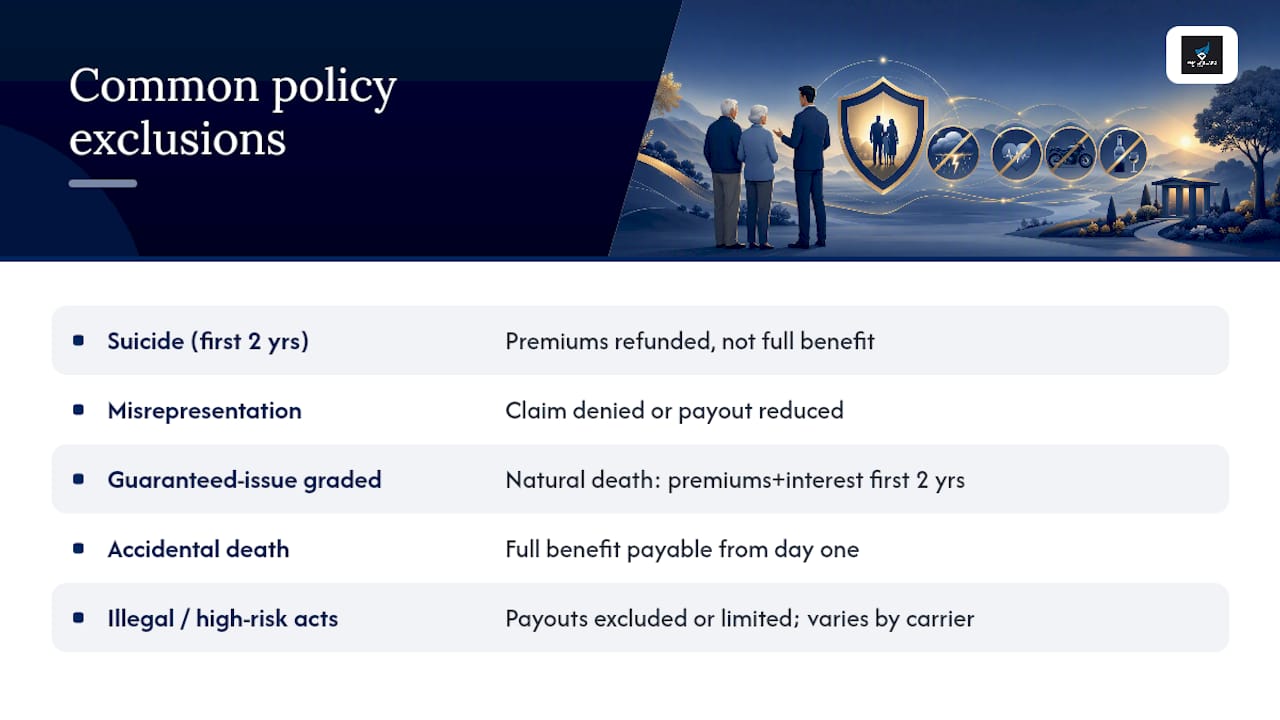
The most common exclusion is suicide within the first two years of the policy, standard across nearly every life insurance product, not unique to final expense plans. During that window, most carriers refund premiums paid rather than the death benefit.
Misrepresentation on the application is another. If you answered a health question inaccurately on a simplified-issue policy and the insurer later discovers it, they can deny the claim or reduce the payout, particularly if the misstatement happened within the contestability period, usually the first two years.
Guaranteed-issue policies carry the graded-benefit limitation described earlier: a death from natural causes in the first two years pays out premiums plus interest, not the full face amount. Death by accident is typically covered in full from day one, even during that graded period.
Some policies exclude or limit payouts for deaths connected to illegal activity or certain high-risk circumstances specified in the contract. These clauses vary by carrier, which is exactly why reading the policy language, not just the marketing brochure, matters before you buy.
None of these exclusions make final expense insurance a weak product. They're standard guardrails that keep premiums affordable for everyone in the risk pool. The point is simply to know them going in, so the day your family files a claim isn't the day they learn about them.
Filing a Claim: What Your Family Should Expect
The claims process for final expense insurance is built to be faster and simpler than most life insurance claims, and that speed is the entire reason the product exists.
Your beneficiary starts by contacting the insurance carrier directly, either by phone or through an online claims portal, and requesting a claim form. They'll need a certified copy of the death certificate, which the funeral home or county vital records office can provide, along with the original policy number and the beneficiary's identifying information.
Once the carrier receives the completed form and death certificate, review typically takes anywhere from a few days to two to three weeks, depending on whether the death falls within a contestability or graded-benefit period. A death occurring years into an active policy, with a straightforward cause, generally moves fastest. A death within the first two years may trigger a more thorough review to confirm there was no material misrepresentation on the original application.
Payment goes directly to the named beneficiary, not to an estate or funeral home, unless the policyholder specifically assigned it that way. That's an important detail to set up correctly when you first buy the policy, because it determines who controls the money and how quickly they can access it. Naming a specific person, rather than "my estate," generally speeds up payment since it avoids probate entirely.
Do Beneficiaries Pay Taxes on the Payout?
Generally, no. Life insurance death benefits, including final expense payouts, are not counted as taxable income for the beneficiary under federal tax law. Your family receives the full face amount without reporting it on their income tax return.
There are a few edge cases worth knowing. If the death benefit earns interest before it's paid out, say the insurer holds the funds briefly in an interest-bearing account, that interest portion is taxable. If the policy was transferred to another owner for value before death (a rare situation with final expense policies, but possible), part of the proceeds could become taxable under the transfer-for-value rule.
Estate taxes are a separate question from income taxes. For the vast majority of Americans, this doesn't matter because federal estate tax only applies to estates well above the exclusion threshold, but very large estates that include a life insurance payout as part of the taxable estate could see a different tax treatment. That's a conversation for an estate attorney, not a blanket rule that applies to typical final expense buyers.
Premiums you pay into a final expense policy aren't tax-deductible, similar to other personal life insurance premiums. The tax advantage is entirely on the back end, in the tax-free nature of the payout itself.
Will a Pre-Existing Condition Keep You From Getting Covered?
A pre-existing condition changes your price and your underwriting path far more often than it blocks coverage outright, which is the exact reason final expense insurance exists as a category.
Conditions like diabetes, high blood pressure, past cancer in remission, or a history of heart disease typically still qualify for simplified-issue underwriting, just at a higher premium tier than someone with a clean health history. Carriers assign risk classes based on the severity and recency of a condition. A controlled condition managed for years with stable medication usually rates better than a recent diagnosis or hospitalization.
More serious conditions, such as active cancer treatment, recent major surgery, or advanced kidney disease, can push an applicant toward guaranteed issue, where no health questions are asked but premiums run higher and the graded benefit period applies for the first two years. Our explainer on life insurance table ratings walks through how carriers translate health conditions into specific premium increases.
The practical takeaway: don't assume a diagnosis disqualifies you before you've actually applied. Carriers differ significantly in how they underwrite the same condition, and an agent who works across multiple carriers can often find a better rate than the first quote you get.
What Seniors Get Wrong About Final Expense Insurance
The biggest misconception isn't about price. It's timing. Most people wait until a health scare forces the issue, and by then they're choosing between a higher premium and guaranteed issue instead of the better rate they could have locked in five years earlier.
The second mistake is picking a face amount out of thin air. A round number like $10,000 feels safe, but it should come from an actual conversation with a local funeral home, not a guess. Funeral costs vary enough by region that a policy sized for a national average can leave a real gap in a high-cost market.
What I'd tell any reader weighing this decision: buy earlier than feels necessary, size the policy against a real quote from a funeral home, and work with someone who can compare simplified-issue and guaranteed-issue paths across more than one carrier. That comparison is where the actual value of a licensed agent shows up, not in the sale itself, but in steering you away from the wrong product for your specific health and budget.
— Shereka
Get a Personalized Final Expense Quote
Family Guard Life and Health gives you something a single-carrier sales call can't: an independent look across multiple insurers before you commit to a premium you'll pay for life. We're licensed across 22 states, including AZ, CO, FL, GA, IA, IN, MA, MD, ME, MI, MS, MT, NC, NV, OH, OK, PA, SC, TN, TX, VA, and WA, and we work specifically with clients planning final expense, whole life, and broader retirement income coverage.

A licensed agent's job is to compare underwriting paths, read the graded-benefit fine print, and match your health profile to the carrier that prices it fairest, work that's hard to do alone from a stack of mailers. If you're weighing timing with family, our partner resource on talking about money with aging parents is a useful starting point for that conversation.
Before you reach out, have your birthdate, a general sense of your health history, and a rough funeral-cost figure ready. Then request a personalized quote and get specific numbers instead of a guess.
This article is general information, not a substitute for advice from a qualified financial advisor. Consult a qualified financial professional about your own circumstances before acting on anything here.
Sources
- What Is Final Expense Insurance? - Investopedia
- NFDA statistics
- Final Expenses | AARP Life Insurance from New York Life