

Life insurance pays a death benefit for most causes of death, including illness, old age, and accidents. AD&D pays only when death or a specific severe injury results directly from a qualifying accident. If you have dependents, a mortgage, or income someone else relies on, life insurance is the primary purchase. AD&D works best as a cheap supplement, not a replacement, unless a health condition currently blocks you from qualifying for standard life coverage.
TL;DR:
- AD&D only pays for death or injuries caused by qualifying accidents, not illnesses or natural causes, making it much narrower than life insurance.
- Employer-sponsored AD&D offers limited portability and coverage amounts, often ending with employment, while individual life policies can last a lifetime and be transferred.
- Underwriting for life insurance involves health review and possibly medical exams, whereas AD&D is often guaranteed-issue or part of a group plan with minimal qualification hurdles.
- Many policies include AD&D riders that pay double benefits for accidents, but relying solely on AD&D leaves a family unprotected against most causes of death.
- For comprehensive coverage, combine a properly underwritten term or permanent life policy with an AD&D rider, considering your actual risks and financial needs.
Table of Contents
- ADD vs Life Insurance at a Glance
- How Life Insurance Actually Works
- How AD&D Insurance Actually Works
- The Real Differences That Should Drive Your Decision
- Who Should Buy Life Insurance, AD&D, or Both
- How to Actually Buy or Add This Coverage
- An Agent's View From Family Guard Life and Health
- What the Data Actually Tells Buyers in 2026
- Get a Coverage Plan That Actually Fits Your Situation
- Sources
- FAQ
ADD vs Life Insurance at a Glance
The fastest way to see the gap between these two products is to line up how each one actually pays out.
- Cause of payout: Life insurance covers nearly any cause of death, from cancer to a car accident. AD&D pays only for death or specified severe injury from a qualifying accident, not illness.
- Cost: AD&D premiums tend to run lower because the payout conditions are so narrow. You're paying less because the insurer is on the hook for less.
- Availability: AD&D is often bundled into employer benefits or sold as guaranteed-issue, meaning no medical exam. Individual life insurance usually requires underwriting, sometimes including blood work and a paramedical exam.
- Portability: Employer-sponsored AD&D typically ends the day you leave the job. Many individual life policies can be kept for life or converted from a group plan, depending on the product.
Those four differences explain nearly every question people ask when comparing accidental death insurance to a standard life policy.
How Life Insurance Actually Works
Life insurance exists to replace income, pay off debt, or cover final expenses when the person supporting a household is gone. The payout, called a death benefit, goes to your named beneficiary regardless of whether you died from a heart attack at 70 or a motorcycle accident at 35.
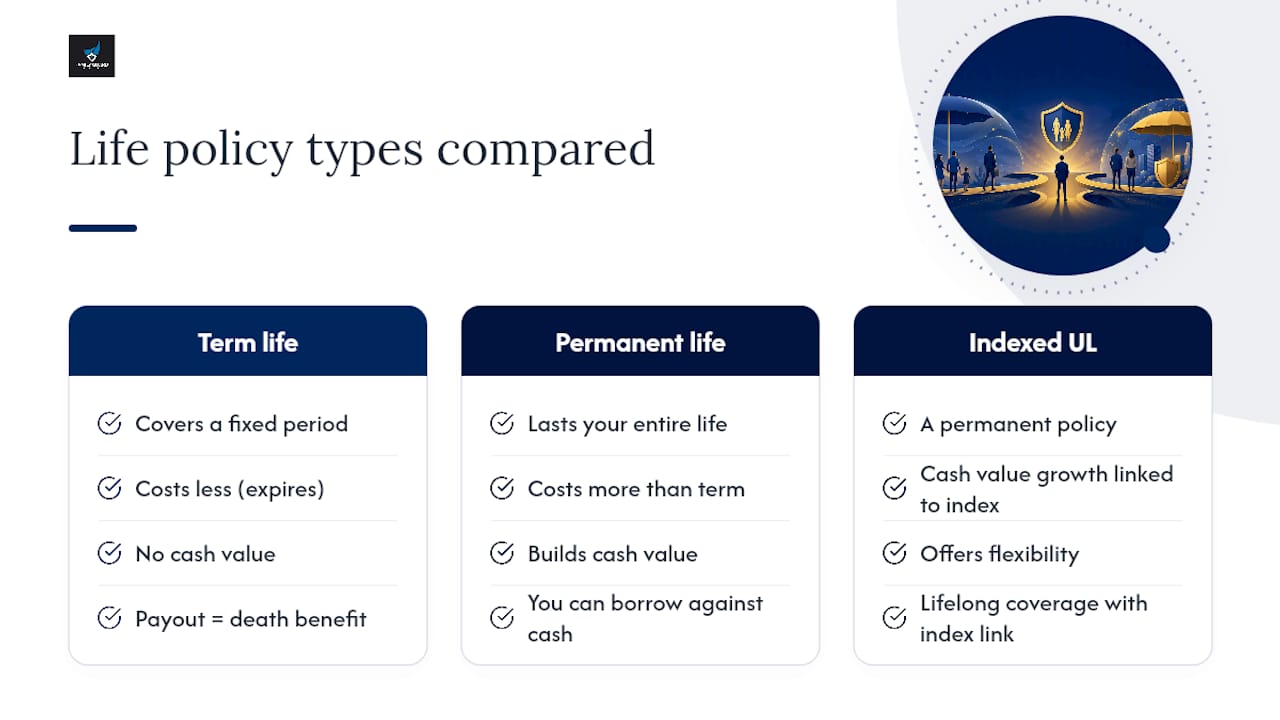
Two main structures dominate the market. Term life covers a fixed period and costs less because it expires. Permanent life, including whole life and universal life, lasts your entire life and builds cash value you can borrow against. An indexed universal life policy links some of that cash value growth to a market index, which appeals to buyers who want flexibility alongside lifelong coverage.
Getting approved involves underwriting: a review of your health history, sometimes a medical exam, and a rating that determines your premium. Buyers with health issues often land in a table rating, which raises the price but doesn't necessarily disqualify them. Most policies also carry a contestability period, typically the first two years, during which the insurer can investigate a claim if it suspects the application contained false information. A standard suicide clause usually applies during that same window.
When a policyholder dies, beneficiaries file a claim with a death certificate and the policy number. Insurers typically pay within 30 to 60 days once paperwork clears, faster if the death falls outside the contestability window and there's no dispute.
How AD&D Insurance Actually Works
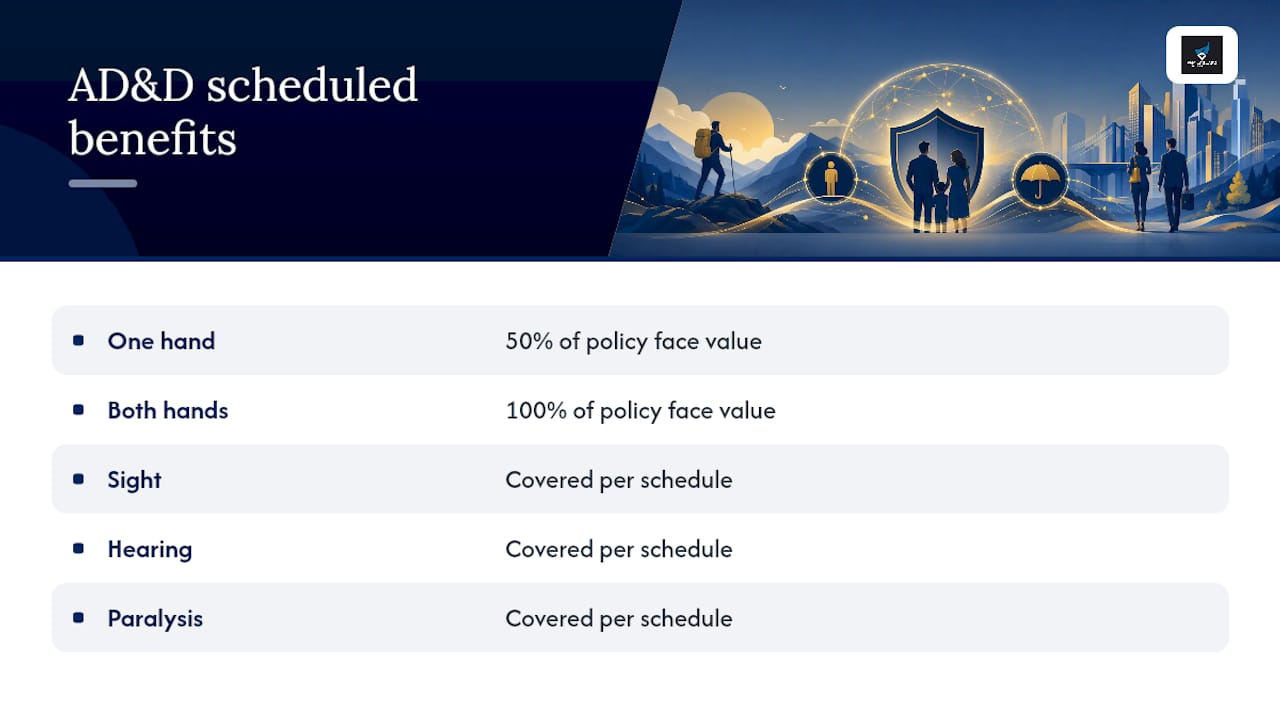
AD&D stands for accidental death and dismemberment, and the name tells you exactly what it covers: dying in an accident, or losing a limb, your sight, your hearing, or suffering paralysis because of one. Payouts for dismemberment follow a scheduled benefits table, meaning losing one hand might pay 50% of the policy's face value while losing both hands pays the full amount.
The exclusions matter more than the coverage list. AD&D typically will not pay for death from illness, drug overdose, suicide, war, or injuries sustained during high-risk activities the policy specifically carves out. Intoxication at the time of an accident is a common disqualifier too. This is the detail people miss until a claim gets denied.
You'll find AD&D in three forms: bundled into a group life insurance plan through an employer, sold as a standalone policy, or added as a rider onto an existing life contract. Group versions often mirror your group life benefit amount, but portability is limited. Once you leave the job, the AD&D coverage usually leaves with it.
Because the payout hinges on proving the death or injury meets the accident definition, claims documentation runs heavier than a standard life claim. Insurers want the police report, medical records, and sometimes a coroner's finding before releasing funds, and accidental deaths represent a meaningful but secondary slice of total U.S. deaths, which is exactly why the coverage stays narrow and cheap.
The Real Differences That Should Drive Your Decision
Picture two scenarios: a 45 year old dies of a heart attack, and a 45 year old dies in a highway collision. A life insurance policy pays the same death benefit in both cases. An AD&D policy pays in the second case and nothing in the first. That single distinction is the whole comparison in miniature.
- Cost versus protection gap: A $250,000 AD&D policy might cost less per month than a similar term life policy, but it only protects against a narrow slice of ways your family could lose your income.
- Underwriting and eligibility: Group AD&D through an employer is usually guaranteed-issue, no questions asked. Individual life insurance requires underwriting, which can mean higher premiums or denial for serious health conditions.
- Portability: Life insurance you own personally stays with you through job changes. AD&D tied to your employer typically does not, and riders attached to a group life plan may not convert either.
- Stacking benefits: Some life policies include an AD&D rider that pays extra, sometimes double the base death benefit, if death results from a covered accident. This is often called double indemnity, and it's a supplement layered on top of a real life policy, not a substitute for one.
Pro Tip: Ask your employer's benefits summary specifically what dollar amount your AD&D pays for a "loss of one hand" or "loss of sight in one eye." Most employees have never actually read that schedule, and the numbers are often lower than people assume.
Who Should Buy Life Insurance, AD&D, or Both
Matching coverage to your actual life circumstances beats guessing.
- You have dependents, a mortgage, or a spouse who relies on your income. Life insurance is the priority purchase. Almost every risk to that income, illness, accident, or old age, gets covered.
- You work in construction, transportation, or another accident-prone field. AD&D as a supplement makes sense here, layered on top of life insurance rather than instead of it.
- You need coverage fast and can't wait on a medical exam. Guaranteed-issue AD&D fills a gap temporarily, but treat it as a bridge, not a destination.
- You're relying on AD&D alone as your only death coverage. This is the riskiest setup for a family that needs income replacement, since a health-related death pays nothing.
- Your employer already provides group life and AD&D. Check the coverage amount against your actual income needs. Most group life benefits cap around one to two times salary, well short of what a family typically needs, which is why agents commonly recommend adding a personal term policy on top.
How to Actually Buy or Add This Coverage
Start with what you already have before shopping for anything new.
- Pull your employer benefits summary and confirm your current life and AD&D amounts, whether the AD&D is portable, and what evidence of insurability is required if you want to increase it.
- Get term life quotes for the same benefit level you're considering for a standalone AD&D policy, then compare the monthly cost side by side.
- Prepare for underwriting by having your medications, height and weight, and any past diagnoses ready. A cancer survivor or someone with a chronic condition may still qualify, sometimes at a higher rating rather than an outright decline.
- Ask your agent directly about exclusions, the contestability period, how claims get proven, and whether a rider or a standalone policy fits your situation better.
Pro Tip: If a health issue makes you nervous about underwriting, apply for life insurance first anyway. A table rating still gets you real income-replacement coverage; a decline just tells you where you stand, and an agent can usually find a carrier with more forgiving underwriting for your specific condition.
An Agent's View From Family Guard Life and Health
An agent has fielded the same confusion repeatedly: employees assume their workplace AD&D and life benefits are enough, then discover the AD&D portion pays nothing when a spouse dies of a stroke.
The most common surprise involves older buyers hitting a table rating they didn't expect, which raises premiums but rarely closes the door on coverage entirely. When a client's health complicates standard underwriting, the practical move is often a modest guaranteed-issue AD&D policy as a stopgap while pursuing a properly underwritten life policy, sometimes through a carrier that specializes in impaired risk. Readers thinking about how a payout fits into a broader estate plan may also want guidance from an estate planning attorney to coordinate beneficiary designations correctly.
What the Data Actually Tells Buyers in 2026
The conventional advice treats life insurance and AD&D as interchangeable "death coverage," and that framing does real damage. AD&D exists to plug a narrow accident gap cheaply, not to replace the broad protection a life policy provides. Employer benefits packages make this worse by presenting both as equivalent line items on a benefits summary, when one covers nearly every cause of death and the other covers a fraction of them.
The bigger blind spot is underwriting. Buyers assume a health condition means they're locked out of life insurance entirely, so they settle for guaranteed-issue AD&D and call it done. That's usually the wrong move. A table-rated life policy still pays for illness, which is how most people actually die. AD&D pays for accidents, which are a smaller share of deaths.
Prioritize qualifying for life insurance first, at whatever rating you land, and treat AD&D as what it is: a low-cost accident supplement, useful, but never the foundation of a family's financial protection.
— Shereka
Get a Coverage Plan That Actually Fits Your Situation
Coverage should be built around what you'd actually need paid out, not just the cheapest premium on a comparison chart. That can mean pairing a properly underwritten term or permanent life policy with an AD&D rider when it genuinely adds value, rather than relying on accident-only coverage alone.

Getting started takes less than most people expect. Have your age, health history, income, and any existing employer coverage amounts ready, and an agent licensed in your state can walk through term versus permanent options, riders, and how they layer with what your employer already provides. Visit the Family Guard Life and Health site to request a personalized quote and get a clear answer on what coverage actually fits your household.
Sources
- NerdWallet — Life insurance vs. accidental death and dismemberment
- CDC — Leading causes of death
- Wikipedia — AD&D insurance (Accidental death and dismemberment insurance)
FAQ
Which is better, AD&D or life insurance?
Life insurance is better for most people because it pays for nearly any cause of death; AD&D only pays for qualifying accidents, so it works best as a supplement rather than your primary coverage.
Do I need both AD&D and life insurance?
You need life insurance if anyone depends on your income; AD&D is optional on top of that, worth adding if you work an accident-prone job or want extra low-cost protection.
How much a month is a $500,000 term life insurance policy?
Monthly cost depends heavily on your age, health rating, and the term length you choose, since underwriting and table ratings directly affect the final premium.
Is AD&D on top of life insurance?
Yes, in most cases AD&D functions as a rider or supplement added to a life policy or employer benefit, paying an extra amount, sometimes double the base benefit, only when death results from a covered accident.