

If you need affordable coverage for a specific period, term life is usually the better choice; if you need guaranteed lifelong coverage and cash value you can tap while you're alive, whole life is usually the better fit. Term makes sense while you're raising kids or paying off a mortgage. Whole life makes sense when the need for coverage never really ends. Budget matters too: read the decision framework below before you commit either way.
TL;DR:
- Term life premiums are significantly lower than whole life, often by a factor of ten to twenty, making it more affordable for temporary needs.
- Whole life guarantees a death benefit and accrues cash value that grows with guaranteed minimums and possible dividends, offering lifelong coverage.
- Buying the wrong term length or neglecting to consider conversion options can lead to higher costs or coverage gaps later in life.
- Using whole life for final expenses or lifelong dependents can be a cost-effective way to address permanent needs with predictable benefits.
- Comparing actual quotes across multiple carriers and assessing the insurer’s financial strength helps ensure the chosen policy fits your real protection goals.
Table of Contents
- Term Life Vs Whole Life: The Key Differences At a Glance
- What Is Term Life Insurance and How Does It Work?
- What Is Whole Life Insurance and How Does It Work?
- Where Term and Whole Life Actually Agree
- Term Life Vs Whole Life: What Actually Drives the Cost
- Who Should Buy Term and Who Should Buy Whole Life?
- How Much Coverage Should You Buy?
- Alternatives and Hybrids Worth Knowing About
- How to Buy Life Insurance: Quotes, Underwriting, and Comparing Offers
- What Agents See That Buyers Usually Miss
- The Real Question Isn't Term Or Whole, It's What You're Actually Protecting
- How Family Guard Life and Health Can Help You Choose
- Sources
- FAQ
Term Life Vs Whole Life: The Key Differences At a Glance
The short version: term is lower cost and temporary, whole life is higher cost and permanent. Everything else flows from that one distinction.
- Length of coverage: Term runs a set period, usually 10 to 30 years. Whole life covers you for your entire life as long as premiums are paid.
- Cash value: Term builds none. Whole life accumulates cash value you can borrow against or withdraw from.
- Cost: Term premiums stay low for the length of the term. Whole life premiums are fixed but dramatically higher.
- Best use case: Term fits income replacement and debt payoff. Whole life fits estate planning, final expenses, and lifelong dependent care.
- Guarantees: Term guarantees a death benefit only if you die within the term. Whole life guarantees a death benefit and a minimum cash-value growth rate for life.
The cost gap is the number that surprises most people. A healthy 30-year-old buying a $500,000 policy will typically pay a fraction for term what they'd pay for the same face amount in whole life, according to Forbes Advisor's comparison of term and whole life premiums. That gap is exactly why so many households end up buying term for the bulk of their coverage and layering in a smaller whole life policy for narrower goals like final expenses.
What Is Term Life Insurance and How Does It Work?
Term life insurance pays a death benefit if you die within a fixed period, commonly 10 to 30 years, and it generally builds no cash value. Once the term ends, so does the coverage, unless you renew it (usually at a much higher rate) or convert it to a permanent policy.
Most term policies sold today are level term, meaning the death benefit and premium stay flat for the entire term. Decreasing term, where the payout shrinks over time, still shows up occasionally tied to mortgage protection, but it's far less common than it was a decade ago.
Underwriters set your premium based on a handful of factors:
- Age at application: the single biggest driver of price, since risk climbs with every year.
- Health history: conditions like diabetes or heart disease move you into a higher rate class.
- Tobacco status: smokers often pay two to three times what non-smokers pay for identical coverage.
- Occupation and hobbies: pilots, commercial divers, and other high-risk jobs can trigger rate adjustments or exclusions.
Riders change the math in useful ways. A convertibility rider lets you switch some or all of your term coverage to a permanent policy later without new medical underwriting, which matters if your health declines during the term. A return-of-premium rider refunds the premiums you paid if you outlive the term, but it can roughly double your monthly cost. An accelerated death benefit rider, now standard on many policies at no extra charge, lets you access part of the death benefit early if you're diagnosed with a terminal illness. Each rider trades a bit of simplicity for a specific kind of protection, so it's worth asking which ones actually apply to your situation before you assume you need them all.
What Is Whole Life Insurance and How Does It Work?
Whole life insurance is permanent coverage with fixed premiums that never increase, and it builds a cash-value component that grows over time and may pay dividends on participating policies. You're covered for life as long as premiums get paid, and part of every payment funds an account you can eventually borrow against.
The cash value grows two ways. There's a guaranteed minimum growth rate written into the contract, and on participating policies from mutual insurers, there's a non-guaranteed annual dividend on top of that. Dividends aren't promised. They depend on the insurer's investment performance and mortality experience, and a bad year can mean a smaller dividend or none at all.
- Guaranteed growth: contractually locked in, unaffected by market swings.
- Dividends: an added bonus on participating policies, never guaranteed.
- Policy loans: you can borrow against cash value, but unpaid interest compounds and reduces the death benefit if you die with a loan outstanding.
- Surrender charges: cashing out early triggers a penalty that typically fades after the first 10 to 15 years of the policy.
The tax treatment is a genuine advantage: cash value grows tax deferred, and policy loans typically aren't taxed as income as long as the policy stays in force. Surrender the policy, though, and any gain above what you paid in premiums usually becomes taxable.
Pro Tip: Ask for an in-force illustration before you buy, not just a sales projection. It separates the guaranteed numbers from the dividend assumptions, so you know exactly what's locked in versus what's a best-case guess.
Where Term and Whole Life Actually Agree
Before getting lost in the differences, it helps to know what these two products have in common. Both are still life insurance, after all, built on the same basic promise.
- Both pay a death benefit that's generally income-tax-free to your beneficiaries, as long as the policy is in force when you die.
- Both require underwriting, meaning the insurer evaluates your health, age, and lifestyle before setting your rate.
- Both depend on you keeping up with premium payments; miss enough of them, and either policy can lapse.
- Both can be customized with riders, whether that's a child rider on a whole life policy or a disability waiver on a term policy.
The overlap ends there. Everything about how long you're covered, what it costs, and what happens to your money over time is where these two products split.
Term Life Vs Whole Life: What Actually Drives the Cost
Cost is where most people make their decision, so it deserves the closest look. A healthy, non-smoking 35-year-old shopping for $500,000 in coverage will typically find term premiums running in the range of $20 to $35 a month for a 20-year term, based on sample rate data from NerdWallet's average life insurance rate comparisons. The same $500,000 in whole life coverage for that same buyer often runs $400 to $600 a month or more, because the premium isn't just paying for mortality risk, it's funding lifelong coverage and building cash value on a guaranteed schedule.
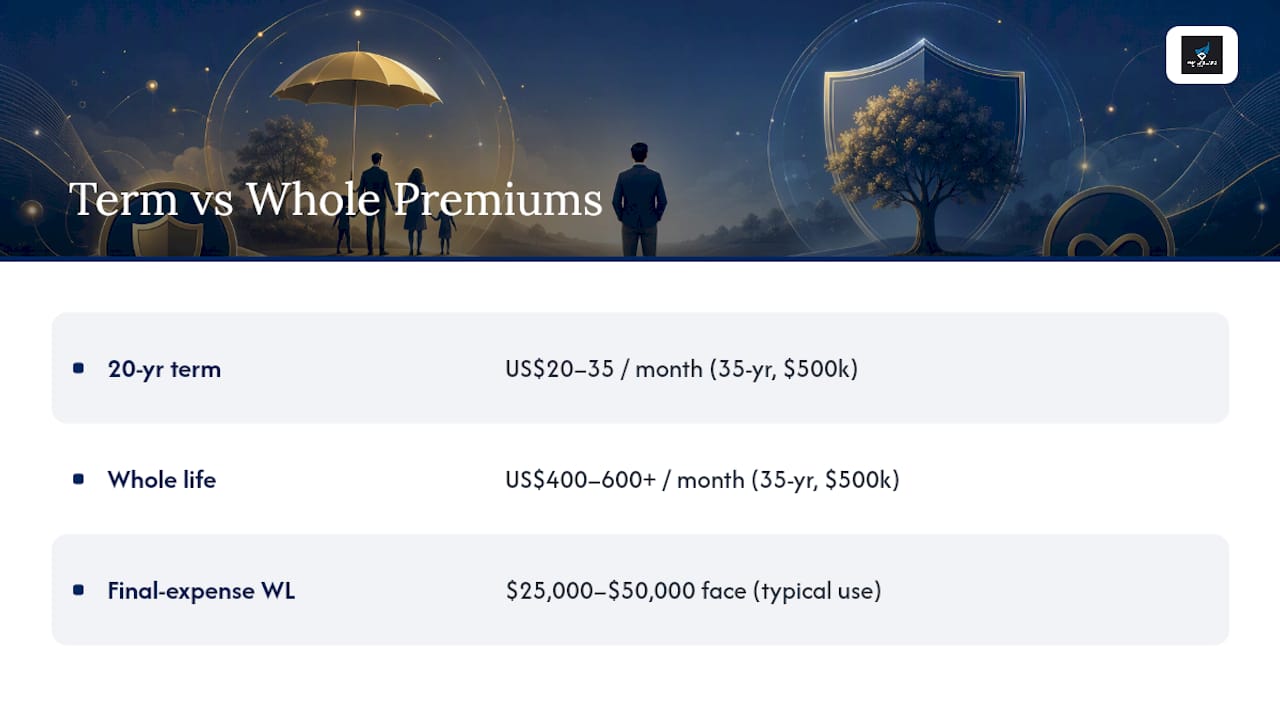
That multiple, often ten to twenty times higher for whole life, is the reason so many financial planners default to recommending term first and asking questions second. It's also why whole life makes more sense in smaller face amounts, like a $25,000 or $50,000 policy meant to cover final expenses, than as a way to replace $500,000 or $1,000,000 of income.
Coverage length changes the risk you're carrying, not just the price. Term is a bet on a specific window of time. If you buy a 20-year term at 35 hoping to cover your kids until they're independent, you're covered until 55. If you still need coverage at 56, you're either renewing at a rate that reflects your current age and health, or applying for new coverage from scratch, which can mean paying substantially more if your health has changed. Whole life sidesteps that renewal risk entirely because the coverage never expires as long as premiums are paid, but you're paying for that certainty every single month for decades.
Cash value access looks appealing until you read the fine print on loans. Borrowing against your whole life cash value doesn't require credit approval or a new application, and the money isn't taxed as income when you take it out. A $50,000 loan left unpaid for fifteen years can quietly turn into a $90,000 or $100,000 reduction in what your beneficiaries receive. It's not free money. It's a loan against your own policy that has to be settled one way or another.
Guarantees and projections are not the same thing, and the difference matters more than most buyers realize. A whole life illustration you get at the point of sale typically shows two columns: a guaranteed column, reflecting the contractual minimum, and a non-guaranteed (dividend-based) column, reflecting what the insurer projects if current performance holds. Agents who know the product well will tell you to plan your finances around the guaranteed column only. The dividend column is a forecast, not a promise, and forecasts change when interest rates or claims experience shift.

Who Should Buy Term and Who Should Buy Whole Life?
Matching the policy to the actual life situation is where this decision gets easier. A handful of profiles cover most buyers.
- Parents with a mortgage and young kids usually fit term best. The need is temporary and specific: replace income and pay off debt until the kids are grown and the house is paid down. A 20 or 30 year level term sized to the mortgage balance plus income replacement covers that window at a fraction of what permanent coverage would cost.
- Anyone on a tight budget who still needs meaningful coverage should generally start with term. Getting $500,000 of protection at an affordable premium beats getting $50,000 of whole life coverage because it's all that fits the budget.
- People planning around estate taxes or legacy goals often lean toward whole life, since the guaranteed death benefit and predictable cash value support long-term wealth transfer plans in a way a policy that expires can't.
- Families with a lifelong dependent, such as an adult child with a disability, frequently choose whole life because the need for coverage genuinely never ends. A 20 or 30 year term eventually runs out; the dependent's need for support doesn't.
- People who want a cash cushion tied to insurance sometimes choose whole life specifically for the forced savings and loan access, understanding they're paying a premium for that flexibility.
A mixed approach works for plenty of households: a large term policy to cover the income-replacement years, paired with a smaller permanent policy sized to final expenses or a specific legacy goal. Consumer guidance generally lines up with this pattern, pointing to term for defined-duration needs and whole life for lifelong or estate-focused goals.
How Much Coverage Should You Buy?
Figuring out the right number matters more than picking term or whole life first, because either policy is useless if it's sized wrong. A simple three-step process gets most people to a reasonable figure.
- Calculate your protection gap. Add up what your family would need: years of income replacement, outstanding debts (mortgage, car loans, student loans), and final expenses (funeral costs typically run $7,000 to $12,000). Subtract existing savings and any coverage you already have.
- Pick a term length matched to your actual timeline. If your youngest child is 8 and you want coverage until they're financially independent at 22, that's a 15 to 20 year term, not a generic default. Consumer guides consistently recommend calculating this protection gap rather than guessing at a round number.
- Stress-test the premium against your actual budget. A policy you can't afford in year three does nobody any good. If the number feels tight, look at whether a convertibility rider on a shorter term makes more sense than overcommitting now.
A widely used rule of thumb is 10 to 12 times your annual income as a starting face amount, adjusted up if you have significant debt or multiple dependents, and down if you're closer to retirement with fewer obligations. That range is a starting point, not a formula. Someone with $300,000 in mortgage debt and three kids under ten needs a very different number than someone with a paid-off house and one adult child.
Alternatives and Hybrids Worth Knowing About
Term and whole life aren't the only two options on the table, and understanding the middle ground helps you see whether whole life's cash value is actually serving you or just costing you.
- Buy term and invest the difference is the classic alternative strategy: buy cheap term for the death benefit, then invest what you would have paid in whole life premiums into a retirement account or brokerage account instead. It works only if you actually invest the difference consistently, which is the part that trips people up in practice.
- Universal life and indexed universal life sit between term and whole life. They offer permanent coverage with more flexible premiums, and indexed versions tie cash-value growth to a market index with a cap and a floor. You can learn more about how indexed universal life insurance works and who it tends to fit if you want coverage that isn't fully fixed like whole life but isn't purely temporary like term.
- Conversion riders let you switch a term policy to permanent coverage later without new medical underwriting. They're valuable specifically when your health changes during the term, since a conversion locks in coverage you might otherwise be denied.
How to Buy Life Insurance: Quotes, Underwriting, and Comparing Offers
Getting quotes is the easy part. Comparing them well is where people either save money or get stuck with a policy that doesn't fit.
You can get quotes through an independent agent who represents multiple carriers, an online marketplace, or directly from a single insurer. An independent agent typically gives you the broadest view, since they can compare rate classes across several companies instead of just one.
- Underwriting for term policies often includes a medical exam, checking blood pressure, cholesterol, and sometimes a urine sample, along with a review of your medical history, tobacco use, and certain high-risk activities.
- The process typically takes two to six weeks from application to approval, depending on how quickly medical records come back.
- Beyond price, compare the insurer's financial strength rating, the specific riders offered, cash-value illustrations for permanent policies, and the surrender charge schedule.
- If a health condition is part of your history, ask directly how it might affect your rate class or table rating before you apply, since that shapes which carrier is worth applying to first.
Pro Tip: Get your exam scheduled for the morning after a good night's sleep, avoid caffeine and heavy salt the day before, and don't apply to multiple carriers back to back. Repeated medical inquiries in a short window can occasionally raise questions during underwriting.
What Agents See That Buyers Usually Miss
Years of underwriting conversations reveal the same handful of mistakes over and over. The single biggest one is buying a term length that doesn't match the actual timeline, either too short (leaving a gap right when it matters most) or too long (paying for years of coverage nobody needs). Right behind that is ignoring conversion riders entirely, then discovering years later that a health diagnosis makes new coverage difficult to get. A third common misstep is surrendering a whole life policy in the first decade, right when surrender charges are highest and the cash value hasn't had time to build meaningfully.
Before signing anything, ask your agent three direct questions: are they licensed in your state, which carriers do they actually represent, and can they show you an in-force illustration rather than just a sales projection. A good agent should answer all three without hesitation.
- Ask whether the term length matches your specific financial timeline, not a generic default.
- Ask what the conversion window looks like and whether it closes at a certain age.
- Ask to see the guaranteed column of any whole life illustration, separate from dividend projections.
- Ask how the agent gets paid and whether that affects which products they're showing you.
Family Guard Life and Health approaches policy selection by starting with the protection gap and budget, then comparing quotes across multiple carriers rather than defaulting to one product.
The Real Question Isn't Term Or Whole, It's What You're Actually Protecting
Most of the "term versus whole life" debate online treats this like a religious argument, and that's a mistake. The math clearly favors term for pure income replacement. It's not close. But the argument falls apart when people use it to dismiss whole life entirely, because the two products aren't competing for the same job.
Where I'll push back on the conventional wisdom: whole life gets criticized for being expensive, and it is, but that criticism usually compares it against term for the wrong use case. Nobody should buy $500,000 of whole life to replace their salary. That's a legitimate misuse of the product. But sizing a $25,000 or $50,000 whole life policy specifically for final expenses or a lifelong dependent isn't a bad decision dressed up in insurance jargon. It's matching a permanent need to a permanent product.
Check the insurer's financial strength rating before you buy either type, and confirm your agent is actually licensed in your state. Those two checks catch more problems than any premium comparison ever will.
— Shereka
How Family Guard Life and Health Can Help You Choose
Our agency offers a practical alternative to shopping blind through online marketplaces. We provide comparative quotes across multiple carriers for both term and whole life so you can see actual numbers side by side, not projections designed to look good in a sales pitch.

If you already have a policy, we also offer a straightforward policy review, checking whether your term length still fits your timeline, whether a conversion makes sense, or whether a smaller permanent policy alongside your term could close a gap you didn't know you had. Families weighing final expense coverage specifically can also lean on resources like Golden Memorial for planning around end-of-life costs alongside the insurance side. Ready to see real numbers for your situation? Request a quote or policy review and talk with a licensed agent about what actually fits your budget and your timeline.
This article is general information, not a substitute for advice from a qualified financial advisor. Consult a qualified financial professional about your own circumstances before acting on anything here.
Sources
- Term life vs. whole life insurance — Fidelity
- Term life vs. whole life insurance — Investopedia
- Term Life vs. Whole Life Insurance — Forbes Advisor
- Term vs. Whole Life Insurance — AARP
FAQ
What Are the Downsides of Term Life Insurance?
Term life builds no cash value, and coverage ends when the term expires, which means you could outlive the policy right when you still need protection. Renewing after the term ends usually costs significantly more because pricing resets based on your current age and health.
Why Does Dave Ramsey Say No to Whole Life Insurance?
Ramsey's argument centers on cost: whole life premiums run far higher than term for the same death benefit, and he argues investors do better buying cheap term coverage and investing the premium difference separately rather than relying on a policy's cash value growth.
Do You Get Money Back at the End of Term Life Insurance?
Standard term life insurance pays nothing back if you outlive the policy, since it generally does not build cash value. A return-of-premium rider refunds what you paid, but it roughly doubles the monthly cost.
Is It Worth It to Convert Term Life to Whole Life?
Converting makes the most sense when your health has declined and new underwriting would mean higher rates or denial, since conversion riders let you switch without a new medical exam. If your health is still good and your need remains temporary, staying on term or buying new term coverage is usually cheaper than converting.