

Most self-employed workers get coverage through the ACA Marketplace, since it's the only route that unlocks premium tax credits, but spouse coverage, COBRA, or Medicaid can beat it depending on your household. Start by estimating your projected net self-employment income for the year, then check plans at healthcare.gov or your state exchange during open enrollment.
TL;DR:
- Self-employed workers should prioritize the ACA Marketplace for coverage, especially to qualify for subsidies, unless spouse coverage or COBRA is more cost-effective.
- Accurate income estimation from Schedule C and timely updates are crucial to maximize subsidies and avoid repayment surprises at tax time.
- The self-employed health insurance deduction reduces gross income on Schedule 1 but cannot be claimed if eligible for an employer-sponsored plan in the same month.
- Cost-effective plan choice depends on income, health needs, and whether you want HSA eligibility, with silver plans favored for subsidies and bronze HDHPs for tax sheltering.
- State-specific rules, income fluctuations, and employer coverage options significantly influence available plans and total costs for self-employed individuals.
Table of Contents
- What Self-Employed Health Insurance Options Actually Exist?
- How Much Does Self-Employed Health Insurance Cost After Subsidies?
- How Does the Self-Employed Health Insurance Deduction Work?
- Which Plan Should You Actually Pick?
- When Should You Enroll, and What Do You Need to Prepare?
- Does Your Health Plan Affect SEP IRA and Retirement Contributions?
- Are Health Sharing Ministries a Real Alternative?
- Do Marketplace Options Vary by State?
- How Do You Handle Insurance When Your Income Changes Mid-Year?
- What Do Clients Consistently Get Wrong?
- How Family Guard Life and Health Helps You Enroll and Save
- Where to Verify These Rules Yourself
- Sources
What Self-Employed Health Insurance Options Actually Exist?
There's no single "self-employed plan." What exists is a set of routes into coverage, and the right one depends on your income, your household, and how much flexibility you need on doctors and networks.
The ACA Marketplace is the default starting point for most independent contractors, freelancers, and small business owners. Every Marketplace plan carries guaranteed-issue protection, meaning an insurer can't deny you or charge more because of a pre-existing condition, and every plan covers the ten essential health benefits, from maternity care to mental health services. If you're self-employed, you can enroll through the individual Health Insurance Marketplace and find out in the same session whether you qualify for a subsidy.
Private or off-exchange plans sit outside the Marketplace, sold directly by an insurer or through a broker. You lose access to premium tax credits entirely, but you gain access to plan designs and provider networks that some Marketplace insurers don't offer in your area. This tradeoff mostly makes sense once your income is high enough that subsidies wouldn't apply anyway, or when a specific doctor or hospital system only accepts an off-exchange product.
Beyond those two, self-employed workers typically weigh:
- Spouse's employer plan: Often the cheapest option if your spouse's employer covers a meaningful share of the premium, but compare that contribution against what you'd lose in subsidies before assuming it wins.
- COBRA: Lets you keep a former employer's plan for up to 18 months (sometimes 36 for specific qualifying events), but you pay the full premium plus up to a 2% administrative fee, which usually makes it the most expensive short-term bridge.
- Medicaid: Available if your household income falls under your state's threshold, particularly relevant in states that expanded eligibility. Income swings common to self-employment can push you in and out of eligibility year to year.
- Short-term plans: Cheap and fast to activate, but they can deny claims for pre-existing conditions and typically exclude maternity and mental health coverage, so treat them as a true gap-filler, not a primary strategy.
- Association health plans: Sometimes offered through trade groups or chambers of commerce, with pricing that can undercut individual Marketplace plans, but coverage generosity and consumer protections vary by plan and state, so read the certificate of coverage closely before enrolling.
How Much Does Self-Employed Health Insurance Cost After Subsidies?
Your premium tax credit is calculated from two numbers: your projected net income for the year and your household size. Get either one wrong and your subsidy estimate is wrong too, which is the single most common mistake self-employed filers make during enrollment.
The credit works on a sliding scale tied to the federal poverty level for your household size. Lower projected income means a bigger credit; income near or above the upper eligibility range shrinks the credit toward zero. For many subsidized filers, a silver plan paired with cost-sharing reductions (CSRs) is the strongest financial move available, since CSRs can push a silver plan's real-world value closer to gold-tier coverage while keeping premiums at silver-tier pricing, an advantage Treasury Department analysis flags as one reason Marketplace coverage matters so much to self-employed households.
Estimating net income starts with Schedule C, not your gross revenue. Take your gross receipts, subtract business expenses, and that's your net profit before the self-employed health insurance deduction and half of your self-employment tax adjustment. Three mistakes show up constantly:
- Using last year's income instead of this year's projection, especially after landing a new client or losing one.
- Forgetting to subtract deductible business expenses, which inflates your income estimate and shrinks your subsidy.
- Failing to update the Marketplace mid-year when income shifts materially, which sets up a painful reconciliation at tax time.
Treasury's 2024 analysis found that a significant share of self-employed workers ages 21 to 64 had Marketplace coverage in 2022, a share described as disproportionately high compared to traditionally employed workers, underscoring how central the Marketplace has become for this group.
A single filer projecting around $30,000 in net income often sees silver premiums drop to a small fraction of the sticker price after subsidies, while a household projecting income well above 400% of the poverty line may see credits phase out completely, making an HSA-eligible bronze or off-exchange plan more attractive. If you're healthy and want to shelter income, a bronze high-deductible health plan (HDHP) paired with a health savings account lets you deduct HSA contributions separately from your premium, which is worth running the numbers on before defaulting to silver.
How Does the Self-Employed Health Insurance Deduction Work?
The self-employed health insurance deduction lets you subtract your premiums from your income above the line, on Schedule 1 (Form 1040), Line 17, rather than itemizing. That's a meaningful advantage: it reduces your adjusted gross income even if you take the standard deduction.
There's a catch that trips up a lot of filers. You can't claim this deduction for any month you were eligible to participate in an employer-subsidized health plan, whether through your own job, your spouse's job, or a business you don't fully own. Eligibility is checked month by month, not for the year as a whole, so a spouse's new job halfway through the year can cut your deduction for the remaining months.
Form 7206 determines your exact deduction amount and is required if you're claiming this deduction, including cases where you have multiple businesses reporting income on separate Schedule Cs. The form walks through allocating premiums across businesses and capping the deduction at your net self-employment income from the specific business paying for the coverage.
Documents to keep on file:
- Form 1095-A if you enrolled through the Marketplace
- Monthly premium invoices or bank statements showing what you actually paid
- Schedule C for each business, to support income allocation
- Form 8962, used to reconcile any advance premium tax credit against your final income at tax time
One detail matters more than most filers realize: this deduction lowers your AGI but does not reduce your self-employment tax, since IRS guidance on Form 7206 treats it as an income adjustment, not a business expense deduction on Schedule C.
Pro Tip: If you received advance premium tax credits during the year and your income came in higher than projected, run a quick Form 8962 estimate in November, not April. Catching an income overshoot early gives you time to adjust withholding or set aside cash for the reconciliation, instead of getting surprised by a repayment come tax season.
Which Plan Should You Actually Pick?
Strip away the marketing and plan comparison boils down to three things: can you see the doctors you need, what's your total expected annual cost, and does the plan work with an HSA if that matters to your tax strategy.
Total expected cost isn't just the premium. It's your premium after subsidy, plus what you're likely to spend out of pocket based on your actual health needs. A plan with a lower premium and a $9,000 deductible can cost more in a bad year than a plan with a higher premium and a $2,000 deductible.
Your one-page comparison checklist:
- Premium after subsidy (monthly)
- Deductible and out-of-pocket maximum
- HSA eligibility (HDHP status)
- Whether your current doctors and prescriptions are in-network and on formulary
- Any prior authorization requirements for ongoing treatments
| Situation | Usually the better fit |
|---|---|
| Lower income, subsidy-eligible | Silver plan with cost-sharing reductions |
| Higher income, healthy, wants tax shelter | Bronze HDHP with HSA |
| Income above subsidy cliff, specific provider needs | Off-exchange PPO |
| Spouse has strong employer coverage | Spouse's plan, if contribution beats subsidy value |
Before you enroll, ask a broker or carrier directly about their provider directory's accuracy, their prior authorization process for any ongoing care, and their surprise billing protections under federal law. Directories go stale fast, and confirming network status by phone before you enroll saves headaches later.
When Should You Enroll, and What Do You Need to Prepare?
Open enrollment for individual Marketplace coverage typically runs in the final weeks of the calendar year, with exact dates set annually by healthcare.gov and by state-based exchanges where they exist. Miss it, and you generally need a qualifying life event to enroll outside that window, things like marriage, the birth of a child, losing other coverage, or a significant income change in some states.
Before you sit down to apply:
- Pull together your most recent 1099s and a rough projection of this year's net Schedule C income.
- Gather proof of citizenship or immigration status if you're a new applicant.
- Have your household size and everyone's expected income ready, since subsidies are calculated per household, not per person.
- Set a calendar reminder to update your income mid-year if it shifts meaningfully, and reconcile using Form 8962 at tax time if you received advance credits.
Does Your Health Plan Affect SEP IRA and Retirement Contributions?
Your health insurance choice and your retirement contributions pull from the same pool of net self-employment income, so a decision on one affects room for the other. SEP IRA contribution limits are calculated as a percentage of your net self-employment earnings after certain adjustments, and the self-employed health insurance deduction reduces the income figure those calculations start from.
That interaction cuts both ways. A larger health insurance deduction lowers your AGI, which can help with Marketplace subsidy eligibility for the following year, but it also slightly lowers the net earnings base used for your SEP IRA contribution ceiling. Most self-employed workers won't feel this at modest income levels, but it becomes relevant for higher earners trying to maximize both retirement contributions and tax efficiency in the same year.
The practical move is sequencing: estimate your net income, apply your health insurance deduction, then calculate your SEP IRA contribution room off the adjusted figure, rather than guessing at a round contribution number in January and hoping it fits. If retirement income planning is part of your broader financial picture, it's worth looking at how these tax interactions play out over a longer horizon, not just the current filing year.
Are Health Sharing Ministries a Real Alternative?
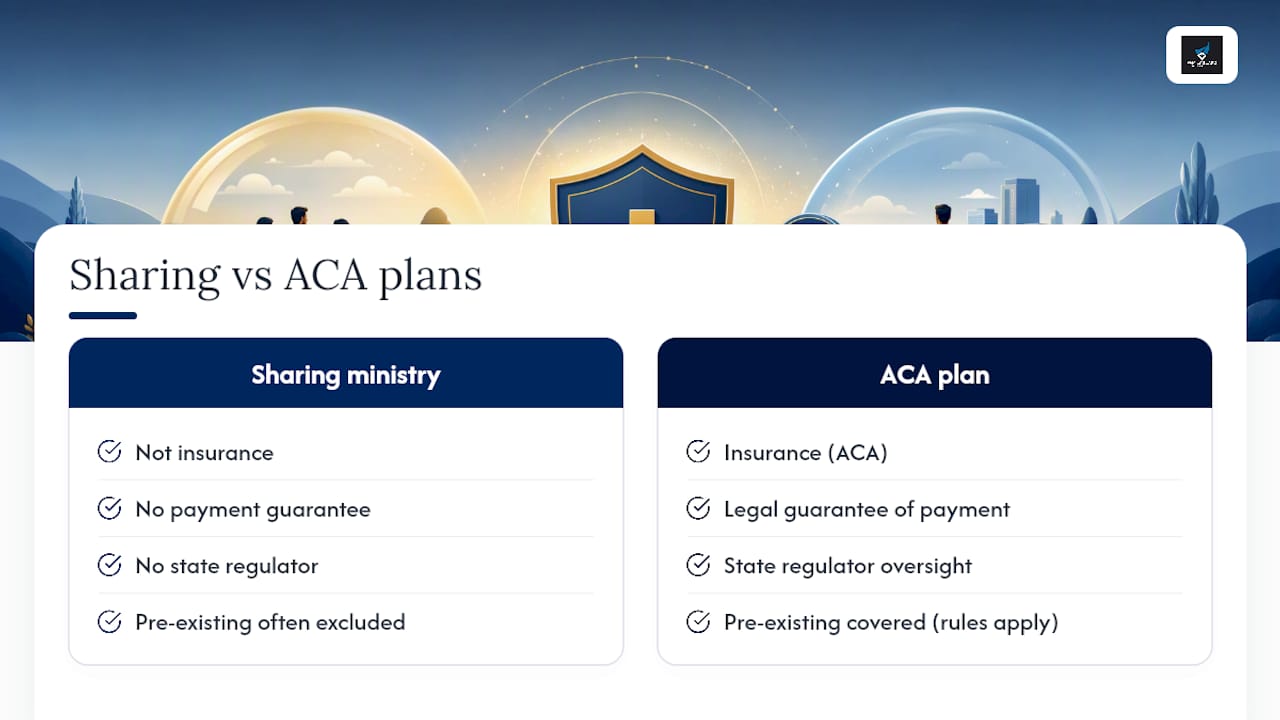
Health sharing ministries let members pool money to cover each other's medical bills, and they're worth understanding, but they are not insurance. Members share costs voluntarily; there's no legal guarantee of payment and no state insurance regulator backing the arrangement the way there is with an ACA plan.
For a self-employed worker who's healthy, wants a lower monthly cost, and understands the risk, a sharing ministry can function as a stopgap. The tradeoffs are real: pre-existing conditions are frequently excluded or limited, maternity coverage often has waiting periods, and because these plans aren't required to cover essential health benefits, a serious diagnosis can leave you exposed to costs a Marketplace plan would have covered. You also lose eligibility for premium tax credits entirely, since sharing ministry payments aren't insurance premiums, and in most cases they don't qualify for the self-employed health insurance deduction.
Treat a health sharing arrangement as a calculated risk for short gaps or as a supplement, not as your only coverage if you have a chronic condition, are planning a pregnancy, or can't absorb a five or six-figure medical bill out of pocket. If cost is the driving factor, run the math on a bronze HDHP with subsidies first. It often lands close in monthly cost while keeping ACA consumer protections intact.
Do Marketplace Options Vary by State?
Yes, meaningfully. Some states run their own exchange instead of using healthcare.gov, and those state-based marketplaces sometimes offer extended enrollment windows, additional state-funded subsidies on top of federal premium tax credits, or state-specific Medicaid expansion rules that change who qualifies at what income.
A self-employed worker in a state with expanded Medicaid and a state-funded subsidy program can end up with meaningfully lower costs than someone with identical income in a state that didn't expand Medicaid and relies solely on federal credits. Some states also run their own small business or SHOP-style programs that self-employed people with even one employee can sometimes access, which is worth exploring if you've hired even part-time help. For business owners weighing group coverage as they grow, it's worth understanding how group health and business planning insurance options compare to staying on an individual plan.
Because these rules shift by state and change from year to year, check your specific state exchange directly, or work with an agent licensed in your state who tracks the local variations rather than relying on generic national guidance.
How Do You Handle Insurance When Your Income Changes Mid-Year?
Fluctuating income is the defining financial reality of self-employment, and the Marketplace is built to handle it, if you actively manage it. The subsidy you're getting today is based on the income estimate you entered, not what you'll actually earn, so a big swing in either direction should trigger an update to your Marketplace account, not a wait-and-see approach.
Report income increases as soon as they look durable, not from a single good month, to avoid owing back credits at tax time. Report decreases too. Waiting until year-end reconciliation to fix a downward swing means you overpaid all year for coverage you could have gotten more cheaply. For workers who can influence when they invoice or collect payment, coordinating that timing with a tax advisor can help keep income near a subsidy threshold without artificially suppressing your business, though this only works with genuine flexibility in payment timing, not by hiding income.
Keep a simple record of your income projection and the date you made it. If your numbers get questioned during Form 8962 reconciliation, being able to show your reasoning at the time you estimated makes the conversation far easier.
What Do Clients Consistently Get Wrong?
The biggest mistake is guessing at income instead of pulling real Schedule C numbers, which either inflates the subsidy owed back later or leaves money on the table all year. The second is picking a plan on premium alone and skipping the HSA math, which often costs healthy, high-deductible-friendly clients hundreds in missed tax savings. The third is ignoring provider networks until they need a specialist and discover their doctor is out of network.
In practice, lower-income households do best with silver plus cost-sharing reductions, mid-income self-employed workers who are healthy tend to come out ahead with bronze and an HSA, and anyone with strong spousal coverage available should run that math before assuming the Marketplace wins. Family Guard Life and Health walks clients through income projection, plan comparison, and the Form 8962 reconciliation each of those choices eventually triggers.
— Shereka
How Family Guard Life and Health Helps You Enroll and Save
Figuring out subsidies, deductions, and plan tiers alone means piecing together IRS instructions, healthcare.gov tools, and your own Schedule C math with no one checking your work. Family Guard Life and Health handles that process with you directly, matching your projected income to the right plan tier, helping you document eligibility for the self-employed health insurance deduction, and flagging HSA strategy before you lock in a plan you'll regret in April.

Coverage runs through ACA Marketplace enrollment, private off-exchange plans for those above subsidy thresholds, and Medicare, dental, and vision supplements once you're ready to think past your working years. Licensed across 22 states, including Arizona, Florida, Georgia, and Texas, Family Guard Life and Health helps clients gather the documents that matter, income projections, 1099s, and prior coverage records, before enrollment windows close. If you're weighing your options this enrollment season, start a consultation with a licensed agent and get a plan comparison built around your actual numbers, not a generic estimate.
Where to Verify These Rules Yourself
Check healthcare.gov's self-employed guidance, the IRS Form 7206 instructions, and the IRS Self-Employed Tax Center before you enroll or file.
This article is general information, not a substitute for advice from a qualified financial advisor. Consult a qualified financial professional about your own circumstances before acting on anything here.
Sources
- Healthcare
- Instructions for Form 7206 (2025) | Internal Revenue Service
- ACA Marketplace coverage for self-employed and small business owners | U.S. Department of the Treasury (2024)