
Yes. Medicare Part B covers medically necessary cataract surgery and a conventional intraocular lens (IOL) when a doctor implants one during the procedure. Once you've met your Part B deductible, you'll typically owe 20% of the Medicare-approved amount for the surgery, the surgeon's fee, and the facility charge.
There's one more piece people miss: after cataract surgery with an IOL, Part B also covers one pair of standard eyeglasses or one set of contact lenses, as long as you buy them from a Medicare-enrolled supplier.
- Medically necessary cataract removal with a conventional IOL: covered under Part B
- After the deductible, you pay 20% of the approved amount
- One pair of standard frames or one set of contacts is covered post-surgery
- Premium lenses and upgraded frames are not covered and come out of your pocket
Quick fact: Medicare beneficiaries owe 20% coinsurance on the approved amount for covered cataract services after satisfying the annual Part B deductible.
Key Takeaways
| Point | Details |
|---|---|
| Core coverage | Part B pays 80% of the approved amount for medically necessary cataract surgery and a conventional IOL after the deductible. |
| Eyewear benefit | One pair of standard glasses or one set of contacts is covered per eye, only from a Medicare-enrolled supplier. |
| Premium upgrades cost extra | Multifocal, toric, or presbyopia-correcting IOLs and upgraded frames are never covered and are billed directly to you. |
| No annual cap on Part B | There's no out-of-pocket maximum on Original Medicare coinsurance; a Medigap policy can close that gap. |
| Get help reviewing your options | Family Guard Life & Health can review Medigap and supplemental choices to reduce your cataract-related coinsurance exposure. |
Table of Contents
- Medicare Cataract Coverage: What Part B Actually Pays For
- What Cataract Surgery Costs You Under Medicare
- Medigap and Medicare Advantage: How Your Plan Changes the Math
- Verifying Coverage Before You Book Surgery
- What Medicare Won't Pay For After Cataract Surgery
- Getting Cataract Surgery Approved: The Practical Steps
- Is There a Cap on What You'll Pay for Cataract Care?
- Appealing a Cataract Coverage Denial
- How Family Guard Life & Health Can Lower Your Cataract Costs
- A Licensed Agent's Take on Avoiding Cataract Surgery Surprises
- Frequently Asked Questions
- Sources
Medicare Cataract Coverage: What Part B Actually Pays For
Medicare cataract coverage breaks down into three buckets: the surgery itself, the lens that replaces your clouded one, and the eyewear you may need afterward. Part B pays for cataract removal, insertion of a conventional IOL, and the physician and facility services tied to the procedure, whether it happens in a hospital outpatient department, an ambulatory surgical center, or a doctor's office.
Where the surgery happens changes how the bill gets split. Hospital outpatient departments often carry a facility fee on top of the surgeon's charge, while ambulatory surgical centers tend to run leaner and can mean a lower coinsurance amount for you. Office-based procedures are rarer for cataracts but follow the same 80/20 split once the deductible is met.
Coverage isn't automatic just because a cataract exists. Local coverage determinations spell out the clinical bar: your vision impairment has to be more than a nuisance. Medicare's Medicare Administrative Contractors generally look for:
- Visual acuity or function that can't be corrected to a tolerable level with glasses
- Documented interference with daily activities like driving, reading, or managing medications
- A clinical exam and history that support surgery as reasonable and necessary, not elective
Billing runs through specific CPT and HCPCS codes. Routine cataract extraction with IOL insertion has its own standard code, while complex cases involving unusual techniques or devices get coded differently, sometimes with different coverage nuances attached, according to CMS's Vision Services fact sheet. If your surgeon mentions a complex code, ask what that means for your share of the cost.
What Cataract Surgery Costs You Under Medicare
The math starts with your Part B deductible, then shifts to coinsurance. Once you've paid the deductible for the year, Medicare covers 80% of the approved amount for your cataract surgery, and you're responsible for the remaining 20%, per Medicare.gov.
Here's how the costs typically stack up:
- The deductible. You pay this first, before Medicare contributes anything for the year's Part B services.
- Your 20% coinsurance. This applies to the surgeon's fee, the facility charge, and the anesthesia associated with the procedure.
- Eyewear costs. Standard frames or contacts after surgery follow the same 80/20 split; upgraded frames or premium lenses are billed separately and paid entirely by you.
- Extras that sneak in. Pre-op testing, add-on diagnostic scans, or a premium IOL upgrade can generate a bill you didn't expect if nobody flagged them in advance.
Before you schedule anything, Medicare's Procedure Price Lookup tool lets you plug in a CPT code, like the common cataract extraction code 66982, and see a rough national estimate for both facility and physician costs. It won't match your exact bill, but it gives you a number to sanity-check against what your surgical center quotes.
Cost snapshot: Coinsurance on cataract surgery applies after your Part B deductible is met, and it's calculated against the Medicare-approved amount, not the provider's sticker price.
Medigap and Medicare Advantage: How Your Plan Changes the Math
Original Medicare with a Medigap policy works differently than Medicare Advantage when it comes to cataract costs, and the gap between them shows up fastest at the billing counter.
- A Medigap policy can pick up some or all of that 20% coinsurance, depending on which lettered plan you carry, which shrinks your out-of-pocket exposure for the surgery itself.
- Medicare Advantage plans (Part C) are required to cover cataract surgery at least as well as Original Medicare, but many layer on prior authorization requirements and restrict you to an in-network surgeon or facility.
- Copays, deductibles, and coinsurance structures vary by Advantage plan, so a $50 copay at one plan might be a percentage-based charge at another.
Pro Tip: Call your Advantage plan's member services line before you book surgery and ask two specific questions: is prior authorization required, and is your chosen surgeon and facility in-network? Getting a "yes" in writing beats finding out after the bill arrives.
If you're weighing Medigap against an Advantage plan, the choice usually comes down to whether you value predictable coinsurance coverage or a potentially lower monthly premium with more network restrictions.

Verifying Coverage Before You Book Surgery
A little homework before your surgery date saves a lot of frustration after it. Run through this checklist with your surgeon's office or your insurance agent:
- Confirm provider status. Ask whether the surgeon and facility accept Original Medicare assignment, or, if you're on Medicare Advantage, whether they're in-network for your specific plan.
- Get a written estimate. Request an itemized breakdown that separates medically necessary services from optional upgrades like premium IOLs or designer frames.
- Check supplier enrollment. Confirm the optical shop or DME supplier providing your post-surgery glasses or contacts is Medicare-enrolled; otherwise, Part B won't pay its share and the claim gets denied.
- Keep your documentation. Hold onto the clinical notes showing how your cataract affects daily activities like driving or reading; this is often the deciding factor if a claim needs review.
Pro Tip: Ask your surgeon's billing coordinator for the exact CPT code they plan to submit. Cross-checking it against Medicare's Procedure Price Lookup before surgery takes ten minutes and can flag a coverage mismatch early.
What Medicare Won't Pay For After Cataract Surgery
Medicare draws a clean line between what's medically necessary and what's a lifestyle upgrade, and premium lens technology sits firmly on the upgrade side.
- Multifocal, toric, and other presbyopia-correcting IOLs aren't covered; you pay the difference between the conventional lens Medicare covers and the premium version out-of-pocket
- Routine eye exams and routine refractions fall outside the cataract-surgery exception and aren't covered by Medicare at all, according to Medicare's routine eye exam page
- Upgraded eyeglass frames beyond the standard allowance aren't covered
- Elective refractive lens exchange done purely to reduce dependence on glasses, without a cataract diagnosis, isn't covered
If you want a premium outcome, your options are paying out-of-pocket, asking the surgical center about financing plans, or choosing the covered conventional IOL paired with your covered pair of post-surgery glasses. Talk through what's clinically appropriate for your eyes with your surgeon before deciding.
Getting Cataract Surgery Approved: The Practical Steps
Getting from diagnosis to a covered surgery date follows a fairly predictable path, though the details shift slightly depending on whether you have Original Medicare or Medicare Advantage.
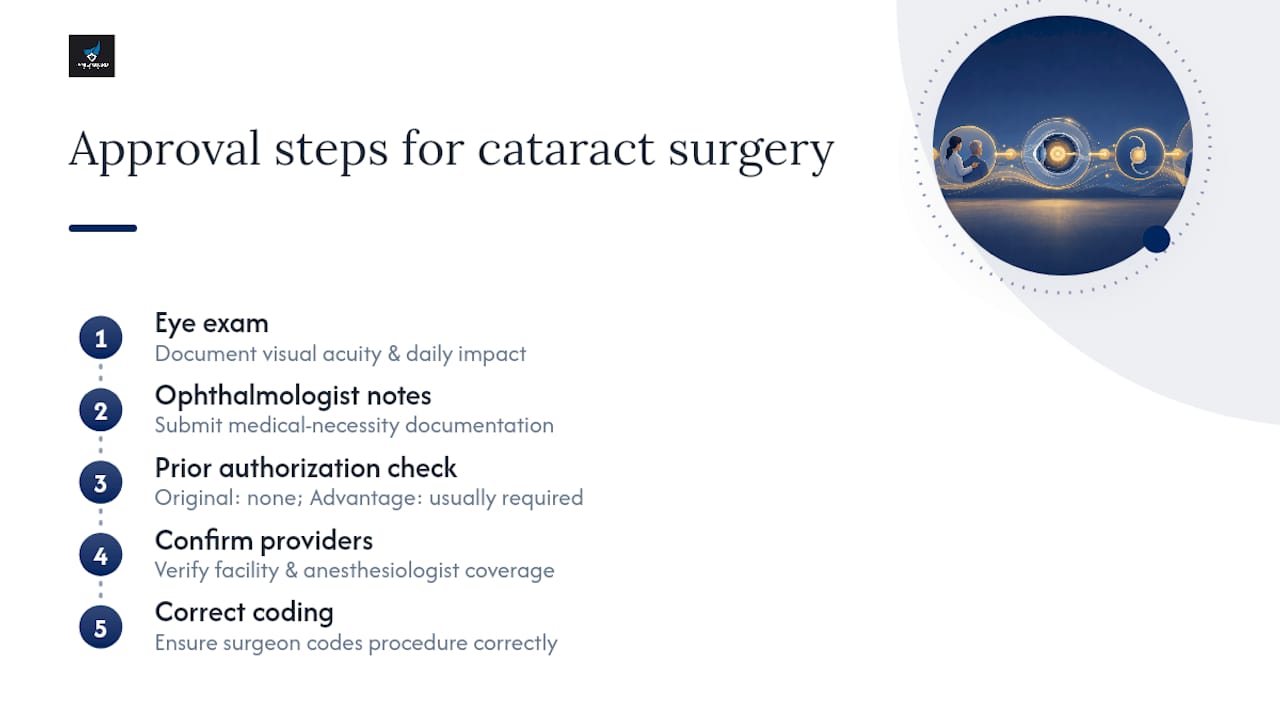
Start with an eye exam that documents how the cataract affects your vision and daily life; this becomes the foundation of medical necessity. Your ophthalmologist submits notes showing your visual acuity, how it interferes with tasks like driving or reading, and why glasses no longer solve the problem. Under Original Medicare, no prior authorization is required.
Medicare Advantage adds a checkpoint. Most Advantage plans require prior authorization before the surgery is scheduled, meaning your plan reviews the clinical documentation and issues an approval (or a denial) before you get a surgery date. Ask your plan directly whether prior authorization applies to your case, because skipping this step can mean a denied claim even when the surgery itself was clearly appropriate.
Once approved, confirm your surgical facility and anesthesiologist are also covered, since some Advantage networks approve the surgeon but not every provider involved in the procedure. Ask your surgeon's office to handle the coding correctly from the start; a routine cataract extraction coded incorrectly as a complex procedure can trigger unnecessary scrutiny or a coverage question that delays your surgery.
Is There a Cap on What You'll Pay for Cataract Care?
Original Medicare doesn't cap your out-of-pocket costs for cataract surgery the way some people assume.
That's exactly where a Medigap policy earns its premium. Without one, a bilateral cataract surgery, meaning both eyes done in separate sessions, means paying that 20% coinsurance twice.
Medicare Advantage plans work differently: most do build in an annual out-of-pocket maximum across all Part B and Part A services combined, which can offer more predictability if you hit it. But that maximum resets every year, and it covers all your medical costs for the year, not just cataract care, so a bad year for other health issues could eat into that ceiling before your cataract surgery even happens.
The eyewear benefit has its own built-in limit regardless of your plan type: one pair of standard glasses or one set of contacts per eye that receives an IOL. If you need a second cataract surgery on your other eye later, that resets the eyewear benefit for that eye specifically.
Appealing a Cataract Coverage Denial
A denial isn't the final word. Medicare and Medicare Advantage plans both have formal appeals processes, and cataract-related denials get overturned often enough that it's worth the paperwork.
Start by reading the denial notice carefully. It should cite the specific reason, whether that's insufficient documentation of medical necessity, a lens or service the plan considers noncovered, or a supplier that wasn't Medicare-enrolled. That reason determines your next move.
For Original Medicare, you'll receive a Medicare Summary Notice showing the denial, and you have 120 days from that notice to file a redetermination request with your Medicare Administrative Contractor. Ask your surgeon's office for additional documentation supporting medical necessity, particularly notes on how the cataract limited daily activities, since that's often what a first denial is missing.
For Medicare Advantage, the plan itself handles the first-level appeal, and you typically have 65 days to file after a denial notice. If that appeal fails, you can escalate to an independent review entity, and further levels exist beyond that if needed.
For eyewear-specific denials, double-check first that the supplier was Medicare-enrolled; that single detail causes more automatic denials than almost anything else in the cataract-coverage process. If your vision loss is severe enough to affect your ability to work, it may also be worth exploring whether it qualifies you for Social Security disability benefits, which follow a separate documentation process from Medicare appeals.
How Family Guard Life & Health Can Lower Your Cataract Costs
Familyguardlh is the alternative to guessing your way through Medigap plan letters alone: a licensed agency that compares your coinsurance exposure against actual plan benefits before you commit to anything. Familyguardlh works with individuals across 22 states, including Florida, Texas, Ohio, and Pennsylvania, offering Medicare supplement plans, dental, vision, and retirement income planning alongside traditional health and life insurance.

Instead of discovering your out-of-pocket exposure after the surgery is scheduled, you find out beforehand, with someone who reviews these plans for a living. If you're weighing surgery timing against your coverage, request a Medicare supplement consultation with Family Guard Life & Health and get a plan comparison specific to your state and situation.
A Licensed Agent's Take on Avoiding Cataract Surgery Surprises
The costliest mistakes with medicare cataract coverage rarely come from Medicare denying something it was always going to deny. They come from nobody checking supplier enrollment, nobody asking about prior authorization on an Advantage plan, and nobody reading the itemized estimate closely enough to spot a premium IOL upgrade buried in the paperwork.
Licensed in 22 states, I've seen how often the eyewear benefit trips people up specifically because it feels like an afterthought compared to the surgery itself. It shouldn't be. That last point alone changes the math for a lot of retirees weighing whether a Medigap premium is worth paying. If you have questions about your specific situation, reach out for a consultation.
Frequently Asked Questions
Does Medicare cover glasses after cataract surgery? Yes. Medicare Part B covers one pair of standard eyeglasses or one set of contact lenses after cataract surgery that implants an IOL, as long as you buy from a Medicare-enrolled supplier.
How does Medicare cover cataracts if I choose a premium lens? Medicare pays what a conventional IOL would cost. You're responsible for the price difference between that conventional lens and any multifocal, toric, or presbyopia-correcting lens you choose instead.
Does Medicare Advantage require prior authorization for cataract surgery? Many Medicare Advantage plans do require prior authorization before scheduling cataract surgery, and they typically require in-network surgeons and facilities. Confirm this directly with your plan before booking.
What are typical cataract treatment costs with Medicare? After your Part B deductible, you generally owe 20% of the Medicare-approved amount for the surgery and facility fee. Use Medicare's Procedure Price Lookup for a rough estimate based on your CPT code.
Can a Medigap plan eliminate my cataract surgery coinsurance?