

The Medicare Part B giveback is a premium reduction that some Medicare Advantage plans offer, and it works one of two ways: it either adds money back to your Social Security check or shaves the amount off your Part B bill if you pay it directly. It is not a check mailed to your door, and it is not available on every plan or in every ZIP code.
Here is what to do right now if you think you qualify:
- Pull up your plan's Summary of Benefits or Evidence of Coverage (EOC) and search for "Part B" or "giveback."
- Confirm your address falls inside the plan's approved service area, since availability is county specific.
- Call your plan's customer service line and ask directly whether the giveback applies to your enrollment tier.
- If you're already enrolled and don't see a change after two billing cycles, that's your cue to escalate.
Key Takeaways
The Medicare Part B giveback lowers your effective Part B cost through Social Security withholding relief or a bill credit, but availability and amount depend entirely on your specific plan and ZIP code.
| Point | Details |
|---|---|
| Not a cash payment | The giveback shows up as a higher Social Security check or a reduced Part B bill, never a direct deposit. |
| Availability varies locally | Confirm giveback offers through your plan's Evidence of Coverage, since coverage differs by county and carrier. |
| Expect a short delay | The first adjustment can take up to two months, and you're entitled to a retroactive refund if it's missed. |
| Save your documentation | Keep receipts, enrollment letters, and SSA notices in case you need to file for reimbursement. |
| Get a personalized check | Family Guard Life & Health can review plan EOCs by ZIP code and help you compare net monthly costs before you switch. |
Table of Contents
- What Is the Medicare Part B Giveback, Exactly?
- Who Qualifies for a Part B Giveback?
- How the Giveback Reduction Actually Gets Applied
- How to Get Reimbursed If You Paid the Full Premium
- Where Can You Find Plans That Offer a Part B Giveback?
- How Much Money Are We Actually Talking About?
- Is Switching for a Giveback Actually Worth It?
- Watch for Misleading Giveback Marketing
- How a Licensed Agent Can Check Your Options
- Get Help Finding a Plan With a Real Part B Giveback
- Frequently Asked Questions
- Sources
What Is the Medicare Part B Giveback, Exactly?
Private Medicare Advantage carriers receive rebate dollars from the federal government based on how efficiently they manage costs against a benchmark. Some carriers choose to return a slice of that rebate to members by covering part or all of the Part B premium, which is otherwise a cost every Medicare enrollee pays regardless of which plan they choose.
The money never touches your hands directly. If your Part B premium normally comes out of your Social Security payment, the plan reduces what's withheld and your check goes up. If you're billed separately for Part B, quarterly, the plan applies the reduction to your invoice. Either way, the benefit functions as a withholding adjustment or a bill credit, not a cash payment.
Pro Tip: Don't describe this to friends or family as "free money from Medicare." It's a premium offset built into a specific plan's design, and the amount and availability can change every year during Medicare's annual enrollment period.
Who Qualifies for a Part B Giveback?
You need two things to get this benefit: enrollment in Original Medicare (Parts A and B), and a Medicare Advantage plan in your area that has chosen to offer the giveback. That second part trips people up constantly, because not every carrier builds this into their plan design, and even carriers that do often limit it to specific counties.
A few things to keep straight before you go plan shopping:
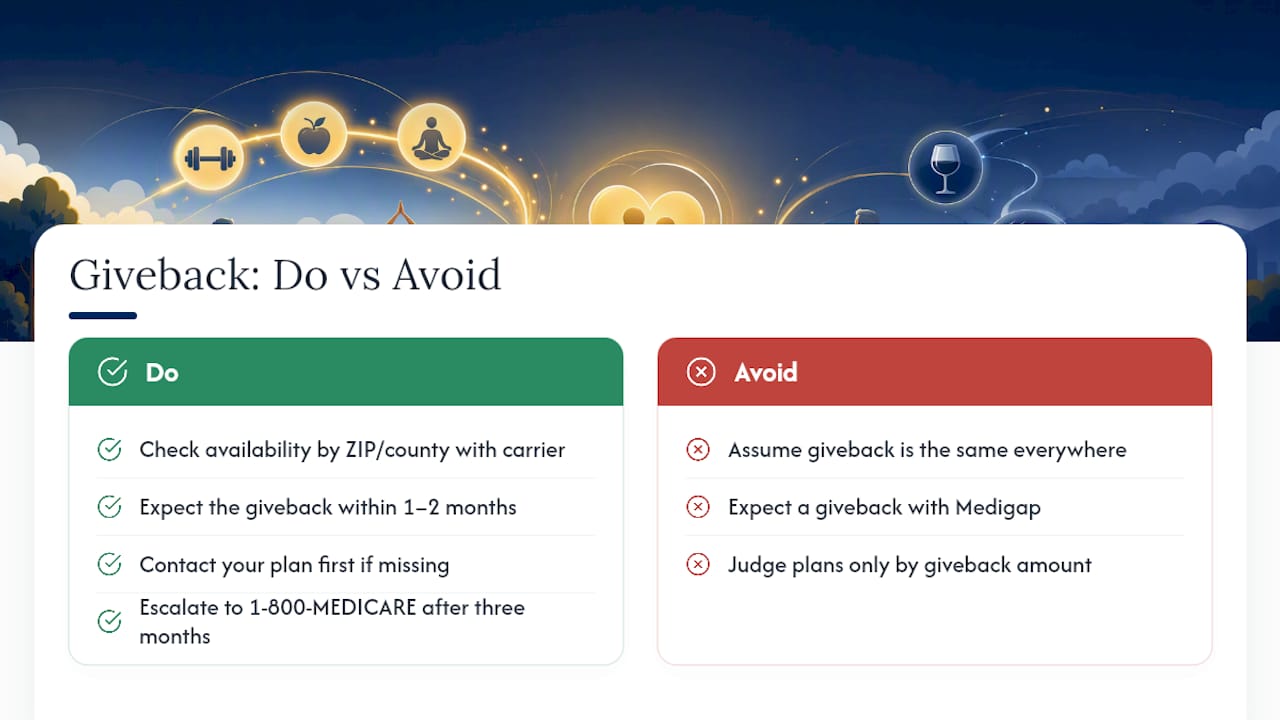
- Medigap (Medicare Supplement) plans never offer a Part B giveback. It's exclusively a Medicare Advantage feature, since Medigap works alongside Original Medicare rather than replacing it.
- If you're enrolled in a Medicare Savings Program that already covers your Part B premium through your state, a giveback plan won't add extra savings on top of that assistance.
- Whether you pay Part B through Social Security withholding or by direct bill changes which mechanism you'll see does not change your eligibility.
- Zip code matters more than almost anything else. Two neighboring counties can have completely different giveback availability.
How the Giveback Reduction Actually Gets Applied
Once you enroll in a plan offering a giveback, the adjustment lands one of two ways. Most people see it as a bump in their monthly Social Security deposit, because Social Security processes the reduced Part B withholding automatically once your plan enrollment syncs with the Social Security Administration's records. If you pay Part B directly rather than through Social Security, your plan applies the credit to your quarterly bill instead.

Timing is the part nobody warns you about. The first adjustment can take up to two months to show up after your plan's effective date, since it depends on data transfers between your carrier and Social Security. If you were shorted during that gap, you're entitled to a retroactive refund covering the missed months.
Here's a simple timeline to follow after you enroll:
- Month 0: Your plan enrollment becomes effective, and the giveback provision is active on paper.
- Month 1: Check your Social Security deposit or Part B invoice for the expected change.
- Month 2: If nothing has changed, call your plan's customer service line and ask them to check the transmission to Social Security.
One thing worth knowing: this reduction can be as small as a couple of dollars a month or, in less common cases, cover the full standard Part B premium, depending on how much rebate the carrier has to work with in your area.
How to Get Reimbursed If You Paid the Full Premium
If your giveback hasn't kicked in and you've been paying the full Part B premium out of pocket, you have a documented path to get that money back rather than just eating the loss.
- Call your plan's member services line first and confirm your giveback enrollment date and expected credit amount.
- Ask specifically for a reimbursement or claim form if you paid a bill directly during the gap.
- Gather every receipt, Social Security notice, and enrollment confirmation letter tied to the overpayment period.
- Submit the documentation exactly as instructed, keeping copies of everything you send.
- Follow up in writing if you haven't heard back within a few weeks.
Keep these on hand before you make that first call:
- Original payment receipts or bank statements showing the Part B charge
- Your plan's Evidence of Coverage document
- Any Social Security benefit verification letters
- Your Medicare Advantage enrollment confirmation
Refunds typically process within a few months once your documentation is complete. CMS guidance instructs plans to reimburse overpayments for covered costs once a claim is properly submitted. If three months pass with no resolution, escalate to 1-800-MEDICARE rather than continuing to wait on the plan alone.
Where Can You Find Plans That Offer a Part B Giveback?
The most reliable starting point is Medicare's official Plan Finder tool, where you can filter available Medicare Advantage plans by your exact ZIP code and review each plan's premium structure side by side.
Follow this sequence when you're comparing options:
- Enter your ZIP code into Plan Finder and pull up every Medicare Advantage plan serving your county.
- Open each plan's Summary of Benefits and search for "Part B premium reduction" or "giveback."
- Cross-check anything promising against the plan's full Evidence of Coverage, since summary documents sometimes simplify details.
- Call the carrier directly, or contact a licensed agent, to confirm the giveback applies to your specific enrollment category rather than just a subset of members.
Pro Tip: Some plans advertise a giveback amount that only applies to certain plan tiers within their portfolio. Always ask the agent or representative to confirm the number applies to the exact plan you're comparing, not a different plan from the same carrier.
How Much Money Are We Actually Talking About?
Giveback amounts range widely, from a few cents a month up to, in rare cases, the entire standard Part B premium. Most fall somewhere in between, and the amount depends entirely on how large a rebate the carrier has to distribute in your specific service area.
Consider three scenarios against the standard Part B premium that Medicare sets each year:
- Small giveback: A $5 monthly reduction means your Social Security check rises by roughly that amount, or your quarterly Part B bill drops by about $15.
- Mid-range giveback: A $25 monthly reduction adds up to $300 a year back in your pocket, whether through withholding or bill credits.
- Large giveback: In select markets, some plans cover close to the full Part B premium, which produces the biggest visible jump in a Social Security deposit.
CMS has projected Medicare Advantage enrollment and program stability to remain steady, but rebate amounts, and therefore giveback sizes, shift plan by plan every year based on each carrier's cost performance.
Is Switching for a Giveback Actually Worth It?
A lower Part B cost feels good on paper, but it's only one line item in a much bigger equation. The real question is whether your total monthly cost, including plan premium, drug coverage, and provider access, comes out ahead once you factor in the giveback.
What makes it worth considering:
- A genuine reduction in your visible monthly cost
- Often bundled with extra benefits like dental, vision, or fitness perks funded by the same rebate pool
What can offset the savings:
- Narrower provider networks that might exclude your current doctors
- Different drug formularies that could raise your prescription costs
- Changes to prior authorization rules or your annual out-of-pocket maximum
Before switching, answer these five questions: What's your net monthly cost after the giveback? Are your current doctors in network? Are your prescriptions covered at a similar cost? What's the plan's out-of-pocket maximum? And does the Evidence of Coverage confirm the giveback applies to your specific situation? A $5 giveback that forces you out of network with your cardiologist is rarely a good trade. A $40 giveback on a plan that keeps your same doctors and adds dental coverage usually is.
Watch for Misleading Giveback Marketing
Carriers know the word "giveback" sells, and some advertisements lean on that appeal harder than the fine print supports. Federal rules govern how Medicare Advantage plans can communicate benefits to enrollees, but marketing materials still oversimplify things regularly.
Red flags worth taking seriously:
- Any suggestion that you'll receive a literal cash payment rather than a premium adjustment
- High-pressure enrollment tactics tied to a giveback deadline that doesn't match the actual Medicare enrollment period
- Vague language that doesn't specify whether the reduction applies to Social Security withholding, direct billing, or both
If something doesn't add up, verify it against the plan's actual EOC rather than the advertisement. For unresolved questions or complaints, your state's SHIP (State Health Insurance Assistance Program), Medicare.gov, or 1-800-MEDICARE are your official channels.
How a Licensed Agent Can Check Your Options
Shereka, a licensed agent with Family Guard Life & Health, works across 22 states and can pull up plan EOCs to confirm giveback availability by your exact ZIP code before you commit to anything.
What that support looks like in practice:
- Comparing net monthly cost across multiple plans, not just the advertised giveback number
- Reviewing the Evidence of Coverage line by line for eligibility restrictions
- Assisting with enrollment paperwork
- Following up if a refund or Social Security adjustment gets delayed past expectation
A Quick Note on What Actually Matters Here
Most people fixate on the giveback dollar amount and skip the harder question: does the rest of the plan still work for your life? Check your net savings, confirm your doctors and prescriptions are covered, and only then decide if switching makes sense. If you want a second set of eyes on the math, a licensed agent or Medicare's Plan Finder can walk through it with you.
Get Help Finding a Plan With a Real Part B Giveback
Comparing giveback amounts across a dozen Medicare Advantage plans while also checking networks, drug formularies, and out-of-pocket maximums is a lot to do alone, especially when marketing materials oversimplify the details. Family Guard Life & Health reviews the actual Evidence of Coverage for plans in your area instead of relying on advertised numbers, so you know the real net cost before you enroll.

Shereka and the Family Guard Life & Health team serve Medicare beneficiaries across 22 states, including Arizona, Florida, Georgia, Michigan, North Carolina, Ohio, Pennsylvania, Texas, and Virginia, and can check giveback availability by your ZIP code, compare plan tradeoffs side by side, and help you enroll once you've found the right fit. If you're ready to see what's actually available where you live, reach out to Family Guard Life & Health to schedule a plan review.
Frequently Asked Questions
Is the Medicare Part B giveback the same in every state? No. Giveback availability and amount depend on each Medicare Advantage carrier's rebate in a given county, so two nearby ZIP codes can have very different offers.
Can I get a Part B giveback with a Medigap plan? No. The giveback is exclusive to Medicare Advantage plans and isn't available through Medigap (Medicare Supplement) coverage.
How long does it take to see the giveback on my Social Security check? Typically one to two months after your plan's effective date. If it hasn't appeared by then, contact your plan and request a retroactive adjustment.
What should I do if my plan never applies the giveback? Contact your plan's customer service first, then escalate to 1-800-MEDICARE if the issue isn't resolved within about three months.
Does a bigger giveback always mean a better plan? Not necessarily. A larger giveback paired with a restrictive network or higher drug costs can leave you worse off than a smaller giveback on a plan that fits your care needs.
This article is general information, not a substitute for advice from a qualified financial advisor. Consult a qualified financial professional about your own circumstances before acting on anything here.
Sources
- Medicare Give Back Benefit: Definition, Eligibility, and More — Healthline
- Partner Tip Sheet - 11246-P 8-26-11.qxp — CMS
- My Social Security — SSA
- Medicare
- What is the Medicare Part B Give Back Benefit? — Medical News Today