

A QLAC lets you shift up to $210,000 of pre-tax retirement savings out of your required minimum distribution calculations and convert it into guaranteed income starting as late as age 85. It works well if you don't need those RMD dollars now and want insurance against outliving your money. The trade-off: the funds are locked up, and most contracts leave little or nothing for heirs if you die before payments start.
TL;DR:
- QLACs can reduce required minimum distributions by up to $210,000, lowering annual RMDs and associated taxes across the lifespan until payments start.
- They are only fundable from qualified pre-tax accounts like traditional IRAs, 401(k)s, 403(b)s, or 457(b)s, with a recent flat cap of $210,000 that adjusts for inflation.
- Buyers should verify start-date flexibility, death benefit options, cost-of-living adjustments, and insurer ratings before purchasing.
- A QLAC's fixed payments are vulnerable to inflation erosion and insurer credit risk, and they lock up funds for a decade or more with limited access to principal.
- Combining a QLAC with other income sources and profession modeling helps ensure it fits into an overall retirement strategy and legacy priorities.
Table of Contents
- What Is a QLAC for Retirees, and Who Can Fund One?
- How Does a QLAC Change Your RMDs and Taxes?
- Pros, Cons, and a Suitability Checklist for QLACs
- How to Buy a QLAC: A Step-by-Step Checklist
- Worked Examples: Comparing Deferral Ages and RMD Effects
- How an Advisor Evaluates a QLAC for a Client
- Death Benefit Basics and Beneficiary Considerations
- Where Does a QLAC Fit in Your Overall Retirement Income Plan?
- How Do QLACs Compare to Other Longevity Insurance Options?
- Risks and Drawbacks People Don't Talk About
- Do QLACs Affect Medicaid or Supplemental Security Income Eligibility?
- What I Tell Clients Considering a QLAC
- How Family Guard Life and Health Helps You Model a QLAC
- Sources
- FAQ
What Is a QLAC for Retirees, and Who Can Fund One?
A Qualified Longevity Annuity Contract is a deferred income annuity purchased inside a qualified retirement account. You hand an insurer a lump sum now, and in exchange, the insurer promises to pay you a fixed monthly income starting at a future date you choose, no later than age 85. The mechanism that makes it valuable for tax planning is simple: the premium you pay comes out of the account balance used to calculate your required minimum distributions until the payments actually begin.
Not every retirement account qualifies. You can fund a QLAC from:
- A traditional IRA or rollover IRA
- A 401(k) plan, if the plan sponsor allows it
- A 403(b) plan
- A governmental 457(b) plan
Roth IRAs and regular taxable brokerage accounts are off the table. Roth accounts already skip RMDs, so there's nothing to shape, and a QLAC only exists as a feature of qualified pre-tax money.
The IRS attaches real strings to these contracts. Insurers must file Form 1098-Q every year a QLAC is outstanding, reporting the premium paid and the contract's status. The contract itself can't offer a cash surrender value beyond narrow exceptions, can't be commuted for a lump sum once payments start, and must begin distributions by the month after you turn 85. If you exchange another insurance contract for a QLAC, the fair market value of that exchanged contract counts toward your premium limit, not just any cash you put in.
Before signing anything, verify:
- The exact income start date and whether it can be changed
- Whether a death benefit rider is included or optional
- Cost-of-living adjustment options, if any
- The insurer's cancellation and free-look terms
Read the contract's own definitions section closely. Some issuers bury the death-benefit language in a way that surprises buyers later.
How Does a QLAC Change Your RMDs and Taxes?
The RMD math is where a QLAC earns its keep. Once you buy one, the premium you paid gets carved out of your year-end account balance for every year the contract sits in deferral. If you have a $1 million IRA and put a large portion into a QLAC, your RMD for that year gets calculated on the reduced account balance excluding the QLAC premium. That's a real, immediate reduction in the income the IRS forces you to withdraw and pay tax on, and it persists every year until the QLAC starts paying out.
The current dollar limit is set by the IRS and adjusts for inflation, recently around a bit over $200,000. SECURE 2.0 replaced the old rule that capped QLAC premiums at 25% of your account balance, and now sets a flat lifetime dollar cap that adjusts for inflation in $10,000 increments. For 2026, that cap sits at $210,000 per person. Now the ceiling is the same dollar figure regardless of account size, which opened QLACs up to smaller savers who were previously locked out.
One point trips people up constantly: a QLAC is not a tax dodge. It's a tax deferral tool. Every dollar that eventually comes out gets taxed as ordinary income the year you receive it, exactly like any other IRA withdrawal. You're not avoiding tax, you're moving when you pay it.
That timing shift is where the real planning value shows up:
- Roth conversion window. The years between buying a QLAC and its payments starting often become your lowest-taxable-income years in retirement, ideal for converting other IRA balances to Roth at a lower bracket.
- IRMAA management. Lower reported income during deferral can help keep you under Medicare's income thresholds that trigger higher Part B and Part D premiums.
- Bracket smoothing. Delaying a chunk of taxable income to your mid-80s can spread out your lifetime tax bill instead of stacking it all in your 70s when RMDs from everything else are already climbing.
Pros, Cons, and a Suitability Checklist for QLACs
The case for a QLAC rests on three things: it hedges against outliving your money, it lowers your taxable RMDs while deferred, and it gives you a fixed, predictable paycheck starting exactly when you choose. Insurers can offer surprisingly strong monthly payouts at older start ages precisely because they're pooling longevity risk across everyone who buys in, including the people who don't live long enough to collect much.
The downsides are just as concrete. Your money is locked up, often for over a decade, with no access to principal outside limited exceptions. Inflation will erode the buying power of a fixed monthly payment unless you pay extra for a cost-of-living rider. If you die before income starts and skipped the death benefit rider, your heirs may see little to nothing from that premium. And you're taking on insurer credit risk. State guaranty associations offer a backstop, but coverage limits vary by state and may not fully protect a large contract.
Pro Tip: Split a large QLAC purchase across two insurers if you're near your state's guaranty association coverage limit. It costs a little in convenience but meaningfully reduces single-carrier exposure.
Run through this before you call an agent:
- Liquidity check. Do you have at least three to five years of living expenses in accessible accounts outside this purchase?
- Other income sources. Do you already have Social Security, a pension, or other guaranteed income covering your baseline needs?
- Account size. Is your qualified account large enough that RMDs are becoming a genuine tax burden, not just an annoyance?
- Health and family longevity. Do you have reasonable expectation of living well into your 80s and beyond?
- Legacy priorities. Are you comfortable directing money toward your own longevity insurance instead of leaving it to heirs?
Three situations that almost always rule a QLAC out: you have a shortened life expectancy due to serious illness, you'll need access to this specific money for care costs within the next decade, or leaving a maximized inheritance is your top financial priority.
How to Buy a QLAC: A Step-by-Step Checklist
Buying a QLAC involves more paperwork than opening a savings account, and the order of operations matters. Skip a step and you can end up with a contract that doesn't do what you expected.
Start by confirming your plan or custodian actually permits QLACs. Not every 401(k) plan sponsor offers this option, and even IRA custodians vary in how smoothly they process the transfer. Call your plan administrator or custodian first, before you fall in love with a particular insurer's quote.
- Ask your custodian directly whether QLAC purchases are supported and what paperwork they require on their end
- Request payout illustrations from at least two or three insurers for different start ages (75, 80, and 85 are common benchmarks)
- Ask specifically about riders: cost-of-living adjustments, cash refund features, and joint-life options for a spouse
- Check the insurer's financial strength rating and confirm your state's guaranty association coverage limit
- Complete the transfer through your custodian, review the contract during the free-look period, and keep every document for tax season
| Step | What to request | Why it matters |
|---|---|---|
| Confirm eligibility | Written confirmation from custodian/plan | Some plans exclude QLACs entirely |
| Compare illustrations | Payout quotes at 3 start ages | Rates shift daily and by issuer |
| Check the carrier | Financial strength rating, guaranty limit | Protects against insurer default |
| Finalize purchase | Signed contract, free-look terms | You typically get about 10 days to cancel |
| File taxes correctly | Form 1098-Q from issuer | Confirms premium and RMD exclusion |
Keep a folder with the contract, the illustration you were quoted, and every 1098-Q the insurer sends. Your tax preparer will need that documentation for as long as the QLAC sits in deferral.
Worked Examples: Comparing Deferral Ages and RMD Effects
Numbers make this concrete faster than any explanation. Here are two simplified illustrations using round figures, not actual insurer quotes.
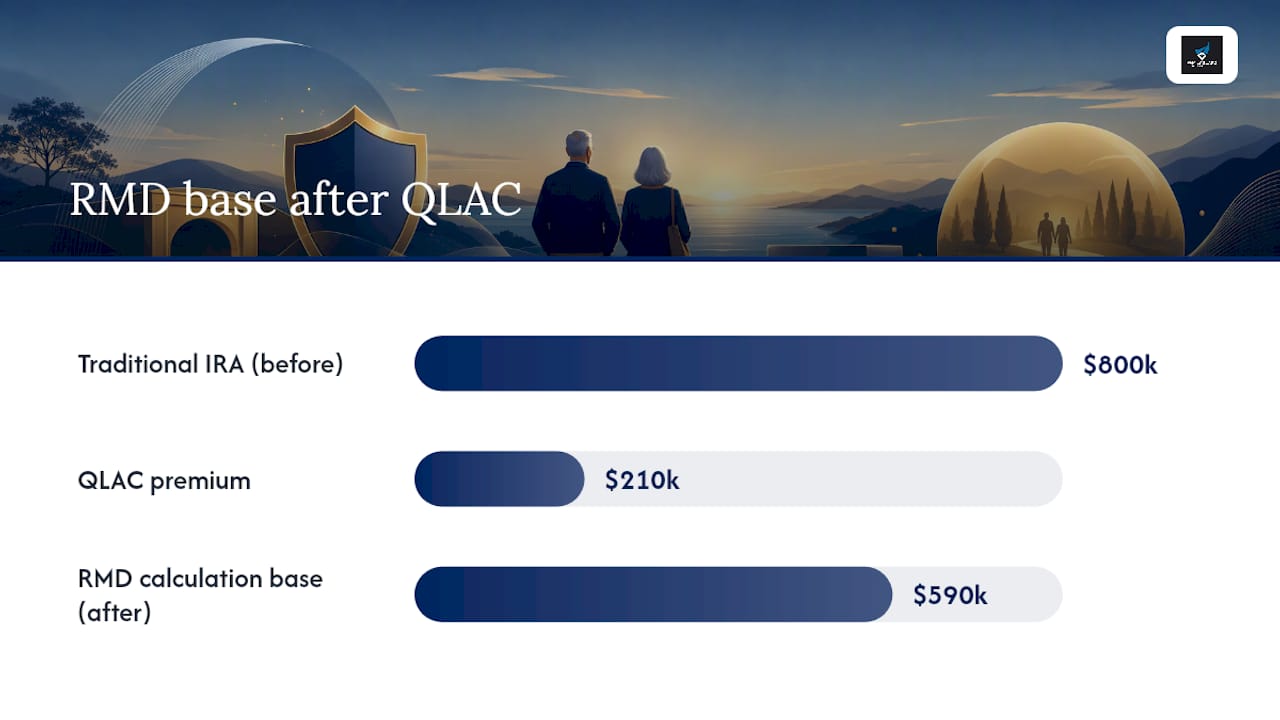
Example A: RMD reduction. Say you have an $800,000 traditional IRA and buy a QLAC at the 2026 limit of $210,000. Your RMD calculation base drops from $800,000 to $590,000 for every year the QLAC stays in deferral.
Example B: start-age comparison. A $210,000 QLAC purchased at age 70 will pay meaningfully more per year if you delay income to 85 instead of 80, because the insurer is spreading the payout pool over fewer expected years and pooling mortality risk more heavily among older buyers. Delaying five extra years commonly increases the annual payout by a substantial margin, though the exact percentage varies by issuer and current rates.
Both examples use rounded assumptions for illustration. Actual insurer quotes shift daily based on interest rates, your age, and gender, so request a real illustration before deciding anything.
How an Advisor Evaluates a QLAC for a Client
Family Guard Life and Health is licensed across 22 states, and QLAC conversations follow a consistent process regardless of where a client lives. The first step is always documentation, not a product pitch: current IRA and 401(k) statements, existing income sources, and a rough sketch of expected expenses in the client's 80s.
From there, the process typically runs through:
- Modeling current and projected RMDs with and without a QLAC purchase at different premium amounts
- Running payout simulations across multiple start ages (75, 80, 85) using current insurer illustrations
- Stress-testing the scenario against inflation and a spouse's potential survivorship needs
- Comparing the QLAC option against alternatives, including an annuity ladder built outside a qualified account, a standalone deferred income annuity, or simply keeping the money liquid and accepting the RMD tax hit
Clients considering long-term care costs sometimes find a QLAC competes directly with other long-term care funding strategies, which is worth working through before locking funds away. For a meeting to be useful, bring your most recent account statements, a list of other guaranteed income sources, and an honest read on your own health and family longevity.
Death Benefit Basics and Beneficiary Considerations
The default QLAC contract is built around your own income, not your heirs. If you die before your income start date and never added a death benefit rider, the insurer typically keeps the remaining premium. This is the single most misunderstood feature of these contracts, and it catches people off guard during the buying process.
Two riders address this gap. A return-of-premium rider guarantees that if you die before receiving payments equal to what you paid in, your beneficiary gets the difference back. A cash refund feature works similarly but can apply even after payments have started. Both riders reduce your monthly payout in exchange for that protection, so there's a direct trade-off between maximizing income and protecting a legacy.
If you die after payments start, most contracts simply stop paying, unless you selected a joint-life option covering a spouse or a period-certain guarantee. A joint-life QLAC pays a reduced amount but continues for as long as either spouse is alive, which matters enormously for couples where one partner has little other guaranteed income.
None of this happens automatically. You choose these features at purchase, and they cannot be added later. If leaving something to children or grandchildren matters to you, that decision belongs at the top of your conversation with the insurer, not an afterthought once the contract is signed. Retirees weighing legacy priorities against guaranteed income sometimes look at survivorship life insurance as a separate way to protect an inheritance while still buying the QLAC for its income and RMD benefits.
Where Does a QLAC Fit in Your Overall Retirement Income Plan?
A QLAC works best as one piece of a layered income strategy, not a replacement for the rest of your plan. Think of your retirement income in tiers: Social Security and any pension cover baseline survival expenses, a QLAC covers the risk of running out of money in your later years, and your remaining liquid portfolio, bonds, and other annuities handle everything in between.

The sequencing question matters. Most retirees draw down other assets first, in their 60s and early 70s, while the QLAC sits deferred and quietly shrinking their RMD base. By the time the QLAC starts paying, other income sources may have declined or portfolio balances thinned, so the QLAC arrives right when it's needed most.
Coordinating a QLAC with other income sources also means checking your overall asset allocation. If a QLAC premium comes out of a portfolio that was mostly bonds anyway, you haven't given up much growth potential. If it comes out of a growth-oriented allocation, you're trading some upside for certainty. Retirees comparing that trade-off often find it useful to look at how annuities stack up against a traditional bond allocation before committing a large premium.
How Do QLACs Compare to Other Longevity Insurance Options?
A QLAC is one specific flavor of a broader category called deferred income annuities, and the distinction matters. Any deferred income annuity, QLAC or not, lets you pay a premium now for guaranteed income later. What makes a QLAC different is purely tax treatment: it must live inside a qualified account, follow the IRS's contract rules, and stay under the current $210,000 lifetime cap.
You can buy a deferred income annuity outside a qualified account, using taxable savings, with no dollar cap and no requirement to start income by 85. The trade-off is that you lose the RMD-shaping benefit entirely, since money outside a qualified account was never subject to RMDs in the first place, and taxation of the eventual payments works differently.
Some retirees also compare QLACs to a simple annuity ladder, buying several smaller immediate or deferred annuities at staggered dates instead of one large QLAC. A ladder offers more flexibility and diversifies insurer risk across several carriers, but it typically doesn't carry the RMD exclusion. The right choice depends on whether the tax deferral benefit outweighs the flexibility you give up, and that's a math problem worth running with actual numbers rather than guessing.
Risks and Drawbacks People Don't Talk About
Most QLAC coverage focuses on the obvious trade-offs: illiquidity, inflation, and insurer risk. A few less obvious risks deserve equal attention.
Tax law is not fixed in stone. A future Congress could change how these payments are taxed, adjust the age-85 requirement, or alter the inflation indexing formula. You're locking in a contract structure today based on today's rules, and the tax treatment of your eventual payments 10 or 15 years from now depends on laws that don't exist yet.
There's also a subtler risk in how insurers price these contracts. Payout rates depend heavily on current interest rates and mortality tables at the time you buy. If you purchase during a low-rate environment, you're locked into that pricing for the life of the contract, even if rates rise significantly afterward. There's no refinancing a QLAC.
Finally, consider opportunity cost carefully. Money that goes into a QLAC stops participating in market growth entirely. Over a 10 to 15 year deferral period, a diversified portfolio has historically outpaced a fixed annuity's implied return in many stretches, though obviously not in every stretch. You're buying certainty, and certainty has a price, even when the RMD tax savings are real.
Do QLACs Affect Medicaid or Supplemental Security Income Eligibility?
This is a legitimate concern and the answer depends heavily on the specific program and your state. For Medicaid long-term care eligibility, rules around annuities, including QLACs, vary considerably by state, and many states apply specific "look-back" and actuarial-soundness requirements to annuity purchases made in the years before applying for benefits. A QLAC's illiquidity and irrevocability could work for or against you depending on how your state treats deferred annuity contracts in its asset tests, so this is not a do-it-yourself calculation.
For Supplemental Security Income (SSI), the program has strict asset limits, and how an annuity is counted depends on whether it's considered an available resource or an income stream once payments begin. A QLAC that hasn't started paying yet may be treated differently than one currently distributing income.
Because these rules are state-specific and change periodically, anyone considering Medicaid or SSI eligibility alongside a QLAC purchase should talk to an elder law attorney or benefits specialist before signing a contract, not after. This is one area where a generic article, including this one, cannot substitute for personalized legal guidance tied to your specific state and circumstances.
What I Tell Clients Considering a QLAC
I tell clients a QLAC earns its place when three things line up: you don't need the money for near-term spending, your RMDs are becoming a real tax problem, and you want a guaranteed paycheck that outlasts your own uncertainty about how long you'll live. The one caveat I repeat every time: don't fund a QLAC with money you might need for a legacy or an emergency, because once it's in, it's in. If the math and your comfort level both check out, model the actual numbers with an advisor before you commit a dollar.
— Shereka
How Family Guard Life and Health Helps You Model a QLAC
Family Guard Life and Health is the retirement income specialist alternative to guessing your way through QLAC math on a spreadsheet. Where a generic online calculator gives you a single number, our retirement income planning service models your actual RMD trajectory, compares payout illustrations across multiple insurers, and checks carrier financial strength before you commit a dollar.

That process runs the same way across every state we're licensed in: gather your account statements, model your RMD schedule with and without a QLAC, compare start-age scenarios side by side, and handle the custodian paperwork and Form 1098-Q documentation once you decide. We also look at how a QLAC interacts with life insurance, Medicare Supplement coverage, and other pieces of your retirement plan, since these decisions rarely happen in isolation. If you want a real answer instead of a guess, start a retirement income planning conversation with our team today.
Sources
Rules around QLACs come from the IRS and get interpreted by insurers and financial publishers, so it pays to check the primary sources directly.
- Instructions for Form 1098-Q (Rev. April 2025)
- QLACs: A way to secure retirement income later in life | Fidelity
- Annuity
This article is general information, not a substitute for advice from a qualified financial advisor. Consult a qualified financial professional about your own circumstances before acting on anything here.
FAQ
What Are the Downsides of a QLAC?
The biggest downsides are illiquidity, since your premium is locked up until income starts, and limited death benefits, since heirs typically get nothing if you die before payments begin without a rider. Inflation risk and insurer credit risk round out the main concerns.
What Is the Best Age to Buy a QLAC?
Most buyers purchase in their mid-60s to early 70s, while choosing an income start date anywhere up to age 85. The best combination depends on your other income, health, and how much RMD relief you need in the meantime.
Where Can I Purchase a QLAC?
You can buy a QLAC through an insurance company, a licensed agent or broker, or in some cases directly through your IRA custodian if they support these contracts. Family Guard Life and Health helps clients compare insurer illustrations and handle the purchase process across its licensed states.
Does Vanguard Offer a QLAC?
Large brokerage custodians vary in whether they directly issue or facilitate QLAC purchases, and availability changes over time, so check directly with your specific custodian. Regardless of custodian, the QLAC itself is always issued by an insurance company, not the brokerage holding your IRA.
What Happens to a QLAC if I Die Before Payments Start?
Without an optional death benefit rider, the insurer generally keeps the remaining premium if you die before your income start date. Adding a return-of-premium or cash refund rider protects your beneficiary but reduces your monthly payout.