

A guaranteed lifetime income annuity converts part of your savings into a dependable paycheck for life, structured to keep paying no matter how long you live. It works best for retirees who need to cover essential expenses that Social Security alone won't stretch to meet. Licensed agents can help retirees compare these contracts against real payout numbers instead of guesswork.
TL;DR:
- The payout from a $100,000 principal for a single-life immediate annuity around age 65 typically ranges from $500 to $700 monthly, increasing with deferred start dates and higher ages.
- Adding inflation riders like COLA can reduce initial payouts by 20% or more, so comparing quotes with and without such riders helps assess inflation protection costs.
- The financial strength rating of the insurer and state guaranty limits directly influence the guarantee’s reliability, making carrier evaluation essential before purchase.
- A portion of the payout may be taxable based on your funding source, and certain riders or beneficiaries can affect the amount passing to heirs upon death.
- Proper sizing of the annuity to cover only essential expenses preserves flexibility and mitigates risks like inflation erosion and liquidity loss over time.
Table of Contents
- What Is a Guaranteed Lifetime Income Annuity?
- Types, Riders, and Trade-offs Worth Weighing
- How Much Does a Guaranteed Lifetime Income Annuity Pay?
- Is a Lifetime Income Annuity a Good Fit for Your Retirement Plan?
- How Are Annuity Payments Taxed, and What Happens to Beneficiaries?
- What Questions Should You Ask Before Buying an Annuity?
- What Backs the "Guaranteed" Part of a Lifetime Income Annuity?
- How We Help Clients Compare Guaranteed Income Options
- Family Guard Life and Health: Get a Personalized Quote
- Where to Verify the Numbers Yourself
- Why Most Annuity Advice Misses the Point
- Sources
What Is a Guaranteed Lifetime Income Annuity?
A guaranteed lifetime income annuity is an insurance contract, not an investment fund. You hand a lump sum to an insurance carrier, and in return, the carrier commits to sending you payments for as long as you live, regardless of how markets perform or how long you end up living. This is the standard industry term for what's often marketed loosely as a "pension alternative" or "secure retirement fund." The mechanics differ depending on when payments start.
Immediate annuities (SPIAs) begin paying within about a year of purchase. You hand over the lump sum, and the checks start almost right away. Retirees who are already drawing down savings and want to lock in income now typically choose this route.
Deferred income annuities (DIAs), including Qualified Longevity Annuity Contracts (QLACs), delay payments to a future date, often five, ten, or more years out. Because the insurer holds your money longer before paying anything back, deferred contracts usually generate a larger monthly payout per dollar invested than an immediate annuity would.
Payout size depends on several moving pieces:
- Single life vs. joint and survivor: A single-life payout stops at your death and pays more each month. A joint-and-survivor option continues paying a spouse after you're gone, which lowers the monthly amount since the insurer expects to pay out over two lifetimes.
- Start date: The longer you defer, the higher the eventual payment, because the insurer has fewer years left to pay once income begins.
- Age at purchase: Older buyers get higher monthly payments per dollar, since the insurer expects a shorter payout period.
- Riders attached: Adding features like inflation adjustments or death benefits reduces the base payout in exchange for added protection.
Payments typically arrive monthly, though some contracts offer quarterly or annual options.
Types, Riders, and Trade-offs Worth Weighing
Four main annuity structures dominate the U.S. market, and each trades predictability for a different kind of flexibility.
- Fixed annuities pay a set amount on a set schedule. No surprises, no upside, no downside.
- Variable annuities tie payments to the performance of underlying investment subaccounts, so income can rise or fall with the market.
- Indexed annuities credit interest based on a market index like the S&P 500, usually with a cap on gains and a floor against losses.
- Hybrid annuities blend guaranteed income features with investment components, often through riders layered onto a variable or indexed base.
Riders are optional add-ons that reshape the contract's behavior, and each one comes at a cost:
- Cost-of-living adjustment (COLA) riders increase payments annually to offset inflation, but they can reduce your starting payout by 20% or more compared to a level payment structure.
- Return-of-premium riders guarantee your heirs get back any premium not yet paid out as income, at the cost of a lower monthly check.
- Period-certain riders guarantee payments for a minimum number of years even if you die early, protecting against the "died too soon and lost it all" scenario.
Pro Tip: Run two quotes side by side, one with a COLA rider and one without. The gap tells you exactly what inflation protection is costing you in real dollars, which makes it easier to decide if it's worth it for your situation.
How Much Does a Guaranteed Lifetime Income Annuity Pay?
Payout quotes swing based on six inputs: your principal amount, your age, whether you choose single or joint life, your income start date, any riders attached, and current interest rates at the time of purchase. Insurers reprice offers regularly as rates shift, which is why two quotes requested a month apart can look different even with identical inputs.
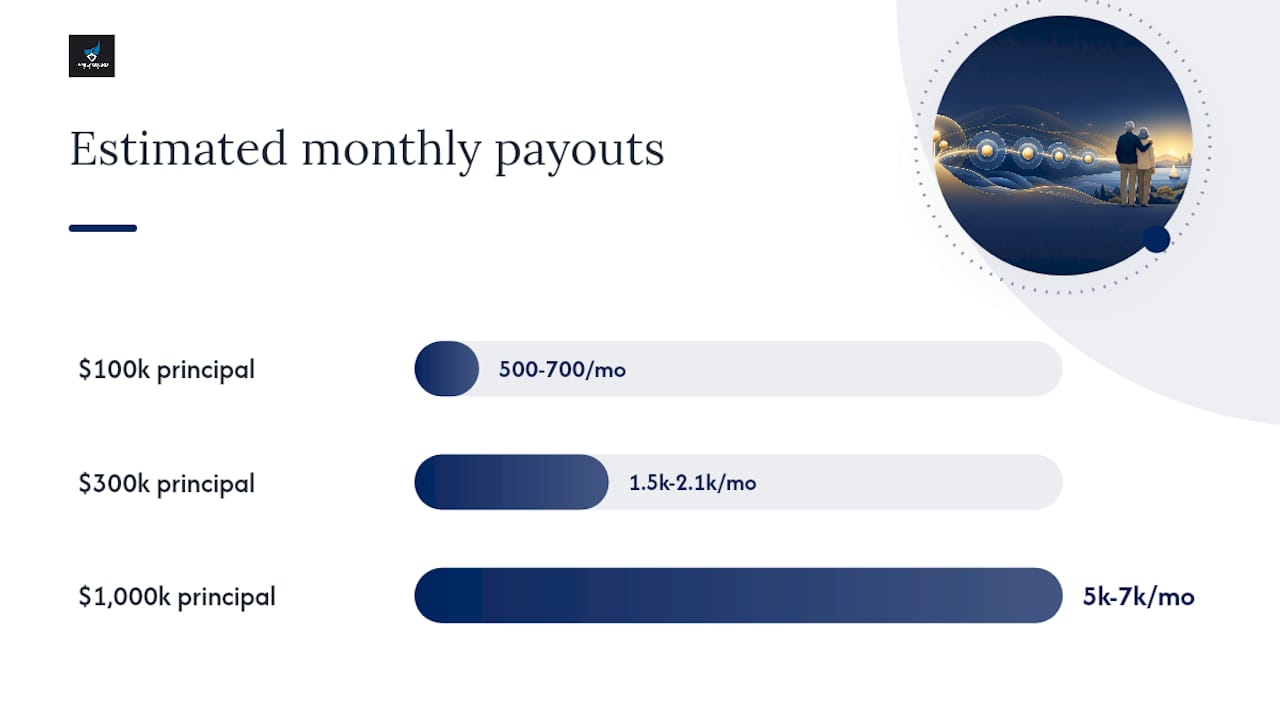
Annuity for common principal amounts, and they're a useful starting point for ballpark planning. As a rough guide for a single-life immediate annuity purchased around age 65:
- A $100,000 principal might generate roughly $500 to $700 per month.
- A $300,000 principal scales up proportionally, landing somewhere near $1,500 to $2,100 per month.
- A $1,000,000 principal could produce something in the range of $5,000 to $7,000 monthly.
These are illustrative only. Joint-life elections, deferred start dates, and rider selections all shift the numbers, sometimes substantially.
Fidelity's guaranteed income estimator lets you plug in your own numbers and see live illustrations, and it's worth running before you talk to any agent. Live carrier quotes account for underwriting and the exact rate environment on the day you apply, so treat online estimators as a planning tool rather than a locked-in number. When you sit down with an agent, ask them to walk through exactly why their quote differs from what the calculator showed you, and have them isolate which input, rate, age calculation, or rider pricing, is driving the gap.
Is a Lifetime Income Annuity a Good Fit for Your Retirement Plan?
Guaranteed income earns its place in a retirement plan when it closes a specific gap, not because it sounds safe in the abstract. Vanguard's retirement income research recommends covering essential expenses, housing, food, insurance premiums, with guaranteed sources like Social Security, a pension, or an annuity, specifically to reduce the risk of outliving your money.
The upside can be significant. BlackRock's lifecycle-model analysis found that adding guaranteed lifetime income, paired with an adjusted portfolio allocation, increased annual spending capacity substantially and cut downside portfolio risk notably. The logic is simple: once your basics are covered by a guaranteed check, the rest of your portfolio can afford to take on more growth-oriented risk.
The downsides are just as real:
- Liquidity loss. Once you annuitize, that lump sum is generally locked in. Emergency access is limited or comes with penalties.
- Fees and commissions are built into the pricing, though they're not itemized as a separate line the way a mutual fund expense ratio is.
- Inflation erosion hits hard on level-payment contracts without a COLA rider. A fixed $2,000 monthly check today buys noticeably less in fifteen years.
Good candidates tend to be retirees with a clear gap between guaranteed income and essential monthly expenses, plus family longevity on their side.
How Are Annuity Payments Taxed, and What Happens to Beneficiaries?
Tax treatment hinges on how the annuity was funded. Qualified annuities, purchased with pretax dollars inside an IRA or 401(k), are fully taxable as ordinary income when distributed. Nonqualified annuities, funded with after-tax savings, are taxed only on the earnings portion, using an exclusion ratio that spreads your original contribution back to you tax free over time.
Death benefits depend on the riders you selected at purchase:
- A return-of-premium rider ensures any unpaid principal passes to your named beneficiary.
- A period-certain rider guarantees remaining scheduled payments continue to a beneficiary if you die before the term ends.
- Without either rider, a straight single-life annuity typically stops paying entirely at death, with nothing passed on.
Annuity income also counts toward the income thresholds used for Medicare's income-related monthly adjustment, so a large payout increase can, in some cases, nudge premiums higher. It's worth mapping this out with an advisor before finalizing a purchase amount.
What Questions Should You Ask Before Buying an Annuity?
Work through this checklist before signing anything:
- Define the purpose first. Are you covering a specific expense gap, or just looking for general income diversification?
- Pick single or joint life based on whether a spouse needs continued income after you're gone.
- Decide on inflation protection. Would a COLA rider's reduced starting payout still leave you covered on essentials?
- Check your liquidity needs. Do you have enough outside the annuity for emergencies before committing the lump sum?
- Ask for full cost transparency, including any surrender charge schedule and how long it runs.
- Verify the carrier's financial strength rating before comparing payout numbers.
- Confirm your state's guaranty association coverage limit for the amount you're considering.
When you're on the phone with a carrier or agent, ask them directly: What's the exact monthly payout for my age and principal? How is the rider priced, as a flat reduction or a percentage? What's the surrender schedule if I need to exit early? Is there an underwriting waiting period before payments start?
Pro Tip: If an agent can't clearly break out how much a rider is costing you in reduced monthly income, ask again in writing. A vague answer here is the biggest red flag in the entire buying process.
Also watch for high-pressure sales tactics, unusually long surrender periods (over ten years), and any carrier unwilling to share its financial strength rating on request. Considering an annuity ladder strategy instead of a single large purchase can also reduce the risk of locking in a rate at the wrong moment.
What Backs the "Guaranteed" Part of a Lifetime Income Annuity?
The guarantee is only as strong as the insurer standing behind it. Check a carrier's financial strength rating through Moody's or S&P before comparing quotes side by side.
- Every state runs a guaranty association that backs annuity payments up to a set limit if a carrier fails, though limits vary by state.
- Use SIPC and FINRA BrokerCheck to confirm an agent or firm's registration and complaint history.
- Licensed agents can walk you through carrier ratings, guaranty limits in your state, and personalized quote comparisons.
How We Help Clients Compare Guaranteed Income Options
The process often starts with a fact-finding conversation: your income gap, timeline, and family longevity. From there, quotes can be pulled across multiple carriers and the cost of each rider in reduced payout is explained, so you're comparing real numbers, not marketing brochures.
Family Guard Life and Health: Get a Personalized Quote
Some services provide a licensed agent who runs real numbers across carriers instead of pointing you to a single company's calculator and calling it a day.

Before reaching out, gather three things: your intended purchase amount, your target income start date, and who you'd want named as a beneficiary. With those in hand, a consultation moves fast, and you'll walk away with actual payout comparisons instead of ballpark ranges.
Family Guard Life and Health also handles the surrounding pieces of a retirement income plan, including long-term care alternatives and how rising interest rates affect annuity payouts, so a lifetime income decision doesn't happen in isolation from the rest of your finances. If inflation risk is on your mind heading into this decision, it's also worth reading how inflation-era investing choices intersect with fixed income planning. Visit Familyguardlh to request a personalized quote and start the comparison process.
Where to Verify the Numbers Yourself
- Fidelity's income estimator: run live payout illustrations
- Annuity: compare ballpark figures
- Investopedia's annuity explainer: review trade-offs in plain terms
- SIPC: check broker and firm registration
Why Most Annuity Advice Misses the Point
Most coverage of guaranteed lifetime income annuities treats the decision as binary: buy one or don't. That framing misses what actually matters, which is sizing. The real question isn't whether an annuity belongs in your plan. It's how much of your essential-expense gap it should cover, and how much you leave exposed to market growth.
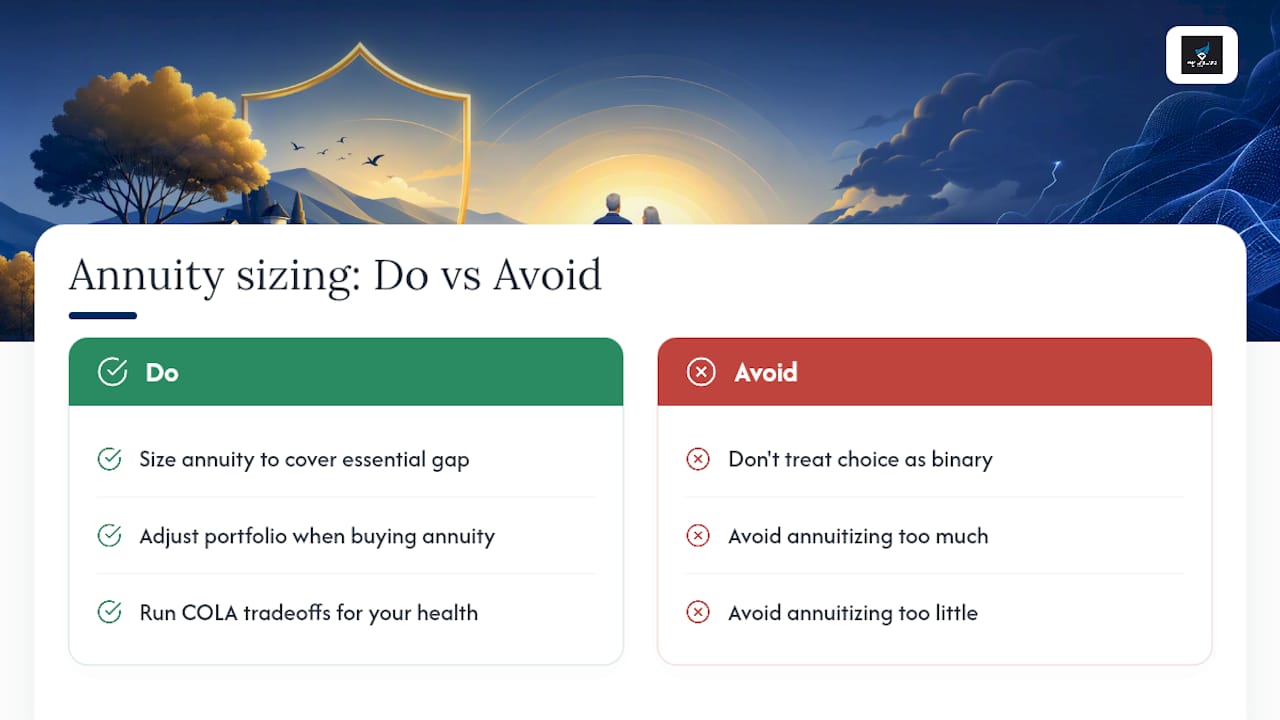
Retirees who annuitize too much lose flexibility they'll regret at 78 when a grandchild needs help or a roof needs replacing. Retirees who annuitize too little end up white-knuckling market downturns in their 80s with no income floor beneath them. The BlackRock research on spending capacity backs this up: the benefit shows up specifically when guaranteed income is paired with an adjusted portfolio allocation, not as a standalone purchase.
Rider decisions get treated as an afterthought too often, when they're really the whole ballgame. A COLA rider that cuts your starting payout by a fifth isn't a minor detail buried in the fine print. It's a trade you need to run the actual numbers on, against your specific health history and family longevity, before deciding it's worth it.
— Shereka
This article is general information, not a substitute for advice from a qualified financial advisor. Consult a qualified financial professional about your own circumstances before acting on anything here.
Sources
- Strategies for optimizing retirement income | BlackRock
- Principles for retirement income | Vanguard
- Immediate fixed income annuities | Fidelity
- Annuity
- Guaranteed lifetime annuity | Investopedia