

If your tooth was already gone before your dental policy started, insurance will almost certainly deny the replacement. The missing tooth clause excludes implants, bridges, and dentures for teeth extracted before your coverage effective date. The extraction date, not the treatment date, decides the claim. Continuous prior coverage is often the only thing that overturns a denial.
TL;DR:
- Insurance will deny claims for replacing teeth extracted before the policy’s start date, unless continuous coverage is proven through prior documentation.
- The missing tooth clause primarily excludes implants, bridges, and dentures for pre-existing missing teeth, but generally does not affect fillings or crowns on existing natural teeth.
- Verifying the extraction date and continuous coverage before treatment can prevent claim denials, with documentation needed in writing from the insurer.
- Accident-related tooth loss or replacing an existing prosthesis may be exceptions, but most cases require careful validation of coverage windows.
- Buying or upgrading dental insurance while the tooth is still intact is the most effective way to avoid losing coverage for future replacements.
Table of Contents
- What Is a Missing Tooth Clause, and Which Procedures Does It Affect?
- How Insurers Apply the Clause: Extraction Date, Waiting Periods, and Plan Variants
- Exceptions: Congenital Gaps, Old Prostheses, Accidents, and Group Plans
- The Verification Checklist Before Anyone Signs a Treatment Plan
- What to Do After a Missing Tooth Clause Denial
- How to Avoid the Missing Tooth Clause Before You Need Coverage
- An Agent's View on Catching This Clause Early
- What Patients and Offices Should Do Next
- How Family Guard Life and Health Helps You Avoid a Denied Claim
- Sources
What Is a Missing Tooth Clause, and Which Procedures Does It Affect?
Insurers write this clause to prevent adverse selection: people signing up for a plan only after they already need an expensive prosthetic. If the tooth was missing before your policy started, the carrier treats the loss as a pre-existing condition and refuses to pay for its replacement, no matter how the case is coded.
The clause targets tooth replacement specifically, not tooth repair. Here's what commonly falls on each side of that line.
Typically excluded:
- Dental implants and implant crowns replacing a tooth missing before the policy start date
- Fixed bridges, including both the pontic (the fake tooth) and the retainer crowns anchoring it
- Partial and full dentures replacing pre-existing gaps
Typically unaffected:
- Fillings and crowns placed on a natural tooth that's still in your mouth
- Root canals and periodontal therapy
- Routine cleanings and exams
The distinction matters because a single treatment plan can mix covered and excluded components, which comes up again when we get to billing strategy.
How Insurers Apply the Clause: Extraction Date, Waiting Periods, and Plan Variants
The extraction date is the single fact that decides the claim. Everything else, including when you filed the claim or when the crown was seated, is secondary.
- Find the extraction date first. If the tooth came out before your policy's effective date, the clause applies regardless of how long ago that was.
- Check for a waiting period on top of the exclusion. Many plans layer a separate 6 to 12 month waiting period on major services like bridges and dentures, per NAIC's consumer guidance. You can clear the waiting period and still hit the missing tooth clause if the tooth was already gone.
- Identify which variant your plan uses. Some certificates apply a permanent exclusion with no exceptions. Others include a "sunset" provision that lifts the exclusion after a set number of years on the plan. A smaller group gives continuous coverage credit if you switch carriers without a coverage gap.
Plan type shapes how strictly this gets enforced. PPO and indemnity plans tend to follow the written certificate closely, while DHMO structures sometimes handle major service exclusions differently depending on the network contract.
Exceptions: Congenital Gaps, Old Prostheses, Accidents, and Group Plans
Not every missing tooth triggers a flat denial. A few situations create real exceptions worth checking before you assume the worst.
- Congenitally missing teeth (teeth that never developed) are generally still treated as a pre-existing absence, so the clause usually applies the same way it would to an extracted tooth.
- Replacing an existing prosthesis placed while you had prior coverage is often allowed, though most plans cap how often you can replace it, typically once every 5 to 10 years.
- Accident or trauma cases sometimes bypass the exclusion entirely, since the tooth loss happened after enrollment and under medical necessity.
- Group employer plans and some Medicaid programs relax or drop the clause as a competitive concession, making enrollment source a real variable, not just a formality.
The Verification Checklist Before Anyone Signs a Treatment Plan
Denials on prosthetic cases are almost always preventable with a five-minute phone call before treatment starts. Dental offices that build this into intake see fewer post-treatment surprises.
- Call the carrier and ask directly: "Does this policy include a missing tooth clause? What is the effective date? Do you credit prior continuous coverage?"
- Collect the extraction date from the original treating dentist's chart notes, x-rays, or the patient's memory if records aren't available.
- Request prior Explanation of Benefits (EOBs) and old insurance ID cards to prove continuous coverage if the patient switched carriers.
- Get the verification in writing. A phone reference number isn't enough. Ask for a fax, email, or portal confirmation and file it in the patient's chart before treatment begins.
Pro Tip: Keep a one-line "extraction audit trail" on every prosthetic case intake form: extraction date, source of that date, and whether a prior EOB was requested. It takes thirty seconds and it's the single piece of documentation that saves a denied claim later.
What to Do After a Missing Tooth Clause Denial
Standard appeals almost never work here, because the denial isn't a coding error. It's a contractual exclusion, and arguing medical necessity won't move it. What works is documentation that the extraction date falls inside your coverage window, per PracticeAlpha's analysis of missing tooth clause appeals.
- Attach the original extraction record, operative notes, and any x-rays showing the tooth was present after your policy started.
- Include prior EOBs proving continuous coverage if you switched carriers without a gap.
- Split the claim where possible. If part of the case (like a periodontal procedure) is unrelated to the missing tooth exclusion, bill it separately instead of bundling it into the denied claim.
- Resubmit as a corrected claim, not a duplicate, once you have the missing documentation attached.
Pro Tip: If the appeal still fails, ask your office manager about dental savings plans or financing options like CareCredit before assuming the patient has to pay the full fee upfront.
How to Avoid the Missing Tooth Clause Before You Need Coverage
The cheapest fix is timing. Once a tooth is gone, your options narrow fast.
- If an extraction is elective, buy or upgrade dental coverage while the tooth is still in your mouth, then schedule the extraction after the policy is active.
- Confirm benefits in writing before any extraction that might lead to future implant or bridge work.
- Favor group or employer-sponsored plans when you have a choice. They relax this clause more often than individual Marketplace dental plans.
- Keep coverage continuous when switching jobs or carriers. Even a one-month gap can reset your continuous coverage credit.
- When insurance won't help, dental savings plans, financing, or state Medicaid programs sometimes cover dentures for qualifying adults, though eligibility varies by state.
An Agent's View on Catching This Clause Early
Reviewing plan certificates for clients across 22 states makes one pattern clear: the clause almost never gets flagged until the treatment plan is already built and the patient is expecting coverage.
The fix is asking the exact verification questions above before, not after, work begins. In the cases that win appeals, the difference is never a stronger argument. It's a prior EOB or an extraction record that proves the tooth came out inside the coverage window.
— Shereka
What Patients and Offices Should Do Next
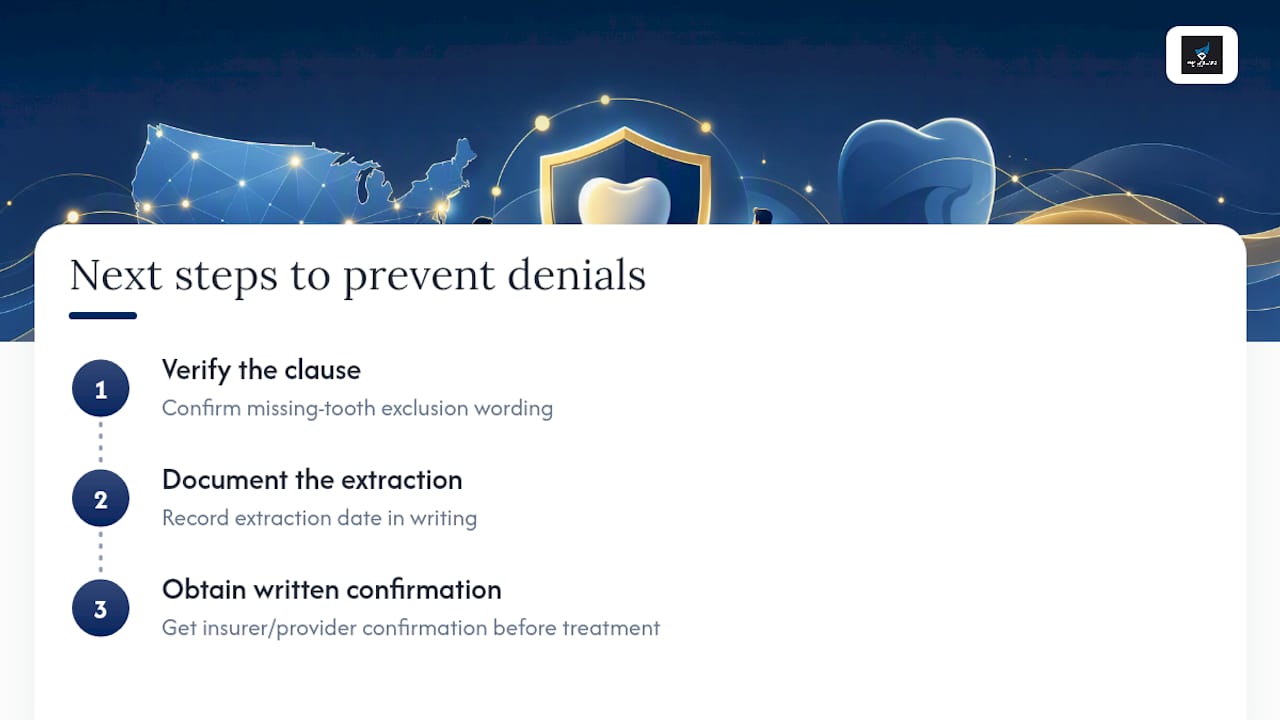
Verify the clause, document the extraction date, and get confirmation in writing before treatment starts. That single habit prevents most denials. If you're shopping for a plan or unsure how your current one handles missing tooth exclusions, Family Guard Life and Health reviews dental policies for clients across the 22 states we serve.
How Family Guard Life and Health Helps You Avoid a Denied Claim
Family Guard Life and Health reviews your dental certificate of coverage before you commit to treatment, not after a claim gets rejected. That's the real advantage over guessing based on a plan brochure: we read the actual exclusion language, effective dates, and continuous coverage credit rules, then tell you plainly whether your implant, bridge, or denture is likely to be covered.

Bring three things to a consultation: a copy of your current policy or certificate of coverage, the extraction date for the tooth in question, and your dentist's proposed treatment plan. We'll match those details against the plan language and flag any gap before you're financially committed. We serve individuals across Arizona, Colorado, Florida, Georgia, Iowa, Indiana, Massachusetts, Maryland, Maine, Michigan, Mississippi, Montana, North Carolina, Nevada, Ohio, Oklahoma, Pennsylvania, South Carolina, Tennessee, Texas, Virginia, and Washington. Visit Family Guard Life and Health to schedule a plan review before you schedule your next dental appointment.
Sources
- Healthcare
- Understanding your dental insurance - NAIC
- Missing tooth clause: What it is and how it affects coverage | PracticeAlpha
This article is general information, not a substitute for advice from a qualified financial advisor. Consult a qualified financial professional about your own circumstances before acting on anything here.