

The ACA premium tax credit is a federal subsidy that lowers your monthly Marketplace health insurance bill based on income, and starting in 2026 it works differently for millions of people. Enhanced subsidies from the pandemic era expired, so the original 100%–400% of the federal poverty line eligibility cap is back, and the percentage of income you're expected to pay toward premiums has increased. If you earned just over the federal poverty line eligibility cap and paid little or no premium in 2025, you could lose your subsidy entirely this year.
TL;DR:
- The 2026 premium tax credit eligibility will be narrower, mainly due to increased income limits and higher applicable percentages, reducing support for many households.
- Your subsidy depends on your household MAGI, county, and plan choice, with higher benchmark premiums in rural areas leading to larger credits.
- Choosing a Silver plan is necessary to qualify for cost-sharing reductions, but your premium credit remains fixed regardless of the plan tier.
- Underreporting income or failing to update changes can lead to significant repayment obligations during tax reconciliation.
- Consulting with a licensed broker helps optimize your subsidy and avoid costly mistakes, especially if your income fluctuates or you're near eligibility thresholds.
Table of Contents
- Who Qualifies for the ACA Premium Tax Credit
- How the Premium Tax Credit Formula Actually Works
- APTC, Form 1095-A, and How Reconciliation Actually Works
- The 2026 Subsidy Cliff Is Back: What It Means for Your Wallet
- Estimate Your Credit and Protect Yourself From Repayment
- What Families Should Prioritize Right Now
- Get Help Choosing and Enrolling in the Right Marketplace Plan
- Where to Check the Exact Numbers Yourself
- Sources
Who Qualifies for the ACA Premium Tax Credit
You have to buy your plan through the Health Insurance Marketplace to get this credit. Coverage purchased directly from an insurance company, through a private broker's off-exchange platform, or through a short-term plan doesn't count, no matter how similar it looks to a Marketplace plan on paper.
A few baseline rules determine whether you're even in the game. You (or the person you're claiming) must be a U.S. citizen or lawfully present, and you can't be incarcerated. If someone else claims you as a dependent on their tax return, you generally can't claim the credit yourself, even if you paid your own premiums.
The employer coverage test trips up a lot of people. If your job offers health insurance that's considered "affordable" and meets "minimum value" standards under IRS rules, you're generally locked out of premium tax credit eligibility, even if you decline that coverage and buy a Marketplace plan instead. The same goes for anyone eligible for Medicaid, Medicare, or TRICARE. Being technically eligible for a government program disqualifies you even if you never enrolled.
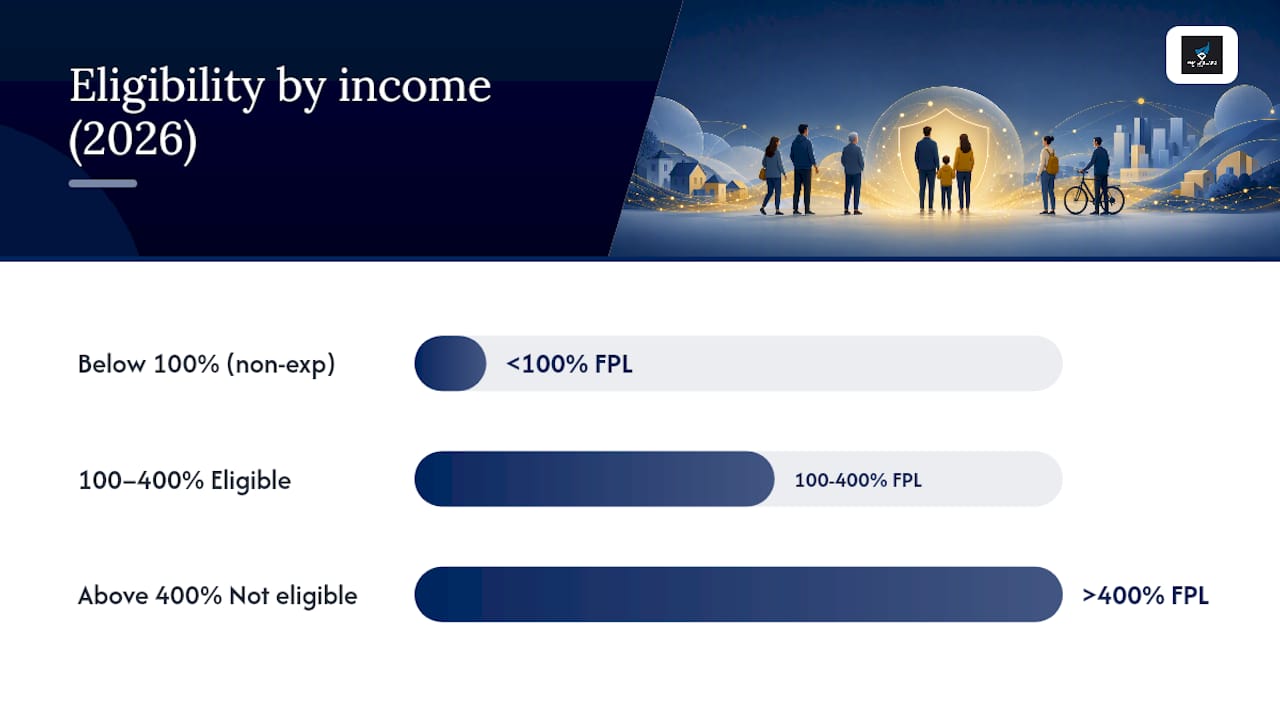
Income is where most of the real complexity lives. The IRS uses your household's modified adjusted gross income (MAGI) measured against the federal poverty line for your household size and state. The baseline rule for 2026 restricts eligibility to households between 100% and 400% of the poverty line, though there's an important carve-out: in states that haven't expanded Medicaid, some people below 100% of the poverty line who don't qualify for Medicaid can still claim the credit.
Filing matters as much as earning. If you or anyone in your household received advance payments of the credit during the year, you're required to file a federal tax return and attach Form 8962, even if you'd otherwise fall under the filing threshold. Married couples filing separately are typically barred from claiming the credit, with narrow exceptions for domestic abuse or spousal abandonment situations.
Quick eligibility checklist:
- Enrolled in a plan through the Health Insurance Marketplace, not a private off-exchange policy
- U.S. citizen or lawfully present, not incarcerated
- Not claimed as a dependent on someone else's return (unless you're the one claiming others)
- Not eligible for affordable, minimum-value employer coverage
- Not eligible for Medicaid, Medicare, or TRICARE
- Household MAGI between 100% and 400% of the federal poverty line (or below 100% in a non-expansion state, under specific conditions)
- Filing status other than married filing separately, with limited exceptions
Pro Tip: Even if your paycheck stub says you make too much for Medicaid, check your state's expansion status. In non-expansion states like Florida, Texas, and Georgia, the income math for ACA subsidy income limits works differently than in states that expanded Medicaid coverage.
How the Premium Tax Credit Formula Actually Works
The credit isn't a flat discount. It's the gap between what a specific reference plan costs and what the government decides you can reasonably afford to pay, and that reference plan is the second-lowest-cost Silver plan available in your area, commonly called the benchmark plan.
Here's why the benchmark matters more than people realize: your credit amount is fixed to that benchmark premium regardless of which plan you actually buy. Pick a cheaper Bronze plan, and you might pay little or nothing out of pocket. Pick a pricier Gold or Platinum plan, and you cover the difference yourself. The credit amount doesn't shift with your choice, only your out-of-pocket cost does.
The math runs through three steps:
- Find your applicable percentage. This is the sliding-scale rate the IRS assigns based on where your income falls within the 100%–400% FPL band. Lower incomes get a lower percentage; incomes near the top of the range get a higher one.
- Calculate your expected contribution. Multiply your MAGI by your applicable percentage. That dollar figure is what you're expected to pay annually toward the benchmark plan.
- Subtract from the benchmark premium. The second-lowest-cost Silver plan premium in your rating area minus your expected contribution equals your annual premium tax credit.
Say a benchmark Silver plan in your county costs $9,600 a year and your applicable percentage works out to your household owing $4,800 toward it. Your credit would be $4,800 for the year, or $400 a month, applied toward whichever plan you actually choose.
Two households earning the exact same income can end up with wildly different credits simply because they live in different counties. Rural areas with fewer insurers competing often have higher benchmark premiums, which can mean a bigger credit. Areas with more competitive Marketplaces tend to have lower benchmarks and smaller credits, even for identical income levels. This geography effect surprises a lot of people who assume the subsidy is calculated the same way nationwide.

One more detail worth knowing: you can apply your credit to any metal tier except Catastrophic plans. But if you want access to cost-sharing reductions, the program that lowers your deductibles and copays on top of the premium subsidy, you have to select a Silver plan specifically. Choosing Bronze or Gold to save on premiums means walking away from CSR eligibility entirely, even if your income would otherwise qualify you.
Statistic to watch: the Congressional Research Service projects that applicable percentages across the income spectrum are rising for 2026 compared to the temporarily reduced rates in place from 2021 through 2025, which means the same income now produces a smaller credit than it did last year.
APTC, Form 1095-A, and How Reconciliation Actually Works
Most Marketplace enrollees don't wait until tax season to get their subsidy. They take it as advance premium tax credit, or APTC, meaning the government pays your insurer directly each month and your bill shows up already reduced. The alternative is paying full price monthly and claiming the entire credit as a lump sum when you file your taxes.
Either path leads back to the same tax form. Every January, the Marketplace sends you Form 1095-A, which lists your monthly premiums, the benchmark plan cost, and how much APTC was paid on your behalf. You transfer those numbers onto Form 8962 when you file, and that form reconciles what you actually earned against what the Marketplace estimated when you enrolled.
This reconciliation step is where things get financially painful for a lot of filers. If your income came in lower than projected, you often get an additional credit refunded. If your income came in higher, meaning you underestimated on your application, you may owe some or all of the APTC back to the IRS, sometimes with repayment caps depending on your final income level, and sometimes with no cap at all if you ended up above 400% of the poverty line.
Common triggers that throw off the math:
- A job change or raise that bumped your income mid-year without you updating the Marketplace
- A year-end bonus that wasn't factored into your original estimate
- A change in household size, like a child aging off your plan or a new dependent
- Freelance or self-employment income that fluctuated more than expected
- A spouse returning to work after being unemployed when you applied
Pro Tip: If your income is unpredictable, consider taking only part of your APTC each month, or none at all, and claiming the rest at tax time. It's a conservative move that trades a bigger monthly bill now for far less repayment risk in April. This approach comes straight from Healthcare.gov's own guidance for people who aren't confident in their income projections.
The single most useful habit here is reporting changes as they happen rather than waiting for open enrollment. Logging into your Marketplace account and updating income or household details the moment something shifts keeps your APTC amount closer to accurate all year, which shrinks whatever gap you'd otherwise have to settle in reconciliation.
The 2026 Subsidy Cliff Is Back: What It Means for Your Wallet
Nobody, regardless of income, paid more than 8.5% of their income toward the benchmark plan during those years, and people below 150% of the poverty line often paid nothing at all.
Those provisions expired at the end of 2025. For 2026, the original ACA framework is back in force: eligibility is capped again at 400% of the federal poverty line, and the applicable percentages used to calculate your expected contribution have risen across every income band.
Under 2026's reinstated rules, that same family gets zero premium tax credit and pays full price for coverage, because they've crossed the reinstated income ceiling entirely.
The Medicaid expansion status of your state adds another layer. In states that expanded Medicaid, coverage exists down to very low income levels, so the coverage gap barely applies. This gap has existed since the ACA's original design, but rising applicable percentages elsewhere in the system make the overall affordability squeeze worse for people just above that line too.
If your income puts you near either edge, a few moves are worth considering now:
- Run your numbers through a state-specific subsidy calculator before assuming you're priced out
- Check whether a Silver plan with cost-sharing reductions changes your total cost picture even without a premium tax credit
- Time major income events, like a bonus or asset sale, around your enrollment period when possible
- Compare total annual cost across metal tiers rather than fixating on the monthly premium number alone
Estimate Your Credit and Protect Yourself From Repayment
Getting your MAGI estimate right is the single biggest lever you control in this whole system, and it starts with knowing what actually counts. Wages, self-employment net income, unemployment compensation, and most investment income all factor into MAGI. Child support, most gifts, and certain veterans' benefits generally don't.
- Pull last year's tax return as your starting point, then adjust for anything you know will change, like a new job, a raise, or a spouse's return to the workforce.
- Add back anything MAGI includes that regular AGI doesn't, including tax-exempt interest and excluded foreign income, if those apply to your household.
- Run the number through a calculator that lets you input household size, state, and county, since local benchmark premiums swing the output significantly, even for identical income figures.
- Log into your Marketplace account and update your application the moment your income estimate materially changes, rather than waiting for the annual renewal window.
- Decide how much APTC to actually take each month based on your confidence in that income estimate, not just the maximum you're offered.
Pro Tip: If your income comes from a mix of a steady paycheck and unpredictable freelance work, estimate the freelance portion conservatively low. It's far easier to get a refund for underestimating than to write a check for overestimating.
If any of this starts feeling like more math than you want to do alone, a licensed insurance broker can run the numbers with you, check employer coverage eligibility, and flag Medicaid or CHIP overlap before you commit to a plan.
What Families Should Prioritize Right Now
Three things matter more than anything else this year. First, estimate your MAGI as precisely as you can, using real pay stubs and contracts, not guesswork. Second, compare total annual cost across metal tiers, not just the monthly premium, since a slightly higher premium with a Silver CSR plan often beats a cheap Bronze plan once you factor in deductibles.
When income is genuinely unpredictable, lean conservative and take less APTC than you're offered. A broker earns their keep when your household has multiple income sources, a recent life event, or genuine confusion about employer coverage rules. That's exactly where Family Guard Life and Health's licensed agents step in across our 22 states.
— Shereka
Get Help Choosing and Enrolling in the Right Marketplace Plan
Running these numbers alone is doable, but a mistake on your MAGI estimate can cost you real money at tax time, and that's where working with someone who does this daily pays off. Family Guard Life and Health is a licensed independent brokerage across 22 states, including Florida, Texas, Georgia, and Pennsylvania, and unlike a do-it-yourself calculator, our agents walk through your specific household situation, check your employer coverage against the affordability test, and compare total annual cost across metal tiers before you commit to anything.

A consultation typically covers your income estimate, your state's Medicaid expansion status, and whether a Silver plan with cost-sharing reductions beats a cheaper Bronze plan once deductibles are factored in. We also help with Medicare supplement, dental, vision, and life insurance decisions that often come up alongside ACA enrollment for people 45 and older. If you want a second set of eyes on your numbers before open enrollment closes, schedule a consultation with Family Guard Life and Health and bring your most recent pay stubs or self-employment records.
Where to Check the Exact Numbers Yourself
For current figures and forms, consult the IRS premium tax credit guidance, Healthcare.gov's enrollment help, the KFF subsidy calculator, the CRS 2026 policy FAQ, and HealthInsurance.org's state calculator.
This article is general information, not a substitute for advice from a qualified financial advisor. Consult a qualified financial professional about your own circumstances before acting on anything here.
Sources
- Questions and answers on the premium tax credit
- Enhanced Premium Tax Credit and 2026 Exchange Premiums: Frequently Asked Questions (CRS)
- Healthcare
- Healthinsurance