

Review your life insurance annually and after any significant life or financial change. Check three things first: your beneficiaries, whether your death benefit still matches your family's needs, and any term expiration or conversion deadline coming up. The NAIC recommends this combined approach, and you can request a current in-force illustration from your carrier to see exactly where your policy stands today.
TL;DR:
- If you have a major life event like marriage, a new child, or a job change, update beneficiaries and reassess your death benefit without delay.
- Request current in-force illustrations that separate guaranteed and projected values to determine if your policy remains funded and viable long-term.
- Compare your policy’s surrender charges, renewal deadlines, and conversion options before considering replacing or surrendering it, ensuring you avoid unnecessary risks.
- Verify that beneficiary designations are current, accurate, and aligned with estate plans to prevent payout issues and fulfill your intentions.
- Seek professional review when dealing with complex policies, replacements, or trusts to ensure decisions are properly modeled, compliant, and in your best interest.
Table of Contents
- Life Events That Should Trigger an Immediate Policy Review
- Life Insurance Policy Review Checklist: What to Inspect and How to Read It
- How Do You Actually Run a Policy Review Step by Step?
- Should You Ever Replace or Surrender a Policy?
- Beneficiary Verification and Estate Planning Coordination
- When Should You Bring in a Licensed Agent or Broker?
- Often the Right Answer Is No Change
- Request a Policy Review From Family Guard Life and Health
- Primary Sources and Regulatory References
- Sources
- FAQ
Life Events That Should Trigger an Immediate Policy Review
A policy that fit your life in 2019 might not fit it now. Certain events change your coverage math overnight, and waiting for your next annual checkup means months of being underinsured or misaligned.
- Marriage or divorce. Update beneficiaries immediately. A divorce decree does not automatically remove an ex-spouse from your policy.
- Birth or adoption of a child. Add the child as a contingent beneficiary and reassess whether your death benefit covers years of income replacement plus future education costs.
- Death of a beneficiary. Notify your carrier right away and name a new primary or contingent beneficiary before there's a gap.
- Job change or income shift. A raise, a layoff, or a new job with employer-provided group life coverage can change how much personal coverage you actually need.
- Home purchase, new debt, or a health diagnosis. A new mortgage raises your liability exposure; a health event can affect future insurability, so lock in coverage decisions before your health changes further.
Document every change in writing and confirm the carrier processed it. A verbal update to your agent means nothing if it never reaches the policy file.
Life Insurance Policy Review Checklist: What to Inspect and How to Read It
A real review goes well past confirming the premium got paid. The NAIC's consumer guide frames a proper review as a full reassessment of death benefit, premium, term end date, beneficiaries, ownership, riders, exclusions, conversion rights, loans, and cash value. Here's the order to work through it.
- Cover page and schedule of benefits. Confirm your name, date of birth, policy number, and face amount are all correct. Typos on decades-old paperwork happen more often than you'd think.
- Beneficiaries. Verify legal names, percentages, and whether designations are revocable. Check that they line up with your will or trust, since beneficiary forms typically control the payout regardless of what your will says.
- Premium history and dates. Note your renewal or expiration date and project whether you can comfortably afford premiums if they're scheduled to rise.
- In-force illustration (permanent policies). Request a current one and separate the guaranteed column from the nonguaranteed projections. This single document tells you whether the policy is funded to last, or drifting toward a lapse.
- Loans, cash value, and surrender charges. Any outstanding loan reduces your death benefit dollar for dollar plus accrued interest. Know that number before you assume your payout is what the face amount says.
- Term policy conversion window. Check your expiry date, expected renewal pricing, and the age cutoff for converting to a permanent policy without new medical underwriting.
Statistic Callout: In-force illustrations must separate guaranteed values from nonguaranteed projections, according to NAIC guidance on life insurance illustrations. Treating a projection as a guarantee is one of the most common review mistakes.
How Do You Actually Run a Policy Review Step by Step?
Once you know what to look for, the process is mostly paperwork and a few pointed questions.
- Gather your documents. Pull the original policy contract, your most recent annual statement, any prior in-force illustration, premium payment receipts, loan statements, and your will or trust.
- Request a fresh in-force illustration. Ask the carrier for both the guaranteed and current (nonguaranteed) columns, plus the projected premium needed to keep the policy in force to a stated age.
- Bring specific questions to your agent or carrier. Ask about renewal terms, conversion rights and deadlines, surrender charge schedules, and how a replacement would affect your underwriting class.
- Confirm your timeline. Illustration requests typically take a few weeks to process, and any new policy carries a free-look period, usually 10 to 30 days depending on your state, during which you can cancel without penalty.
Pro Tip: Ask the carrier to run the in-force illustration at your current premium AND at a higher "keep it funded to age 100" premium. Seeing both numbers side by side shows you whether your policy is quietly heading toward a lapse.
Should You Ever Replace or Surrender a Policy?
Sometimes, yes. But replacement is one of the riskiest moves in insurance, and the NAIC's buyer's guide is blunt about why: replacing a policy can reset acquisition costs, trigger a brand new underwriting exam, and create tax consequences you didn't have with the original contract.
- Never cancel your existing policy until the new one is issued and approved. A gap in coverage during underwriting is a real risk, not a technicality.
- Compare guaranteed values, not headline premiums. A lower quoted rate can hide a worse surrender charge schedule or a shorter guarantee period.
- Get tax advice before a 1035 exchange. An IRS private letter ruling on a 1035 exchange shows how fact-specific these tax outcomes are. Nonrecognition treatment only applies under particular ownership and contract conditions, so don't assume your exchange is automatically tax-free.
- Use the free-look period on the new policy. Read the actual issued contract, not just the illustration you were shown when you applied.
Beneficiary Verification and Estate Planning Coordination
Beneficiary designations generally control who gets paid, regardless of what your will says. That single fact catches more families off guard than almost anything else in estate planning.
- Verify legal names, exact percentages, and current contact information for every primary and contingent beneficiary.
- Check for irrevocable designations, trust ownership arrangements, or divorce decrees that may override a prior beneficiary form.
- Update changes using the carrier's official beneficiary form, get written confirmation, and file that confirmation with your estate documents. An informal note to your agent does not count as an official change.
When Should You Bring in a Licensed Agent or Broker?
Some reviews are simple enough to handle yourself. Others aren't. If you own a cash-value policy with loans against it, you're evaluating a replacement proposal, or the policy sits inside a trust, get a licensed agent or independent broker involved before you sign anything.
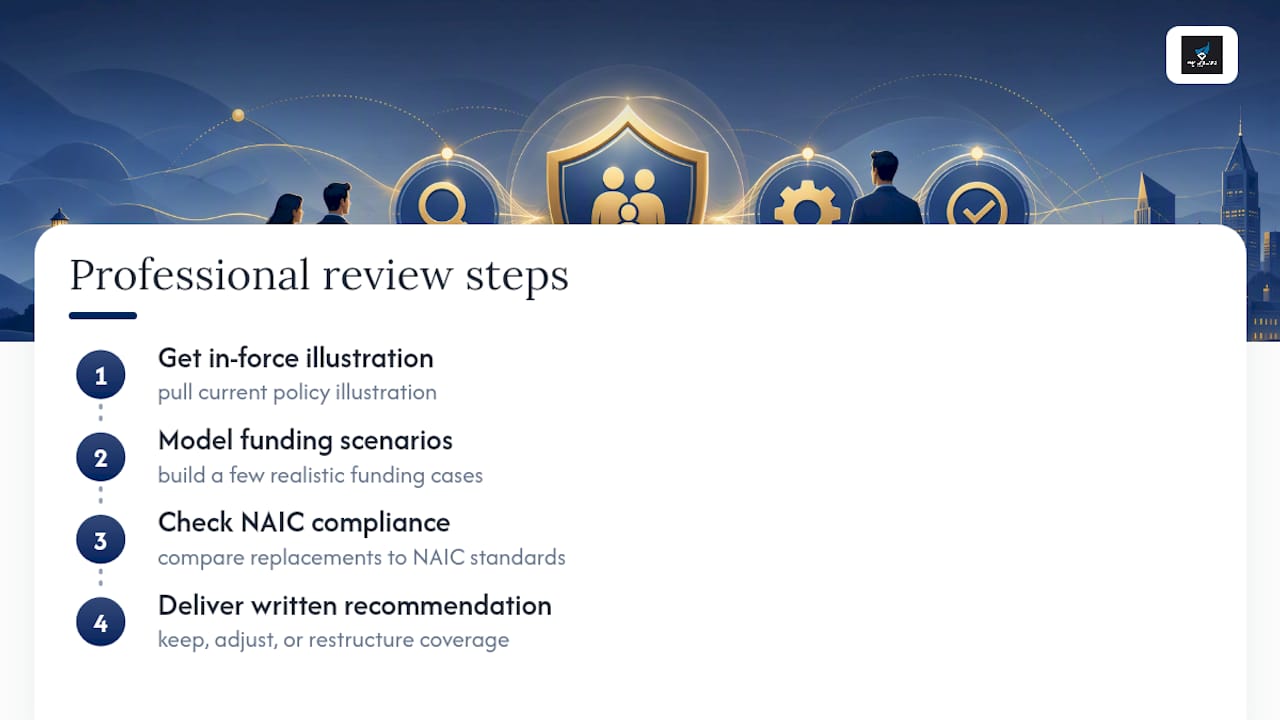
A proper professional review pulls the current in-force illustration, models a few realistic funding scenarios, checks any replacement against NAIC-based compliance standards, and hands you a written recommendation instead of a verbal opinion. Independent insurance brokers licensed across multiple states often help existing policyholders decide whether to keep, adjust, or restructure coverage. If you're weighing whether a permanent policy still fits, the mechanics of products like indexed universal life are worth understanding before that conversation.
Often the Right Answer Is No Change
The instinct to replace a policy after a scary headline or a pushy sales pitch is usually wrong. Guaranteed rates, a favorable underwriting class you locked in years ago, and a cost structure you already understand are worth protecting.
Action is warranted when there's a real funding gap, a term policy expiring soon, or beneficiaries who no longer match your life. Otherwise, document your findings and set a follow-up date. A review that ends in "no changes needed" is still a successful review.
— Shereka Boukouvalas
Request a Policy Review From Family Guard Life and Health
An independent insurance broker typically works for clients, not for any single insurance carrier, so a policy review like this is an independent look at what you already own, not a pitch to sell something new.

The review pulls together your existing documents, requests a current in-force illustration from your carrier, and compares your guaranteed values against what you'd need to keep the policy funded long term. You get a written recommendation, not a sales script, and there's no obligation to act on it. If the review turns up a genuine gap, whether that's a term policy nearing its conversion deadline or a retirement-income shortfall a permanent policy could help solve, you'll know exactly what your options look like before making any decision. Explore term, whole, and universal life options or ask about how coverage fits into a broader retirement income plan. Reach out through the life insurance page to get a review started.
Primary Sources and Regulatory References
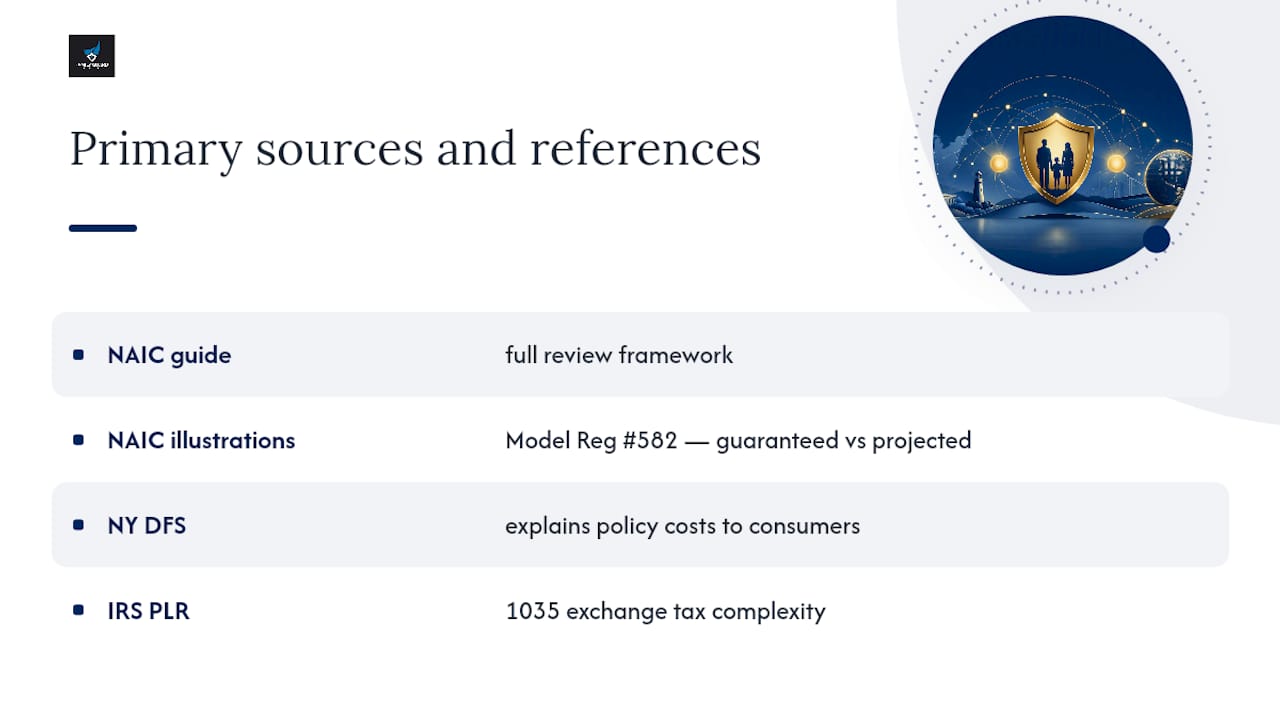
For readers who want to go straight to the source, three references anchor this checklist. The NAIC consumer guide to life insurance covers the full review framework. The NAIC's illustration guidance, tied to Model Regulation #582, explains how insurers must present guaranteed versus projected values. The New York DFS page on the cost of life insurance shows how a state regulator explains policy costs to consumers, and the IRS private letter ruling illustrates the complexity behind 1035 exchange tax treatment.
This article is general information, not a substitute for advice from a qualified financial advisor. Consult a qualified financial professional about your own circumstances before acting on anything here.
Sources
- NAIC — Consumer guide: Life insurance
- IRS private letter ruling (PLR-120953-12) — example for 1035 exchange context
FAQ
How Often Should I Review My Life Insurance Policy?
Review your policy at least once a year, plus immediately after any major life event like marriage, a new baby, divorce, or a significant income change. The NAIC recommends this combined cadence rather than relying on annual reviews alone.
What's the Best Life Insurance Company in the U.S.?
There's no single "best" carrier for everyone, since the right fit depends on your health, budget, and coverage goals. Independent insurance brokers often compare options from multiple carriers rather than pushing one company's products.
How Much Does a $100,000 Life Insurance Policy Cost Per Month?
Monthly cost depends heavily on your age, health, and whether you choose term or permanent coverage, so there's no flat rate that applies to everyone. Current pricing for specific coverage amounts is available by requesting a quote directly through Family Guard Life and Health's life insurance page.
Can I Cancel My Old Policy as Soon as I'm Approved for a New One?
No. The NAIC specifically warns against canceling an existing policy until the new policy is fully issued and you've reviewed it during the free-look period. Canceling early risks a coverage gap if the new policy falls through.
What Documents Do I Need for a Policy Review?
Gather your original policy contract, the most recent annual statement, any prior in-force illustration, premium payment records, loan statements if you have any, and your will or trust documents. Having all of this together lets an agent or broker spot gaps in a single sitting rather than over several follow-up calls.