

A life insurance beneficiary is the person, trust, or organization you name to receive your policy's death benefit, and that designation almost always overrides whatever your will says about the same money. If you can't remember who you listed, or you've never named anyone, stop reading and check today. Beneficiary paperwork usually beats a will in the eyes of an insurer, and a blank field can send your family into probate court.
TL;DR:
- Naming a contingent beneficiary is essential to prevent probate delays and ensure the payout goes directly to your chosen recipient if the primary beneficiary predeceases you.
- Providing full legal names, birth dates, Social Security numbers, and relationship details on beneficiary forms minimizes delays and avoids disputes during the claims process.
- Regularly reviewing and updating beneficiary designations, especially after major life events like divorce or the birth of a child, prevents outdated information from triggering probate or legal complications.
- Using trusts as beneficiaries, particularly for minors or beneficiaries with special needs, offers control over the timing and conditions of the payout, shielding the funds from creditors.
- Changes to a will do not automatically update beneficiary designations; official forms with the insurer must be amended to reflect your current wishes.
Table of Contents
- What Life Insurance Beneficiaries Actually Determine
- Primary, Contingent, Revocable, Irrevocable: What These Terms Mean
- Who You Can Name and What Insurers Need From You
- How to Choose Beneficiaries and Split the Payout
- Changing Your Beneficiary: The Paperwork That Actually Matters
- What Happens When No Beneficiary Is Named or One Can't Be Found
- How Beneficiaries Actually Get Paid
- What Agents See Go Wrong, and How to Avoid It
- What the Rules Actually Reward, and What They Punish
- Get Your Beneficiary Designations Reviewed Before It's a Problem
- Where to Verify the Details
- Sources
- FAQ
What Life Insurance Beneficiaries Actually Determine
A beneficiary can be a spouse, a child, a friend, a charity, a business partner, or a trust set up to manage money for someone who isn't ready to handle it directly. Whoever you name receives the payout directly from the insurance company, without a judge, a lawyer, or your other heirs weighing in.
That's the part people get wrong. Many assume their will controls everything they own, but beneficiary designations generally take precedence over wills for the specific asset they're attached to, whether that's a life insurance policy, an IRA, or a 401(k). If your will leaves everything to your children but your ex-spouse is still listed on the policy from a decade ago, the ex-spouse gets the check.
Skip naming anyone, and the outcome changes for the worse. The payout typically lands in your estate, which means:
- Creditors can potentially claim against those funds before your family sees a dime
- The money moves through probate, a court process that can take months or longer
- A missing or invalid beneficiary can delay payouts for years while the court sorts out rightful recipients
- Your state's intestacy laws, not your wishes, may decide who ultimately benefits
Primary, Contingent, Revocable, Irrevocable: What These Terms Mean
Insurance paperwork throws around terms that sound like legalese but are actually simple once you see them in plain English.
Primary vs. contingent beneficiary. Your primary beneficiary is first in line. Say you name your husband as primary. If he's alive when you die, he gets the payout, full stop. A contingent beneficiary only inherits if every primary beneficiary has died or can't legally receive the money, such as in a simultaneous accident. Skip the contingent slot, and you've left a gap that probate will fill for you.
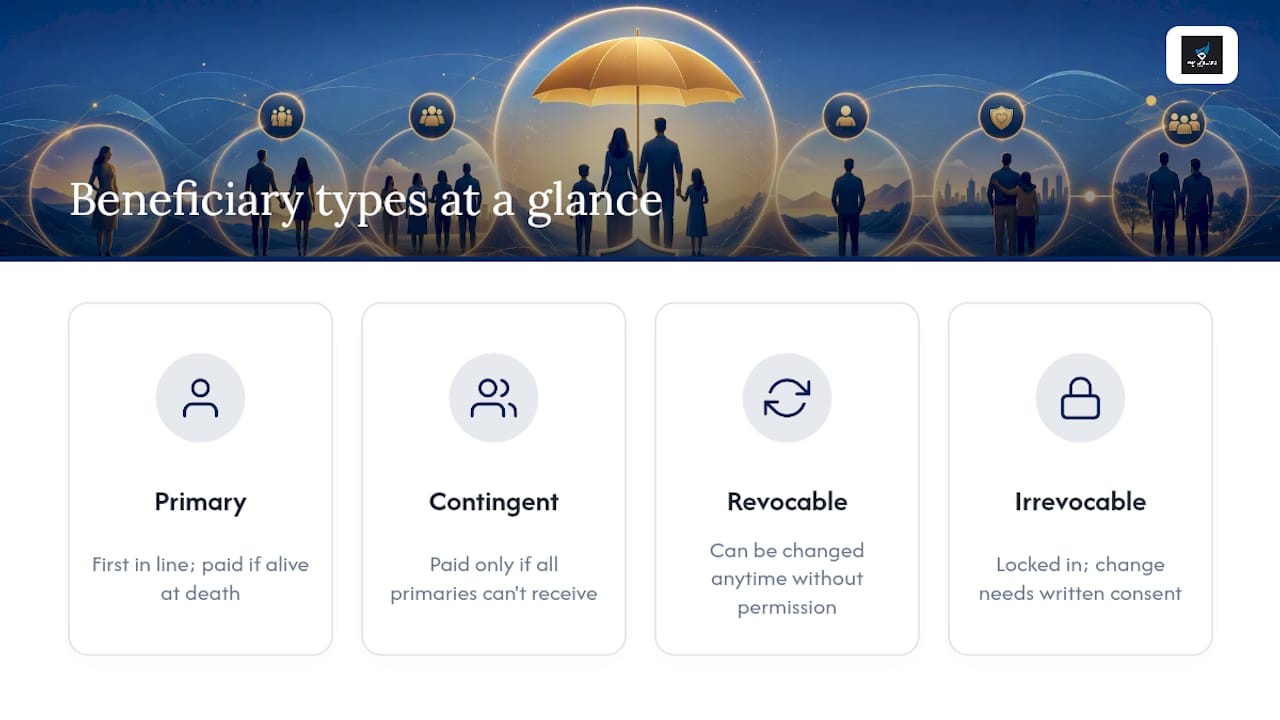
Revocable vs. irrevocable designations. A revocable beneficiary can be changed anytime, for any reason, without asking permission. An irrevocable beneficiary is locked in. Changing an irrevocable designation generally requires that beneficiary's written consent, which shows up most often in divorce settlements or certain business agreements where one party needs a guarantee the coverage won't disappear.
Naming a trust. You can name a trust as beneficiary instead of a person, which puts a trustee in charge of managing and distributing the money under terms you set. This works well when beneficiaries are minors, have special needs, or simply aren't ready to manage a large sum responsibly.
Per stirpes vs. per capita. These Latin terms control what happens if a listed beneficiary dies before you and has children of their own. Per stirpes means that beneficiary's share passes down to their kids. Per capita means the money gets redistributed only among the surviving beneficiaries you named, cutting out that branch of the family entirely. Most policies default to per capita unless you specify otherwise, so read the fine print.
Who You Can Name and What Insurers Need From You
Almost anyone or anything with a legal identity can be a beneficiary:
- Your spouse or partner, though community property states may require spousal consent if you name someone else as primary.
- Children, either directly (once they're adults) or through a trust if they're minors.
- Other family members or friends, with no requirement that they be related to you at all.
- Charities or nonprofits, which can reduce your taxable estate depending on your overall situation.
- A trust, which controls timing and conditions rather than handing over a lump sum.
- Your own estate, though this is rarely the right move since it invites probate.
Naming a minor directly creates a real headache. Insurers generally can't pay a death benefit straight to a child under 18, so the money gets tied up until a court appoints a guardian to manage it, or until the child turns 18 or 21 depending on the state. Setting up a simple trust avoids that entirely.
Whatever you decide, insurers need specifics. Vague names cause more delays than almost anything else. Full legal name, date of birth, Social Security number or Tax ID, relationship to you, and current contact information all belong on the form, not just "my daughter" or "my nephew."
How to Choose Beneficiaries and Split the Payout
Start with a blunt question: who actually depends on your income or would face financial hardship without it? That's usually your spouse, minor children, or an aging parent you support. From there, work through a short list of practical filters before you write anyone's name on a form.
Consider creditor exposure. If a potential beneficiary is drowning in debt or facing a lawsuit, a direct payout could get swept up by their creditors. A trust can shield the money instead.
Consider age and maturity. An 19-year-old inheriting $500,000 in one lump sum rarely ends well. Staggered trust distributions, or naming a custodian until they hit a certain age, often serves them better than a check.
Decide how to split the money. You can divide proceeds equally among several beneficiaries, or assign specific percentages. Equal splits work fine for kids in similar financial situations. Targeted percentages make more sense when one child has special needs, one already received significant help with a home down payment, or you want to weight the split toward a caregiver.
Run through this checklist before finalizing anything:
- If my spouse predeceases me, who gets the proceeds?
- Have I named a contingent beneficiary for every primary?
- Does anyone I'm naming have creditor or legal issues that a trust could protect against?
- Is a named beneficiary a minor, and if so, do I need a trust or custodial arrangement?
- Have I documented percentages clearly instead of leaving allocation vague?
Pro Tip: Name a contingent beneficiary even when your primary choice seems bulletproof. Accidents, illness, and simultaneous deaths happen, and a missing contingent designation is one of the fastest routes into probate court.
Changing Your Beneficiary: The Paperwork That Actually Matters
Updating a beneficiary is usually simpler than people expect, but the process has real limitations worth knowing before a life event catches you off guard.
- Contact your insurer or agent and request a beneficiary change form, either on paper or through the carrier's online portal.
- Fill out the new designation completely, including full legal names and identifying details for every beneficiary you're adding.
- Submit and confirm receipt. Verbal requests or a note in your will do not count. The insurer needs the signed form on file.
- Watch for consent requirements. If your existing designation is irrevocable, you'll need written sign off from that beneficiary before the insurer processes any change.
Certain life events should trigger an immediate review: marriage, divorce, the birth or adoption of a child, or the death of a named beneficiary. Divorce decrees sometimes include specific language requiring an ex-spouse to remain on a policy for a set period, so read that document carefully before assuming you're free to make changes.
Here's the mistake that trips up even careful people: updating your will does not update your beneficiary designations. These are two entirely separate legal documents, and insurers follow the paperwork on file with them, not your estate plan.
What Happens When No Beneficiary Is Named or One Can't Be Found
Without a valid, living beneficiary, the death benefit typically flows into your estate and gets distributed according to your will, or according to state intestacy law if you didn't leave one. That triggers probate, a public court process that can take months and often comes with legal fees that eat into the payout.
Insurers do make an effort to locate missing beneficiaries, searching public records and sometimes hiring investigators, but unresolved cases can drag on for years. Tools like the NAIC life policy locator exist for exactly this scenario, letting beneficiaries or executors search participating insurers when they suspect a policy exists but don't know the carrier.
Naming contingent beneficiaries and trusts sidesteps this problem entirely, since the money has somewhere specific to go regardless of what happens to the primary beneficiary.
If you're executing an estate and suspect an unclaimed policy exists, gather these items before contacting insurers:
- Certified copies of the death certificate
- Any old insurance statements, premium payment records, or tax documents mentioning a policy
- Bank statements showing recurring premium withdrawals
- The deceased's Social Security number for insurer verification
How Beneficiaries Actually Get Paid
Filing a claim is more straightforward than most people expect, though delays creep in when paperwork is incomplete. The process runs in three steps: notify the insurer of the death, submit a certified death certificate along with your own identification, and complete the insurer's claim form.
From there, you typically choose how to receive the money:
- Lump sum, the most common option, paid out in full shortly after claim approval
- Interest option, where the insurer holds the funds and pays interest until you withdraw
- Annuitization, converting the death benefit into a stream of payments over time
Life insurance death benefits are generally not subject to federal income tax for the beneficiary, though interest earned on a held payout is taxable, and estate tax can apply in specific high value situations.
Most delays trace back to one of two problems: a beneficiary's identifying details don't match insurer records, or the claim form is missing a signature or supporting document. Contact the insurer's claims department directly, or your agent, to confirm exactly what's outstanding, since policy specific payout rules vary by carrier and product type.
What Agents See Go Wrong, and How to Avoid It
After years of processing beneficiary paperwork, licensed agents see the same handful of mistakes repeat themselves, and nearly all of them are preventable with a five minute review.
The most common: vague names ("my kids," "my estate"), missing Social Security numbers, and designations that never got updated after a divorce or remarriage. A practical agent checklist for verifying beneficiary details includes confirming SSN and date of birth at the time the policy is issued, adding trustee contact information whenever a trust is named, and keeping a copy of the designation with your other estate documents where an executor can find it.
If your situation involves a trust, a blended family, or significant assets, loop in an estate attorney alongside your insurance agent. The two roles aren't interchangeable. An agent handles the policy mechanics; an attorney makes sure the trust language and your broader estate plan actually align with what you've named on the insurance form.
Pro Tip: Review your beneficiary designations every time you review your budget, not just after major life events. A five minute annual check catches outdated names before they become a probate problem.
What the Rules Actually Reward, and What They Punish
Most advice on this topic treats beneficiary designation like a one-time form you fill out and forget. That's backward, and it's the single biggest reason payouts get delayed or contested. The forms matter less than the discipline of keeping them current.
Here's what the evidence actually supports: administrative precision beats good intentions every time. An insurer doesn't care how much you loved your beneficiary. It cares whether the name, Social Security number, and date of birth on file match. Families lose months, sometimes years, to a payout stuck in limbo because someone wrote "my wife" instead of a full legal name a decade earlier.
The conventional wisdom oversells trusts and estate attorneys as the first move for everyone. They matter enormously for complex situations, blended families, minor children, business interests. But for a straightforward household, the highest leverage action is far simpler: pull out your policy documents this week, confirm every name and identifier is current, and add a contingent beneficiary if one is missing. Get that right, and you've solved the problem that causes most real world delays, no attorney required.
— Shereka
Get Your Beneficiary Designations Reviewed Before It's a Problem
Family Guard Life and Health works as an independent broker, which means the review is about what fits your situation, not what a single carrier wants to sell you. If you're not sure whether your current policy still reflects your life, an ex-spouse still listed, no contingent beneficiary, a trust that was never set up, that's a conversation worth having now rather than after a claim gets stuck.

Family Guard Life and Health can walk through your existing coverage, help you correct outdated designations, and place new term, whole, or universal life coverage if your current policy no longer matches your family's needs. For readers also thinking about how beneficiary decisions intersect with retirement assets, retirement income planning services are available too. Services are available to qualified individuals across 22 licensed states. Reach out through the life insurance page to schedule a review and get your paperwork in order.
Where to Verify the Details
Confirm any suspected policy through the NAIC life policy locator, check a charity's tax-exempt status with the IRS search tool before naming it, and consult resources like Kiplinger and Fidelity for deeper explainers on payout mechanics. If insurance proceeds become tangled with inherited real estate, a probate focused property guide can help executors sort out next steps.
This article is general information, not a substitute for advice from a qualified financial advisor. Consult a qualified financial professional about your own circumstances before acting on anything here.
Sources
- Life insurance beneficiary: what it is and how it works | Kiplinger
- What is a contingent beneficiary? | Fidelity
- NAIC life policy locator
- IRS tax-exempt organization search
FAQ
What Are the Rules for Life Insurance Beneficiaries?
A beneficiary designation names who receives the death benefit directly from the insurer, bypassing your will entirely for that specific asset. You can name multiple beneficiaries, split percentages, and designate contingent beneficiaries in case your first choice can't inherit, but the paperwork on file with the insurer governs, not your estate plan.
Who Gets Life Insurance Money After Someone Dies?
Whoever is named as the primary beneficiary on the policy receives the payout, regardless of what a will says. If no valid beneficiary exists, the money typically goes to the deceased's estate and moves through probate before reaching heirs.
Will I Be Notified if I'm a Beneficiary on a Life Insurance Policy?
Insurers generally only notify beneficiaries after they're informed of the policyholder's death, not while the policyholder is alive. If you suspect you're named on a policy but haven't been contacted, the NAIC life policy locator can help you search participating carriers.
Can Adult Children Be Named as Life Insurance Beneficiaries?
Yes, adult children can be named directly with no restrictions, unlike minors who typically require a trust or custodial arrangement. Many parents split proceeds equally among adult children or adjust percentages based on individual financial circumstances.
Does Updating My Will Change My Life Insurance Beneficiary?
No. Beneficiary forms filed with the insurer control the payout regardless of what your will states, so you must update them separately through the insurer directly. This is one of the most common and costly mistakes families discover only after a death.