

If you lose employer coverage before Medicare, you almost always bridge the gap with COBRA for a short stretch, then an ACA Marketplace plan for the long haul. A spouse's plan or short-term insurance covers the rest of the field. Your household's modified adjusted gross income and a handful of enrollment deadlines decide both cost and timing, so the earlier you run the numbers, the cheaper and calmer this gets.
TL;DR:
- COBRA typically lasts up to 18 months but can be extremely costly for families, making it suitable mainly for active treatment periods or short-term needs.
- ACA Marketplace plans become more affordable with subsidies based on household income, which can sharply vary depending on taxable events and income timing.
- Enrolling through a spouse's employer plan usually offers lower costs but requires swift action within roughly 30 days after coverage loss.
- Short-term and indemnity plans are only suitable for very brief, healthy bridging periods due to coverage gaps and medical underwriting restrictions.
- Precise timing and documentation are crucial to avoid coverage overlaps or gaps, especially when coordinating COBRA, Marketplace, and Medicare enrollment dates.
Table of Contents
- Health Insurance Gaps Before 65: The Main Bridge Options at a Glance
- How Does COBRA Work, and When Should You Use It?
- What Role Does the ACA Marketplace Play, and Why Does Income Matter?
- Can You Get Coverage Through a Spouse's Plan Instead?
- How Should HSAs and Income Timing Factor Into Your Plan?
- Are Short-Term or Indemnity Plans Worth Considering?
- When Does Medicare Actually Start, and What Happens if You Miss the Window?
- How Do You Decide Which Bridge Option Fits Your Situation?
- What Protections or Rules Vary by State?
- What Happens to Pre-Existing Condition Protections If You Have a Gap?
- What If You Have a Disability or Qualify for Medicare Early?
- What Actually Happens When You Let Coverage Lapse?
- How Do You Keep End Dates and Start Dates From Ever Overlapping?
- What I Tell People Who Wait Too Long
- How Family Guard Life and Health Helps You Bridge the Gap
- Sources
Health Insurance Gaps Before 65: The Main Bridge Options at a Glance
Four paths cover almost every early retiree's situation. Here's how they stack up before you dig into the mechanics of each:
- COBRA: Lasts up to 18 months, you pay the full premium plus up to 2% in fees, and it's best when you're mid-treatment and don't want to switch doctors or networks.
- ACA Marketplace plan: Available year-round after a qualifying event, cost depends heavily on your MAGI, and it's the default long-term bridge for most people because it's guaranteed-issue regardless of health history.
- Spouse's employer plan: Often the cheapest option if your spouse still works, but you generally have just 30 days to enroll after losing your own coverage.
- Short-term or indemnity plan: Cheap monthly premiums, but medically underwritten and full of coverage gaps, so it fits only healthy people bridging a very short window.
The sequence most early retirees land on: COBRA for a few months to avoid disrupting active treatment, then a Marketplace plan once premiums or subsidy math make the switch worthwhile. The exception is anyone with a working spouse. That spouse's plan usually beats COBRA and the Marketplace on price alone. Whichever path fits, get quotes now and mark every deadline on a calendar today. Enrollment windows close fast, and missing one can mean months without coverage.
How Does COBRA Work, and When Should You Use It?
COBRA lets you keep your exact employer group health plan after you leave your job, for up to 18 months in most job-loss situations. You have about two months from the date you'd lose coverage to elect it, and the Department of Labor confirms plans can charge you up to 102% of the full premium, which means your old paycheck deduction plus your employer's former share plus a 2% administrative markup.
That full-premium sticker shock is why COBRA rarely works as a permanent solution. A family plan that cost you $400 a month as a payroll deduction can easily run $1,800 to $2,200 a month once your employer stops subsidizing it.
COBRA still makes sense in specific situations such as:
- You're mid-treatment for cancer, a surgery recovery, or another condition where switching doctors or networks mid-course carries real medical risk.
- Your former employer's plan is dramatically better than anything available on the Marketplace in your county.
- You need a short bridge of a few months while you sort out MAGI-based subsidy eligibility for a Marketplace plan.
Pro Tip: Elect COBRA even if you're not sure you'll keep it. You have 60 days to decide, and electing it retroactively covers you back to your last day of employer coverage. That gives you a real safety net while you compare Marketplace plans without ever risking a lapse.
What Role Does the ACA Marketplace Play, and Why Does Income Matter?
The ACA Marketplace is where most early retirees end up for the multi-year stretch before Medicare, and how much you pay depends almost entirely on your household's modified adjusted gross income, not your age or health history. Losing job-based coverage triggers a Special Enrollment Period, typically letting you enroll up to 60 days before or 60 days after your coverage ends. Miss that window without another qualifying event, and you could wait until the next open enrollment period.
Premium tax credits scale down as MAGI rises, and the math creates what planners call a subsidy cliff: cross certain income thresholds and your monthly premium can jump by hundreds of dollars overnight. A retiree pulling $40,000 from a taxable brokerage account pays a very different premium than one pulling the same amount from a Roth IRA, even though the spending looks identical from a budgeting standpoint. The HHS overview of the ACA lays out how MAGI drives subsidy eligibility, and it's worth reading before you touch any retirement account.
By the numbers: Special Enrollment Periods generally last about two months before and after your coverage-loss date, and your premium tax credit resets every year based on your estimated MAGI for that tax year.
Here's a practical sequence for getting this right:
- Estimate your MAGI for the coming year before you touch any retirement accounts, including Social Security if you're claiming early.
- Get county-level Marketplace quotes at multiple income levels. The same plan can cost dramatically different amounts depending on which income bracket you land in.
- Time any one-time taxable events (Roth conversions, capital gains harvesting, IRA withdrawals) around your subsidy math, not just your tax bracket.
- Re-check your estimate mid-year if your income picture changes, since reconciling at tax time can mean owing back credits you weren't entitled to.
Our ACA premium tax credit guide breaks down exactly how the 2026 subsidy formulas work if you want the deeper math.
Can You Get Coverage Through a Spouse's Plan Instead?
If your spouse still works and carries employer coverage, joining their plan is usually your cheapest option, but the clock moves fast. Most employer plans give you around 30 days from your own coverage-loss date to enroll as a qualifying life event, and HR will typically ask for proof of your prior coverage's end date.
Cost-wise, a spouse's employer plan usually beats both COBRA and an unsubsidized Marketplace plan because the employer is still absorbing part of the premium. Compare it honestly, though:
- Spouse's plan: Often the lowest out-of-pocket cost, but you're locked into their network and plan design.
- Marketplace with subsidy: Can beat a spouse's plan if your MAGI is low enough to qualify for a significant premium tax credit.
- COBRA: Almost always the most expensive of the three, useful mainly as a short bridge while you sort out the other two.
Retiree medical benefits from a former employer are worth checking, but they're increasingly rare. Vanguard's research on the pre-Medicare gap notes that employer-sponsored retiree health coverage now reaches only a minority of retirees, so most households need a self-managed plan rather than relying on a benefit that may not exist.
How Should HSAs and Income Timing Factor Into Your Plan?
Your HSA is one of the few tools that helps on both sides of this equation: it funds medical costs tax-free now, and the withdrawal timing you choose elsewhere in your finances directly changes your Marketplace subsidy. The IRS sets annual HSA contribution limits and catch-up amounts for savers 55 and older, so check the current-year figures before you max out contributions in your final working year.
A few sequencing moves matter more than people expect:
- Front-load HSA contributions in your last year of employer coverage. Once you enroll in Medicare, you lose eligibility to contribute.
- Time Roth conversions carefully. A large conversion in the same year you're buying subsidized Marketplace coverage can push your MAGI over the subsidy cliff and erase thousands in tax credits.
- Delay Social Security claiming if you can. Taxable Social Security income counts toward MAGI and can shrink your subsidy just as much as a withdrawal.
- Draw from Roth accounts or basis in taxable accounts before tapping traditional IRAs, since Roth withdrawals generally don't count toward MAGI.
Pro Tip: Run your Marketplace subsidy estimate before you finalize any Roth conversion, not after. A conversion that looks smart from a lifetime-tax perspective can cost you far more in lost subsidies than it saves in future tax brackets.
Our self-employed health insurance and HSA guide covers how these accounts interact with income planning if you're managing 1099 income alongside retirement withdrawals.
Are Short-Term or Indemnity Plans Worth Considering?
Short-term plans and indemnity plans are not the same as ACA major medical coverage, and that distinction matters more than the lower premium suggests. Short-term plans provide temporary, limited benefits and typically exclude pre-existing conditions. Indemnity plans pay fixed cash amounts per service rather than covering a percentage of costs, leaving you exposed to whatever the fixed payout doesn't cover.
State law, not federal law, mostly governs how long these plans can last and whether insurers can even sell them in your state. Federal guidance issued in 2025 shifted enforcement in ways that changed practical availability, but HHS's overview of the Affordable Care Act makes clear that state rules still set the real boundaries, so check your specific state before assuming a plan you saw advertised is actually available to you.
Before buying either type, ask:
- Does this plan exclude my current medications or ongoing conditions?
- What's the maximum payout per claim, and does it actually cover a hospital stay?
- Is this plan renewable, or does it expire and require new underwriting?
These plans can work for a genuinely short, healthy bridge of a month or two. They're a poor substitute for anything longer.
When Does Medicare Actually Start, and What Happens if You Miss the Window?
Medicare's Initial Enrollment Period runs for seven months: three months before the month you turn 65, the month you turn 65, and three months after. Medicare is explicit that missing this window can trigger a late-enrollment penalty for Part B that follows you for as long as you're enrolled.
Here's the part that trips up early retirees: COBRA and Marketplace coverage do not count as employer coverage for purposes of delaying Part B without penalty. Only active employer group coverage, generally from an employer with 20 or more employees, qualifies for that special delayed-enrollment protection. If you're on COBRA or a Marketplace plan when you turn 65, you need to enroll in Medicare on schedule, not when your bridge coverage happens to run out.
A short action checklist for this stretch includes:
- Mark your Initial Enrollment Period start date, which begins three months before your 65th birthday month, on your calendar promptly.
- Confirm whether your current coverage counts as active employer coverage for delay purposes. If it doesn't, don't wait.
- Coordinate your bridge plan's cancellation date to align exactly with your Medicare Part A and Part B start date, leaving zero gap days.
- Confirm your Part D or Medicare Advantage enrollment timing separately, since drug coverage penalties work on their own clock.
Our Medicare enrollment timeline guide walks through the full calendar if you want every deadline in one place.
How Do You Decide Which Bridge Option Fits Your Situation?
Four questions narrow this down faster than any generic comparison chart. Ask them in this order:
- How long is the actual gap? A few months favors COBRA or short-term coverage. A year or more favors the Marketplace.
- Are you or a dependent mid-treatment for anything serious? If yes, weigh network continuity heavily, even at a higher cost.
- What does your MAGI look like this year versus next? This alone can change your best option by hundreds of dollars a month.
- Does your spouse have access to group coverage? If so, price that first, before anything else.
Ask your former employer's HR department exactly when your coverage ends and whether it's a 20-plus-employee plan (relevant for Medicare delay rules). Ask a broker or Marketplace representative for quotes at two or three different MAGI scenarios, not just your current estimate. Ask directly whether a short-term plan excludes your specific medications or conditions before you buy one.
The costliest mistakes are rarely about picking the "wrong" option. They're about timing: electing COBRA late and creating a coverage gap, guessing at MAGI instead of modeling it, or assuming bridge coverage delays Medicare penalties when it doesn't.
What Protections or Rules Vary by State?
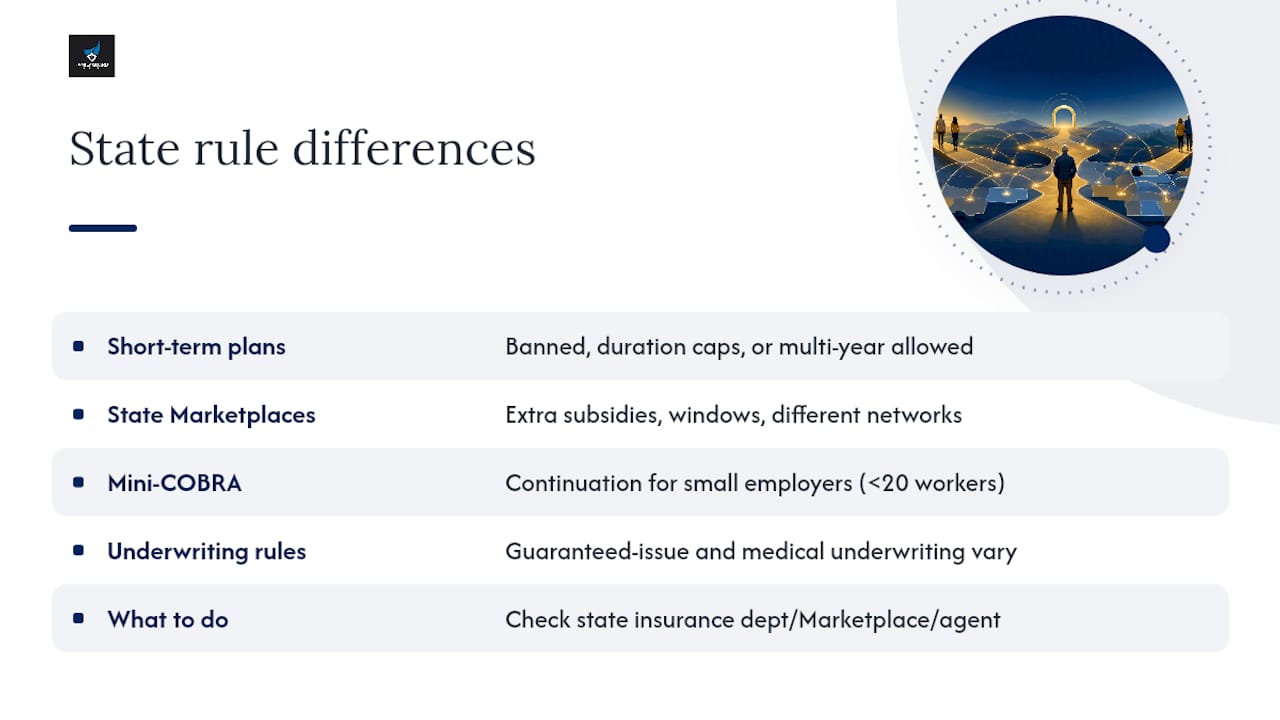
Coverage rules for the pre-Medicare bridge aren't uniform across the country, and that matters most for short-term plans and Marketplace plan availability. Some states ban short-term plans outright or cap their duration well below what federal rules allow, while others permit multi-year renewable short-term contracts. A plan advertised nationally may simply not be sellable where you live.
State-based Marketplaces add another layer of variation. States running their own exchange, rather than using the federal HealthCare.gov platform, sometimes offer additional state-funded subsidies on top of federal premium tax credits, extra enrollment windows, or different plan networks than what you'd see through the federal site. A few states also extend their own continuation-coverage laws, often called "mini-COBRA," to employees at small businesses with fewer than 20 workers, who wouldn't otherwise qualify for federal COBRA at all.
Insurance department rules on guaranteed-issue plans outside open enrollment also differ by state, as do rules governing how insurers can medically underwrite short-term and indemnity products. Before assuming a plan or rule applies to you, check with your state's insurance department or Marketplace directly rather than relying on a national article or a plan brochure written for a different state's market. This is one area where the generic advice genuinely doesn't travel, and a licensed agent who holds appointments in your specific state can flag rules a national guide will miss entirely.
What Happens to Pre-Existing Condition Protections If You Have a Gap?
A coverage gap before 65 does not put your pre-existing conditions at risk the way it did before the Affordable Care Act. ACA-compliant Marketplace plans are guaranteed-issue, meaning insurers cannot deny you coverage, charge you more, or exclude your condition from coverage based on your health history, even if you had a lapse in coverage beforehand. That protection applies whether your gap lasted two weeks or two years.
The real risk sits with the plans outside that ACA framework. Short-term and indemnity plans are medically underwritten, which means insurers can and do ask about your health history, deny coverage for pre-existing conditions, or exclude specific conditions from any payout. If you buy a short-term plan to bridge a gap and develop a new health issue during that window, that condition can follow you into underwriting for your next short-term policy, even though it wouldn't affect a Marketplace application at all.
This is the strongest practical argument for leaning on Marketplace coverage over short-term plans whenever a gap runs longer than a month or two: the guaranteed-issue protection means your health history stops being a pricing or eligibility factor the moment you're on an ACA-compliant plan. It's also why timing your Special Enrollment Period correctly matters so much. A gap of even a few weeks without ACA-compliant coverage in place is a few weeks where a short-term policy, if you're relying on one, could be underwriting against you.
What If You Have a Disability or Qualify for Medicare Early?
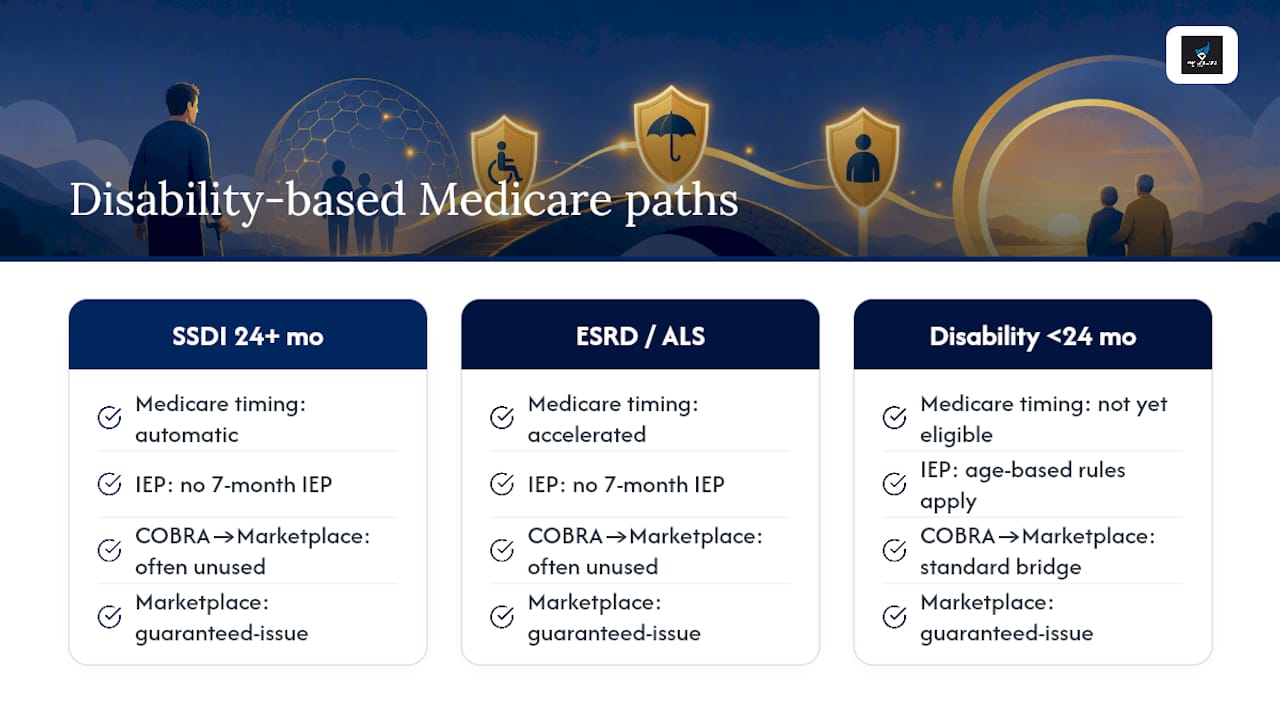
Not everyone waits until 65 for Medicare. People who have received Social Security Disability Insurance benefits for 24 months generally qualify for Medicare automatically, regardless of age, and that enrollment happens without the seven-month Initial Enrollment Period calculation that applies to age-based eligibility. If you're in this situation, your bridge-coverage timeline looks completely different from a standard early retiree's, often much shorter.
People with End-Stage Renal Disease or amyotrophic lateral sclerosis also qualify for Medicare on accelerated timelines that don't follow the standard 65th-birthday clock. If either applies to you or a household member, the COBRA-then-Marketplace sequence described earlier may be unnecessary. Medicare eligibility could arrive well before you'd otherwise need it.
For those managing a disability that doesn't yet meet the 24-month SSDI threshold, the standard bridge options apply, but with one added wrinkle: ACA Marketplace plans remain guaranteed-issue regardless of disability status, so a disability alone never blocks Marketplace enrollment or triggers higher pricing. Short-term and indemnity plans are a different story. They can and often will deny coverage or exclude disability-related conditions, making the Marketplace the more reliable option for anyone managing an ongoing condition during the bridge years. Anyone in this situation should talk with a licensed agent about how disability-based Medicare eligibility timing interacts with any current employer or COBRA coverage, since the rules diverge from the standard age-65 path in ways that are easy to miss.
What Actually Happens When You Let Coverage Lapse?
A coverage gap before 65 isn't just an inconvenience. It's a direct financial exposure with a few distinct failure modes. The most obvious is medical debt: a single emergency room visit or short hospital stay without insurance can run into five figures fast, and that bill doesn't negotiate itself down the way an insurer's contracted rate would.
The subtler risk shows up at your next enrollment point. If your gap runs past your Special Enrollment Period window without a new qualifying event, you may be stuck waiting for the next open enrollment period, extending an unplanned gap into months rather than weeks. And while ACA plans can't deny you for a pre-existing condition once you do enroll, a short-term or indemnity plan bought to cover a gap can absolutely use that gap's timing against you if a new condition developed during it.
There's also a compounding effect that's easy to underestimate: people who skip routine care during a coverage gap, whether that's a mammogram, a blood pressure check, or a prescription refill, tend to catch problems later and at a higher cost, both medically and financially. Panic Proof Retirement's analysis of pre-Medicare coverage points out that the households who fare best treat the bridge years as a continuous coverage problem to solve in advance, not a gap to patch reactively after something goes wrong.
How Do You Keep End Dates and Start Dates From Ever Overlapping?
The single most common, and most avoidable, mistake in this entire process is a calendar error: canceling one plan before the next one actually starts. Coverage doesn't autopilot itself into alignment. You have to build the calendar yourself.
Start by getting the exact termination date of your employer coverage in writing from HR, not just a verbal estimate. Then work backward: if you're electing COBRA, confirm your coverage is retroactive to that exact termination date, since COBRA elections made within the 60-day window do cover you back to day one. If you're heading straight to a Marketplace plan, confirm your Special Enrollment Period application requests a coverage start date that matches your employer plan's end date exactly, not the first of the following month by default, which is a common error.
For the spouse's-plan route, get written confirmation from your spouse's HR department of the exact enrollment effective date before you cancel anything else. And if you're timing a transition into Medicare, confirm your Part A and Part B effective dates line up with your last day of bridge coverage, since Medicare's start date depends on when you enroll relative to your birthday month, not when you happen to apply.
A simple rule covers most of this: never cancel existing coverage until you have written confirmation, not just a submitted application, that the next plan's start date is locked in.
What I Tell People Who Wait Too Long
The costliest mistakes I see are rarely about picking the wrong plan. They're about sequencing and timing: electing COBRA a week too late, guessing at income instead of modeling it, or assuming bridge coverage delays Medicare's clock when it doesn't. Price three real scenarios this week, not someday, and put every deadline on a calendar before you touch a single retirement account. If the math feels tangled, that's exactly what a licensed agent is for.
— Shereka
How Family Guard Life and Health Helps You Bridge the Gap
Family Guard Life and Health works with early retirees on exactly this problem: matching ACA and private plan enrollment, Medicare timeline coaching, and HSA guidance to your actual numbers, not a generic rule of thumb. We are licensed in multiple states, and every recommendation is checked against your specific state's rules before you commit to anything.

What that looks like in practice: an agent runs county-level Marketplace quotes at two or three MAGI scenarios so you can see exactly how a Roth conversion or an IRA withdrawal changes your premium tax credit before you make the move, not after. We coordinate the coverage calendar too. COBRA election dates, Marketplace start dates, and Medicare enrollment windows all lined up so there's no gap and no early scramble. If you're within a year or two of leaving employer coverage, the smartest move is getting your specific numbers modeled now, while you still have time to adjust. Start a consultation with Family Guard Life and Health and bring your rough retirement date, your expected household income, and any ongoing treatments. We'll confirm licensing for your state and build the bridge from there.