

If your 2024 income (MAGI) topped $109,000 as an individual or $218,000 filing jointly, IRMAA Medicare surcharges apply to your 2026 Part B and Part D premiums automatically. The added cost ranges from roughly $75 to $443 more per month for Part B alone, plus a separate Part D surcharge. Both are billed on top of your standard premium, and you can appeal through Form SSA-44 if your income has since dropped.
TL;DR:
- IRMAA surcharges for 2026 start at an income of $109,000 for individuals and $218,000 for joint filers, with the highest tiers adding up to $443 extra per month for Part B.
- The surcharges are calculated based on MAGI from two years prior, including various income sources such as taxable pensions, capital gains, and Roth conversions, which may surprise beneficiaries.
- A single high-income year can trigger higher premiums two years later, making large sales or conversions a key focus for income management and planning.
- Appeals for IRMAA adjustments are possible through Form SSA-44 if income changes due to specific life events like job loss or death, but most beneficiaries do not proactively seek them.
- Most people pay IRMAA through automatic deductions from Social Security benefits, but unpaid surcharges may lead to plan disenrollment or separate bills, emphasizing the need for careful documentation and timely appeals.
Table of Contents
- What Are the 2026 IRMAA Brackets for Medicare?
- How Is IRMAA Calculated From Your Tax Return?
- What Are the 2026 Part B Surcharge Amounts?
- How Does Part D IRMAA Work in 2026?
- Who Actually Pays IRMAA Surcharges?
- How Do You Appeal an IRMAA Determination?
- How Is IRMAA Billed and What Happens if You Don't Pay?
- Can You Reduce Your MAGI to Avoid IRMAA?
- How Family Guard Life and Health Helps With IRMAA Planning
- Where to Verify These Figures Yourself
- What People Get Wrong About IRMAA
- Sources
What Are the 2026 IRMAA Brackets for Medicare?
The 2026 standard Part B premium is $202.90 a month. That's the baseline everyone pays before any income adjustment. IRMAA Medicare surcharges stack on top of that number in five tiers, and each tier applies per person, not per household. A married couple who both cross the same threshold each pays their own surcharge, doubling the household impact even though it feels like one income number triggered it.
Here's the quick reference for 2026, based on 2024 MAGI:
Corresponding Part B and Part D surcharges apply starting at this income range | | — | Higher corresponding Part B and Part D surcharges apply | | — | Even higher corresponding Part B and Part D surcharges apply | | — | Substantially higher Part B and Part D surcharges apply | | — | Top-tier Part B and Part D surcharges apply |
These figures come from CMS's 2026 fact sheet and match the ranges published in SSA's POMS guidance. Married couples filing separately face a much steeper ladder, which the filing-status section below covers in detail. One thing that trips people up: the bracket that applies in 2026 isn't based on this year's income at all.
How Is IRMAA Calculated From Your Tax Return?
IRMAA Medicare surcharges run on Modified Adjusted Gross Income, or MAGI, which is your Adjusted Gross Income plus tax-exempt interest. It's a broader number than most people expect, and it catches income sources beneficiaries don't always think of as "income" for Medicare purposes.
MAGI for IRMAA purposes includes:
- Wages, self-employment income, and taxable pensions
- Capital gains from selling stock, a business, or a second home
- The taxable portion of Social Security benefits
- Traditional IRA and 401(k) distributions, including Roth conversion amounts
- Tax-exempt municipal bond interest
The two-year lookback is the part that catches people off guard. Your 2026 Part B and Part D premiums are set using your 2024 tax return, the most recent one the IRS had on file when SSA ran its determinations. If 2024 data wasn't available, SSA falls back to your 2023 return. That two-year gap means a single high-income year, a big Roth conversion or a home sale, won't hit your premium until two years later, often after the income event is long forgotten.
The administrative flow works like this: the IRS sends SSA your MAGI data, SSA matches it against the CMS-published thresholds, and CMS is the agency that sets the dollar amounts each year. SSA then mails you a determination notice, separate from your regular Medicare mail, telling you which tier applies and why. Save that notice. It's the document you'll need if you ever appeal.
What Are the 2026 Part B Surcharge Amounts?
Part B IRMAA is where most beneficiaries feel the pinch first, since it's deducted the same way your base premium is. SSA describes the surcharge using a "percentage of true cost" framework: a standard enrollee covers about 25% of Part B's actual program cost through premiums, while the highest IRMAA tier covers up to 85%.
Pro Tip: Don't confuse the surcharge amount with the total premium. The tables above list the full monthly Part B premium, including the base $202.90, not just the added surcharge portion.
Consider two examples. A single retiree with $150,000 in 2024 MAGI lands in the second tier, paying $405.90 a month for Part B, or $2,436 more per year than the standard premium. A married couple where each spouse reports $160,000 in individual MAGI (each filing individually within a joint return context) both sit in that same tier, so the household pays double: roughly $4,872 more annually combined.
That jump from 25% to 85% is the real story behind IRMAA Medicare. It's not a flat penalty. It's a sliding scale where the government's share of your Part B cost shrinks as your income climbs, until the top tier covers more than three times the standard share.
How Does Part D IRMAA Work in 2026?
Part D IRMAA works differently from Part B in one key way: it's added to whatever premium your specific drug plan charges, not to a single national number. The Part D national base premium for 2026 is $38.99, but your actual plan premium could be higher or lower depending on the insurer and formulary you chose.
The 2026 Part D surcharge tiers, using the same 2024 MAGI brackets as Part B:
- Standard: $0 surcharge
- Tier 1: $14.50 added monthly
- Tier 2: $37.50 added monthly
- Tier 3: $60.60 added monthly
- Tier 4: $83.60 added monthly
- Tier 5: $91.20 added monthly
So if you're in Tier 2 and your chosen Part D plan charges $45 a month, your actual total is $82.50, not $37.50. That surcharge gets added regardless of which plan you pick or how much that plan's base premium runs.
Collection works the same way as Part B in most cases: SSA deducts it directly from your Social Security check when you're already receiving benefits. If you're not collecting Social Security yet, or if your benefit isn't large enough to cover the full deduction, you'll get a separate bill, either from SSA directly or coordinated with your Part D plan.
Who Actually Pays IRMAA Surcharges?
Every Medicare enrollee is assessed individually, even within a married household. There's no such thing as a "household IRMAA" that one spouse absorbs for both. If both spouses are enrolled in Medicare and both report income above the threshold, both pay a surcharge, calculated on each person's own MAGI relative to their filing status bracket.
Married filing separately gets penalized hard. Instead of the wide $218,000 joint threshold, MFS filers hit the second IRMAA tier at just $109,001 in individual MAGI, essentially the same cliff as a single filer, but with far less room before the surcharge climbs.
Common income events that push people over a threshold without warning:
- A large capital gain from selling investment property or a business
- A Roth IRA conversion timed to reduce future required minimum distributions
- A high-dividend year from a taxable brokerage account
- Selling a long-held rental property in one lump-sum year
How Do You Appeal an IRMAA Determination?
Form SSA-44 exists for exactly this situation: your MAGI from two years ago doesn't reflect your income today because something changed. SSA accepts appeals tied to specific, documented life-changing events, not general complaints that the surcharge feels unfair.
- Confirm your event qualifies: marriage, divorce, death of a spouse, work stoppage, work reduction, loss of income-producing property, loss of pension income, or an employer settlement.
- Gather supporting documentation. A termination letter works for job loss; a death certificate for a spouse's passing; a signed statement from a former employer for pension loss.
- Complete Form SSA-44 and submit it to your local Social Security office, either by mail or in person.
- Attach your best estimate of current-year income along with the documentation.
- Wait for SSA's written determination, and keep a copy for your records.
Pro Tip: File as soon as you have documentation in hand. SSA can apply an approved SSA-44 retroactively to the start of the premium year, so waiting costs you money you could otherwise recover.
Decisions typically arrive within a few weeks when documentation is clear and complete. If SSA denies the appeal, you can request a formal reconsideration.
How Is IRMAA Billed and What Happens if You Don't Pay?
Most beneficiaries never write a check for IRMAA specifically. If you're already receiving Social Security or Railroad Retirement Board benefits, SSA deducts the surcharge directly from your monthly check, bundled with your standard Part B premium as one combined withholding.
- If you haven't started Social Security yet, you'll get a direct bill from SSA or your Part D carrier.
- Your Part B surcharge shows up as part of the same withholding line as your base premium, not as a separate deduction.
- Part D surcharges may appear on a separate statement from your drug plan, depending on how your plan coordinates billing with SSA.
- Unpaid Part D IRMAA is the riskier one: falling behind can lead to disenrollment from your Part D plan, unlike Part B, where SSA typically pursues collection through other means first.
Keep every notice SSA sends. Predetermination and initial determination letters arrive separately from your regular Medicare mail, and they're the paper trail you'll need if a bill looks wrong or you decide to appeal.
Can You Reduce Your MAGI to Avoid IRMAA?
Since your 2026 premium is based on 2024 income, the real leverage point for avoiding future IRMAA Medicare surcharges is planning two years ahead, not reacting to this year's bill. A handful of decisions made now shape what SSA sees on your return in two years.
Roth conversions are the classic example. Converting a large traditional IRA balance in one year can spike your MAGI enough to trigger a higher tier two years later, even though the conversion itself isn't "income" in the traditional sense. The same logic applies to selling appreciated stock or property in a single tax year rather than spreading the gain across multiple years. Industry guidance on MAGI drivers consistently points to these lump-sum events as the most common surprise triggers.
Practical tactics worth discussing with a tax professional or financial advisor:
- Stagger Roth conversions across several smaller years instead of one large one
- Harvest capital losses in the same year as planned gains to offset MAGI
- Time annuity or IRA withdrawals to smooth income rather than front-load it
- Use qualified charitable distributions from an IRA in years when income is already elevated, since QCDs don't count toward MAGI
Pro Tip: Run the two-year lookback math before any big financial move. A withdrawal or sale that looks fine on this year's tax bill can quietly cost you thousands in extra Medicare premiums two years from now.
Annuity income deserves its own look here, since payout structure affects how much of each distribution counts toward MAGI. Family Guard Life and Health's piece on annuity taxes in retirement breaks down how different annuity types get taxed, and the Part B giveback benefit explains a separate mechanism that can offset some premium costs for eligible enrollees. None of this replaces a conversation with a licensed advisor who can see your full tax picture.
How Family Guard Life and Health Helps With IRMAA Planning
Family Guard Life and Health is licensed across 22 states, helping retirees plan around income cliffs like IRMAA before they hit. Clients typically come to us either mid-crisis, staring at a surprise surcharge notice, or proactively, structuring withdrawals to avoid one. We also help clients gather documentation and file Form SSA-44 correctly the first time. If you want a second set of eyes on your Medicare income strategy, reach out to our team.
Where to Verify These Figures Yourself
Start with CMS's 2026 Medicare Parts A & B premium fact sheet for the official standard premium and IRMAA tables. SSA's POMS HI 01101.031 lays out the calculation policy language and percentage-of-cost tiers in full regulatory detail. The Medicare.gov 2026 costs PDF offers a consumer-friendly summary of the same numbers. And if you're appealing, Form SSA-44 is the exact document you'll need, along with its instructions on qualifying events and acceptable evidence.
What People Get Wrong About IRMAA
Most people treat IRMAA like a tax bracket, something you can see coming and plan around in real time. It doesn't work that way. The two-year lookback means the beneficiaries who get blindsided aren't usually high earners who expect a surcharge. They're retirees who sold a house, converted a chunk of a 401(k), or had one unusually good investment year, then forgot about it entirely by the time SSA's letter shows up.
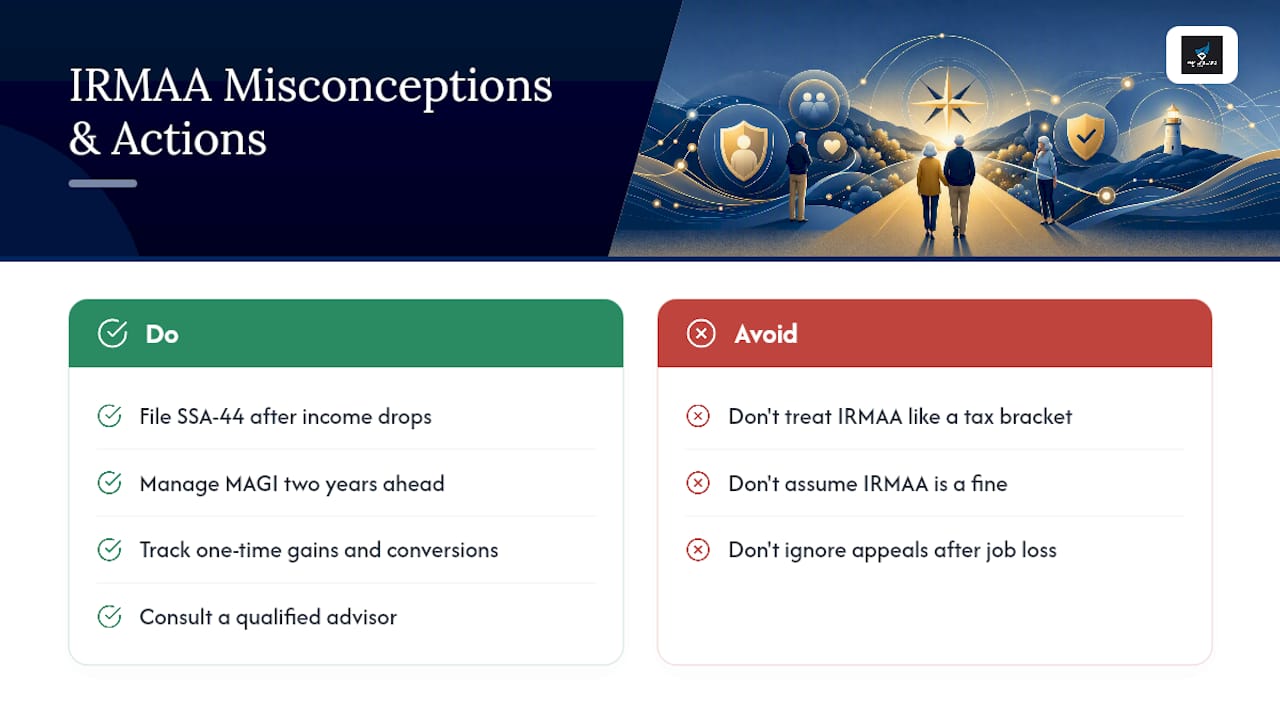
The bigger misconception is thinking of IRMAA as punitive. You're not being fined for earning money. You're simply receiving less government subsidy as your ability to pay increases. That distinction matters for how you plan, because it means the fix isn't complaining about fairness, it's managing MAGI two years in advance.
The appeals process is underused, too. SSA-44 exists precisely because lookback income doesn't always reflect current reality, yet plenty of eligible retirees never file it after a job loss or a spouse's death simply because they don't know the form exists. If your income dropped and you're still paying a surcharge based on a better year, that paperwork is worth ten minutes of your time.
— Shereka
This article is general information, not a substitute for advice from a qualified financial advisor. Consult a qualified financial professional about your own circumstances before acting on anything here.
Sources
- 2026 Medicare Parts A & B Premiums and Deductibles | CMS
- HI 01101.031 How IRMAA is Calculated and How IRMAA Affects the Total Medicare Premium
- 2026 Medicare costs