

Plan G buys predictability. Plan N buys a lower monthly bill in exchange for small, capped copays and exposure to Part B excess charges. If you visit doctors often, want zero surprise bills, or your providers don't accept Medicare assignment, choose Plan G. If you're healthy, your doctors accept assignment, and you'd rather save on premium, Plan N usually wins.
TL;DR:
- Plan N generally offers lower monthly premiums but exposes enrollees to copays of up to $20 for office visits and $50 for certain emergency room visits.
- Plan G covers Medicare Part B excess charges in full, while Plan N leaves these charges on the beneficiary if providers do not accept Medicare assignment.
- The cost savings of Plan N versus Plan G depend heavily on individual healthcare usage and whether doctors bill above Medicare rates, making personal estimates essential.
- Premium differences between the plans vary based on the insurer's rating method and your ZIP code, with Plan N typically costing less on average.
- Switching plans outside the open enrollment period requires medical underwriting unless qualifying for guaranteed issue due to specific circumstances.
Table of Contents
- Plan G vs Plan N: The Quick Comparison
- How Do Excess Charges and Copays Actually Work?
- What Do Plan G and Plan N Actually Cost?
- Which Plan Fits Your Situation?
- When Can You Switch Between Plan G and Plan N?
- An Agent's View on Plan G Versus Plan N
- Get a Personalized Medigap Quote
- Where to Verify the Numbers Yourself
- Sources
- FAQ
Plan G vs Plan N: The Quick Comparison
Both plans cover the same long list of core Medigap benefits. That's the part almost nobody argues about. Where they split is narrow but financially meaningful.
Plan G and Plan N both cover:
- Part A hospital coinsurance and coverage for an extra 365 days after Medicare benefits run out
- Part A hospice care coinsurance or copayments
- The first three pints of blood each year
- Skilled nursing facility coinsurance
- Part A deductible
- Foreign travel emergency care, up to plan limits (typically 80% of costs after a $250 deductible, capped at plan maximums)
Neither plan touches the Part B deductible, which CMS has set for 2026. You pay that out of pocket regardless of which plan you buy, so don't let a sales pitch tell you otherwise.
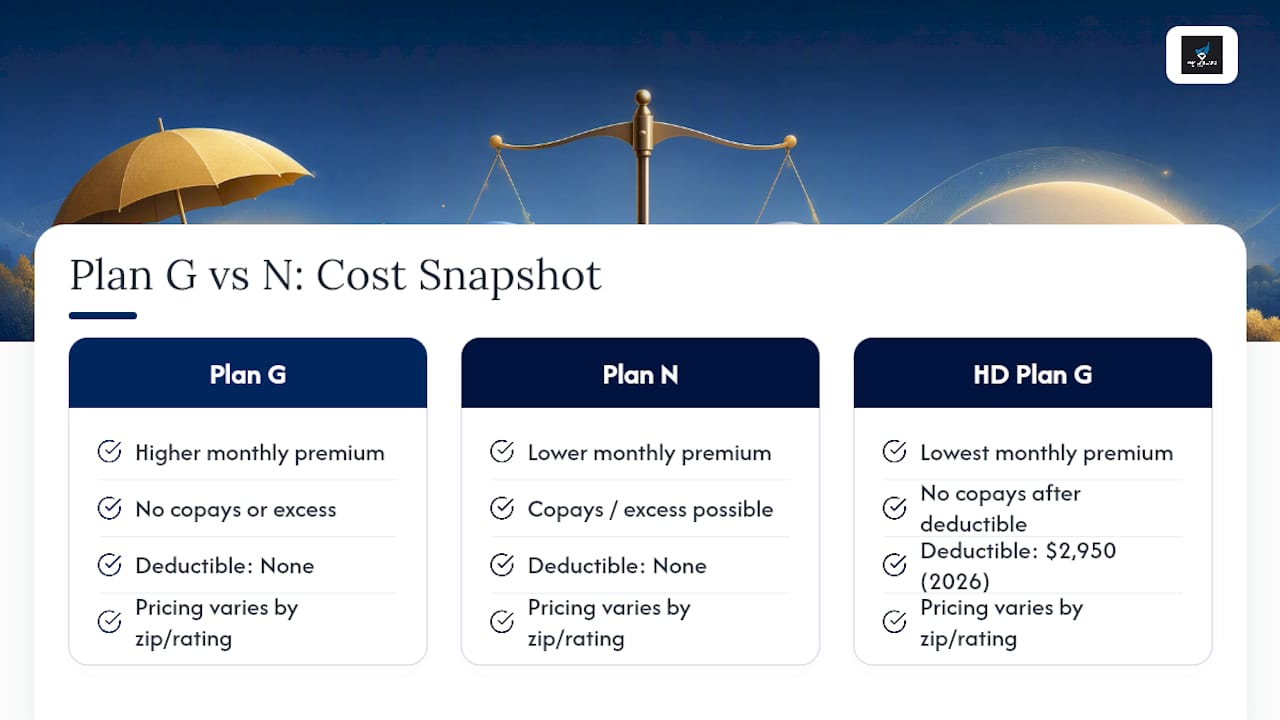
The two real differences are these: Plan G covers Medicare Part B excess charges in full; Plan N does not. And Plan N charges small copays for some office visits (up to $20) and some emergency room visits that don't lead to admission (up to $50); Plan G charges neither. Everything else on the Medigap benefits comparison chart is identical between the two.
How Do Excess Charges and Copays Actually Work?
The terms sound abstract until you see them applied to a real bill. Here's the mechanics.
A Part B excess charge happens when a doctor doesn't "accept assignment," meaning they don't agree to Medicare's approved payment as full payment. In that case, the provider can bill you up to a limiting charge, generally capped at approximately 15% above Medicare's approved amount. Plan G pays that difference. Plan N leaves it on you.
Plan N's copays apply differently depending on the visit:
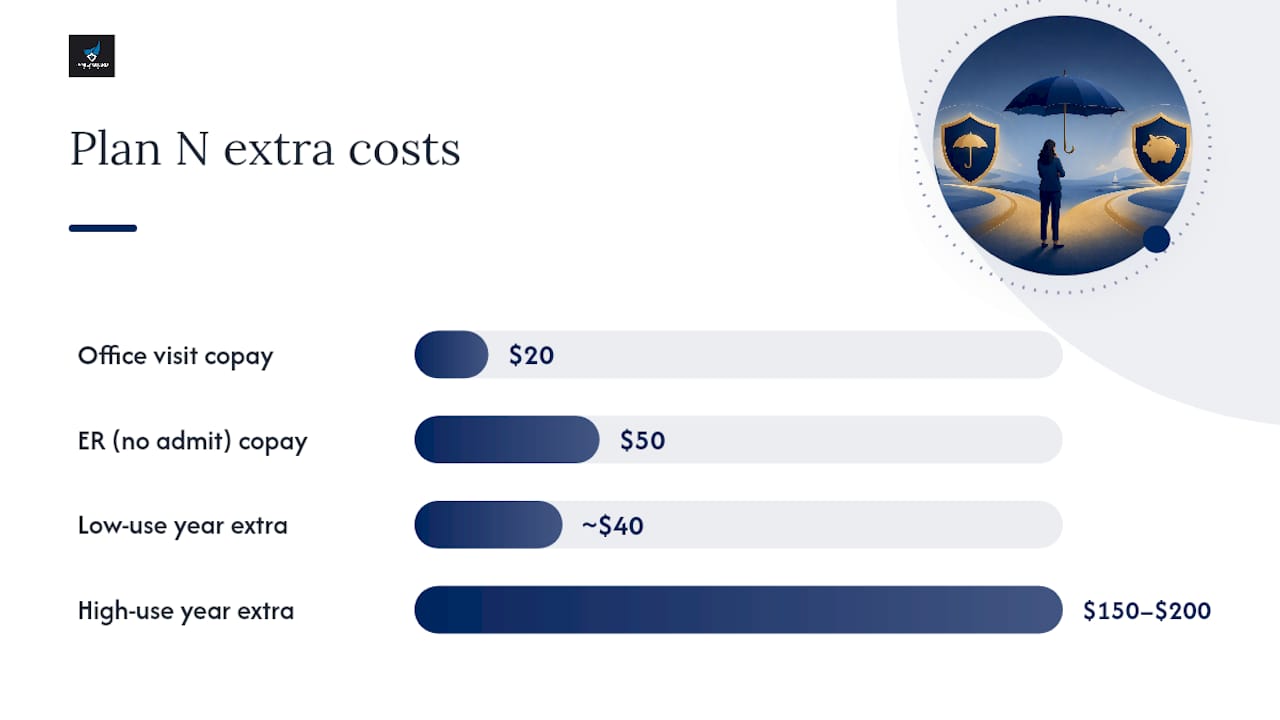
- Office visit: you may owe up to $20 per visit, and Plan N covers the rest of the Part B coinsurance.
- ER visit that doesn't result in inpatient admission: you may owe up to $50, on top of any Part B deductible still owed for the year.
- ER visit that does result in admission: the copay is waived, and the visit is treated under standard Part B cost sharing.
Quick math: A low-use year, say two office visits and no ER trips, might cost a Plan N holder around $40 more in copays than a Plan G holder, assuming both providers accept assignment. A high-use year with a handful of specialist visits and one ER trip that doesn't lead to admission could add up to $150 to $200 in Plan N copays, plus whatever excess charges apply if any provider doesn't accept assignment. Providers who don't accept assignment are the wildcard: they can turn a "cheap" Plan N year into an expensive one fast, since Plan G would have absorbed that limiting charge automatically.
What Do Plan G and Plan N Actually Cost?
Premiums for both plans vary more by your zip code and insurer's rating method than by the plan letter itself. That's the part people underestimate.
Insurers price Medigap policies three ways: issue-age rated (premium locked to your age when you bought the policy), attained-age rated (premium climbs as you age), and community-rated (everyone in the area pays the same regardless of age). Two people with identical health and identical coverage can pay wildly different premiums depending on which rating method their carrier uses and which state they live in. This is why running a quote for your actual zip code matters more than reading a national average.
Generally, Plan N runs cheaper than Plan G by a noticeable monthly margin, according to comparisons of typical premium ranges across markets. Whether that savings beats the copay and excess-charge exposure depends entirely on how often you use care and whether your doctors bill at Medicare's approved rate.
High-deductible Plan G offers a third path. You pay a much lower premium in exchange for covering your own costs up front until you hit an annual deductible. For 2026, CMS set that deductible at $2,950 for Plans F, G, and J. Once you've paid that amount out of pocket in Medicare-covered costs and the Part B deductible, the plan pays like standard Plan G for the rest of the year. Eligibility depends on your Medicare effective date, so check with a licensed agent before assuming you qualify.
Which Plan Fits Your Situation?
Run through these questions honestly before you compare a single premium quote:
- How often do you see doctors or specialists? Frequent visits favor Plan G, since copays on Plan N add up fast across multiple appointments a year.
- Do your providers accept Medicare assignment? If any regular provider doesn't, Plan G's excess-charge coverage becomes far more valuable than the premium gap suggests.
- What's your monthly budget ceiling? If the premium difference is tight, Plan N's lower cost might matter more than the copay risk, especially if you're healthy.
- Can you tolerate an unpredictable bill? Plan G removes that variable entirely. Plan N trades some of that certainty for savings.
- Do you travel internationally? Both plans cover foreign travel emergencies identically, so this one's a wash.
The calculator logic is simple: take the annual premium difference between Plan G and Plan N for your zip code, then compare it to your realistic estimate of copays plus a buffer for possible excess charges. Say Plan N saves you $300 a year in premium. If you expect two office visits (up to $40 in copays) and your providers all accept assignment, Plan N comes out ahead. If you expect five specialist visits, an ER trip, and one provider who bills above the Medicare rate, Plan G likely saves you money over the year, not just headaches.
Pro Tip: Ask your doctor's billing office directly whether they "accept Medicare assignment." Don't assume, since even providers in a Medicare network can bill above the approved amount on certain services.
Red flags that point toward Plan G: chronic conditions requiring regular specialist care, a provider you love who doesn't accept assignment, or a low tolerance for surprise bills. Signals that point toward Plan N: good health, providers who consistently accept assignment, and a preference for lower fixed costs over ironclad predictability.
When Can You Switch Between Plan G and Plan N?
Your best pricing and easiest approval come during the six-month Medigap open enrollment period, which starts the month you turn 65 and have Part B active. During this window, insurers generally can't use medical underwriting or charge you more for health conditions, according to Medicare's enrollment guidelines.
Outside that window, switching plans usually requires medical underwriting, unless you qualify for a guaranteed-issue right. Common guaranteed-issue triggers include:
- Your current plan's insurer leaves the market or goes insolvent
- You lose employer group coverage that was paying secondary to Medicare
- You moved out of your plan's service area
The agent checklist for Medicare guaranteed-issue rights breaks down the exact 63-day window and paperwork these situations require. If none of those apply, shop carefully: get quotes from multiple carriers, ask each one directly what rating method they use, and request any underwriting decision in writing before you cancel an existing policy.
An Agent's View on Plan G Versus Plan N
Working across 22 states gives you a wide lens on how people actually choose between these two plans, and the pattern holds up more often than not: healthy, budget-conscious enrollees who've confirmed their doctors accept assignment tend to gravitate toward Plan N. Enrollees managing a chronic condition, or those who've been burned once by an unexpected bill, tend to land on Plan G and stay there.
The clients who second-guess their choice later are almost always the ones who skipped the assignment question. One client assumed Plan N's lower premium was a clear win, only to discover her specialist billed above the Medicare rate, turning a "savings" plan into a costlier one within a single year. Another, in excellent health with a small network of assignment-accepting doctors, saved meaningfully on Plan N with zero regrets after two years.
The lesson isn't which plan is objectively better. It's that the checklist matters more than the marketing.
— Shereka
Get a Personalized Medigap Quote
Comparing Plan G and Plan N on paper only gets you so far. What actually moves the decision is your zip code's real premium spread and whether your specific doctors accept assignment, and that's exactly where a licensed agent earns their keep.

We work with clients to pull real quotes for both plans, explain rating methods carriers use, and help determine whether a guaranteed-issue right applies to your situation. When you reach out, expect a straightforward conversation: your current coverage, your typical care needs, and a side-by-side quote for Plan G and Plan N in your area, plus help with any required paperwork if you're switching. Availability and specific carrier options depend on your state. Visit the Family Guard Life and Health landing page to request a personalized quote and find out which plan actually fits your numbers.
Where to Verify the Numbers Yourself
Every figure in this article traces back to a federal source, and you should confirm them yourself before enrolling. Medicare's Compare Medigap Plan Benefits tool lays out the full benefit grid for every lettered plan, side by side. CMS publishes the annual Part B premium and deductible figures that determine your out-of-pocket exposure each year, along with the high-deductible Plan G, F, and J amounts.
For enrollment timing questions, the Medicare enrollment timeline guide and the guaranteed-issue rights checklist cover the deadlines and paperwork in more depth than this article has room for.
This article is general information, not a substitute for advice from a qualified financial advisor. Consult a qualified financial professional about your own circumstances before acting on anything here.
FAQ
What Is the Disadvantage of Plan G?
Plan G's main drawback is cost: it carries a higher monthly premium than Plan N, and you still pay the annual Part B deductible out of pocket before coverage kicks in fully.
What Are the Disadvantages of Plan N?
Plan N leaves you responsible for Part B excess charges from providers who don't accept assignment, plus copays of up to $20 for some office visits and up to $50 for some ER visits that don't lead to admission.
How Much Cheaper Is Plan N Than Plan G?
The gap varies by state, insurer, and rating method, so there's no single national number. Published market comparisons show Plan N typically runs cheaper on premium, but the only way to know your actual savings is to run quotes for your specific zip code.
Should I Switch From Plan G to Plan N?
Only if you're in good health, your providers accept Medicare assignment, and the annual premium savings outweighs your realistic estimate of Plan N's copays. Switching outside your Medigap open enrollment period may require medical underwriting unless a guaranteed-issue right applies.
Does Either Plan Cover the Part B Deductible?
No. Neither Plan G nor Plan N covers the Medicare Part B deductible; both leave that amount to the beneficiary each year.