

If you qualify for a subsidy, a Marketplace plan almost always beats COBRA on price. If you're mid-treatment, close to meeting your deductible, or need to keep the exact same doctors, COBRA can still be worth the higher cost. Either way, your clock is running: pull your COBRA premium quote and run a Marketplace eligibility check today, both take under 15 minutes, and you have 60 days to decide.
TL;DR:
- Marketplace subsidies often make plans cheaper than COBRA unless your income exceeds 400% FPL or you have ongoing treatment needs.
- COBRA maintains your existing network, deductible, and drug coverage, which can be advantageous during ongoing or expensive treatments.
- Your COBRA window begins immediately after job loss, with an election period of 60 days; Marketplace enrollment runs on a separate 60-day special period from plan end date.
- COBRA costs include your former employer’s full premium plus up to 2%, often resulting in several hundred to over a thousand dollars monthly for families.
- It is crucial to verify provider networks and formulary coverage on new Marketplace plans before switching, especially if undergoing surgeries or ongoing treatments.
Table of Contents
- COBRA vs. Marketplace Insurance: How the Enrollment Windows Actually Work
- Cost Comparison: The COBRA Formula vs. the Marketplace Subsidy Math
- Does COBRA Protect Your Deductible and Provider Network Better?
- Which Situations Favor COBRA, and Which Favor Marketplace?
- How to Compare COBRA and Marketplace Before Your 60 Days Run Out
- What a Licensed Agent Actually Checks Before You Decide
- Cost or Continuity: What Actually Should Decide This for You
- Get Help Comparing COBRA and Marketplace Coverage
- Where to Verify These Rules Yourself
- Sources
- FAQ
COBRA vs. Marketplace Insurance: How the Enrollment Windows Actually Work
Losing job-based coverage triggers two separate 60-day clocks, and they don't work the same way. Marketplace enrollment runs on a Special Enrollment Period that starts the day your old plan ends. Miss it, and you're typically stuck waiting for Open Enrollment in the fall. COBRA gives you a separate 60-day election window from the date you receive your COBRA notice, and it's retroactive to your last day of employer coverage. That retroactivity matters: you can wait almost the full 60 days to elect COBRA, and if you get sick or injured in week three, you're still covered once you sign up and pay.
The effective dates differ too. Marketplace coverage usually starts the first of the following month. COBRA fills the entire gap behind it.
In your first two weeks after job loss:
- Confirm your COBRA notice arrival date and read the exact deadline.
- Create a HealthCare.gov account and check subsidy eligibility.
- Gather pay stubs, severance letters, and your COBRA premium quote.
- Call your doctors' offices to ask which plans they accept.
Cost Comparison: The COBRA Formula vs. the Marketplace Subsidy Math
COBRA's price is simple math: your former employer's full group premium, plus up to a 2% administrative fee. Your employer isn't chipping in anymore, so you inherit the whole bill, including the share they used to cover. KFF's guidance notes this often runs several hundred to well over a thousand dollars a month for family coverage.
Marketplace pricing works differently. Premiums are set by your age, location, and projected household income, and your subsidy shrinks or disappears as income rises.
2026 statistic callout: The pandemic-era enhanced tax credits expired at the end of 2025. For 2026, subsidy eligibility snaps back to the 100%–400% FPL band, the so-called subsidy cliff. Cross 400% of the federal poverty line and you pay full price with no help at all.
Two quick scenarios:
- A 29-year-old earning $38,000 a year likely lands well within the subsidy band and could pay $50 to $150 a month for a decent Marketplace plan.
- A married couple in their early 60s earning $95,000 combined may sit above 400% FPL depending on household size and state, paying full, unsubsidized Marketplace premiums that can rival or exceed COBRA.
Pro Tip: Run your Marketplace quote before assuming you're "too high income" for a subsidy. The FPL thresholds shift with household size, and losing a job often drops your actual 2026 income lower than you'd expect.
Does COBRA Protect Your Deductible and Provider Network Better?
COBRA keeps you inside the exact plan you already had. Same doctors, same deductible progress, same drug formulary, nothing resets. If you've already paid $4,000 toward a $5,000 deductible in March, switching to a new Marketplace plan in April usually means starting that deductible over at zero.
Marketplace plans can shift the ground under you in ways that cost real money:
- A new plan's network might exclude your specialist, forcing an out-of-network bill.
- A different formulary tier can turn a $10 prescription into a $200 one.
- A fresh deductible means you pay full price for care again until you hit the new threshold.
Before deciding, call your plan's member services line and ask two things: is my doctor in-network on the specific Marketplace plan I'm considering, and is my medication covered at the same tier? Five minutes on the phone can save you thousands.
Pro Tip: If you're scheduled for surgery or mid-course in physical therapy, ask your provider's billing office how a plan switch would affect your treatment cost specifically. They see this every week and can flag problems you won't think of.
Which Situations Favor COBRA, and Which Favor Marketplace?
Match your situation to the option that actually fits it, rather than the one that sounds better in theory.
- Choose COBRA if: you've made major progress toward your deductible, you have a scheduled surgery or ongoing treatment, your income lands above 400% FPL, or you just need a short bridge until a new job's insurance kicks in.
- Choose Marketplace if: your income qualifies for a subsidy, you need coverage for the long haul rather than a few months, or your old employer plan was expensive to begin with (meaning COBRA just extends that expense).
- **Check Medicaid first if income dropped sharply. Many people who lost a job qualify for free or nearly free coverage through Medicaid, especially in expansion states, and that beats both COBRA and Marketplace on cost every time.
How to Compare COBRA and Marketplace Before Your 60 Days Run Out
- Pull together your COBRA notice, your former employer's premium amount, any severance agreement, and your household size.
- Estimate your realistic full-year 2026 income, including severance and unemployment benefits, not just your old salary.
- Run that number through a Marketplace quote to see your subsidy and net premium.
- Call your top two providers and pharmacy to confirm network and formulary status on the Marketplace plan you're considering.
- Compare the true monthly cost of COBRA (premium plus 2%) against your subsidized Marketplace premium, factoring in deductible reset risk.
- Leave your COBRA election open until you've confirmed a Marketplace start date, since COBRA's retroactivity gives you a safety net.
Common estimating mistakes to avoid:
- Forgetting to count severance pay as income for the year it's received.
- Using your old annual salary instead of your actual part-year earnings.
- Assuming unemployment benefits don't count toward household income (they usually do).
What a Licensed Agent Actually Checks Before You Decide
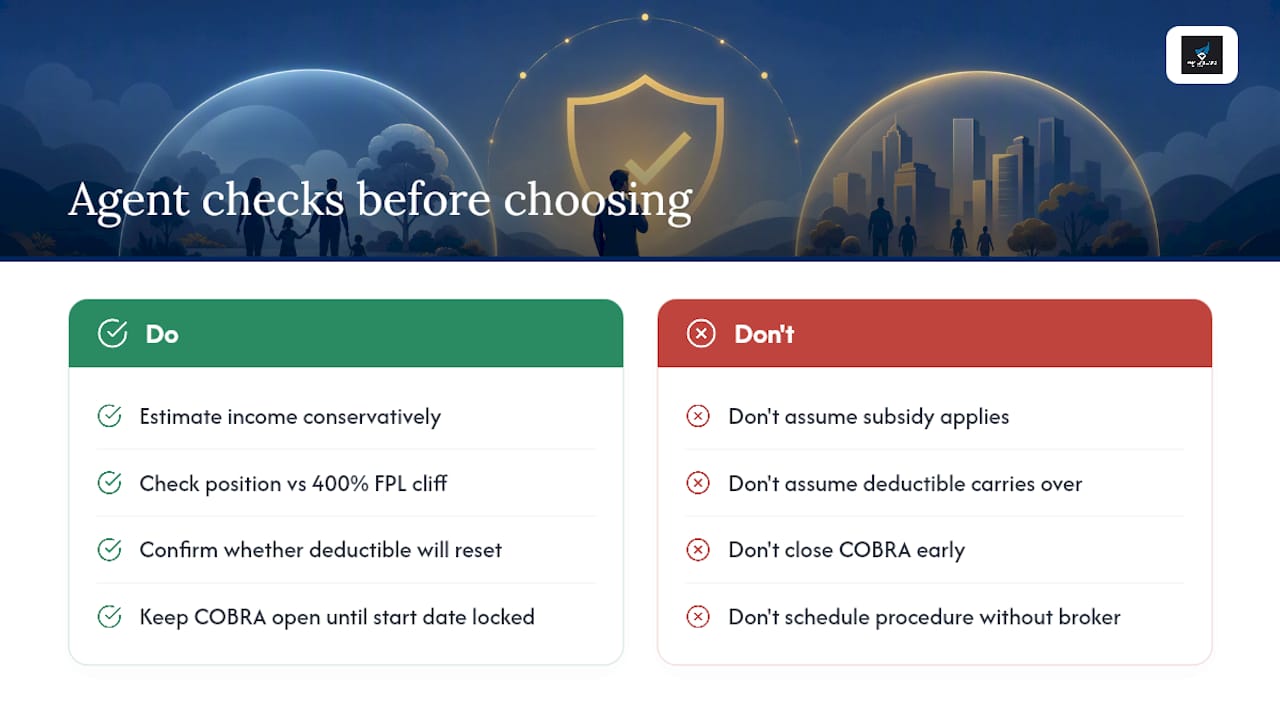
Licensed agents run this comparison daily, and a few habits separate a good decision from a costly guess. Estimate income conservatively rather than optimistically. Watch where you land relative to the 400% FPL cliff before assuming a subsidy applies. Assume a deductible reset unless you've confirmed otherwise. And keep your COBRA election open as a fallback until your Marketplace start date is locked in.
Licensed agents can run eligibility checks, verify whether your specific doctors sit inside a Marketplace network, and pull side-by-side quotes. If you're weighing a scheduled procedure against a subsidy estimate, that's exactly the moment to loop in a broker rather than guess. Bring your COBRA notice, a rough income estimate, and your provider list to the conversation.
Cost or Continuity: What Actually Should Decide This for You
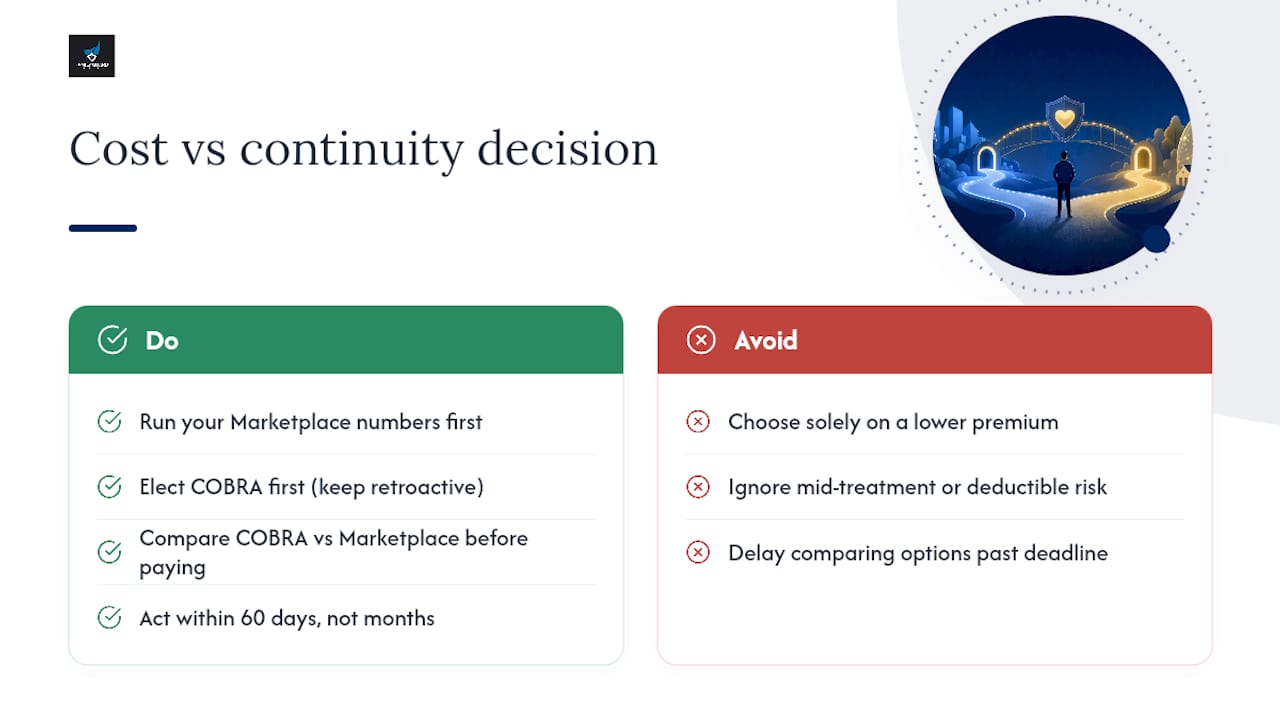
Strip away the paperwork and this decision comes down to one tension: cost versus continuity. Most healthy people under 400% FPL should run their Marketplace numbers first, because the subsidy math usually wins. But if you're mid-treatment or close to a deductible threshold, don't let a lower premium talk you out of coverage that's actually cheaper once you count the reset.
My honest advice: elect COBRA to keep it retroactively available, then compare it against your Marketplace quote before you pay a dime. Run both numbers today. You have 60 days, not 60 months.
— Shereka
Get Help Comparing COBRA and Marketplace Coverage
Running these numbers alone is doable, but a second set of eyes catches things a spreadsheet won't, like whether your cardiologist is actually in-network on the plan you're eyeing, or whether your income estimate will push you past the subsidy cliff.

Family Guard Life and Health runs eligibility checks, compares COBRA costs against real Marketplace quotes, verifies provider networks before you switch, and handles the enrollment paperwork once you've picked a direction. Licensed across 22 states including Florida, Texas, and Georgia, the agency works directly with people navigating this exact 60-day window. If your household is also weighing what happens as you approach 65, the timing between COBRA and Medicare deserves its own look before you commit. Visit Family Guard Life & Health to get a quote comparison started and talk through your specific COBRA notice, income estimate, and provider list with a licensed agent this week.
Where to Verify These Rules Yourself
Double check anything time-sensitive directly with the source before you commit to either option.
- Use Healthcare to confirm your Special Enrollment Period and run a subsidy estimate.
- Read the DOL's COBRA overview for your legal rights and the 2% fee rule.
- Review CMS's consumer guidance PDF for a side-by-side breakdown of both paths.
- Check Marketplace agent and broker resources if you want a licensed professional to verify your specific network questions.
This article is general information, not a substitute for advice from a qualified financial advisor. Consult a qualified financial professional about your own circumstances before acting on anything here.
Sources
- Healthcare
- COBRA — U.S. Department of Labor (EBSA)
- COBRA coverage and Marketplace: consumer guidance — CMS (PDF)
FAQ
Is It Better to Use COBRA or a Marketplace Plan?
For most people who qualify for a subsidy, Marketplace coverage costs less than COBRA's full premium plus the 2% fee.
Should I Choose COBRA or Marketplace After a Layoff?
Compare your actual numbers rather than assuming: calculate your COBRA premium, then run a Marketplace quote using your realistic full-year income, including severance and unemployment. A licensed agent can run both comparisons for you in one call.
What Is the Downside of Marketplace Insurance?
Switching to a new Marketplace plan usually resets your deductible to zero and can change your provider network or drug formulary, which sometimes costs more than staying on your old plan despite a lower premium.
What Are the Disadvantages of COBRA Insurance?
You pay the full group premium plus up to a 2% administrative fee with no employer contribution, coverage typically lasts a limited time, and enrolling in COBRA disqualifies you from Marketplace premium tax credits until you drop it.