

Original Medicare will not pay for routine eye exams, eyeglasses, or contact lenses. That's the short answer. Medicare Part B does pay for vision care when it's tied to a medical problem: cataract surgery, glaucoma screening for high-risk patients, diabetic eye exams, and a handful of other diagnosed conditions. If you want routine eyewear covered, you'll need a Medicare Advantage plan, a standalone vision policy, or another workaround.
TL;DR:
- Medicare covers only eye care linked to specific medical conditions, such as cataract surgery, glaucoma screenings, and diabetic retinopathy exams, not routine eye exams or glasses.
- After cataract surgery, Medicare pays for one pair of glasses or contact lenses from a Medicare-enrolled supplier, with costs including the Part B deductible and 20% coinsurance.
- Medicare Advantage plans often include routine vision benefits, but coverage varies widely in allowances, frequency, and network restrictions, requiring careful plan comparisons.
- Out-of-pocket costs for routine glasses can be reduced through standalone vision insurance, retail discount programs, or charitable resources, but these are outside standard Medicare coverage.
- To prevent surprise bills, beneficiaries should verify provider enrollment, request written cost estimates, and confirm prior authorization requirements before services.
Table of Contents
- What Does Medicare Vision Coverage Actually Include?
- When Does Medicare Consider Vision Care Medically Necessary?
- How Do Medicare Advantage Plans Handle Routine Vision Benefits?
- What Are Your Options If You Stay on Original Medicare?
- How Do You Confirm Coverage Before You Get Billed?
- Original Medicare Plus Out-of-Pocket vs. Medicare Advantage With Vision
- A Quick Note From Family Guard Life and Health
- Get Help Comparing Your Medicare Vision Options
- Where to Verify These Rules Yourself
- Sources
- FAQ
What Does Medicare Vision Coverage Actually Include?
Medicare draws a hard line between "medically necessary" and "routine." Medically necessary means a doctor is treating or monitoring an actual eye disease. Routine means you just want an updated prescription or a new pair of frames. Original Medicare doesn't pay for the second category at all — you cover 100% of those costs yourself.
What Part B does pick up, when a doctor determines it's necessary:
- Cataract surgery, including the intraocular lens implant
- One pair of standard eyeglasses or one set of contact lenses after that surgery
- Glaucoma screening for beneficiaries at high risk
- Diabetic retinopathy exams for people with diabetes
- Prosthetic eyes and related fittings
Here's the part that trips people up on cost: Part B doesn't work like a flat copay system. You pay your annual Part B deductible first, then 20% coinsurance on the Medicare-approved amount for the covered service. There's no cap on how many times this applies across different services in a year. And the supplier providing your post-cataract glasses or lenses has to be enrolled in Medicare, or the whole claim can fall apart.
When Does Medicare Consider Vision Care Medically Necessary?
Four situations account for most of the vision claims Medicare actually pays.
- Cataract surgery: Medicare covers the intraocular lens and one pair of corrective glasses or contacts afterward, but only from a Medicare-enrolled supplier. Skip that step and you could be stuck with the full bill.
- Glaucoma screening: covered once every 12 months for people with diabetes, a family history of glaucoma, African American beneficiaries age 50 and older, or Hispanic beneficiaries age 65 and older. The screening includes a dilated eye exam and intraocular pressure measurement.
- Diabetic eye disease: annual dilated eye exams are covered for beneficiaries with diabetes, along with certain diagnostic tests and injectable treatments for retinal disease when medically indicated.
- Prosthetic eyes: covered when an eye has been removed or is nonfunctional due to injury or disease.
A quick example on cost: say a covered diagnostic eye test is billed at $150. You've already met your Part B deductible for the year.
How Do Medicare Advantage Plans Handle Routine Vision Benefits?
This is where most people find their answer for exams and glasses. Medicare Advantage plans are sold by private insurers, and many bundles in routine vision as an extra benefit Original Medicare simply doesn't offer. The catch: no two plans structure it the same way. Plans vary widely in their allowances toward frames and lenses and in how often they provide coverage, as well as network requirements.
Before you assume a plan's vision benefit covers what you need, run through this checklist:
- Pull the plan's Evidence of Coverage and find the vision benefits section specifically, not just the marketing summary.
- Note the dollar allowance, and whether it applies annually or every two years.
- Check if there's a frequency limit on exams (most plans allow one routine exam per year).
- Confirm which optometrists and opticians are in-network, since out-of-network vision claims often aren't reimbursed at all.
- Ask if any vision service requires prior authorization before you schedule it.
Pro Tip: Call the plan directly and ask, "What's my exact vision allowance, and does it cover contact lenses or only glasses?" Advertised allowances are often written to sound generous but apply narrowly in practice.
What Are Your Options If You Stay on Original Medicare?
Plenty of beneficiaries prefer to stay on Original Medicare for other reasons and just handle vision separately. You've got three realistic paths.
- Standalone vision insurance: a monthly premium in exchange for set allowances toward exams, frames, and lenses, sold independent of any Medicare product.
- Retailer membership programs: discount clubs at optical chains that reduce out-of-pocket pricing but aren't insurance.
- Community and charitable resources: organizations like EyeCare America, Lions Club, VSP Eyes of Hope, and New Eyes provide free or reduced-cost exams and eyewear to qualifying low-income seniors.
If you're budgeting for routine care out-of-pocket, ask local optical shops about seasonal frame sales, and check whether your area has a Lions Club chapter running an eyeglass recycling program before you pay full retail.
How Do You Confirm Coverage Before You Get Billed?
Surprise bills in vision care almost always trace back to a skipped verification step. Here's the order to check things in.
- Confirm your eye care provider and any lens or glasses supplier is enrolled in Medicare, particularly for post-cataract eyewear.
- Ask the provider's office for the specific billing codes they'll submit and request a written cost estimate before the appointment.
- If you're on a Medicare Advantage plan, ask whether the service requires prior authorization and get that in writing.
- Save your Evidence of Coverage pages and any plan emails or letters confirming what's covered.
- If something looks off after a visit, call your plan's member services line before you pay the bill, not after.
Pro Tip: Photograph or screenshot your EOC's vision section before your appointment. If a claim gets denied, you'll have the exact language in hand instead of scrambling to find it later.
Original Medicare Plus Out-of-Pocket vs. Medicare Advantage With Vision
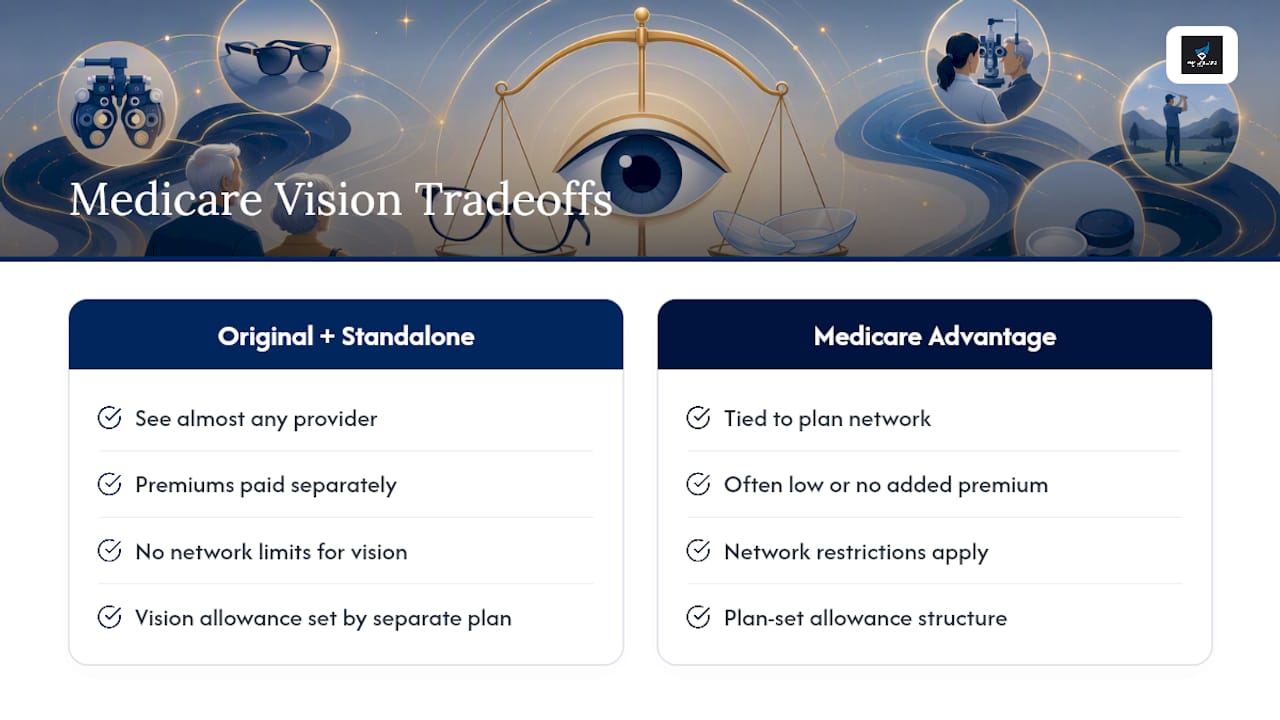
Choosing between these two paths usually comes down to how you weigh predictability against flexibility. Original Medicare plus a standalone vision plan gives you freedom to see almost any provider, but you're managing more moving pieces and paying premiums separately. Medicare Advantage bundles vision in, often at low or no added premium, but ties you to a network and a specific allowance structure that can change year to year.
Licensed agents who work with Medicare beneficiaries often spend time walking clients through their Evidence of Coverage line by line, comparing plan vision allowances side by side, and flagging enrollment deadlines before they get missed. Because licensing rules vary, not every plan is available in every state, which is exactly why that comparison step matters.
A Quick Note From Family Guard Life and Health
We hear the same questions constantly: "Why won't Medicare pay for my glasses?" and "Which plan actually covers my exam?" We help beneficiaries read the fine print on their Evidence of Coverage and pick a plan that fits. If you want a second set of eyes on your options, we're glad to help.
— Shereka Boukouvalas
Get Help Comparing Your Medicare Vision Options
Figuring out whether Medicare Advantage, a Medicare Supplement plan, or a standalone vision policy makes more sense for your situation isn't something you should have to sort out by reading fine print alone. Some independent brokers work for clients rather than any insurance company, meaning recommendations are based on specific coverage gaps and budget, not a quota.

If routine eye exams and glasses matter to you, our dental and vision coverage page walks through standalone policy options you can pair with Original Medicare. If you're weighing Medicare Advantage against a Medicare Supplement plan instead, that comparison is worth a conversation before your next enrollment window closes. Reach out and we'll walk through your specific plan options together, no obligation attached.
Where to Verify These Rules Yourself
- Medicare for coverage exclusions.
- CMS's vision services fact sheet for medically necessary criteria.
- Your plan's own Evidence of Coverage for exact vision allowances.
Sources
FAQ
What Vision Coverage Comes With Medicare?
Original Medicare covers vision care only when it's tied to a medical condition, such as cataract surgery, glaucoma screening for high-risk patients, or diabetic eye exams. Routine eye exams and glasses aren't included unless you have a Medicare Advantage plan with added vision benefits.
Can I Get Free Eyeglasses With Medicare?
Not through Original Medicare, except for one specific case: one pair of standard eyeglasses or contact lenses after cataract surgery that implants an intraocular lens. Outside that scenario, low-income beneficiaries can look to programs like EyeCare America or New Eyes for free or discounted eyewear.
Does Walmart Accept Medicare for Eyeglasses?
Optical retailers, including Walmart's vision centers, can bill Medicare only for medically covered services, such as post-cataract corrective lenses from a Medicare-enrolled supplier. Routine eyeglass purchases at any retailer are an out-of-pocket cost under Original Medicare.
How Much Will Medicare Pay for Eyeglasses?
Medicare only pays toward eyeglasses in the post-cataract surgery scenario, and even then, you're responsible for the Part B deductible plus 20% coinsurance on the Medicare-approved amount. Outside that exception, Medicare pays nothing toward eyeglasses, which is why many beneficiaries add a Medicare Advantage plan or standalone vision policy for routine costs.