

Whole life insurance is defined as a permanent life insurance policy that covers you for your entire life, as long as premiums are paid. Unlike term policies that expire after 10, 20, or 30 years, whole life never lapses due to age or health changes. Every policy includes a guaranteed death benefit, fixed premiums that never rise, and a cash value component that grows at a guaranteed minimum rate, tax-deferred. Families use whole life for estate planning, covering final expenses, and leaving a financial legacy that does not depend on market conditions.
What is whole life insurance and how does it work?
Whole life insurance works by splitting each premium payment into two parts. One portion funds the death benefit. The other builds cash value inside the policy. This structure makes whole life fundamentally different from term coverage, which collects premiums and pays out only if you die during the policy period.
Premium allocation and cash value growth
Every dollar you pay above the cost of insurance goes into the cash value account. That account grows at a guaranteed minimum rate, tax-deferred for as long as the policy stays active. Growth is slow in the early years and accelerates over time, which is why whole life rewards patience. The IRS does not tax the growth while it sits inside the policy, giving you a compounding advantage you do not get with a standard savings account.

Accessing your cash value
Cash value is usually accessible after 10 years through policy loans or withdrawals. That 10-year window matters because early access often produces little value and may trigger fees. When you borrow against the cash value, the insurer uses the account as collateral. The loan itself is not taxable income. However, policy loans reduce the death benefit if they remain unpaid when you die, so tracking outstanding balances is critical.
Death benefit and payment options
The death benefit pays as an income-tax-free lump sum to your named beneficiaries. That tax-free status is one of the most underappreciated features of any life insurance policy. Whole life also offers limited-pay options, where you fund the entire policy in 5 to 20 years or by age 65. These options are set at contract inception and generally cannot be changed later, so choose carefully at the start.
Pro Tip: If you want the flexibility of a shorter payment window, ask about a 10-pay or 20-pay whole life policy. You pay higher premiums for a fixed period, then the policy is fully paid up and coverage continues for life with no further payments required.
What are the benefits and drawbacks of whole life insurance?
Whole life insurance offers a set of guarantees that no other financial product replicates exactly. Understanding both sides helps you decide whether those guarantees are worth the cost.
Core benefits
- Lifelong coverage. The policy never expires, regardless of age or health changes after issue.
- Fixed premiums. Your payment stays the same from day one. Budget planning becomes straightforward.
- Guaranteed cash value growth. The account grows at a minimum rate set in the contract, shielded from stock market swings.
- Tax advantages. Cash value grows tax-deferred, loans are generally not taxable, and the death benefit is income-tax-free.
- Estate planning tool. The death benefit transfers wealth to heirs efficiently, often bypassing the delays of probate.
Drawbacks worth knowing
Whole life premiums can run 3 to 10 times higher than term life premiums for the same death benefit. That cost gap is real and should not be minimized. Cash value also builds slowly in the early years, meaning the policy delivers limited liquidity for the first decade. The product is complex. Riders, dividend options, and loan provisions require careful reading before you sign.
Whole life vs. term life: key differences
| Feature | Whole life | Term life |
|---|---|---|
| Coverage duration | Lifetime | Fixed term (10–30 years) |
| Premiums | Fixed, higher | Fixed, lower |
| Cash value | Yes, guaranteed growth | No |
| Death benefit | Guaranteed, income-tax-free | Paid only if death occurs in term |
| Best use case | Permanent need, estate planning | Temporary need, income replacement |
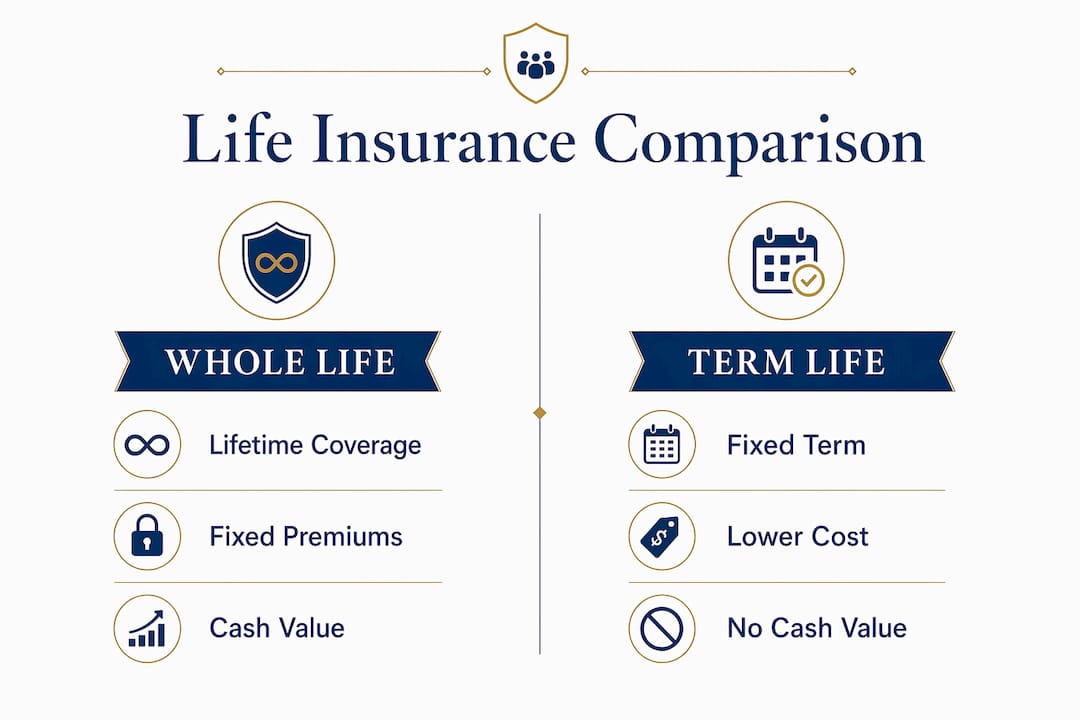
Whole life policies carry fixed death benefits and fixed premiums, which contrasts with universal life policies that allow flexible premiums and adjustable death benefits. Term life is the right fit when you need maximum coverage at the lowest cost for a defined period. Whole life fits when the need for coverage is permanent and the cash value component adds value to your broader financial plan.
Who should consider buying whole life insurance?
Whole life insurance is not the right product for everyone. The people who benefit most share a few common characteristics.
Ideal candidates include:
- Individuals who need coverage that cannot expire, such as those with lifelong dependents or special-needs family members
- People focused on estate planning who want to transfer wealth efficiently and reduce estate tax exposure
- Business owners using life insurance to fund buy-sell agreements or key-person coverage
- Anyone who wants a guaranteed, market-proof savings component alongside their death benefit
- Those planning for final expenses, including burial costs and outstanding medical bills
Early surrender of a whole life policy often triggers surrender charges and taxes, which can wipe out a significant portion of the cash value you built. This fact alone makes whole life a poor choice for anyone who may need to cancel the policy within the first several years. Whole life is a long-term commitment. Treating it as a short-term financial move leads to real financial loss.
Scenarios where term life or other permanent policies make more sense include young families on tight budgets who need large death benefits now, or individuals who prefer to invest the premium difference in the market and accept the associated risk.
Pro Tip: Before buying whole life, calculate the total premiums you will pay over 20 years. Then compare that figure to the guaranteed cash value at year 20. The gap tells you the true cost of the guarantees you are purchasing.
How does whole life insurance fit into financial planning?
Whole life insurance serves as a risk-averse financial foundation that protects against market volatility. Experts treat it as a stable component in a broader portfolio, not a replacement for equities or retirement accounts. That distinction matters. Whole life does not compete with your 401(k) or IRA. It complements them by providing guaranteed, tax-advantaged growth that does not drop when markets fall.
Cash value as a tax-advantaged savings vehicle
The cash value account functions like a private savings account with a guaranteed floor. You do not pay taxes on the growth each year. When you borrow against cash value for retirement income or emergencies, the loan proceeds are not counted as taxable income. This creates a tax-efficient income stream that retirees increasingly used to supplement Social Security or pension income.
Estate planning and legacy building
The death benefit transfers directly to named beneficiaries, typically bypassing probate. That speed matters when a surviving spouse needs funds immediately to cover living expenses. For larger estates, the death benefit can offset estate taxes, preserving more wealth for the next generation. Familyguardlh works with clients across 22 states to align whole life policies with estate plans and retirement income strategies.
Practical financial planning applications
- Use policy loans to cover emergency expenses without disrupting retirement accounts
- Fund a child's education through cash value withdrawals in later policy years
- Supplement retirement income with tax-free loan proceeds after age 65
- Provide a guaranteed inheritance regardless of investment portfolio performance
Key Takeaways
Whole life insurance is the only life insurance product that combines guaranteed lifetime coverage, fixed premiums, and tax-deferred cash value growth in a single contract.
| Point | Details |
|---|---|
| Permanent coverage | Whole life never expires, making it reliable for lifelong financial obligations. |
| Cash value timeline | Significant cash value typically builds after 10 years; early surrender triggers penalties. |
| Tax advantages | Cash value grows tax-deferred, loans are generally not taxable, and the death benefit is income-tax-free. |
| Cost vs. term life | Premiums run 3 to 10 times higher than term life for the same death benefit amount. |
| Best-fit candidates | Ideal for estate planning, permanent dependents, final expenses, and long-term wealth transfer. |
Shereka's take on whole life insurance
Most people come to me asking whether whole life is "worth it." That question misses the point. Whole life is not an investment you measure against the S&P 500. It is a guarantee you buy because you cannot afford to be wrong.
The biggest mistake I see is people surrendering their policies in years 3 to 7, right before the cash value starts to accelerate. They paid the highest cost years and walked away before the product delivered its value. Whole life rewards people who plan in decades, not years.
The second misconception is that whole life replaces other savings vehicles. It does not. The cash value component is a stable, guaranteed layer in your financial plan. Think of it as the foundation of a house. You still need the walls and the roof. Your 401(k), your Roth IRA, and your brokerage account are those walls. Whole life is what keeps everything from sinking.
One thing I rarely see discussed: the death benefit's income-tax-free status is genuinely powerful for estate planning. A $500,000 death benefit transfers to your heirs with no federal income tax. That is not something a savings account or brokerage account can replicate.
My honest advice is this. If you need coverage for a defined period and cost is your primary concern, buy term. If you have a permanent need, a long time horizon, and you value guarantees over growth potential, whole life deserves a serious look. Get a licensed professional to run the numbers for your specific situation before you commit.
— Shereka
Whole life insurance planning with Familyguardlh
Choosing the right life insurance policy is a decision that follows you for decades. Familyguardlh specializes in helping individuals across 22 states find coverage that fits their long-term financial goals, whether that means whole life, term, annuities, or a combination of products.

As a Retirement Income Specialist, Familyguardlh brings licensed expertise to the full range of life and health insurance decisions. The team reviews your financial picture, explains your options in plain language, and helps you build a plan that protects your family now and in retirement. Reach out to Familyguardlh to get a personalized review of your whole life insurance options today.
FAQ
What is the whole life insurance definition?
Whole life insurance is a permanent life insurance policy that provides coverage for your entire life, a guaranteed death benefit, fixed premiums, and a cash value account that grows at a guaranteed minimum rate, tax-deferred.
How does cash value work in a whole life policy?
Cash value grows tax-deferred inside the policy and is typically accessible after 10 years through loans or withdrawals. Outstanding loans reduce the death benefit if not repaid before the insured dies.
What is the main difference between whole life and term life?
Term life covers a fixed period and has no cash value. Whole life covers your entire lifetime, builds guaranteed cash value, and costs 3 to 10 times more in premiums for the same death benefit.
Can I borrow from my whole life insurance policy?
Yes. Policyholders can borrow against the cash value for any purpose, including retirement income or emergencies. The loan is not taxable income, but unpaid balances reduce the death benefit paid to beneficiaries.
Who is whole life insurance best suited for?
Whole life suits individuals with permanent coverage needs, estate planning goals, lifelong dependents, or those who want a guaranteed, market-proof savings component alongside their death benefit.