

The insurance underwriting process is how insurers decide whether to cover you, at what price, and under what terms. An underwriter evaluates your risk profile against the company's guidelines, then sets a premium that reflects the likelihood you'll file a claim. The goal is straightforward: keep the insurer financially healthy by ensuring premiums consistently exceed claims over time, maintaining a balanced loss ratio.
Underwriting applies whether you're buying auto, life, homeowners, or commercial coverage. The core logic is the same across all of them:
- Risk selection: Does this applicant fit the insurer's appetite?
- Risk classification: How does this applicant rank against others (preferred, standard, substandard)?
- Pricing: What premium accurately reflects the risk being assumed?
- Policy terms: What exclusions or conditions reduce the insurer's exposure?
Modern underwriting blends human judgment with data analytics and AI tools. A seasoned underwriter doesn't just tick boxes. They interpret data to distinguish between frequent small risks and rare catastrophic exposures that could threaten the insurer's entire book of business.
What is the insurance underwriting process, step by step?
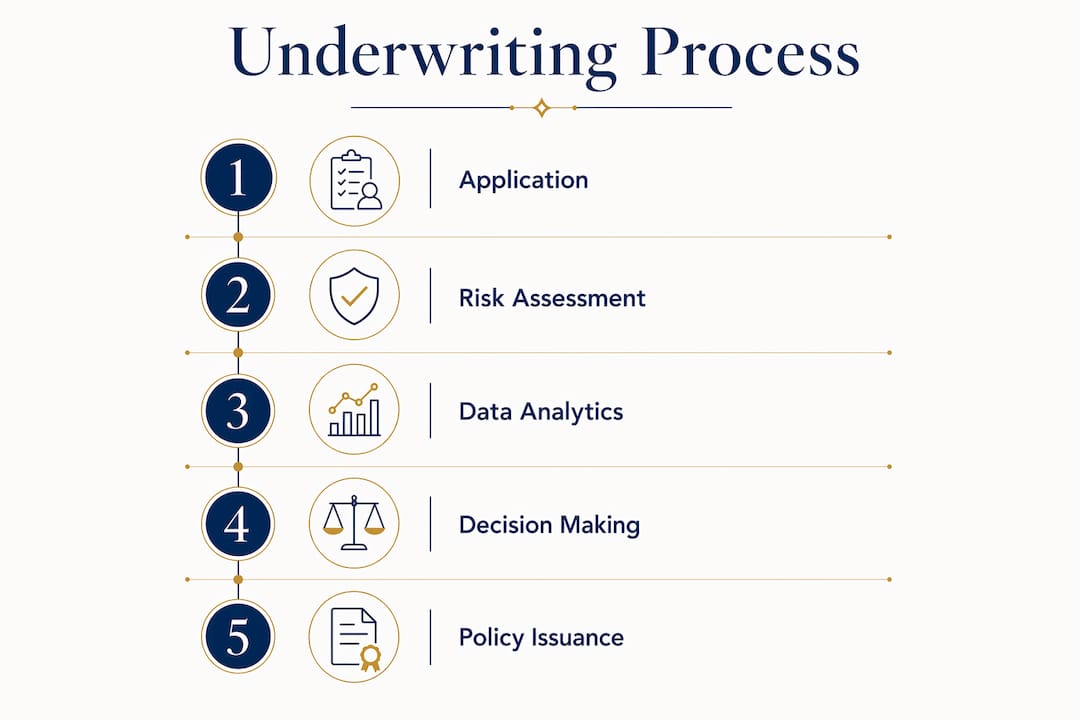
The underwriting workflow follows seven structured stages. Each one builds on the last, and skipping or rushing any step creates problems downstream.
-
Application intake and triage. Your application arrives via an agent, broker, or digital channel. The insurer's system validates required fields, flags missing documents, and routes the submission to the right workflow. At most modern carriers, AI handles this triage automatically.
-
Information gathering and validation. The underwriter collects supporting data: driving records, medical history, credit reports, property records, financial statements. This is where delays build when documentation arrives late or contains inconsistencies. A process that normally takes 24 hours can stretch into weeks when data is incomplete.
-
Risk assessment and classification. The underwriter maps your information against guidelines and risk models. Routine applications get scored automatically. Complex cases, exceptions, and edge cases get human review. The output is a classification: preferred, standard, substandard, or declined.
-
Pricing and coverage terms. Rating models translate the risk classification into a premium, coverage limits, deductibles, and any exclusions. Higher deductibles can make a borderline risk acceptable where flat-rate coverage would not.
-
Decisioning and documentation. The underwriter approves, modifies, or declines. Every decision gets documented with a full audit trail: which guidelines applied, which factors drove the outcome, and which AI models contributed. This is where regulatory requirements land hardest.
-
Policy issuance. The policy document is generated, the applicant or broker is notified, and the file integrates with the insurer's administration system for billing and servicing.
-
Ongoing monitoring. Underwriting doesn't stop at issuance. Mature operations monitor policies continuously for exposure changes, renewal triggers, and mid-term endorsements.
Key factors underwriters evaluate
Underwriters assess different variables depending on the type of coverage. Some factors are universal; others are product-specific.
General factors across most insurance types:
- Accuracy and completeness of the application
- Prior claims history
- Credit-based insurance scores, where payment history forms roughly 40% of the score
- Geographic location and associated risk exposure
Auto insurance (carriers like Progressive use these extensively):
- Driving record and violation history
- Vehicle make, model, and age
- Annual mileage and primary use
Life insurance (carriers like Guardian Life apply these in detail):
- Age and current health status
- Medical history and family health history
- Lifestyle factors: smoking, occupation, high-risk hobbies
- Financial information and existing coverage amounts
- Medical exam results and lab work for larger coverage amounts
Homeowners insurance:
- Property age, construction type, and condition
- Prior claims on the property
- Location relative to flood zones, wildfire risk, or high-crime areas
Pro Tip: Use a life insurance needs calculator before you apply. Knowing your coverage target upfront helps you submit a cleaner application and reduces back-and-forth with the underwriter.
What applicants should know before and during underwriting
Underwriting decisions are data-driven and guideline-based, not personal judgments. A decline or a higher premium reflects statistical risk assessment, not a verdict on you as a person.
- Submit complete information upfront. Incomplete or inconsistent documentation is the single biggest cause of underwriting delays. Provide everything the application asks for on the first submission.
- Be accurate, not optimistic. Non-disclosure of a medical condition, a prior claim, or a driving violation is a red flag. Underwriters verify independently, and discrepancies can void a policy.
- Understand conditional approvals. Underwriters frequently use conditional approvals with exclusions or surcharges rather than outright declines. An exclusion for a specific condition or a higher deductible is often negotiable through your broker.
- Watch for common red flags: inconsistent dates across documents, gaps in coverage history, and prior claims that don't match reported history.
- Work with a licensed agent or broker. They know the insurer's appetite and can frame your submission to address likely concerns before the underwriter ever sees it.
How data, AI, and governance are reshaping underwriting
Modern insurers integrate AI analytics with human judgment to speed up decisions and sharpen accuracy. But the technology comes with accountability requirements that are growing more demanding.

AI handles triage, document extraction, and routine risk scoring on standard products. Human underwriters focus on complex cases where judgment matters: unusual risk exposures, large commercial accounts, and applications that fall outside standard guidelines. The combination is faster and more consistent than either approach alone, but it requires documented governance at every step.
Continuous underwriting models take this further. Rather than a one-time evaluation at application, these systems monitor risk throughout the coverage period using telematics, public records, and claims data, adjusting premiums or renewal eligibility as conditions change. Commercial insurance has adopted this approach most aggressively.
Manual vs. automated underwriting
The method an insurer uses depends on the product's complexity and the volume of applications.

Manual underwriting involves a human underwriter reviewing each application individually. It's standard for complex commercial policies, large life insurance amounts, and any case with unusual risk factors. The process is thorough but slower, often taking days to weeks.
Automated underwriting uses rules engines and AI models to evaluate applications with minimal human involvement. Progressive and other personal lines carriers use automation extensively for auto and homeowners policies, often delivering decisions in minutes. The tradeoff is that automated systems work best on straightforward applications that fit neatly within predefined parameters.
Most carriers use a hybrid: automation handles the routine volume, and human underwriters review exceptions, high-value accounts, and edge cases the algorithm flags for closer scrutiny.
How underwriting affects your premiums and policy terms
Every variable the underwriter assesses feeds directly into your premium calculation. A clean driving record, good credit score, and no prior claims typically land you in a preferred or standard risk category, with lower premiums. A history of claims, a high-risk occupation, or a property in a flood zone pushes you toward substandard classification and higher costs.
Adjusted premiums include a loading factor that covers administrative costs, expected claims, and a profit margin. Policy exclusions limit the circumstances under which claims can be made. Both tools let insurers accept a broader range of applicants while still managing their exposure. Understanding insurance in your broader financial plan helps you see why these pricing decisions matter beyond just the monthly bill.
Regulatory and compliance considerations in underwriting
Every underwriting decision in the United States operates within a framework of state and federal regulations. Insurers must ensure their criteria are objective, consistently applied, and free from unlawful discrimination. The Affordable Care Act, for example, prohibits health insurers from denying coverage or imposing limitations based on pre-existing conditions.
State insurance departments audit underwriting practices regularly. The audit trail from decisioning and documentation is the primary evidence an insurer presents. Carriers that cannot demonstrate consistent, documented application of their guidelines face regulatory penalties and potential license issues. AI-assisted decisions face additional scrutiny: regulators increasingly require insurers to explain which data inputs and models influenced each outcome, and to show that those models were tested for bias.
Key Takeaways
The insurance underwriting process determines your coverage eligibility, premium, and policy terms through a structured, data-driven evaluation that balances insurer profitability with fair, regulation-compliant risk assessment.
| Point | Details |
|---|---|
| Seven-step workflow | Underwriting runs from application intake through ongoing monitoring, with validation being the most common delay point. |
| Product-specific factors | Auto, life, and homeowners underwriting each use different risk variables; credit-based scores apply broadly across types. |
| Conditional approvals are common | Underwriters often use exclusions or surcharges rather than outright declines to manage borderline risks. |
| AI requires documented governance | Insurers must record which AI models influenced each decision to satisfy regulatory scrutiny. |
| Complete submissions prevent delays | Incomplete documentation can extend a standard 24-hour process into multiple weeks. |

Get coverage that fits your actual risk profile. Familyguardlh works with individuals and business owners across 22 states to find health, life, dental, vision, Medicare, and supplemental policies that match your situation. No guesswork, no generic quotes. Talk to a licensed specialist who understands how underwriting decisions affect your options and your costs.