

Executive life insurance, in the personal sense, is a permanent or term policy sized and structured specifically for executives, founders, and high-net-worth individuals who need coverage that goes well beyond a standard retail policy. This is not an employer-funded arrangement. It is a policy you own, you pay for, and you use to solve problems that ordinary coverage cannot reach.
Who benefits most? Executives with illiquid equity, business owners who need buy-sell funding, and high-net-worth individuals facing estate tax exposure at death. If your net worth is concentrated in a business or real estate, a well-structured personal policy can be the only liquid asset your estate has when it needs cash most.
Common practical uses include:
- Providing cash to pay estate taxes without forcing a fire sale of business interests
- Funding a buy-sell agreement so a surviving partner can purchase your share
- Replacing executive income for a family that depends on your compensation
- Building tax-advantaged cash value as a supplemental retirement or borrowing reserve
Table of Contents
- What is executive bonus life insurance, and who actually needs it?
- Advanced strategies executives pair with personal policies
- How to buy and what to ask your advisor
- Pros, cons, and a final verdict
- Key Takeaways
- Why executives often underestimate what personal coverage actually does
- How Familyguardlh helps executives get the right coverage
- Useful sources
What is executive bonus life insurance, and who actually needs it?
The phrase "executive bonus life insurance" circulates widely online, but most search results describe an employer-funded Section 162 arrangement. That is a different product for a different audience. Here, the term refers to a personal life policy purchased by an executive or business owner for their own financial planning needs, not a corporate retention tool.
Advisors consistently recommend sizing personal coverage around family survival needs and estate liquidity, not around what you assume the business will sell for. Business value is illiquid, uncertain, and often tied up in agreements that take months or years to settle. Your family cannot pay estate taxes with a valuation report.
The buyers who typically pursue executive-focused personal policies fall into a few clear profiles: C-suite executives with large compensation packages and dependents who rely on that income; founders and owners whose net worth is almost entirely in the business; and high-net-worth individuals with taxable estates who need a cost-efficient way to fund the tax bill at death. Life insurance planning for executives and founders also requires keeping personal and business programs separate, because mixing the two creates coverage gaps that only surface at claim time.
A quick self-check before you go further:
- Does your estate exceed or approach the federal estate tax exemption?
- Do you have a buy-sell agreement without a funded mechanism?
- Would your family's lifestyle be at risk if your income stopped tomorrow?
- Do you want a tax-advantaged cash reserve you can access during your lifetime?
If you answered yes to any of these, a deeper conversation with a broker is worth your time.
Advanced strategies executives pair with personal policies
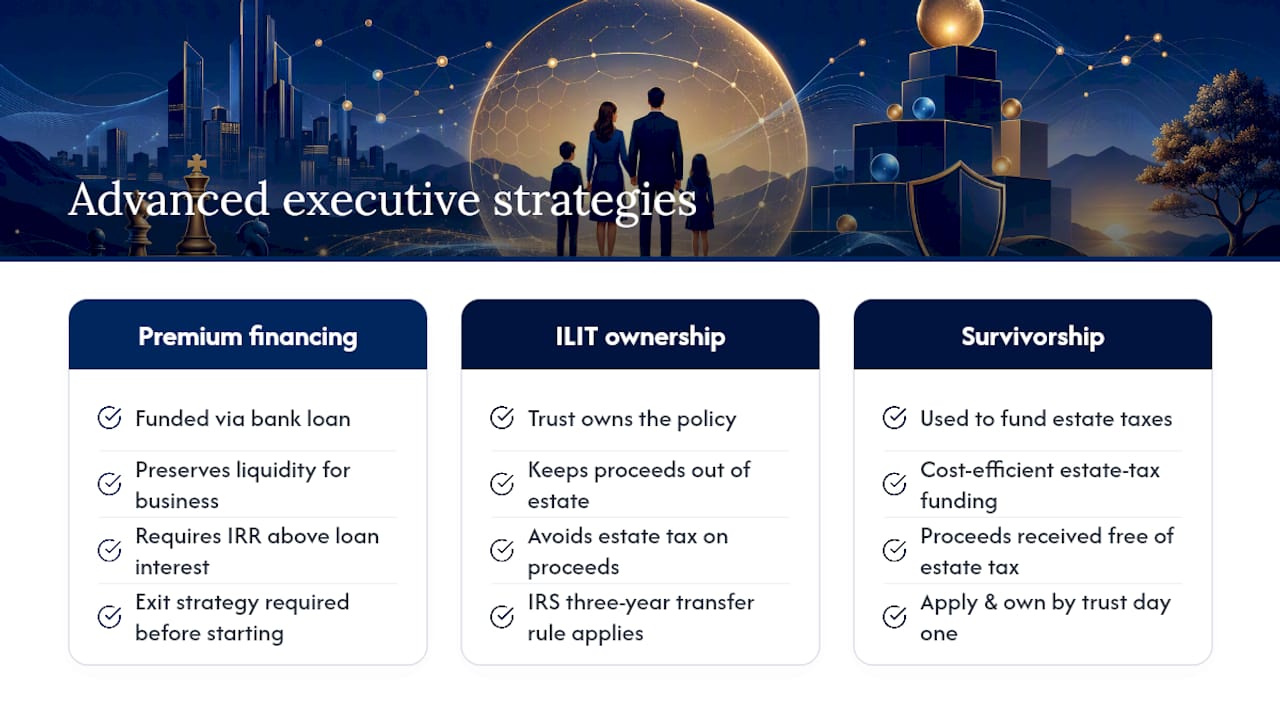
Premium financing, ILIT ownership, and survivorship structures are the three techniques that come up most often in executive planning conversations.
Premium financing lets you fund a large permanent policy using a bank loan rather than out-of-pocket premiums, preserving liquidity for investments or business operations. It works when the policy's internal rate of return exceeds the loan's interest cost, but that spread is not guaranteed. You need a clear exit strategy before you start, not after.
ILIT ownership (Irrevocable Life Insurance Trust) keeps the death benefit out of your taxable estate. If you own the policy personally, the proceeds are included in your estate and taxed accordingly. Survivorship policies and ILIT ownership are among the most cost-efficient ways to fund estate taxes at the moment they are due, precisely because the trust receives the proceeds free of estate tax. The IRS three-year transfer rule applies if you transfer an existing policy into a trust, so new policies should be applied for and owned by the trust from day one.
Pro Tip: Coordinate with your estate attorney and CPA before placing any policy into a trust or entering a premium financing arrangement. The tax and legal structure must be in place before the policy is issued, not retrofitted afterward.
Life insurance for business owners also serves as a liquidity mechanism for buy-sell agreements, ensuring a surviving partner has the cash to purchase your share without liquidating business assets. In some cases, a key-person policy can even be converted or sold on the secondary market after an ownership event, as this case study illustrates.
How to buy and what to ask your advisor
The buying process for an executive-focused personal policy follows a clear sequence: needs analysis, carrier sourcing, application and underwriting, then placement and ownership setup.
Before you sign anything, ask your broker these questions:
- Who will own this policy, and have you coordinated with my estate attorney on the ownership structure?
- If I use premium financing, what is the exit strategy if interest rates rise or the policy underperforms?
- How does this policy interact with my existing business coverage?
- Are you replacing an existing policy? If so, what are the tax and surrender consequences?
Red flags to watch for: illustrations that show aggressive credited rates with no downside scenario; a broker who cannot explain the financing exit strategy; pressure to sign before your CPA or attorney has reviewed the structure; and any suggestion that your business value makes personal coverage unnecessary.
Pros, cons, and a final verdict
Pros:
- Provides liquid cash for estate taxes without forcing asset sales
- Funds buy-sell agreements and business succession cleanly
- Permanent policies build tax-advantaged cash value accessible during your lifetime
- Trust ownership keeps proceeds outside the taxable estate
Cons:
- Premiums for large permanent policies are significant, especially at older ages
- Underwriting is thorough and time-consuming for large face amounts
- Trust and financing structures require coordination with legal and tax counsel
- Premium financing carries real risk if the spread between policy returns and loan costs narrows
The verdict: if your estate has illiquid assets, a buy-sell gap, or a meaningful estate tax exposure, a well-structured personal policy is one of the few tools that addresses all three at once. If your estate is modest and your business has a clear, funded succession plan, simpler term coverage may be all you need.
Key Takeaways
Executive-focused personal life insurance is most valuable when your estate is illiquid, your buy-sell agreement is unfunded, or your estate tax exposure is significant.
| Point | Details |
|---|---|
| Personal, not employer-funded | This is a policy you own and pay for, sized to your estate and family needs. |
| Four coverage components | Add estate tax exposure, buy-sell needs, income replacement, and legacy goals to size coverage. |
| Policy type matches the job | Use term for time-limited needs; use GUL, whole life, or survivorship for estate liquidity. |
| Underwriting takes time | Budget 30–60 days for cases under $5M and 60–120 days or more for larger face amounts. |
| Familyguardlh can help | Familyguardlh provides needs analysis, carrier sourcing, and placement support across 22 states. |
Why executives often underestimate what personal coverage actually does
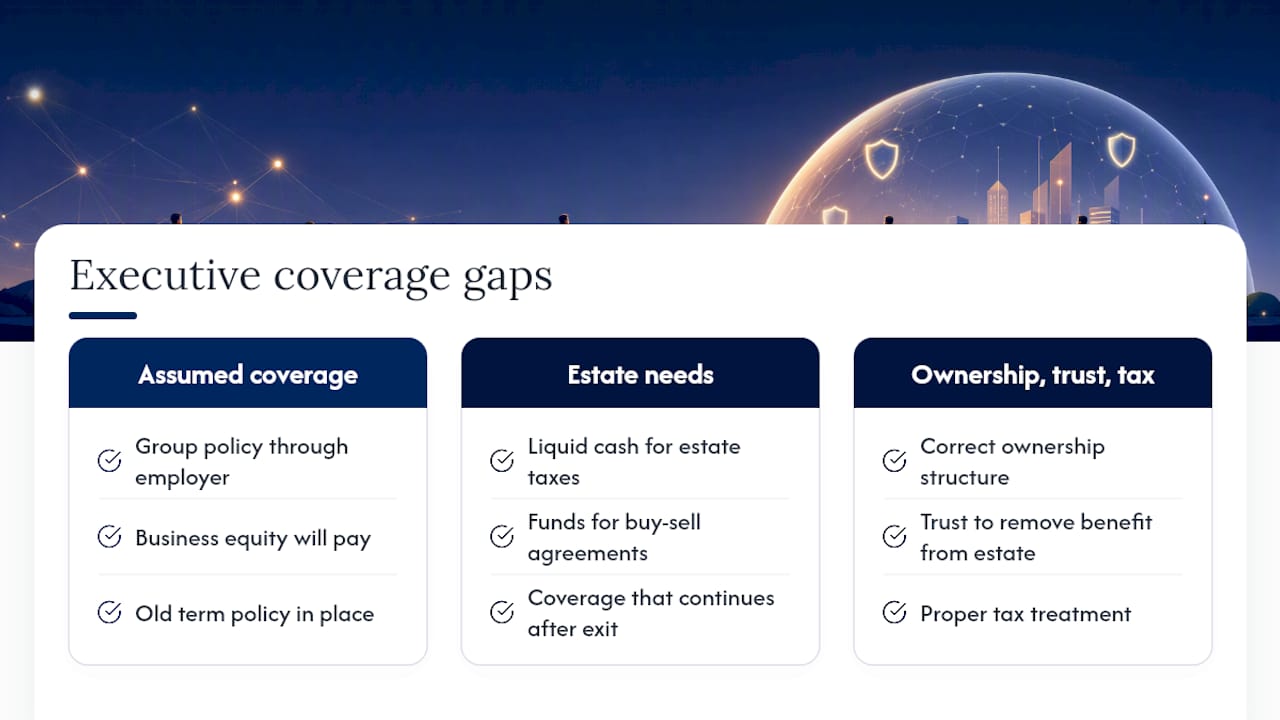
Most executives I work with come in thinking they have the coverage question handled. They have a group policy through the company, maybe a term policy from years ago, and a vague assumption that the business value covers the rest. That assumption is the gap.
Business equity is not liquid. It cannot pay estate taxes on a deadline. It cannot fund a buy-sell without a mechanism already in place. And a group policy ends the day you leave the company. The executives who end up in the most difficult positions are the ones who planned around what they expected to happen, not around what the estate actually needs when it happens.
The other thing that gets underestimated is the coordination requirement. A permanent policy placed in the wrong ownership structure can pull the entire death benefit into the taxable estate, negating the planning entirely. The policy itself is only part of the answer. The ownership structure, the trust, and the tax treatment are the rest of it.
How Familyguardlh helps executives get the right coverage
If you are an executive or business owner who has been putting off a real coverage review, Familyguardlh offers a direct path from confusion to a placed policy. As an independent brokerage licensed across 22 states, including FL, TX, GA, NC, VA, and OH, Familyguardlh works with multiple carriers to find the right fit for your health profile, estate size, and planning goals.

The process starts with a needs analysis that accounts for your estate tax exposure, buy-sell obligations, and income replacement needs. From there, Familyguardlh sources quotes across carriers, coordinates with your CPA and estate attorney on ownership structure, and supports placement through underwriting. Before your first meeting, pull together your last two years of tax returns, a current investment account summary, any existing policy documents, and a rough sense of your estate and business value. That preparation cuts weeks off the process.
Request a consultation at Familyguardlh to get a broker-guided review of your current coverage and a clear picture of what a well-structured executive policy would look like for your situation.
Useful sources
- Life insurance for small-business owners - NerdWallet
- High-net-worth life insurance - MoneyGeek
- Life insurance for business owners - J.P. Morgan Private Bank
- Underwriting high-net-worth life insurance - BMO Insurance
- High Net Worth Life Insurance: 2026 Strategies & Tax Guide - Ogletree Financial
- Life insurance planning for executives and founders - Kelly Insurance Group
- Life insurance for business owners: The complete guide - BetterWealth
- Business Owner Sells Keyman Policy for $290K After Company Sale | Case Study — Accelerated LS
This article is general information, not legal, tax, or financial advice. Confirm current rules and suitability with a licensed advisor, your CPA, and your estate attorney before purchasing any policy.