

The exclusion ratio is the percentage of each annuity payment that comes back to you tax-free because it represents a return of the after-tax money you originally put in. The formula is straightforward: investment in the contract ÷ expected return = exclusion ratio. This calculation applies mainly to non-qualified annuities (funded with after-tax dollars) once you've annuitized the contract. Annuities held inside an IRA or 401(k) are generally fully taxable because you never paid income tax on those contributions in the first place, so there's no basis to recover.
Understanding how the exclusion ratio for annuities works can save you from overpaying taxes or misreading your Form 1099-R. The IRS calls this the General Rule, and it's governed by Internal Revenue Code Section 72 and Treasury Regulation §1.72-4.
Key Takeaways
The exclusion ratio divides your after-tax investment in the contract by your expected return to determine the tax-free percentage of each annuity payment under the IRS General Rule.
| Point | Details |
|---|---|
| Core formula | Investment in the contract ÷ expected return = exclusion ratio, rounded to three decimal places. |
| Who it applies to | Non-qualified annuities funded with after-tax dollars; qualified accounts (IRA, 401(k)) are generally fully taxable. |
| Exclusion ends at recovery | For post-1986 contracts, once cumulative tax-free payments equal your investment, every subsequent payment is fully taxable. |
| Verify your 1099-R | Compare Box 2a against your own exclusion calculation; request the insurer's worksheet if numbers don't match. |
| Familyguardlh | Licensed in 22 states to help annuity recipients review insurer calculations and coordinate retirement income planning. |
Table of Contents
- How the IRS General Rule calculates your exclusion ratio
- A worked example: seeing the numbers in action
- When does the exclusion ratio actually apply to your annuity?
- How to find and use IRS expected-return multiples
- Special cases that change your exclusion ratio
- How the exclusion ratio flows into your tax return
- Common mistakes people make with the exclusion ratio
- Practical next steps before you file
- Why getting this right matters more than most people realize
- Familyguardlh can help you verify the math and coordinate your plan
- Sources
How the IRS General Rule calculates your exclusion ratio
The IRS General Rule, detailed in Publication 939, walks through the calculation in a specific sequence. Here's how it works:
-
Figure your investment in the contract. This is the total after-tax premiums you paid, adjusted for any refund features or death-benefit exclusions. If your contract has a cash refund feature, you subtract the present value of that refund guarantee from the gross premium amount before proceeding.
-
Compute your expected return. For a life annuity, multiply your annual payment by the life-expectancy multiple from the IRS actuarial tables. For a fixed-period annuity, multiply the annual payment by the number of years in the payment period.
-
Divide and round to three decimal places. Investment in the contract ÷ expected return = exclusion ratio. The IRS requires rounding to three decimal places (for example, 0.572, not 0.57).
-
Apply the exclusion percentage to each payment. Multiply the exclusion ratio by your regular periodic payment to get the tax-free dollar amount per payment.
-
Compute the annual tax-free amount. Multiply the per-payment exclusion by the number of payments you receive in a year.
The exclusion percentage is locked in at your annuity starting date, which is the date your payment stream begins. Treasury Regulation §1.72-4 establishes this rule and specifies how to allocate the exclusion when a contract contains multiple annuity elements. Variable annuities use a slightly different approach because the payment amount fluctuates, but the underlying principle of recovering basis proportionally still applies.
Pro Tip: Ask your insurer for the specific life-expectancy multiple they used at your annuity starting date. Insurers are required to use the IRS tables in effect on that date, and having their figure in writing makes it easy to verify the math yourself.
A worked example: seeing the numbers in action
Here's a concrete example using a single-life immediate non-qualified annuity, structured the way the IRS frames its own examples in Publication 939.
Inputs:
| Item | Value |
|---|---|
| Investment in the contract (after-tax premiums) | $100,000 |
| Annual annuity payment | $8,000 |
| Annuitant's age at annuity starting date | 65 |
| IRS life-expectancy multiple (Table V) | 20.0 |
Calculations:
| Step | Calculation | Result |
|---|---|---|
| Expected return | $8,000 × 20.0 | $100,000 |
| Exclusion ratio | $100,000 ÷ $100,000 | 0.625 (62.5%) |
| Tax-free amount per year | $8,000 × 0.625 | $5,000 |
| Taxable amount per year | $8,000 − $5,000 | $3,000 |

Each year, $5,000 of the $8,000 payment comes back tax-free as a return of your original investment. The remaining $3,000 is taxable as ordinary income. Once you've received a total of $100,000 in tax-free payments (your full investment in the contract), every subsequent payment is fully taxable for contracts with an annuity starting date after 1986.
If your first year of payments is a partial year, you prorate the annual exclusion by the number of months you actually received payments. A contract starting in October would yield three months of payments, so the first-year exclusion would be $5,000 × (3/12) = $1,250 tax-free for that partial year. Annuity walk through this kind of proration clearly for readers who want additional illustrations.
When does the exclusion ratio actually apply to your annuity?
The answer depends on how your annuity was funded and whether you've annuitized it. The Balance's consumer guide lays out the three main buckets clearly:
-
Non-qualified annuities (after-tax money): The exclusion ratio applies. You paid premiums with dollars already subject to income tax, so the IRS lets you recover that basis tax-free over the payment period. This is the primary use case for the General Rule.
-
Qualified annuities (IRA, 401(k), 403(b)): Generally fully taxable. Because contributions went in pre-tax, there's no after-tax basis to recover. Every dollar of each payment is ordinary income. The Simplified Method (not the General Rule) applies to qualified-plan annuities, and the IRS covers that in Publication 575.
-
Roth IRAs and Roth 401(k)s: Qualified distributions are generally tax-free because contributions were made with after-tax dollars and the account must meet holding-period requirements. The exclusion ratio as described here doesn't apply in the same way.
Beyond account type, annuitization is the trigger. The exclusion ratio applies only once you've converted the contract into a stream of periodic payments. Pre-annuitization withdrawals from a non-qualified deferred annuity follow LIFO (last-in, first-out) rules, meaning earnings come out first and are fully taxable before you touch your basis at all.
The annuity starting date also determines which IRS rules govern your contract. Contracts with a starting date before January 1, 1987 operate under older rules that allowed the exclusion to continue indefinitely, even past full recovery of basis. For contracts starting on or after that date, the exclusion stops the moment you've recovered your full investment in the contract.
How to find and use IRS expected-return multiples
The life-expectancy multiple is the number you multiply by your annual payment to get your expected return. The IRS publishes these multiples in actuarial tables, and selecting the right one matters.
Which table to use:
| Annuity Type | IRS Table | Key Input |
|---|---|---|
| Single-life annuity (no guaranteed period) | Table V (Ordinary Life Annuities) | Age of annuitant at starting date |
| Single-life annuity with guaranteed period | Table VI | Age and length of guaranteed period |
| Joint-and-survivor annuity | Table VI or Table VII | Ages of both annuitants |
Table V is the most commonly used for straightforward single-life immediate annuities. You look up the annuitant's age as of the annuity starting date and read the corresponding multiple. In the worked example above, a 65-year-old would use a multiple of 20.0 under Table V.
ThinkAdvisor's practitioner guide confirms this sequence: find the multiple, multiply by the annual payment to get expected return, then divide the investment in the contract by that figure. The official tables appear in IRS Publication 939, Appendix A. Most insurers will supply the applicable multiple on request, but cross-checking against the published table is worth the five minutes it takes.
Special cases that change your exclusion ratio
Several contract features and life circumstances require adjustments before you can apply the standard formula. Publication 939 addresses each of these, and §1.72-4 provides the regulatory framework.
-
Joint-and-survivor annuities: The exclusion percentage is computed using the combined expected return for both lives. After the primary annuitant dies, the survivor continues to apply the same exclusion percentage to their reduced payments until the full investment in the contract is recovered.
-
Refund features: If your contract guarantees a minimum payout (a cash refund or installment refund feature), the present value of that guarantee reduces your investment in the contract before you calculate the exclusion ratio. This lowers the tax-free portion slightly.
-
Multiple annuity elements: When a single premium purchase covers more than one annuity element (for example, a life annuity plus a term-certain component), Treasury Regulation §1.72-4 requires you to aggregate the expected returns across all elements and apply a single exclusion ratio to the combined payment stream.
-
Post-1986 cap: Once cumulative tax-free payments equal your full investment in the contract, the exclusion ends. Every payment after that point is 100% taxable as ordinary income. For long-lived annuitants, this transition can meaningfully shift taxable income in later retirement years, so it's worth modeling when you're coordinating annuity income with Social Security and required minimum distributions.
-
Unrecovered investment at death: If an annuitant dies before recovering the full investment in the contract, the remaining unrecovered basis may be claimed as an itemized deduction on the final income tax return. This is seldom discussed but worth confirming with a CPA when estate planning is involved.
AnnuityRatesHQ's plain-language guide covers the post-1986 cap and the annuitization lock-in clearly for readers who want a less regulatory framing of these rules.
How the exclusion ratio flows into your tax return
Your insurer reports annuity payments on Form 1099-R each year. Box 1 shows the gross distribution; Box 2a shows the taxable amount. Ideally, your insurer has already applied the exclusion ratio and Box 2a reflects only the taxable portion. Box 2b may be checked if the insurer did not calculate the taxable amount, which means you're responsible for computing it yourself.
Here's how to verify the insurer's work:
-
Locate your exclusion percentage. This should be on the insurer's worksheet or in your original annuity contract documents. If you don't have it, request it directly from the insurer.
-
Multiply the exclusion percentage by total payments received during the year. Compare this figure to the difference between Box 1 and Box 2a on your 1099-R.
-
Check for cumulative recovery. If you've been receiving payments for several years, confirm whether you've already recovered your full investment in the contract. Once you have, Box 2a should equal Box 1.
-
Report on Form 1040. The taxable amount from Box 2a flows to Line 5b (Pensions and Annuities) on Form 1040. The full gross amount goes on Line 5a. The difference is your tax-free exclusion for the year.
If the numbers don't reconcile, document the discrepancy in writing and contact your insurer to request a corrected Form 1099-R. Bring the original contract, the insurer's exclusion worksheet, and the 1099-R to your tax preparer so they can determine whether an amended return is needed.
The taxable portion of your annuity payment is taxed at ordinary income rates, not capital gains rates. There's no preferential rate for annuity income regardless of how long you held the contract.
Common mistakes people make with the exclusion ratio
A few misunderstandings come up repeatedly, and they can lead to either overpaying or underpaying taxes.
-
Treating the exclusion ratio as a tax shelter. It isn't. The exclusion only recovers the after-tax principal you already paid in. The earnings portion of every payment is fully taxable at ordinary income rates, and the exclusion ratio doesn't reduce that rate.
-
Assuming qualified annuities work the same way. They don't. An annuity purchased inside a traditional IRA or 401(k) is generally fully taxable because the original contributions were pre-tax. The General Rule and the exclusion ratio don't apply.
-
Using the wrong investment-in-contract figure. This is the most common arithmetic error. Forgetting to subtract the present value of a refund feature, or including employer contributions that were never taxed, inflates the investment figure and overstates the tax-free portion.
-
Ignoring the annuity starting date. The exclusion percentage is fixed on that date using the IRS tables in effect at that time. Recalculating it later with a different table or a different age produces the wrong number.
-
Continuing to exclude after basis is recovered. For post-1986 contracts, the exclusion ends when cumulative tax-free payments equal the investment in the contract. Continuing to apply the exclusion after that point is an error the IRS can identify on audit.
Pro Tip: Always ask your insurer for the worksheet showing how they computed the exclusion percentage. Practitioners note that insurers sometimes apply refund-feature adjustments incorrectly, so reconciling their investment-in-contract figure against your own records before filing is a practical safeguard.
Practical next steps before you file
Getting this right takes a few specific documents and a short conversation with your insurer or tax preparer.
-
Gather your original annuity contract. You need the premium amounts, the annuity starting date, and any refund-feature language.
-
Pull your annuity statement from the annuity starting date. This confirms the investment in the contract as of the date the payment stream began.
-
Request the insurer's exclusion worksheet. Ask specifically for the document showing how they computed the investment in the contract, the life-expectancy multiple used, and the resulting exclusion percentage.
-
Collect all Form 1099-R statements. If you've been receiving payments for multiple years, gather prior-year 1099-Rs to track cumulative tax-free amounts received.
-
Confirm proof of after-tax premiums. Bank records, prior-year tax returns, or premium receipts showing you paid with after-tax dollars establish your basis.
Questions to ask your insurer:
- How did you calculate the investment in the contract, and was a refund-feature adjustment applied?
- Which IRS life-expectancy table and which multiple did you use?
- Where can I get a copy of the exclusion worksheet?
- Has my full investment in the contract been recovered yet?
When to bring in a tax preparer or CPA: If your 1099-R shows Box 2b checked (taxable amount not determined), if you have a joint-and-survivor or multi-element contract, or if you're approaching the point where your basis will be fully recovered, a CPA can prevent reporting errors that compound over time. Coordinating annuity income with Social Security, RMDs, and other retirement income sources, including understanding how SSDI interacts with retirement savings for those receiving disability benefits, is exactly the kind of multi-source planning where professional guidance pays for itself.
Why getting this right matters more than most people realize
Most annuitants assume their insurer's Form 1099-R is correct and file accordingly. That's usually fine, but "usually" isn't good enough when the stakes are a multi-decade income stream.
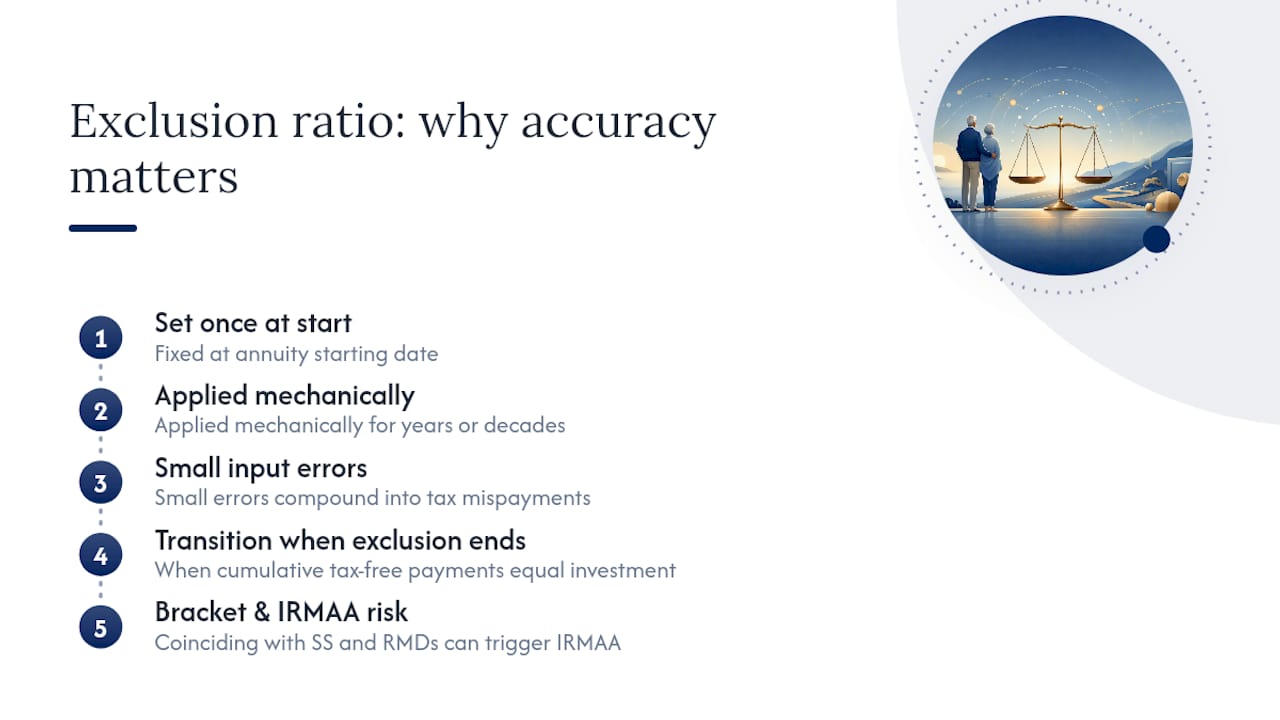
Here's what gets overlooked: the exclusion ratio is set once, at the annuity starting date, and applied mechanically for years or decades. A small error in the investment-in-contract figure, say a missed refund-feature adjustment of a few thousand dollars, compounds into a meaningful tax overpayment or underpayment across a 20-year payment stream. The IRS isn't going to flag it proactively. Your insurer may not catch it either.
The other planning implication that rarely gets discussed is the post-1986 transition point. When your cumulative tax-free payments finally equal your investment in the contract, your taxable income from the annuity jumps. If that transition coincides with Social Security income and RMDs, it can push you into a higher bracket or trigger Medicare IRMAA surcharges. Modeling that transition date in advance, not discovering it on a tax return, is what separates reactive tax filing from actual retirement income planning.
The exclusion ratio isn't complicated once you understand the formula. The challenge is making sure the inputs are right and that someone is watching for the moment the exclusion ends.
Familyguardlh can help you verify the math and coordinate your plan
Annuity tax calculations are straightforward in theory and surprisingly easy to get wrong in practice. At Familyguardlh, we work with annuity recipients across 22 states to review insurer calculations, gather the right documents, and coordinate annuity income with the rest of a retirement plan.

We can help you request the insurer's exclusion worksheet, confirm the investment-in-contract figure, and identify whether you're approaching the point where your basis will be fully recovered. For tax-specific questions or amended returns, we'll connect you with a qualified tax preparer. For the broader retirement income picture, including how your annuity fits alongside Social Security, Medicare, and other coverage, that's exactly what Familyguardlh is built for. Reach out at Familyguardlh to get started.
Sources
The IRS publications and regulations below are the primary references for everything covered in this article. Start with these when verifying any figure or rule, and bring the relevant pages to your insurer or tax preparer.
- Publication 939 (12/2025), General Rule for Pensions and Annuities | Internal Revenue Service
- Understanding Exclusion Ratios: Tax Benefits and Examples | Investopedia
- § 1.72-4 Exclusion ratio | Cornell Law School Legal Information Institute
- Annuity Exclusion Ratio: How Payments Are Taxed | AnnuityRatesHQ
- How is the excludable portion of payments computed under a single-life annuity? | ThinkAdvisor
- What is an exclusion ratio? | The Balance
This article provides general information about annuity taxation and is not a substitute for professional tax or legal advice. Confirm current IRS rules and your specific contract terms with a qualified tax preparer or CPA.