

Critical illness insurance is a supplemental policy that pays a one-time, tax-free lump sum upon diagnosis of a covered serious illness such as cancer, heart attack, or stroke. That payment lands in your bank account with no restrictions on how you spend it. For anyone planning retirement, this type of coverage fills a gap that standard health insurance simply cannot. Medical bills are one thing. Lost income, mortgage payments, and daily expenses during recovery are another problem entirely.
What does critical illness insurance cover?
Most policies cover what the industry calls the "Big 5": cancer, heart attack, stroke, kidney failure, and major organ failure. That core group represents the conditions most likely to derail your finances and your retirement timeline. Some policies expand well beyond those five, covering up to 26 conditions including Parkinson's disease, multiple sclerosis, severe burns, and loss of limbs.

The difference between a basic and an expanded policy matters more than most buyers realize. A basic plan costs less but may leave you without a payout if your diagnosis falls outside the covered list. An expanded plan costs more but covers a wider range of diagnoses that can be just as financially devastating.
| Coverage tier | Typical conditions covered | Best suited for |
|---|---|---|
| Basic | Cancer, heart attack, stroke | Budget-conscious buyers |
| Standard | Big 5 plus organ transplant, blindness | Most individuals and families |
| Expanded | 15–26 conditions including neurological | Those with family health history |
Pro Tip: Read the exact list of covered conditions before you buy. Two policies can both say "cancer" but define it very differently. One may exclude early-stage diagnoses entirely.
How does critical illness insurance work?
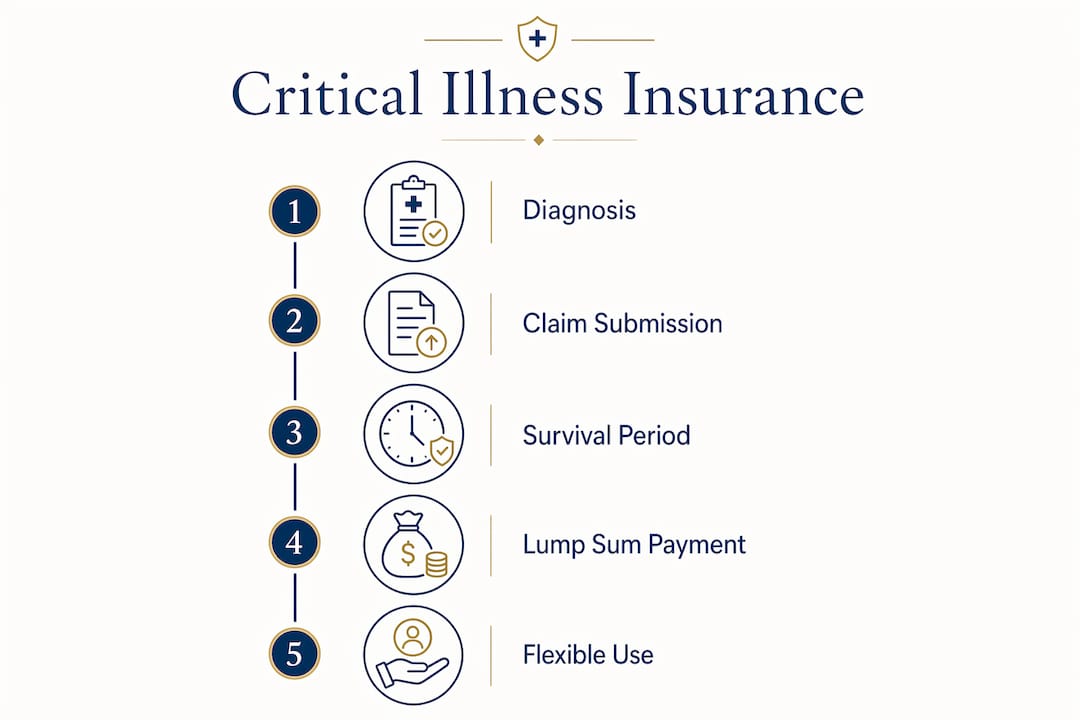
Coverage triggers when a licensed physician diagnoses you with a condition listed in your policy, after the policy's effective date. The diagnosis alone is not enough to receive payment. Most policies require you to survive 30 days after diagnosis before the insurer releases the lump sum. That survival period exists to confirm the illness is stable and real, not a misdiagnosis.
Here is what the claim process typically looks like:
- You receive a covered diagnosis from a licensed physician.
- Your policy must be active and in good standing at the time of diagnosis.
- You survive the required waiting period, usually 30 days.
- You submit a claim with supporting medical documentation.
- The insurer reviews the claim against the policy's medical definitions.
- The lump sum is paid directly to you, tax-free.
The flexibility of that payment is the real benefit. You can use it to cover lost income, pay your mortgage, fund experimental treatment, or support a family member who takes time off work to care for you. No insurer tells you how to spend it.
Pro Tip: Request the policy's exact definition of each covered condition before signing. A heart attack claim, for example, may require specific cardiac enzyme levels and documented ECG changes. Knowing this upfront prevents surprises at claim time.
What factors affect the cost and how much coverage do you need?
Premium pricing follows a straightforward logic. Age is the primary driver. Younger buyers pay significantly less than older applicants for the same coverage amount. The cost of coverage also rises with the benefit amount you select, so a $50,000 policy costs more than a $25,000 one.
Here are the key factors that shape what you pay and what you should buy:
- Your age at application. Locking in coverage earlier in life produces lower lifetime premiums. Waiting until your late 50s or 60s raises costs considerably.
- The benefit amount. Calculate your monthly expenses, mortgage balance, and estimated income loss during a six-month recovery. That number gives you a realistic floor for your coverage amount.
- Individual versus group coverage. Employer group plans often offer lower premiums through payroll deductions and may include employer subsidies. Individual plans cost more but travel with you regardless of employment.
- Policy portability. If you leave a job, a group plan may or may not follow you. Confirm portability terms before relying on employer-provided coverage as your primary protection.
- Your health history. Pre-existing conditions affect eligibility and may increase premiums or result in exclusions.
The right coverage amount is personal. A retiree with a paid-off home and modest expenses needs a different benefit than someone still carrying a mortgage and supporting dependents.
Common misconceptions about critical illness coverage
The biggest source of claim denials is not fraud. It is misunderstanding. Many buyers assume that any serious diagnosis triggers a payout. That is not how these policies work.
- Strict medical definitions apply. A diagnosis alone does not guarantee payment. Policies require precise medical criteria to be met. A heart attack claim may require documented enzyme levels and ECG changes, not just a physician's verbal diagnosis.
- Pre-existing conditions are excluded. Coverage only applies to conditions first diagnosed after the policy's effective date. If you had a prior cardiac event, a future heart attack claim may be denied.
- Not every serious illness qualifies. Chronic conditions like diabetes or high blood pressure are rarely covered, even when they become severe. Only conditions explicitly named in the policy are eligible.
- This is supplemental coverage, not a health insurance replacement. Critical illness insurance does not pay your doctor bills or cover hospital costs directly. It is a financial safety net that works alongside your health plan, not instead of it.
Understanding these limits before you buy sets realistic expectations and helps you choose a policy that actually fits your situation.
How to use critical illness insurance in retirement planning
Retirement planning typically focuses on income streams: Social Security, pensions, 401(k) withdrawals, and annuities. Critical illness coverage belongs in that conversation because a single serious diagnosis can drain years of savings in months.
The lump sum payment addresses several retirement-specific financial risks:
- Income replacement. If you retire early due to illness, the payout replaces the income you expected to earn in your final working years.
- Out-of-pocket medical costs. Health insurance covers a portion of treatment. Copays, deductibles, and non-covered therapies add up fast. The lump sum absorbs those costs.
- Mortgage and housing security. A serious illness should not force you to sell your home. The payout can cover mortgage payments while you recover.
- Family support. A spouse or adult child may need to reduce their work hours to care for you. The benefit can replace their lost income too.
Coordinate your critical illness policy with your other coverage. Review how it interacts with Medicare, any supplemental Medigap policy, and your retirement income sources. If you carry group coverage through an employer, confirm whether it remains portable after you retire or transition to part-time work.
Pro Tip: Consult a licensed insurance specialist before buying. Your personal health history, family medical background, and retirement income structure all affect which policy type and benefit amount make the most sense for you.
Key Takeaways
Critical illness insurance pays a tax-free lump sum upon a covered diagnosis, giving retirees a financial buffer that standard health insurance cannot provide.
| Point | Details |
|---|---|
| Core coverage | Most policies cover cancer, heart attack, stroke, kidney failure, and major organ failure. |
| Survival period | You must typically survive 30 days post-diagnosis before the insurer releases the lump sum. |
| Flexible payout | The benefit is tax-free and unrestricted, covering income loss, mortgage, or family expenses. |
| Strict definitions | Policies require precise medical criteria, not just a diagnosis, to approve a claim. |
| Retirement fit | Pair critical illness coverage with Medicare and retirement income sources for complete protection. |
Why I think most people buy this policy too late
I have worked with clients across 22 states, and the pattern is consistent. People start asking about critical illness coverage after a health scare, not before one. By that point, premiums are higher, pre-existing condition exclusions may apply, and the policy they can afford covers less than they need.
The public awareness gap around survival periods and strict definitions is real. Most buyers focus on the lump sum and skip the fine print. Then a claim gets denied because the cardiac event did not meet the enzyme threshold written into the contract. That is not the insurer acting in bad faith. That is a buyer who did not read the policy before signing it.
My honest advice: treat this coverage like a smoke detector. You do not buy it because you expect a fire. You buy it because the cost of not having it is catastrophic. A 45-year-old in good health can lock in a meaningful benefit at a fraction of what a 60-year-old pays. The math strongly favors buying early and reviewing the policy annually as your retirement picture changes.
Critical illness insurance works best when it is part of a broader plan, not a standalone purchase made in a panic. Match the benefit amount to your actual financial exposure, read every definition in the contract, and confirm portability if you are still employed. Those three steps separate buyers who get paid at claim time from those who do not.
— Shereka
Retirement protection options at Familyguardlh
Serious illness does not wait for a convenient time. A diagnosis during your retirement years can erase the savings you spent decades building.

Familyguardlh specializes in retirement income protection for individuals across 22 states, including AZ, FL, TX, GA, NC, and PA. The team works with clients to match critical illness policies to their specific retirement income structure, health history, and coverage gaps. Whether you are still working and want portable coverage or already retired and looking to supplement Medicare, Familyguardlh can walk you through your options. Schedule a no-pressure consultation to get a clear picture of what coverage makes sense for your situation.
FAQ
What is the difference between critical illness and health insurance?
Health insurance pays medical providers directly for treatment costs. Critical illness insurance pays you a lump sum upon diagnosis, which you use however you need, including for expenses health insurance does not cover.
Does critical illness insurance cover pre-existing conditions?
No. Coverage applies only to conditions first diagnosed after the policy's effective date. Pre-existing conditions are excluded under standard "first after" underwriting rules.
How long does it take to receive the lump sum after diagnosis?
Most policies require a 30-day survival period after diagnosis before releasing the benefit. After that period, the claim review and payment process typically takes a few additional weeks.
Is critical illness insurance worth it for retirees?
Yes, particularly for retirees without employer benefits. A serious diagnosis can deplete retirement savings quickly. The tax-free lump sum covers income loss, out-of-pocket costs, and daily expenses that Medicare and supplemental plans do not address.
Can I use the critical illness payout for non-medical expenses?
The lump sum comes with no usage restrictions. You can apply it to mortgage payments, household bills, travel for treatment, or family support, with no requirement to document how you spend it.