

When you search "what is COLI bank-owned life insurance," most results return information about corporate-owned or bank-owned policies purchased by companies on their employees' lives. That is a different product for a different audience. Here, the phrase refers to personal life insurance — term, whole, and universal policies that individuals buy to protect their families, fund retirement goals, and leave a legacy. The National Association of Insurance Commissioners (NAIC) regulates these products at the state level, and the Social Security Administration often factors them into survivors' income planning. If you want a quick side-by-side of policy types, jump to the comparison section below.
Key Takeaways
Personal life insurance — term, whole, universal, or final expense — is generally the product individual buyers age 45 and older focus on; COLI and BOLI are institutional tools unavailable to individual buyers.
| Point | Details |
|---|---|
| Term vs. permanent | Term costs least and fits most income-replacement needs; permanent suits estate planning, special-needs dependents, and key-person situations. |
| Illustrations vs. guarantees | Always request the guaranteed illustration column; non-guaranteed projections can overstate cash-value growth significantly. |
| Permanent policies need monitoring | Review whole and universal policies at least every two years; underfunding can cause a lapse before your target age. |
| COLI/BOLI are not for individuals | These are institutional products owned by corporations and banks; individual buyers have no access to or benefit from them. |
| Familyguardlh next step | Schedule a no-obligation needs review at familyguardlh.com to get matched to the right policy and receive guaranteed illustrations in writing. |
Table of Contents
- What is COLI bank-owned life insurance for individual consumers?
- Which personal life insurance types should you consider?
- How life insurance fits retirement and legacy planning
- Pros, cons, and who each policy is really for
- What does personal life insurance cost, and how long does buying take?
- How to choose personal life insurance and what to ask an agent
- Why you need to monitor permanent policies regularly
- What is Bank-Owned Life Insurance (BOLI)?
- What is Corporate-Owned Life Insurance (COLI)?
- How COLI and BOLI function in practice
- Legal and regulatory considerations for COLI and BOLI in the U.S.
- Risks, controversies, and ethical considerations around COLI and BOLI
- What COLI and BOLI mean for individual buyers age 45 and older is mostly limited, as these products are institutional tools not available to individual consumers.
- What I've learned from matching clients to the right policy
- Familyguardlh can help you find the right personal policy
- Sources
What is COLI bank-owned life insurance for individual consumers?
The short answer: when individual consumers use this phrase, they are asking about personal life insurance, not the institutional products banks or corporations purchase on employees. According to the Insurance Information Institute (III), all personal life insurance falls into two broad families: term (temporary, no cash value) and permanent (lifetime coverage that typically builds cash value and costs more). Everything else — whole life, universal life, indexed universal life, and final-expense policies — is a variation on those two.
Familyguardlh is licensed in 22 states and works with individuals age 45 and older to match the right policy type to their actual goals, whether that is income replacement, estate liquidity, or guaranteed burial coverage.
Which personal life insurance types should you consider?
Term and permanent policies serve fundamentally different purposes, and the cost difference between them is significant.
| Policy Type | Coverage Length | Cash Value | Typical Cost |
|---|---|---|---|
| Term | a set period, typically spanning a decade or more | No | Lowest |
| Whole life | Lifetime | Yes (guaranteed rate) | High |
| Universal life | Lifetime (if funded) | Yes (variable) | Moderate to high |
| Final expense | Lifetime | Yes (small) | Moderate |
Who each type usually fits:
- Term: A 45-year-old with a mortgage and dependents who needs income replacement for a typical duration of years at the lowest possible premium.
- Whole life: Someone who wants a guaranteed death benefit, predictable premiums, and slow but steady cash-value growth with no market exposure.
- Universal life (including IUL/GUL): A higher-income individual who wants premium flexibility and is willing to monitor the policy actively to prevent a lapse.
- Final expense: A 65-year-old in good-to-fair health who wants a small policy ($5,000–$25,000) to cover burial costs without a medical exam.
How life insurance fits retirement and legacy planning
Life insurance is not a retirement account, and treating it like one usually leads to disappointment. That said, permanent policies can play a real role in a retirement plan when the use case is specific.
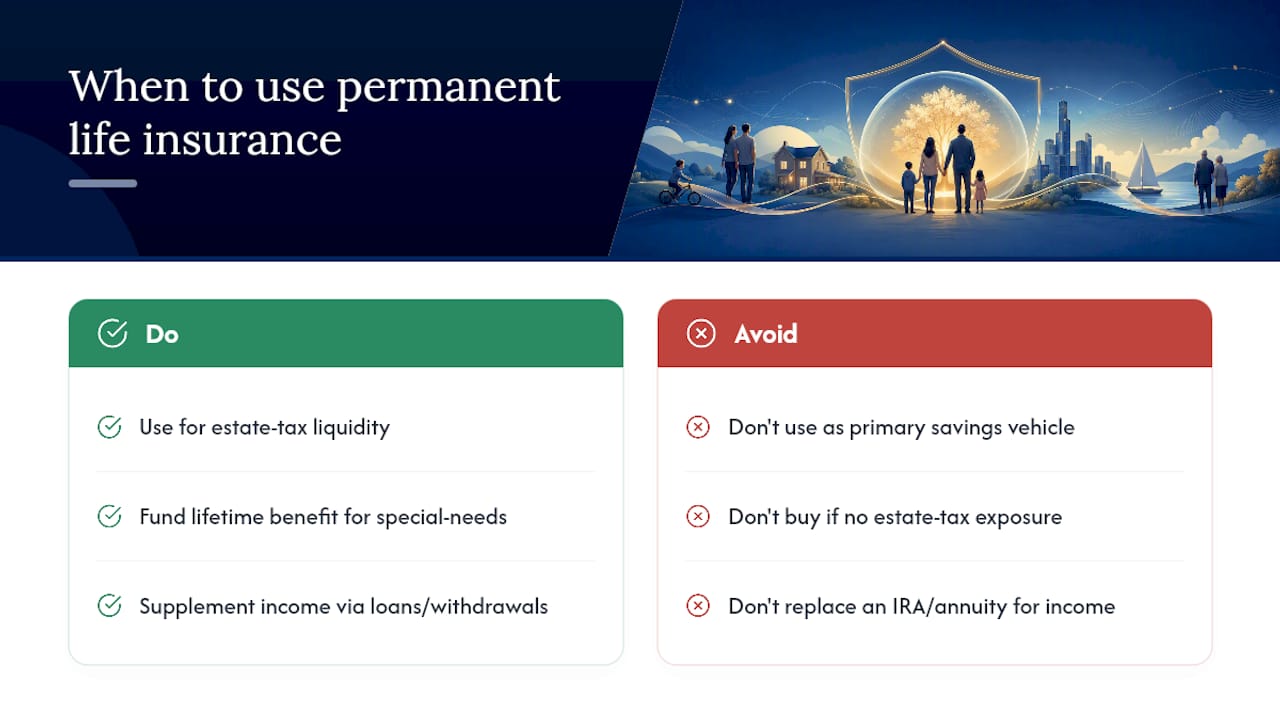
Common scenarios where it genuinely helps: providing estate liquidity so heirs do not have to sell assets to pay estate taxes, funding a guaranteed lifetime death benefit for a special-needs dependent, or supplementing retirement income through policy loans or withdrawals. The caveat on that last one is real. Loans reduce the death benefit dollar-for-dollar if not repaid, and withdrawals above your cost basis are taxable. Universal life mechanics — monthly cost-of-insurance deductions, interest crediting, and loan interest — can erode cash value faster than most buyers expect.
Where life insurance is usually not the right tool: as a primary savings vehicle for someone without estate-tax exposure or a dependent with lifelong needs. A well-funded IRA or annuity typically delivers better retirement income with fewer moving parts.
Pro Tip: Permanent life insurance makes the most sense when you have a guaranteed lifetime need — a special-needs child, an estate-tax liability, or a buy-sell agreement. If your need ends at retirement, term plus a separate annuity or investment account is almost always cheaper and simpler.
Pros, cons, and who each policy is really for
Advisors consistently point to term for most income-replacement needs; permanent policies fit narrower situations.
Term life
- Pros: lowest cost for a given death benefit, simple structure, easy to compare
- Cons: no cash value, coverage ends when the term does, renewal premiums spike with age
- Best for: households with a mortgage, young dependents, or a specific debt to cover
Whole life
- Pros: guaranteed death benefit, guaranteed cash-value growth, predictable premiums
- Cons: premiums are significantly higher than term, cash-value growth is slow
- Best for: estate-planning needs, special-needs dependents, buyers who want certainty above all else
Universal life
- Pros: premium flexibility, potential for higher cash-value growth (especially IUL)
- Cons: requires active monitoring, underfunding can cause a lapse, illustrations can mislead
- Best for: higher-income buyers with a long-term funding plan and an advisor who will review it annually
Final expense
- Pros: no medical exam, small face amounts, straightforward application
- Cons: higher cost per dollar of coverage than term, limited death benefit
- Best for: older adults in fair health who need burial coverage only
One important distinction: employer group life insurance covers you only while you are employed. Individual policies travel with you regardless of job changes, which matters considerably as you approach retirement.
What does personal life insurance cost, and how long does buying take?
Premium cost depends on six primary factors: age, health status, policy type, face amount, riders added, and tobacco use. A 50-year-old non-smoker in good health will pay a fraction of what a 60-year-old smoker pays for the same death benefit. Permanent policies cost more than term at every age and health class.
The purchase timeline runs roughly like this: quote (same day online or by phone), application (1–3 days), underwriting (1–6 weeks depending on health and face amount), policy issue and delivery (a few days after approval). Simplified-issue and guaranteed-issue policies (common for final expense) can close in days because they skip the full medical exam.
Warning: Policy illustrations often show projected values based on non-guaranteed interest rates or dividend assumptions. Guaranteed figures are the only reliable basis for planning. Always ask for the guaranteed column, not just the illustrated one, before signing anything.
How to choose personal life insurance and what to ask an agent
Consulting a financial professional before committing to a permanent policy is worth the time, especially when riders and cash-value projections are involved.
Questions to bring to any agent or broker:
- What is the guaranteed death benefit at age 80, 90, and 100?
- What happens to coverage if I stop paying premiums for 12 months?
- What are the surrender charges, and for how many years do they apply?
- What is the guaranteed cash-value growth rate (not illustrated)?
- What is the carrier's AM Best or S&P financial strength rating?
- Which riders are included, and what does each one cost separately?
- Can I see the guaranteed illustration page, not just the illustrated one?
Red flags: a salesperson who shows only the illustrated column, pushes expensive riders without a written explanation of the benefit, or quotes a return that sounds more like an investment than insurance.
Pro Tip: Request the carrier's guaranteed illustration in writing before you apply. If an agent resists, that is your answer.
Why you need to monitor permanent policies regularly
Financial professionals are clear on this: whole and universal policies are not set-and-forget products. Crediting rates change, cost-of-insurance charges increase as you age, and loans or withdrawals can quietly drain cash value to the point where the policy lapses.
Annual monitoring tasks:
- Review the annual statement and compare current cash value to the original illustration
- Check whether the policy is on track to stay in force to your target age at current funding levels
- Confirm beneficiary designations are still correct (especially after marriage, divorce, or a death in the family)
- Watch for any notice of a premium increase or reduced crediting rate from the carrier
Review frequency: annually for universal life, every two years at minimum for whole life. If you have not reviewed a permanent policy in more than three years, ask a licensed agent or CFP to run a current in-force illustration. That single step has saved policyholders from unexpected lapses more times than most people realize.
What is Bank-Owned Life Insurance (BOLI)?
Bank-Owned Life Insurance, or BOLI, is a category of institutional life insurance purchased by banks on the lives of their employees, typically executives. The bank pays the premiums, owns the policy, and is the beneficiary. BOLI is used primarily as a tax-advantaged asset on the bank's balance sheet: the cash value grows tax-deferred, and death benefits are received income-tax-free. It is a balance-sheet management tool, not a consumer product. Individual buyers cannot purchase BOLI; it is available only to financial institutions meeting specific regulatory criteria.
What is Corporate-Owned Life Insurance (COLI)?
Corporate-Owned Life Insurance (COLI) works on the same structural principle as BOLI but applies to corporations rather than banks. A company purchases life insurance on employees or key executives, pays the premiums, owns the policy, and collects the death benefit. COLI is used for purposes such as funding deferred compensation plans, covering the cost of employee benefits, or providing key-person protection. The critical difference from individual life insurance: the insured employee typically has no ownership rights, no access to cash value, and may not even know a policy exists on their life. COLI and BOLI are institutional tools governed by corporate tax law and banking regulations, not the consumer insurance market.
How COLI and BOLI function in practice
In both structures, the institution is the policy owner, premium payer, and beneficiary. Employees are the insureds. Cash value accumulates inside the policy tax-deferred, and the institution can borrow against it. When an insured employee dies, the death benefit goes to the institution, not the employee's family. The proceeds are typically used to offset benefit costs or recover the premiums paid over the years. From the employee's perspective, these policies are invisible: they appear on the company's balance sheet as a corporate asset, not on any personal financial statement.
Legal and regulatory considerations for COLI and BOLI in the U.S.
Significant restrictions on COLI were imposed by U.S. legislation in 2006. Employers must now notify employees in writing and obtain their consent before purchasing a policy on their lives. The law also limits the income-tax-free treatment of death benefits to policies covering the top 35% of employees by compensation, or to policies covering employees who were employed within 12 months of death. Banks using BOLI must comply with guidance from the Office of the Comptroller of the Currency (OCC), which sets concentration limits and requires pre-purchase due diligence. State insurance regulators also apply insurable-interest rules, which require the policyholder to have a legitimate financial interest in the insured's continued life.
Risks, controversies, and ethical considerations around COLI and BOLI
COLI attracted significant public criticism under the label "dead peasant insurance" after it emerged that some large corporations had purchased policies on rank-and-file employees without their knowledge, collecting death benefits with no obligation to share proceeds with the employee's family. The Pension Protection Act addressed the consent gap, but the ethical tension remains: an institution profits financially from an employee's death. For BOLI, concentration risk is a genuine concern — a bank that holds too large a portion of its Tier Tier 1 capital in BOLI policies may face liquidity and regulatory exposure if the carrier's financial strength deteriorates. Neither product is inherently predatory, but both require transparency and oversight to function ethically.
What COLI and BOLI mean for individual buyers age 45 and older is mostly limited, as these products are institutional tools not available to individual consumers.
Almost nothing, practically speaking. COLI and BOLI are institutional products that individuals cannot buy, own, or benefit from directly. If you are 45 or older and shopping for life insurance to protect your family, fund retirement income, or cover final expenses, the relevant products are term life, whole life, universal life, and final-expense policies. The only reason COLI concepts matter to you as an individual is to understand what you are not buying: a policy owned by your employer or bank on your life, for their benefit. Your personal policy is owned by you, controlled by you, and pays your named beneficiaries.
What I've learned from matching clients to the right policy
Most people who come to me confused about life insurance are not confused about the product itself. They are confused because they received a quote for a permanent policy when they needed term, or vice versa, and nobody explained why.
The clearest example of this: a client in her early 50s had been paying premiums on a universal life policy for eight years without a single review. When we ran a current in-force illustration, the policy was projected to lapse before she turned 75 at the current funding level. A simple funding adjustment and an annual review schedule fixed it. That is not a rare story.
Familyguardlh is licensed in Licensed in 22 states including AZ, CO, FL, GA, IA, IN, MA, MD, ME, MI, MS, MT, NC, NV, OH, OK, PA, SC, TN, TX, VA, and WA — and every client gets a needs review before any product recommendation. If you have a permanent policy you have not reviewed in the last two years, that review is the most valuable thing you can do this year.
Familyguardlh can help you find the right personal policy
Familyguardlh works with individuals age 45 and older across 22 states to match the right life insurance or annuity to their actual retirement and legacy goals — not the product with the highest commission or the flashiest illustration.

Services include consultative retirement-income planning, term and permanent life solutions, annuities, and ongoing policy monitoring for clients who already hold coverage. There is no pressure to buy anything in the first conversation. The goal is a clear picture of what you have, what you need, and what it will cost.
Licensed in AZ, CO, FL, GA, IA, IN, MA, MD, ME, MI, MS, MT, NC, NV, OH, OK, PA, SC, TN, TX, VA, and WA. Schedule a no-obligation review today and get a guaranteed illustration in writing before you commit to anything.
Sources
- Term vs. permanent life insurance — what's right for you? | Liberty Bank
- 4 Different Types of Life Insurance & How to Choose in 2026 - NerdWallet
- Individual Life Insurance: Types, Costs, and How It Works - LegalClarity
- Term vs Permanent Life Insurance Policy Selection | Equicurious
- Life insurance in your forties (MassMutual blog)
This article is general information, not a substitute for advice from a qualified financial advisor. Consult a qualified financial professional about your own circumstances before acting on anything here.