

An asset protection annuity converts a lump sum of liquid assets into a structured income stream that may receive creditor or Medicaid protection under state law — but only when the contract is properly structured and timed. Three caveats belong in the same breath: protections vary significantly by state, Medicaid's five-year lookback period can disqualify transfers made too late, and annuities carry fees and surrender charges that affect whether the product makes sense for your situation. Medicaid rules, state exemption statutes, and the guidance of a licensed agent like those at Familyguardlh all shape what protection you actually get.
Key Takeaways
Asset protection annuities can help retirees shield income and assets from creditors or Medicaid countability, but only when structured correctly, timed before a crisis, and reviewed by both a licensed agent and an elder-law attorney. Specific protection depends on state exemption laws, Medicaid criteria, and contract details — one state's rules or product structure rarely guarantees the same result elsewhere.
| Point | Details |
|---|---|
| Definition and core claim | An asset protection annuity converts liquid assets into an income stream that may receive creditor or Medicaid protection under state law. |
| Timing is everything | Medicaid's five-year lookback period means late transfers can trigger penalties or be reversed as fraudulent conveyance. |
| State rules vary widely | Exemption scope, caps, and Medicaid-compliance requirements differ by state — never assume one state's rules apply to another. |
| Fees and liquidity tradeoffs | Surrender charges, agent commissions, and the irreversibility of annuitization must be weighed against the protection benefits. |
| Familyguardlh next step | Licensed agents in 22 states offer annuity consultations with product illustrations and elder-law attorney referrals for Medicaid-aware planning. |
Table of Contents
- How asset protection annuities work — mechanics and product types
- How annuities can shield assets from creditors and Medicaid countability
- Benefits and tradeoffs of using annuities for protection
- When annuities make sense — use cases and complementary strategies
- What "Medicaid-compliant annuity" actually means
- Questions to ask before buying an annuity for asset protection
- Practical next steps before you commit
- A note on how Familyguardlh approaches this topic
- How Familyguardlh can help you evaluate your options
- Sources
How asset protection annuities work — mechanics and product types
Converting assets into an annuity changes how those assets are classified legally and financially. Instead of sitting in a bank account or brokerage as a countable asset, the money becomes a contractual obligation from an insurance carrier, which many states treat differently under creditor exemption statutes and Medicaid eligibility rules.
The basic cash flow looks like this:
- Money in: you pay a single premium or a series of premiums to an insurance carrier.
- Contract issued: the carrier holds the funds under a legally binding annuity contract.
- Income stream or contract value: the contract either begins paying out immediately (annuitization) or accumulates as a deferred contract value you can draw on later.
Annuitization is the step that matters most for protection purposes. Once a contract is annuitized, the asset is gone; what remains is a right to receive periodic income, which many states treat as exempt from creditor claims or as non-countable for Medicaid.
Product types relevant to protection planning:
- Single-premium immediate annuity (SPIA): funded with one lump sum, begins paying income within a month. Most commonly used in Medicaid planning because annuitization happens right away.
- Deferred annuity: accumulates value over time before income begins. Useful for long-term retirement income planning, though the contract value may still be countable until annuitized.
- Fixed annuity: earns a guaranteed interest rate. Predictable and low-cost relative to other types, which is why it appears frequently in protection-focused planning.
- Fixed-index annuity: credits interest tied to a market index with a floor at zero. Offers growth potential without direct market exposure.
- Variable annuity: invested in sub-accounts that fluctuate with markets. Higher potential growth, but also higher fees and more complex creditor-protection treatment.
Fixed and fixed-index products dominate protection planning because their values are predictable and their fee structures are simpler than variable contracts.
How annuities can shield assets from creditors and Medicaid countability
Annuities can help on two distinct fronts: creditor protection and Medicaid eligibility. The mechanics differ, and so do the limits.
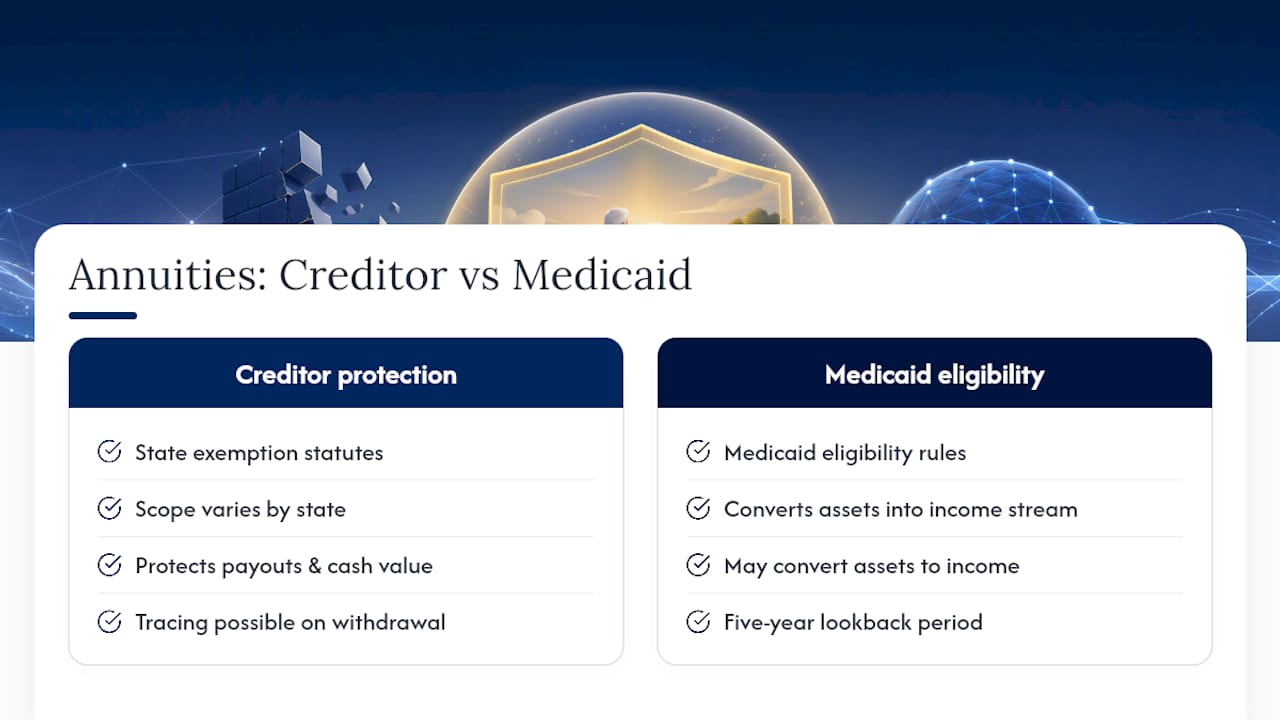
Creditor protection relies on state exemption statutes. Many states exempt annuity payouts and cash surrender values from creditor claims, but the scope varies widely. Florida, for example, provides broad statutory protection for annuity contracts under specific conditions and allows tracing of annuity proceeds in some cases — a nuance that matters if you later withdraw funds. Other states cap the exemption at a dollar amount or limit it to annuities held by certain beneficiaries. Retirement accounts, life insurance, and certain annuity contracts may also receive favorable treatment under federal law, depending on how the contract is structured.
Medicaid eligibility works differently. Annuities can convert countable assets into an income stream that may help with Medicaid eligibility when the annuity meets Medicaid's technical requirements. The key word is may. A poorly structured annuity is still counted as an asset and can disqualify benefits entirely.
Transferring assets into an annuity or trust after a creditor claim or lawsuit has already been filed can be treated as fraudulent conveyance and reversed by a court. Effective protection is built before a threat surfaces, not in response to one.
Timing is the most common failure point. Medicaid's five-year lookback period means that any transfer made within five years of applying for long-term care benefits is scrutinized. A transfer that looks like a last-minute attempt to shelter assets can trigger a penalty period during which Medicaid will not pay for care. Planning after a crisis has already begun carries real legal risk.
State exemption caps, bankruptcy rules under federal law, and the distinction between annuitized income and contract cash value all create additional limits. This is not a substitute for legal or Medicaid advice — consult a licensed elder-law attorney before acting.
Benefits and tradeoffs of using annuities for protection
The core tradeoff is security versus liquidity and cost. Annuities can provide meaningful protection, but they require giving up flexibility.
Benefits:
- Guaranteed income you cannot outlive, which simplifies retirement budgeting.
- Potential state exemption treatment that shields income or contract value from certain creditors.
- Possible Medicaid eligibility help when the contract is structured correctly and timed well.
- Tax-deferred growth on contract earnings until distribution, which can improve long-term accumulation.
Tradeoffs:
- Fees and agent commissions reduce net returns; complex fee structures and early withdrawal penalties deserve careful review before purchase.
- Surrender charges, often lasting several years, penalize early access to funds.
- Annuitization is largely irreversible — once you convert to an income stream, the lump sum is gone.
- A transfer made after a legal threat appears can be reversed as fraudulent conveyance.
A good fit: a retiree with excess countable assets whose spouse needs nursing home care and who has time to structure a Medicaid-compliant SPIA with an elder-law attorney.
A poor fit: someone in their 50s with no near-term care risk who needs liquidity for business or family expenses and cannot tolerate a multi-year surrender period.
When annuities make sense — use cases and complementary strategies
Typical uses cluster around three situations: nursing home and long-term care planning, preserving retirement income for a surviving spouse, and managing creditor exposure for assets that lack other exemptions.
A carefully structured SPIA can convert excess community-spouse assets into an income stream that may help the institutionalized spouse qualify for Medicaid — one of the most documented applications of this strategy. The community spouse keeps the income; the institutionalized spouse's countable assets drop.
Annuities work best as one layer in a broader plan. The most durable asset protection plans combine insurance, ownership structures, and trusts before a threat arises. Common complements include:
- Umbrella insurance: often the most cost-efficient first line of defense against liability claims.
- Irrevocable trusts: remove assets from your estate entirely, though they also remove your control.
- Asset titling: tenancy by the entirety and similar ownership structures protect assets in some states.
- Retirement accounts: 401(k) and IRA assets carry federal and state protections that are often stronger than annuity exemptions.
- LLCs: useful for business owners to separate personal and business liability.
Pro Tip: No single tool covers every risk. A layered plan — insurance first, then ownership structures, then annuities where they fit — is more durable than any one product. Effective protection preserves optionality and gets reviewed regularly as your situation changes.
What "Medicaid-compliant annuity" actually means
A Medicaid-compliant annuity meets federal and state requirements so it is treated as income rather than a countable asset for eligibility purposes. Eligibility is always conditional: miss one technical requirement and the annuity fails the test.
The rules to watch:
- Non-assignable: the contract cannot be sold, transferred, or used as collateral.
- Actuarially sound: the payout period must not exceed the annuitant's life expectancy per standard actuarial tables.
- State as remainder beneficiary: in most states, Medicaid must be named as a remainder beneficiary up to the amount of benefits paid.
- Irrevocable and non-transferable: once purchased, the terms cannot be changed to benefit the annuitant at Medicaid's expense.
State rules vary enough that what qualifies in one state may not qualify in another. Medicaid-compliant annuities require attorney review as standard practice — this is not optional. An elder-law attorney familiar with your state's Medicaid rules, working alongside a licensed agent, is the minimum team for this type of planning.
Questions to ask before buying an annuity for asset protection
Use this checklist when evaluating any proposed annuity with your advisor.
| Evaluation Point | What to Confirm |
|---|---|
| Product type | SPIA, fixed, fixed-index, or variable — and why this type fits your goal |
| Annuitization vs. contract value | Will the contract be annuitized, or does protection depend on contract-value exemption? |
| Surrender period and charges | How long is the surrender period, and what are the early-withdrawal penalties? |
| Fees and commissions | Total annual cost, including mortality and expense charges and rider fees |
| Medicaid-compliance attributes | Non-assignable, actuarially sound, state remainder beneficiary clause included? |
| Beneficiary and remainder terms | Who receives remaining value, and does the state have a claim? |
| Agent licensing and credentials | Is the agent licensed in your state and experienced with Medicaid-aware planning? |
Red flags to watch for: any agent who promises absolute creditor protection, claims to have a shortcut around the lookback period, or cannot provide a written product illustration with full fee disclosure. Insurance is commonly the first line of defense in a sound protection plan — an agent who leads with annuities as the only tool deserves scrutiny.
Practical next steps before you commit
Act before a crisis, not during one. The lookback period alone makes reactive planning expensive.
Action sequence:
- Schedule a consultation with a licensed annuity agent who works in your state and understands Medicaid rules.
- Retain an elder-law attorney to review any proposed Medicaid-planning strategy before you sign.
- Request written product illustrations showing full fees, surrender schedules, and projected income.
- Obtain a written Medicaid analysis specific to your state — not a generic summary.
- Avoid any asset transfer inside a five-year lookback window without attorney sign-off.
Documents to bring to your first consultation (a full retirement income planning checklist can help you prepare):
- Recent statements for all bank, brokerage, and retirement accounts
- Existing annuity or life insurance contracts
- Long-term care insurance policies, if any
- Estate planning documents (will, trust, power of attorney)
- Current Medicare or Medicaid documentation
A note on how Familyguardlh approaches this topic
Annuities are a legitimate tool for retirement income and, in the right circumstances, for asset protection. But they are not a universal fix. The cases where they genuinely help — particularly Medicaid planning for couples facing nursing home costs — require precise structuring, correct timing, and coordination between a licensed agent and an elder-law attorney. Recommending an annuity without that full picture does the client a disservice.
Familyguardlh is licensed in 22 states and publishes retirement-planning educational content to help clients ask better questions before they commit to any product. For any Medicaid-related strategy, attorney review is not optional — it is part of the process.
How Familyguardlh can help you evaluate your options
Retirement income and asset protection planning works best when a licensed agent and an elder-law attorney are working from the same set of facts about your situation. Familyguardlh offers annuity consultations with licensed agents across 22 states, including product illustrations, fee comparisons, and coordinated referrals to elder-law attorneys for Medicaid-aware planning.

The starting point is a straightforward conversation about your assets, your timeline, and your state's specific rules. Every recommendation follows an individual case review — no generic advice, no one-size-fits-all products. Request a consultation with Familyguardlh to get a clear picture of whether an asset protection annuity fits your retirement plan.
Sources
- AARP — Learn about annuities
- Alper Law — Asset protection strategies
- Legal Clarity — Asset protection strategies: trusts, LLCs, and exemptions
- Valerie Shivers Law Group — How can annuities protect assets from nursing home fees?
- Brown Advisory — Asset protection planning: a layered approach
- Creative Planning — Asset protection strategies for family wealth
- Lawyers With Purpose — How to protect annuities without being taxed