

Vision insurance retirement benefits are defined as supplemental coverage plans that pay for routine eye exams, prescription glasses, and contact lenses that original Medicare excludes. Medicare Parts A and B cover almost no routine vision care, leaving retirees to fund these costs out of pocket without a separate plan. Federal programs like FEDVIP and standalone vision plans fill that gap directly. Knowing which options apply to you, when to enroll, and what each plan actually covers is the difference between protected eyesight and a costly surprise bill.
What vision insurance retirement benefits cover that Medicare does not
Original Medicare's vision coverage is narrower than most retirees expect. Medicare Part B excludes routine eye exams, eyeglasses, and contact lenses entirely. It does cover certain medical eye services, such as treatment after cataract surgery or diagnostic tests for diabetic retinopathy, but only with 20% coinsurance after the 2026 annual deductible of $283.
That gap is significant. A routine annual eye exam typically costs $100–$200 without coverage. Add prescription frames and lenses, and a retiree can easily spend $500 or more per year on vision care that Medicare simply does not touch.

Medicare Advantage plans sometimes include routine vision benefits, but the depth of that coverage varies widely across carriers and plan tiers. Most Advantage vision add-ons offer limited annual allowances that fall short of what a dedicated standalone vision plan provides.
Supplemental vision plans, whether through federal programs or private insurers, are designed to cover exactly what Medicare skips:
- Annual comprehensive eye exams with low or no copays
- Frame and lens allowances ranging from $100 to $200 or more per year
- Contact lens benefits as an alternative to eyeglass allowances
- Discounts on elective procedures such as LASIK
- Retinal screening with modest copays, often around $20
Understanding this list tells you what to look for when comparing plans. If a plan does not cover all five categories, you are accepting a coverage gap.
How does FEDVIP work for federal retirees?
FEDVIP, the Federal Employees Dental and Vision Insurance Program, is the primary source of dental vision coverage for federal retirees and their eligible family members. Over 3.5 million individuals are currently enrolled, which reflects how central the program has become to federal retirement planning.
Eligibility depends on how you retire. Immediate retirees and disability retirees can enroll in FEDVIP. Deferred annuitants cannot. Retiring on a deferred annuity eliminates FEDVIP eligibility entirely, and re-enrollment is not allowed once that window closes. This is one of the most overlooked retirement planning gaps in the federal system.
One common myth is that you need five years of continuous FEDVIP coverage before retirement to stay enrolled. That is false. No five-year rule applies to FEDVIP. You can enroll for the first time at the point of immediate or disability retirement, even if you never participated as an active employee.
Enrollment works on a strict timeline:
- Identify your retirement type. Confirm you are retiring on an immediate or disability annuity, not a deferred one.
- Act within 60 days of retirement. Your retirement date triggers a 60-day enrollment window. Missing it means waiting until the annual open season in November and December.
- Use BENEFEDS. The BENEFEDS online portal is the official enrollment platform for FEDVIP. You can compare plans, review premiums, and complete enrollment there.
- Budget for post-tax premiums. Active employees pay FEDVIP premiums pre-tax. Retirees do not. That tax difference effectively increases the cost of the same plan by roughly 20–30% in retirement.
- Review your plan annually. During open season each year, you can switch plans, adjust coverage, or drop enrollment if your needs change.
Pro Tip: Set a calendar reminder for the day you retire. Your 60-day FEDVIP enrollment window starts immediately, and it is easy to miss while managing other retirement paperwork.
What types of vision plans should retirees compare?
Retirees have three main categories of eye insurance to consider: FEDVIP vision plans, Medicare Advantage vision add-ons, and standalone private vision plans. Each works differently, and the right choice depends on your retirement type, budget, and how often you use vision care.
FEDVIP vision plans
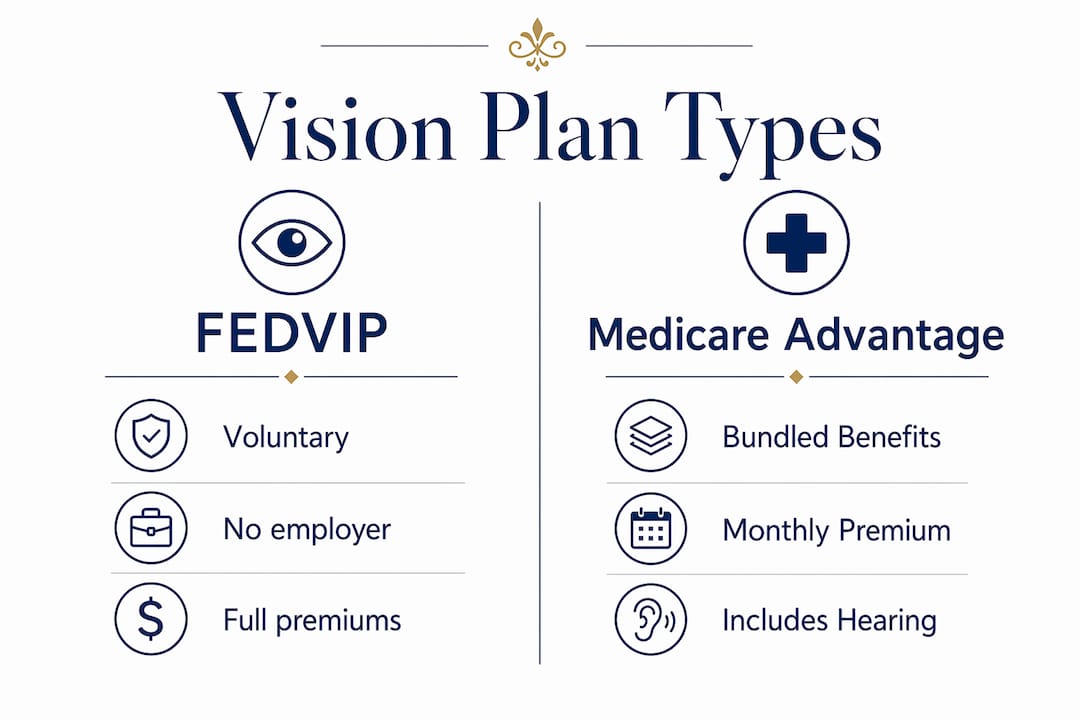
FEDVIP plans are voluntary and enrollee-funded, meaning you pay the full premium with no employer contribution. The trade-off is access to group rates negotiated across a large federal enrollee pool. Coverage typically includes annual exams, frame allowances, and contact lens benefits with defined copay structures.
Medicare Advantage vision add-ons
Medicare Advantage plans bundle vision, dental, and sometimes hearing benefits into a single monthly premium. The vision component is often limited. Frame allowances tend to be lower, and provider networks can be more restrictive than standalone plans. These plans work best for retirees who want simplified billing and already prefer their Advantage plan's medical coverage.
Standalone private vision plans
Standalone plans operate independently of Medicare and FEDVIP. They are available to any retiree regardless of federal employment history. Some are structured as true insurance with copays and deductibles. Others operate as discount networks, reducing the cost of services at participating providers rather than paying claims directly.
A well-structured standalone plan, such as those endorsed through organizations like AARP, can deliver real savings. AARP-endorsed VSP plans offer $0 copays on annual exams, $20 retinal screening copays, and up to $200 in frame allowances, saving members an average of $350 per year. That figure matters because it shows the gap between paying out of pocket and carrying even a modest vision plan.
When comparing any plan type, focus on these factors:
- Annual exam copay: $0 is the benchmark for competitive plans
- Frame or contact allowance: Look for at least $150 per year
- Provider network: Confirm your current eye doctor participates
- Premium cost: Weigh monthly cost against expected annual benefit use
- Deductible: Some plans carry a deductible before benefits apply
Pro Tip: Do not compare plans by premium alone. Calculate your total annual cost, including the premium, expected copays, and any out-of-pocket spending above the frame allowance. That number tells you the real cost of each option.
How to enroll in vision coverage and avoid common mistakes
Enrollment mistakes are the leading cause of coverage gaps for retirees. Federal retirement is a qualifying life event, which triggers specific enrollment windows. Missing those windows has real consequences.
The most common mistakes retirees make:
- Assuming automatic enrollment. No vision plan enrolls you automatically at retirement. You must take action within your enrollment window.
- Ignoring the deferred annuity exclusion. Retirees planning to take a deferred annuity often assume they can enroll in FEDVIP later. They cannot. Deferred annuitants lose FEDVIP eligibility permanently.
- Focusing only on premiums. Retirees who choose the lowest-premium plan often find that narrow provider networks or low frame allowances cost more in the long run.
- Skipping the annual review. Plan benefits and premiums change each year. Staying in the same plan without reviewing alternatives during open season can mean paying more for less coverage.
- Overlooking dental vision coverage together. Many plans bundle dental and vision benefits. Evaluating dental vision insurance retirement benefits as a package often produces better value than purchasing each separately.
The enrollment process itself is straightforward once you know the steps. Log into BENEFEDS for federal plans, or contact a licensed insurance professional for standalone or Medicare Advantage options. Compare at least two or three plans side by side before committing.
Key Takeaways
Vision insurance retirement benefits are the primary tool retirees use to cover routine eye care that Medicare excludes, and proactive enrollment planning is the single most important factor in maintaining that coverage.
| Point | Details |
|---|---|
| Medicare excludes routine vision | Original Medicare does not cover eye exams, glasses, or contacts; supplemental plans are required. |
| FEDVIP has a strict 60-day window | Missing the post-retirement enrollment window means waiting until the annual open season. |
| Deferred annuity blocks FEDVIP | Retiring on a deferred annuity eliminates FEDVIP eligibility permanently with no re-enrollment option. |
| Post-tax premiums raise real cost | Retirees pay FEDVIP premiums post-tax, increasing the effective plan cost by roughly 20–30%. |
| Compare total cost, not just premiums | Factor in copays, frame allowances, and provider network access to find the best-value plan. |
Shereka's take on planning vision coverage before you retire
Most retirees I work with are surprised to learn how little Medicare covers for their eyes. They spent decades assuming that retirement health coverage would handle the basics. Routine vision care is not basic under Medicare. It is simply not covered.
The FEDVIP deferred annuity rule is the one that catches people off guard most often. A retiree who plans to delay their annuity start date to maximize their benefit loses FEDVIP access entirely. That is a permanent loss, not a temporary gap. Knowing that rule before you finalize your retirement date can change the decision entirely.
My honest advice: treat vision coverage as a line item in your retirement budget before you retire, not after. The cost difference between a plan with a $200 frame allowance and paying out of pocket for glasses every two years adds up faster than most people expect. The retirees who feel most financially secure about their eye care are the ones who compared their options during the six months before their retirement date, not the week after.
Balancing cost against coverage value also means looking at the full dental vision coverage picture together. Bundled plans often deliver better per-benefit value than two separate policies. That is worth a conversation with a licensed professional who knows both product categories.
— Shereka
How Familyguardlh helps retirees find the right vision coverage
Choosing the right retirement vision benefits plan takes more than reading a benefits summary. Familyguardlh works with retirees across 22 states to compare vision care retirement plans, explain enrollment rules, and match coverage to actual eye health needs and budgets.

Familyguardlh is licensed in AZ, CO, FL, GA, IA, IN, MA, MD, ME, MI, MS, MT, NC, NV, OH, OK, PA, SC, TN, TX, VA, and WA. Whether you are navigating FEDVIP for the first time or comparing standalone optical benefits for retirees, the team at Familyguardlh provides personalized guidance to help you make a confident, informed decision before your enrollment window closes.
FAQ
Does Medicare cover routine eye exams for retirees?
No. Original Medicare Parts A and B exclude routine eye exams, eyeglasses, and contact lenses. Medicare Part B covers only specific medical eye services, such as post-cataract care, with 20% coinsurance after the 2026 deductible of $283.
Can I enroll in FEDVIP for the first time when I retire?
Yes. There is no five-year continuous coverage requirement for FEDVIP. You can enroll for the first time at retirement, provided you retire on an immediate or disability annuity and act within the 60-day enrollment window.
What happens if I miss the FEDVIP enrollment window at retirement?
Missing the 60-day post-retirement window means you must wait until the annual open season, held each november and december, to enroll. That gap can leave you without vision coverage for several months.
Are FEDVIP premiums more expensive in retirement than during active employment?
Yes. Active employees pay FEDVIP premiums pre-tax, which reduces the effective cost. Retirees pay post-tax, making the same plan cost roughly 20–30% more in real terms.
What is the best vision insurance option for retirees who are not federal employees?
Non-federal retirees should compare Medicare Advantage plans with vision add-ons against standalone private vision plans. Standalone plans, including those available through organizations like AARP with VSP, often provide stronger frame allowances and broader provider networks than Advantage vision add-ons.