

Tax-deferred growth is defined as the accumulation of investment earnings inside a qualified account without any annual tax obligation until the money is withdrawn. The IRS recognizes this structure across accounts including 401(k)s, traditional IRAs, 403(b)s, and annuities. For 2026, the 401(k) contribution limit sits at $24,500, while traditional IRAs allow up to $7,500. Understanding what is tax-deferred growth is the first step toward building a retirement plan that keeps more of your money working for you, longer.
What is tax-deferred growth and why does compounding make it powerful?
Tax-deferred growth removes what financial planners call "tax drag." Tax drag is the annual reduction in your investment returns caused by paying taxes on dividends, interest, and capital gains each year. When you hold investments in a taxable brokerage account, the IRS takes a cut every year. That cut reduces the base on which your future returns compound.
The math is straightforward. An investor in the 22% tax bracket who earns $10,000 in a taxable account pays $2,200 in taxes, leaving only $7,800 to reinvest. Inside a tax-deferred account, the full $10,000 stays invested and compounds. Over 20 or 30 years, that difference in the compounding base produces a significant gap in final account value.

Think of the deferred tax bill as an interest-free loan from the IRS. The deferred tax dollars keep compounding returns until you finally withdraw the money. You eventually pay taxes, but by then your account has grown on a much larger base than it would have in a taxable account.
The table below illustrates the long-term impact of tax deferral on a $50,000 initial investment at a 7% annual return over 30 years, assuming a 22% annual tax rate on gains in the taxable account.
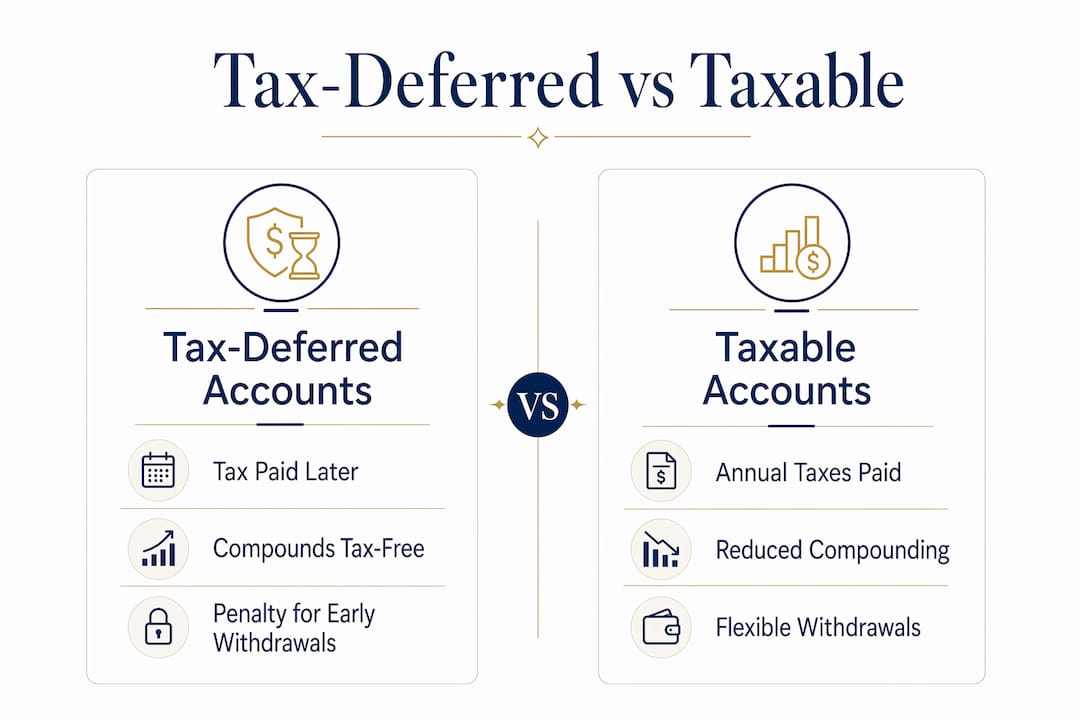
| Scenario | Annual tax on gains | Approximate ending value |
|---|---|---|
| Taxable account | Paid each year | Lower accumulation |
| Tax-deferred account | Paid at withdrawal | Higher accumulation |
Pro Tip: If you are in the 22% bracket or higher today, tax-deferred accounts almost always produce a better outcome than taxable accounts over a 20-plus-year horizon. Run the numbers with your specific rate before assuming otherwise.
What are the main types of tax-deferred accounts in 2026?
Several account structures offer tax-deferred growth, each with its own rules and limits.
- 401(k) and 403(b) plans. Employer-sponsored plans allow employees to contribute pre-tax dollars. The 2026 limit is $24,500, with a catch-up contribution available for savers aged 50 and older. Employers often match contributions, which is effectively free money added to your tax-deferred base.
- Traditional IRA. An individual retirement account funded with pre-tax or after-tax dollars, depending on your income and workplace plan coverage. The 2026 limit is $7,500. Contributions may be tax-deductible, and all growth is tax-deferred until withdrawal.
- 403(b) plans. Functionally similar to a 401(k) but offered by nonprofit organizations, public schools, and certain government employers. Contribution limits mirror the 401(k).
- Annuities. Insurance contracts that allow after-tax money to grow tax-deferred inside the contract. There is no IRS contribution limit on non-qualified annuities, making them a useful option for savers who have already maxed out other accounts.
Withdrawal rules apply uniformly across most tax-deferred accounts. Early withdrawals before age 59½ trigger a 10% penalty on top of ordinary income taxes. That penalty exists to discourage using retirement funds before retirement. Exceptions apply for specific hardship situations, disability, and certain medical expenses.
Required Minimum Distributions, or RMDs, add another layer of planning complexity. Under the SECURE 2.0 Act, RMDs begin at age 73. Missing an RMD carries a penalty of up to 25% on the amount that should have been withdrawn. That penalty is steep enough to erase years of compounding gains if you ignore it.
Pro Tip: Set a calendar reminder for the year you turn 72 to review your RMD obligations with a financial professional. Planning one year early gives you time to adjust withdrawals without scrambling.
How do tax-deferred accounts compare to Roth and taxable accounts?
Tax-advantaged accounts fall into two categories: tax-deferred and tax-exempt. Understanding the difference determines which account type fits your situation.
Tax-deferred accounts (traditional 401(k), traditional IRA, annuities) give you a tax break today. You contribute pre-tax dollars, reduce your current taxable income, and pay taxes only when you withdraw in retirement. The bet you are making is that your tax rate in retirement will be lower than your rate today.
Tax-exempt accounts (Roth 401(k), Roth IRA) flip the timing. You contribute after-tax dollars now, pay no taxes on growth, and withdraw completely tax-free in retirement. The bet here is that your tax rate in retirement will be the same or higher than it is today.
| Account type | When taxes are paid | Growth | Withdrawal |
|---|---|---|---|
| Taxable brokerage | Annually on gains | Subject to annual tax | Taxed on gains |
| Tax-deferred (traditional) | At withdrawal | Tax-deferred | Taxed as ordinary income |
| Tax-exempt (Roth) | At contribution | Tax-free | Tax-free |
Choosing between tax-deferred and Roth accounts depends on your current versus expected future tax bracket. A 35-year-old in the 22% bracket who expects to retire in the 12% bracket benefits more from tax-deferred accounts today. A 45-year-old who expects higher income in retirement may benefit more from Roth contributions now. Combining both account types diversifies your tax liability and gives you flexibility to manage taxable income in retirement.
How to maximize the benefits of tax-deferred growth
Getting the most from tax-deferred accounts requires more than just contributing the maximum. The strategy of asset location determines which investments live in which accounts, and it has a direct impact on your after-tax return.
Asset location is the practice of placing tax-inefficient investments inside tax-deferred accounts and holding tax-efficient investments in taxable accounts. High-yield bonds, actively managed funds, and real estate investment trusts generate significant taxable income each year. Placing these inside a 401(k) or IRA shields that income from annual taxation.
Tax-efficient investments, such as broad market index funds and municipal bonds, belong in taxable accounts. Index funds generate minimal capital gains distributions, so the annual tax cost is low. Holding them in a taxable account preserves your tax-deferred space for assets that need the shelter most.
Here are four concrete steps to apply this approach:
- Max out employer-sponsored plans first. Contribute at least enough to capture the full employer match in your 401(k) or 403(b). That match is an immediate 50% to 100% return on your contribution before any investment growth.
- Place bonds and high-yield assets inside tax-deferred accounts. Bond interest is taxed as ordinary income. Shielding it inside a 401(k) or IRA prevents that income from raising your annual tax bill.
- Hold index funds in taxable accounts. Low-turnover index funds rarely distribute capital gains. They are the most tax-efficient investment type and waste tax-deferred space.
- Plan your withdrawal sequence carefully. In retirement, drawing from taxable accounts first, then tax-deferred accounts, then Roth accounts is a common sequence that manages your taxable income across retirement years.
Misplacing assets across account types increases taxes and reduces the wealth you accumulate over time. The right location for each investment type is not a minor detail. It is one of the highest-leverage decisions in retirement planning.
Key Takeaways
Tax-deferred growth is the most powerful compounding tool available to retirement savers because it removes annual tax drag and lets the full gross return reinvest each year.
| Point | Details |
|---|---|
| Core definition | Tax-deferred growth means earnings accumulate without annual taxes until withdrawal. |
| 2026 contribution limits | 401(k) allows $24,500; traditional IRA allows $7,500 per year. |
| Early withdrawal cost | Withdrawing before age 59½ triggers a 10% penalty plus ordinary income taxes. |
| RMD obligation | Missing RMDs after age 73 carries a penalty of up to 25% on the missed amount. |
| Asset location matters | Place tax-inefficient assets in tax-deferred accounts for the highest after-tax return. |
What I have learned from watching clients misuse tax-deferred accounts
Most people treat tax-deferred accounts as a set-it-and-forget-it solution. They contribute, watch the balance grow, and assume the tax problem will sort itself out in retirement. That assumption costs real money.
The RMD trap catches more retirees than almost any other planning mistake. A client who spent 30 years building a $1.2 million traditional IRA suddenly faces mandatory withdrawals at 73 that push them into a higher tax bracket than they ever experienced while working. The tax-deferred account that felt like a gift becomes a tax liability they did not plan for.
The fix is not to avoid tax-deferred accounts. The fix is to pair them with Roth accounts and taxable accounts so you control which bucket you draw from in any given year. That flexibility lets you manage your taxable income in retirement the same way you managed it during your working years.
The other mistake I see is ignoring asset location entirely. Savers put index funds inside their 401(k) and hold high-yield bonds in a taxable brokerage account. That is exactly backward. The index fund generates almost no annual taxable income and does not need the shelter. The bond fund generates ordinary income every year and absolutely does.
Tax deferral is a powerful tool. It is not a complete plan. Combine it with Roth contributions, apply asset location discipline, and build a withdrawal sequence before you retire. Those three habits separate the savers who arrive at retirement with options from those who arrive with regret. If you want help building that plan, Familyguardlh works with retirement savers across 22 states to structure accounts for long-term tax efficiency.
— Shereka
Familyguardlh can help you build a tax-efficient retirement plan
Retirement planning works best when your tax strategy is built in from the start, not added as an afterthought.

Familyguardlh is a licensed retirement income specialist serving clients in 22 states, including Arizona, Florida, Texas, Georgia, and Michigan. The agency specializes in annuities, life insurance, and supplemental coverage that fits inside a broader tax-deferred strategy. Whether you are deciding between a traditional IRA and a Roth, or figuring out where annuities fit in your portfolio, Familyguardlh provides guidance built around your specific income, bracket, and retirement timeline. Reach out to start a conversation about structuring your accounts for the best possible after-tax outcome.
FAQ
What is tax-deferred growth in simple terms?
Tax-deferred growth means your investment earnings accumulate inside a qualified account without being taxed each year. You pay taxes only when you withdraw the money, typically in retirement.
What accounts offer tax-deferred growth?
The most common tax-deferred accounts are traditional 401(k)s, traditional IRAs, 403(b)s, and annuities. Each has its own contribution limits and withdrawal rules set by the IRS.
What happens when you withdraw from a tax-deferred account?
Withdrawals are taxed as ordinary income at your marginal tax rate. Withdrawals before age 59½ also trigger a 10% early withdrawal penalty in most cases.
What is the difference between tax-deferred and tax-free growth?
Tax-deferred accounts (traditional IRA, 401(k)) postpone taxes until withdrawal. Tax-free accounts (Roth IRA, Roth 401(k)) require after-tax contributions but allow completely tax-free withdrawals in retirement.
How do Required Minimum Distributions affect tax-deferred accounts?
Under the SECURE 2.0 Act, RMDs begin at age 73. Failing to take the required amount results in a penalty of up to 25% on the missed withdrawal, making advance planning critical.