

A Spousal Lifetime Access Trust, known as a SLAT, is an irrevocable trust that removes assets from your taxable estate while keeping your spouse as a beneficiary. SLAT insurance planning explained simply means combining this trust structure with life insurance to protect wealth, pay estate taxes, and preserve what you pass to your heirs. With the federal estate tax exemption set at $15 million per person in 2026, and a 40% tax rate hitting combined assets above $14 million, the window to lock in this exemption is real and closing. If you are approaching retirement or already there, understanding how SLATs work could be the most consequential financial decision you make this decade.
SLAT insurance planning explained: the core structure
A SLAT is a gift from one spouse, called the donor or grantor, to an irrevocable trust that names the other spouse as a lifetime beneficiary. The donor removes assets from their taxable estate permanently. The beneficiary spouse can still receive distributions from the trust for health, education, maintenance, and support. This structure lets a couple effectively keep access to wealth while legally removing it from estate tax exposure.
The critical word is irrevocable. SLAT assets belong permanently to the trust once funded. You cannot reclaim them if your financial situation changes, if your marriage ends, or if your spouse dies. That permanence is both the power and the risk of this strategy.
Life insurance fits into SLAT planning as a liquidity tool and a wealth replacement mechanism. When assets move into the trust, the estate loses direct control of those assets. A life insurance policy held inside or alongside the SLAT can fund estate taxes on assets that were not transferred, and it can replace the value of what was given away for other heirs. This dual function makes life insurance a core component of well-structured SLAT strategies, not an optional add-on.

How does life insurance function within a SLAT?
Life insurance within a SLAT acts as a liquidity source to pay estate taxes on assets that were never transferred into the trust. Without that liquidity, heirs may be forced to sell real estate, business interests, or investments at the wrong time to cover a tax bill. A policy held by the trust means the death benefit passes outside the taxable estate and is available exactly when it is needed most.
The most common structure places a policy on the donor spouse's life inside the SLAT. The trust owns the policy, pays the premiums, and collects the death benefit. This keeps the proceeds out of the donor's estate entirely.
Survivorship life insurance policies, which pay out only after both spouses die, are generally unsuitable inside a SLAT. The reason is straightforward: the beneficiary spouse depends on the trust for access to assets during their lifetime. If the spouse dies before the policy pays out, that access disappears. A survivorship policy does not solve that problem.
A separate life insurance policy on the beneficiary spouse's life, held outside the SLAT, addresses this gap directly. If the beneficiary spouse dies, the donor spouse loses indirect access to the trust assets. A policy on the spouse's life replaces that lost financial cushion. This complementary coverage is a risk management step that many planners overlook.
Pro Tip: When selecting a policy for a SLAT, work with a licensed advisor to match the policy type, term, and death benefit to the specific liquidity needs of your estate plan. Whole life and certain universal life policies are common choices because of their predictable cash value growth and permanent coverage.
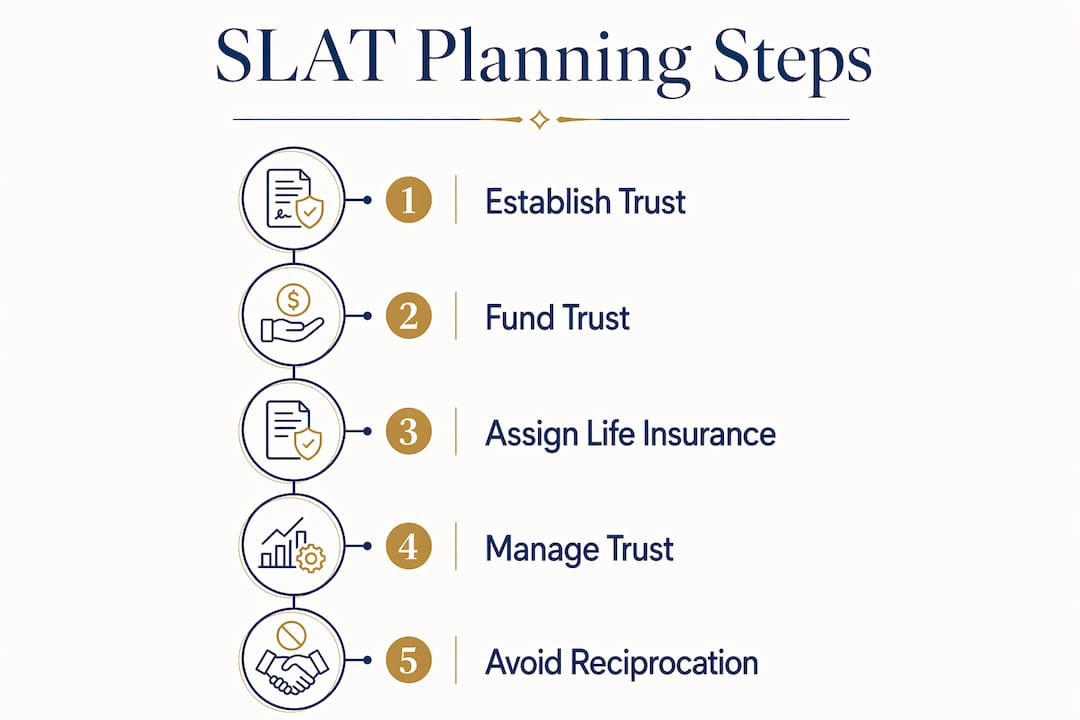
What is the reciprocal trust doctrine and how do you avoid it?
The reciprocal trust doctrine applies when both spouses create nearly identical SLATs for each other. The IRS treats the trusts as if each spouse created their own trust, pulling the assets back into each estate and wiping out the tax benefits entirely. The doctrine exists to prevent couples from using mirror-image trusts to game the estate tax system.
The IRS scrutinizes SLATs for reciprocity closely. A trust that looks like a direct swap, same trustee, same beneficiary class, same distribution terms, same funding date, will almost certainly trigger the doctrine. The solution is to build genuine economic differences into each trust from the start.
Practitioners create deliberate differences in trust terms to establish what tax law calls "economic substance." The differences must be real, not cosmetic. Here is what that looks like in practice:
| Differentiation strategy | Purpose |
|---|---|
| Different trustees | Prevents appearance of mutual control between spouses |
| Different beneficiary classes | One trust includes children; the other does not, or includes different descendants |
| Different distribution standards | One trust uses an ascertainable standard; the other grants trustee discretion |
| Different governing state law | Varying jurisdiction adds legal and structural distinction |
| Staggered funding dates | Separating funding by months or years breaks the appearance of a direct exchange |
Each of these differences signals to the IRS that the trusts were created for independent reasons, not as a reciprocal arrangement.
Pro Tip: Never draft both SLATs at the same time with the same attorney using the same template. Engage separate advisors or at minimum require your estate planning attorney to document the independent reasoning behind each trust's terms.
Which assets work best for funding a SLAT?
The best assets to fund a SLAT are those with high expected appreciation: founder shares, vested restricted stock units (RSUs), concentrated stock positions, and similar equity interests. The logic is simple. When you transfer an asset into the trust, you use your estate tax exemption based on the asset's value at the time of transfer. All future appreciation happens inside the trust, outside your taxable estate. The higher the growth potential, the greater the tax benefit.
Here are the key considerations when selecting assets for SLAT funding:
- Transferability. The asset must be legally transferable to a trust. Some executive compensation plans, deferred compensation arrangements, and certain retirement accounts cannot be transferred and are therefore off the table.
- Liquidity impact. Transferring income-generating assets reduces your personal cash flow. Assess whether you can maintain your lifestyle without those distributions before funding the trust.
- Valuation discounts. Minority interests in closely held businesses or family limited partnerships may qualify for valuation discounts at the time of transfer, stretching your exemption further.
- Control trade-off. Once assets are in the trust, you no longer control them directly. The trustee manages them. Choose assets where you can accept that shift in control.
- Illiquid assets. Placing real estate or private equity in a SLAT requires careful planning. The trust needs enough liquid assets to pay expenses, taxes, and distributions without forcing a sale.
Sophisticated SLAT planning also delivers asset protection benefits that vary by state. In states with strong trust protection laws, creditors of the grantor generally cannot reach SLAT assets. That protection adds a layer of security beyond the estate tax benefit.
What are the ongoing costs and duties of maintaining a SLAT?
A SLAT is not a set-it-and-forget-it structure. Ongoing administration includes annual trust tax returns (Form 1041), state filings, investment oversight, and regular coordination with your broader estate plan. Neglecting these duties can forfeit both the tax advantages and the asset protection the trust was designed to provide.
Typical setup costs range from $10,000 to $50,000, with ongoing trustee fees and tax compliance costs added each year. These figures reflect why SLATs are generally suited for estates between $5 million and $50 million. Below that range, the cost-to-benefit ratio often does not justify the complexity.
The trustee carries real responsibility. Trustee duties include:
- Reviewing and approving distributions to the beneficiary spouse
- Filing annual trust income tax returns and any required state filings
- Maintaining accurate records of trust assets, income, and expenses
- Coordinating with the grantor's estate planning attorney and CPA annually
- Ensuring investment decisions align with the trust's stated purpose and terms
Planning must include substantial liquidity outside the SLAT to cover personal and emergency financial needs. The trust cannot be unwound if you need cash. Keeping accessible assets outside the trust is not optional; it is a structural requirement of sound SLAT planning.
Key Takeaways
A SLAT combines irrevocable trust structure with life insurance to remove assets from your taxable estate while preserving spousal access and funding estate tax liquidity.
| Point | Details |
|---|---|
| Lock in the 2026 exemption | The $15M per-person federal exemption makes 2026 a critical year to fund a SLAT. |
| Life insurance provides liquidity | A policy held by the trust pays estate taxes without forcing heirs to sell assets. |
| Avoid the reciprocal trust doctrine | Differentiate both SLATs in trustees, terms, beneficiaries, and funding dates. |
| Choose appreciating assets | Transferring high-growth assets maximizes the estate tax savings over time. |
| Budget for ongoing administration | Expect $10,000–$50,000 in setup costs plus annual trustee and compliance fees. |
Why I think most people underestimate SLAT complexity
After years of working with retirees on retirement income and estate protection, I have seen one pattern repeat itself: couples hear "your spouse still has access" and assume a SLAT is simple. It is not.
The irrevocability is the part that catches people off guard. I have spoken with clients who funded a SLAT and then faced an unexpected medical expense or a business downturn. The assets in the trust were untouchable. That is by design, but it is a reality that requires honest conversation before you sign anything.
The reciprocal trust doctrine is another area where I see people take shortcuts. Using the same attorney, the same template, and the same funding date for both spouses' trusts is asking for IRS scrutiny. The differences between the two trusts need to be real and documented, not just cosmetic.
What I tell every client is this: a SLAT is one of the most powerful wealth transfer tools available to married couples with significant estates. But it works only when it is built carefully, maintained consistently, and coordinated with your full financial picture. The retirement income planning piece matters just as much as the trust structure. You need enough outside the trust to live comfortably, regardless of what happens inside it.
Do not let the complexity stop you from acting. Let it push you toward the right advisors.
— Shereka
How Familyguardlh supports your retirement and estate planning goals
Familyguardlh specializes in retirement income protection across 22 states, including Florida, Texas, Georgia, and Ohio. The agency works with retirees and pre-retirees to identify the right life insurance structures, annuities, and supplemental coverage that align with estate planning goals like SLAT strategies.

Whether you need a life insurance policy designed to fund estate taxes, coverage to protect a surviving spouse, or guidance on how insurance fits into your broader wealth plan, Familyguardlh offers licensed expertise to match your situation. Reach out to explore retirement income solutions that work alongside your estate planning team to protect what you have built.
FAQ
What is a SLAT in estate planning?
A SLAT is a Spousal Lifetime Access Trust, an irrevocable trust where one spouse transfers assets out of their taxable estate while the other spouse remains a beneficiary. It is used to lock in estate tax exemptions and protect wealth for future generations.
Why is life insurance used inside a SLAT?
Life insurance held by a SLAT provides liquidity to pay estate taxes on assets not transferred into the trust, so heirs do not have to sell property or investments to cover the tax bill.
What is the reciprocal trust doctrine?
The reciprocal trust doctrine is an IRS rule that treats nearly identical spousal SLATs as if each spouse created their own trust, pulling assets back into the taxable estate. Couples avoid it by creating meaningful differences in each trust's terms, trustees, and funding dates.
Can a SLAT be undone if circumstances change?
No. A SLAT is irrevocable once funded. Assets transferred into the trust cannot be reclaimed, even if the grantor's financial situation changes, the marriage ends, or the beneficiary spouse dies.
What does it cost to set up and maintain a SLAT?
Setup costs typically range from $10,000 to $50,000, with additional annual fees for trustee services and tax compliance. SLATs are generally cost-effective for estates between $5 million and $50 million.