

Insurance-based retirement income tax strategies are defined as methods that use permanent life insurance, annuities, and related products to generate tax-advantaged income in retirement. For adults 50 and older who have already maxed out their 401(k) and IRA contributions, these tools offer a second layer of tax protection that most financial plans overlook. Key instruments include whole life insurance, universal life insurance, Life Insurance Retirement Plans (LIRPs), Section 1035 exchanges, and irrevocable life insurance trusts. Understanding how these tools work together is what separates a retirement plan that merely survives from one that thrives.
What are the main types of insurance products used in retirement tax planning?
Permanent life insurance is the foundation of most insurance-based retirement tax strategies. Unlike term policies, permanent policies build cash value over time. That cash value grows tax-deferred and can be accessed through loans or withdrawals, often without triggering income tax.
Whole life insurance provides a fixed death benefit, guaranteed cash value growth, and level premiums. It suits retirees who want predictability. Universal life insurance offers more flexibility in premiums and death benefit amounts, making it easier to adjust as income changes in retirement.

A Life Insurance Retirement Plan, or LIRP, is not a separate product. It is a strategy that uses an overfunded permanent life insurance policy to accumulate cash value for retirement income. LIRPs suit those who have maxed out qualified accounts, have ongoing insurance protection needs, and have sufficient cash flow to fund the policy. They are not a replacement for a 401(k) or Roth IRA for most people.
| Product | Cash Value | Tax Benefit | Best For |
|---|---|---|---|
| Whole life | Guaranteed growth | Tax-deferred accumulation, tax-free loans | Predictable, conservative retirees |
| Universal life | Flexible growth | Tax-deferred accumulation, tax-free loans | Those needing premium flexibility |
| LIRP (overfunded policy) | High accumulation focus | Tax-free income via loans | Maxed-out qualified plan holders |
| Annuity (via 1035 exchange) | Varies by type | Tax-deferred growth, structured income | Guaranteed income seekers |
Pro Tip: Overfunding a life insurance policy to build cash value must stay within IRS limits. Exceeding those limits turns the policy into a Modified Endowment Contract, or MEC, which eliminates the tax-free loan advantage entirely.
How can you integrate life insurance and tax-advantaged accounts to reduce retirement taxes?
The most effective framework for retirement tax planning is the three-bucket approach. Bucket one holds taxable accounts like brokerage accounts. Bucket two holds tax-deferred accounts like traditional IRAs and 401(k)s. Bucket three holds tax-free assets, including Roth IRAs and permanent life insurance cash value. Tax diversification across buckets lowers your marginal tax rate in retirement by giving you control over which bucket you draw from each year.
Life insurance fits squarely in bucket three. A loan against cash value is generally tax-free as long as the policy remains in force. That means you can supplement Social Security or pension income with policy loans without pushing yourself into a higher tax bracket.
One underused strategy involves Required Minimum Distributions, or RMDs. Once you reach the RMD age, you must take taxable distributions from traditional IRAs. Using RMD proceeds to purchase life insurance inside an irrevocable trust converts those taxable dollars into a tax-free death benefit that passes outside your estate. You pay income tax on the RMD now, but your heirs receive the insurance proceeds free of both income and estate tax.
| Income Source | Tax Treatment | Notes |
|---|---|---|
| Traditional IRA / 401(k) withdrawals | Ordinary income tax | Triggers RMDs at age 73 |
| Roth IRA withdrawals | Tax-free | No RMDs during owner's lifetime |
| Life insurance policy loans | Generally tax-free | Policy must remain in force |
| Social Security | Up to 85% taxable | Depends on combined income |
| Annuity income | Partially taxable | Exclusion ratio applies |
Pro Tip: If you are between 50 and 65 and not yet on Medicare, coordinate your income withdrawals carefully before open enrollment. ACA marketplace subsidies can disappear with even a small income increase from a Roth conversion or IRA withdrawal, costing you thousands in health insurance premiums.
What are the essential pre-retirement insurance planning steps?
Most retirees wait too long to review their insurance policies. Deadlines for term conversions and coverage changes often fall 6–12 months before retirement. Missing those windows can mean losing insurability or paying much higher premiums for a new policy.
Start with a full audit of every policy you own. Check whether your term policy has a conversion rider that lets you switch to permanent coverage without a new medical exam. Evaluate the cash value in any existing permanent policies. Confirm that beneficiary designations reflect your current wishes, since outdated beneficiaries override your will.
If you own a permanent policy you no longer need in its current form, do not surrender it without exploring a Section 1035 exchange first. A 1035 exchange lets you transfer the cash value into a new life insurance policy or annuity without triggering income tax on the gains. Surrendering a policy with $80,000 in premiums paid and $120,000 in cash value creates a $40,000 taxable gain. A 1035 exchange avoids that tax entirely.
Common mistakes to avoid in pre-retirement insurance planning:
- Dropping group life insurance from your employer before securing individual coverage
- Surrendering a permanent policy without checking 1035 exchange eligibility
- Failing to update beneficiary designations after divorce, death, or new dependents
- Ignoring term conversion deadlines, which are often age-based and non-negotiable
- Overlooking the impact of new policy premiums on your projected retirement income
- Skipping a policy review when your health has improved, since better health may qualify you for lower rates
How do you execute insurance-based retirement income strategies step by step?
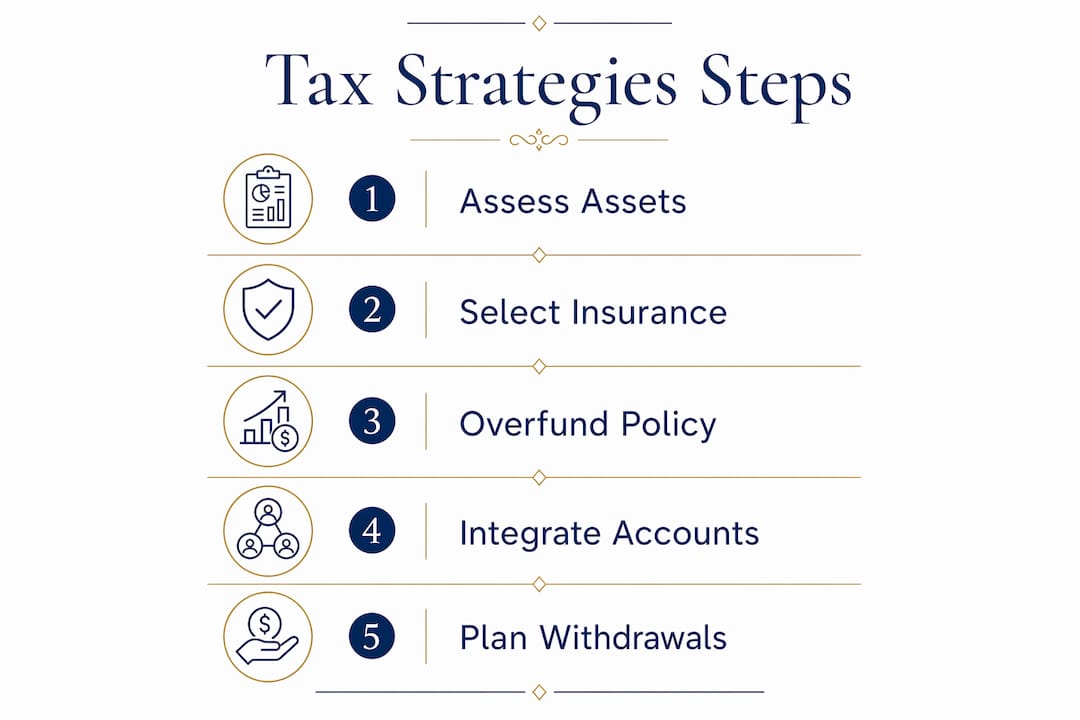
A clear sequence makes these strategies far less intimidating. Follow these steps to put insurance to work as a tax-efficient income source.
-
Assess your current coverage and cash value. Pull every policy statement and calculate total cash value, outstanding loans, and death benefit amounts. This gives you a baseline before making any changes.
-
Max out qualified accounts first. Contribute the maximum to your 401(k), IRA, or Roth IRA before directing money into a life insurance policy for retirement income purposes. Insurance strategies work best as a complement, not a substitute.
-
Fund or convert to a permanent policy. If you have a term policy with a conversion rider, convert it before the deadline. If you are starting fresh, work with a licensed advisor to select a whole life or universal life policy sized to your income goals.
-
Monitor cash value growth annually. Review your policy illustration each year. Confirm that premiums are on track and that the policy is not at risk of lapsing due to rising internal costs.
-
Take tax-free loans in retirement. Once you retire, draw from your policy's cash value through loans rather than surrendering the policy. Loans do not appear as taxable income, which keeps your adjusted gross income lower.
-
Coordinate with Social Security and Medicare timing. Higher income in retirement can trigger Medicare Part B and D premium surcharges known as IRMAA. Keeping income lower by using tax-free policy loans instead of IRA withdrawals can prevent those surcharges.
-
Use RMDs to fund irrevocable trust insurance. Once RMDs begin, consider directing a portion to purchase life insurance inside an irrevocable trust. This structure removes assets from your taxable estate and creates a tax-free legacy for your heirs.
What are common mistakes when using insurance to optimize retirement taxes?
The biggest mistake retirees make is treating insurance as a set-it-and-forget-it product. Permanent life insurance policies require ongoing management. If premiums are underpaid or the policy underperforms, the cash value can erode and the policy may lapse, triggering a large taxable event at exactly the wrong time.
A Modified Endowment Contract, or MEC, is another common trap. Overfunding a policy too quickly causes the IRS to reclassify it as a MEC. Once that happens, loans and withdrawals become taxable and may carry a 10% penalty before age 59½. The tax-free income advantage disappears entirely.
Watch for these warning signs and corrective steps:
- Warning: Policy cash value is declining despite premium payments. Fix: Request an in-force illustration and adjust premiums or death benefit.
- Warning: You received a MEC notice from your insurer. Fix: Stop additional contributions immediately and consult a tax advisor.
- Warning: Your income jumped due to a Roth conversion and you lost ACA subsidies. Fix: Project income before december 31 each year and limit conversions to stay below subsidy thresholds.
- Warning: Beneficiary designations have not been reviewed in more than three years. Fix: Update them now, especially after any major life change.
- Warning: You are considering surrendering a policy for cash. Fix: Explore a 1035 exchange before surrendering to avoid unnecessary income tax.
Pro Tip: Schedule a policy review with your advisor every 12 months. Bring your most recent policy statement, your projected income for the coming year, and your current Medicare or ACA enrollment status. These three pieces of information together reveal most planning gaps before they become costly.
Key Takeaways
Insurance-based retirement income strategies work best when permanent life insurance, 1035 exchanges, and irrevocable trusts are layered with traditional accounts to control taxable income across all retirement years.
| Point | Details |
|---|---|
| Use the three-bucket approach | Combine taxable, tax-deferred, and tax-free insurance assets to lower your marginal tax rate. |
| Act on policy reviews early | Review all insurance coverage 6–12 months before retirement to avoid losing conversion rights. |
| Use 1035 exchanges, not surrenders | Transfer cash value tax-free rather than surrendering a policy and triggering a taxable gain. |
| Coordinate income with ACA and Medicare | Unplanned income spikes can eliminate subsidies and trigger IRMAA surcharges. |
| LIRPs complement, not replace, qualified plans | Use a LIRP only after maxing out your 401(k) and IRA and confirming you still need life insurance. |
What I have learned from helping retirees use insurance for tax efficiency
After working with retirees across multiple states, the pattern I see most often is this: people wait too long. They call me at 64, six months from retirement, having never converted their term policy or reviewed their cash value in years. The options at that point are narrower and more expensive.
The retirees who come out ahead start the conversation at 55 or 56. They have time to fund a permanent policy, let cash value grow, and position themselves to draw tax-free income when they need it most. The 1035 exchange is one of the most underused tools I encounter. People assume surrendering a policy is their only option, and they pay thousands in unnecessary taxes as a result.
The irrevocable trust strategy surprises most people. Using RMDs to buy life insurance inside a trust sounds complicated, but the concept is straightforward. You pay tax on money you were required to take out anyway, and your heirs receive a larger, tax-free benefit. That is a genuine win.
The pre-Medicare years between 62 and 65 are the most fragile window in retirement planning. One Roth conversion too many, one unexpected IRA withdrawal, and ACA subsidies vanish. I have seen retirees lose $8,000 to $12,000 in annual subsidies from a single poorly timed decision. Combined tax and insurance planning during those years is not optional. It is the difference between a plan that works and one that costs you.
— Shereka
How Familyguardlh can support your retirement income plan
Familyguardlh specializes in retirement income insurance options across 22 states, including Florida, Texas, Georgia, and Ohio. The team works with adults 50 and older to assess existing policies, identify 1035 exchange opportunities, and build layered income plans that reduce taxes throughout retirement.

Whether you need whole life insurance, a LIRP structure, an annuity, or Medicare supplemental coverage, Familyguardlh can match you with the right products for your situation. The agency also helps coordinate health insurance during the pre-Medicare years to protect your ACA subsidies. Visit Familyguardlh to connect with a licensed advisor and get a personalized retirement income review built around your tax goals.
FAQ
What is a Life Insurance Retirement Plan (LIRP)?
A LIRP is an overfunded permanent life insurance policy designed to accumulate cash value for tax-free retirement income. It works best for people who have already maxed out their 401(k) and IRA contributions and still need life insurance coverage.
How does a 1035 exchange work for retirement planning?
A 1035 exchange lets you transfer the cash value of one life insurance policy into a new policy or annuity without paying income tax on the gains. Surrendering the policy instead would trigger ordinary income tax on any growth above your cost basis.
Can life insurance loans affect my Medicare premiums?
Policy loans are generally not counted as taxable income, so they do not raise your adjusted gross income. Keeping income lower through policy loans instead of IRA withdrawals can help you avoid IRMAA surcharges on Medicare Part B and D premiums.
When should I start pre-retirement insurance planning?
Start at least 6–12 months before your retirement date. Term conversion deadlines and coverage changes are often age-based and cannot be extended, so waiting until the last minute risks losing your options entirely.
What is an irrevocable life insurance trust and why does it matter?
An irrevocable life insurance trust, or ILIT, holds a life insurance policy outside your taxable estate. Funding it with RMD proceeds means you pay income tax on the distribution now, but your heirs receive the death benefit free of both income and estate tax.