

Protecting spouse retirement income insurance is defined as a coordinated strategy combining pension election choices, life insurance coverage, and federal spousal rights compliance to secure your partner's income after you die. The industry term for this planning approach is "survivor income protection," and it covers everything from Qualified Joint and Survivor Annuity (QJSA) rules under ERISA to pension maximization with life insurance. Couples nearing retirement face one critical risk: the income that supports both of you today may drop sharply when one of you is gone. Getting this right requires more than picking a pension option. It requires layering the right tools together before you retire, because most elections are permanent once made.
How pension maximization can protect spouse retirement income
Pension maximization is a strategy where the retiring spouse selects the higher single-life pension payout and uses part of that extra income to buy a life insurance policy that pays the surviving spouse. The logic is straightforward. A joint-and-survivor pension pays less each month to guarantee income for both lifetimes. A single-life pension pays more, but stops at the retiree's death.
A 2026 case study showed a $900 monthly difference between the two pension options funding a $720,000 life insurance death benefit. That death benefit replaces the income stream the surviving spouse would have lost. The math works when the premium cost is lower than the pension income difference, and when the retiree qualifies for life insurance at a favorable rate.

When pension maximization works and when it does not
This strategy has real prerequisites that couples must evaluate honestly before committing.
- The retiree must qualify for life insurance at a rate that makes the numbers work. Poor health can make premiums too expensive to justify the approach.
- The surviving spouse must be comfortable with the risk that the insurance policy stays in force. If premiums become unaffordable later, coverage lapses and the spouse is left with nothing.
- The pension election is irrevocable. Once you choose single-life, you cannot switch back if circumstances change.
- The life insurance payout is a lump sum, not a monthly income stream. The surviving spouse must manage that capital wisely to replicate ongoing income.
Pro Tip: Get a life insurance quote before you finalize your pension election. The quote tells you whether pension maximization is actually cheaper than the joint-survivor reduction. Many couples assume it works without running the numbers first.
The strategy suits couples where the retiree is in good health, the premium cost is clearly lower than the pension income difference, and the surviving spouse has the financial literacy to manage a lump sum. It is not a universal fix. For couples where health is uncertain or premiums are high, a joint-life annuity is the safer default.
What federal spousal protection laws require
ERISA mandates that most pension plans offer a Qualified Joint and Survivor Annuity as the default payout for married participants. The QJSA pays at least 50% of the retiree's benefit to the surviving spouse for life. A Qualified Pre-Retirement Survivor Annuity (QPSA) applies if the participant dies before retirement. Both protections exist specifically to prevent a surviving spouse from losing all retirement income.
To waive these protections, ERISA requires spousal consent witnessed by a plan representative or notary. The consent must be in writing, signed after marriage, and specific to the plan. This matters because many couples assume a prenuptial agreement covers this. It does not. A prenuptial agreement alone cannot waive ERISA-protected spousal rights. Only a formal, witnessed post-marriage consent on plan documents satisfies the legal standard.
Key steps for navigating spousal consent correctly
- Request the plan's official spousal consent form before making any pension election.
- Read the form with your spouse present. Both of you must understand what rights are being waived.
- Sign in front of a plan representative or notary. An unwitnessed signature is legally invalid.
- Keep a copy of the signed consent in your personal records alongside your pension election paperwork.
- Confirm the plan has received and recorded the consent before your retirement date.
Rolling over your 401(k) to an IRA removes ERISA's spousal protections entirely. IRA beneficiary designations can be changed without your spouse's consent, which means a surviving spouse could be disinherited from funds that were once federally protected. Think carefully before moving ERISA-governed assets to an IRA.
Defined benefit plans and certain defined contribution plans must offer QJSA and QPSA for benefits over $5,000. Most defined contribution plans are not subject to QJSA rules but must pay the vested balance to the surviving spouse unless consent is given to name another beneficiary. Knowing which rules apply to your specific plan is not optional. It is the foundation of any spouse retirement protection plan.
Joint-life annuities versus life insurance for spouse income security
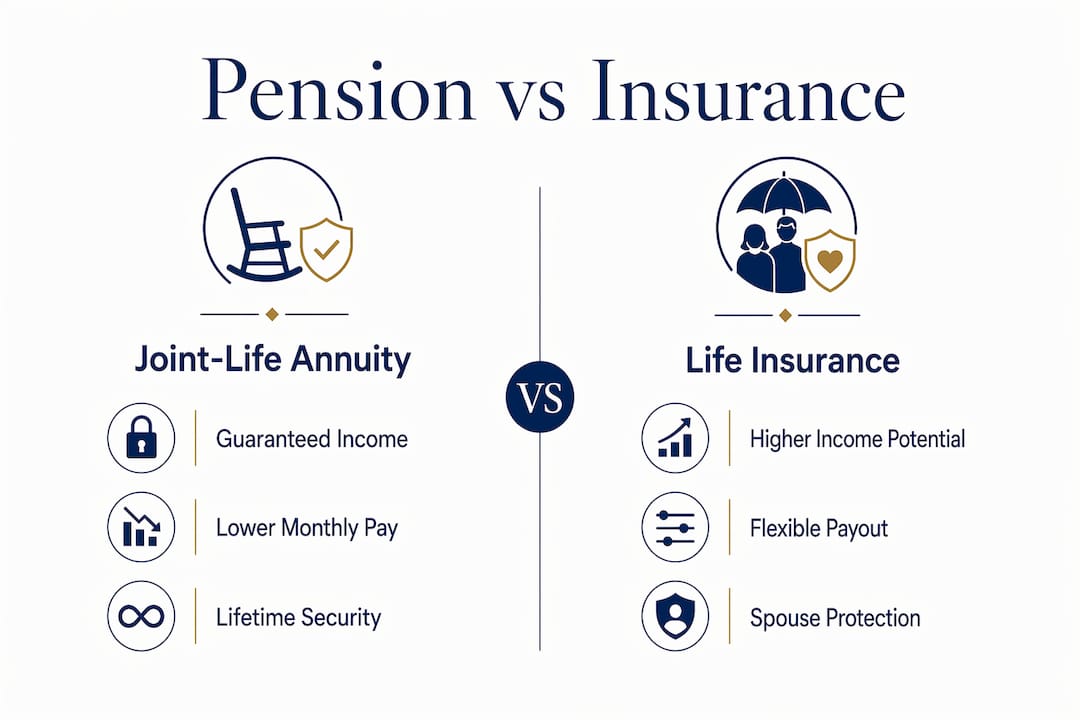
Joint-life annuities and life insurance serve the same core purpose but work very differently. A joint-life annuity pays income to both spouses for as long as either is alive. A life insurance policy pays a lump sum to the surviving spouse at the retiree's death. The right choice depends on your health, age, premium costs, and how dependent your spouse is on your income.
| Factor | Joint-life annuity | Life insurance strategy |
|---|---|---|
| Monthly income | Lower, guaranteed for both lifetimes | Higher single-life pension, funded by premiums |
| Health requirement | None for the annuity itself | Retiree must qualify medically |
| Payout to spouse | Ongoing monthly income | Lump sum death benefit |
| Flexibility | None after election | Policy can lapse if premiums stop |
| Best for | Couples needing predictable income | Couples where retiree is in good health |
Joint-life annuities remove the risk of outliving income. The trade-off is a permanently lower monthly check. Life insurance remains valuable especially when pension survivor benefits are reduced or skipped, or when the surviving spouse needs liquidity for taxes and estate costs that a monthly annuity cannot cover.
Pro Tip: If your spouse has their own retirement income, a joint-life annuity's lower payout may not be necessary. A single-life pension plus a term or permanent life insurance policy can deliver more total income during both lifetimes while still protecting the survivor.
Choosing between these two options depends on multiple factors including age, health, premium affordability, and the spouse's income needs. Couples where one spouse has significant health issues should lean toward the joint-life annuity. Couples where the retiree is healthy and premiums are competitive have more reason to consider the life insurance route.
How to coordinate Social Security, pensions, and insurance for full protection
Protecting a surviving spouse requires a coordinated approach integrating Social Security timing, pension options, and life insurance rather than isolated decisions. Each income source affects the others, and a gap in one can undermine the entire plan.
Social Security survivor benefits allow a surviving spouse to claim the deceased spouse's benefit if it is higher than their own. Delaying Social Security past full retirement age increases the monthly benefit, which means a higher survivor benefit for your spouse if you die first. That timing decision alone can add hundreds of dollars per month to your spouse's income for life.
- Pension survivor annuities often determine health benefit eligibility. Federal employees under FEHB, for example, must maintain a survivor annuity for the spouse to keep health coverage after the retiree's death. Waiving the survivor annuity can eliminate that health coverage, creating a hidden cost that far exceeds the monthly pension reduction.
- Life insurance fills gaps that pension survivor benefits and Social Security do not cover, including estate taxes, final expenses, and income replacement during the period before the surviving spouse claims their own benefits.
- The "widow's penalty" is a real tax risk. A surviving spouse filing as a single filer faces higher tax rates on the same income. Life insurance proceeds paid as a lump sum are generally income tax-free, which makes them a tax-efficient way to transfer wealth to a surviving spouse.
- Reviewing beneficiary designations on all accounts, including IRAs, 401(k)s, and life insurance policies, should happen every three to five years or after any major life change.
Couples who plan these decisions together, rather than letting one spouse handle it alone, make better choices. The spouse who will survive needs to understand the income sources, the amounts, and the conditions attached to each one. Shared knowledge is itself a form of retirement income security.
Key Takeaways
Securing your spouse's retirement income requires combining pension elections, life insurance, and federal spousal rights into one coordinated plan rather than treating each as a separate decision.
| Point | Details |
|---|---|
| Pension maximization requires health | The retiree must qualify for life insurance at a rate lower than the joint-survivor pension reduction. |
| ERISA consent must be witnessed | A prenuptial agreement cannot waive QJSA rights; only a signed, witnessed post-marriage plan document does. |
| IRA rollovers remove federal protections | Moving 401(k) funds to an IRA eliminates spousal consent requirements and exposes the surviving spouse to risk. |
| Health benefits depend on survivor annuity | Waiving a survivor annuity can end a spouse's health coverage, adding a major hidden cost to the decision. |
| Coordination beats single fixes | Aligning Social Security timing, pension options, and life insurance delivers stronger spouse protection than any one tool alone. |
What I've learned about protecting a spouse's retirement income
Shereka here. After working with couples across multiple states on retirement income planning, one pattern stands out clearly. The couples who struggle most are the ones who made pension elections without fully understanding what they were giving up. They signed a waiver because the single-life pension looked better on paper, and they never ran the life insurance numbers first.
The health assessment piece is where I see the most costly mistakes. A retiree assumes they will qualify for life insurance at a standard rate, chooses the single-life pension, and then discovers their health history pushes premiums to a level that makes the math fall apart. At that point, the pension election is already locked in.
My honest recommendation: treat life insurance as a supplement to survivor benefits, not a replacement for them. The joint-life annuity gives your spouse guaranteed income for life with no management required. Life insurance adds liquidity and fills gaps. Using both together, sized correctly, gives your spouse the strongest possible position. The federal protections under ERISA exist for a reason. Use them as your baseline, then build on top of them with insurance.
The couples who come in early, before retirement is six months away, have real options. The couples who come in after the pension election is signed are working with whatever is left. Start this conversation now, and bring your spouse into every meeting.
— Shereka
Retirement income protection options at Familyguardlh
Couples navigating pension elections, life insurance decisions, and spousal consent requirements need guidance that is specific to their situation, not generic advice that fits no one.

Familyguardlh specializes in retirement income insurance for couples and retirees across 22 states, including AZ, CO, FL, GA, TX, VA, and PA. The agency works with clients to evaluate pension maximization strategies, compare life insurance options against joint-life annuity payouts, and identify coverage gaps that could leave a surviving spouse without income. Whether you need a life insurance policy to fund a single-life pension strategy or want to review your current survivor benefit elections, Familyguardlh offers the expertise to build a plan that fits your specific retirement picture.
FAQ
What is pension maximization in retirement planning?
Pension maximization is a strategy where a retiree selects the higher single-life pension and uses part of the extra income to purchase life insurance. The death benefit replaces the income a surviving spouse would have lost by forgoing the joint-survivor pension option.
Can a prenuptial agreement waive ERISA spousal rights?
No. A prenuptial agreement cannot waive ERISA-protected spousal rights. Only a formal, witnessed spousal consent signed after marriage on official plan documents satisfies the legal requirement under QJSA and QPSA rules.
What happens to spousal protections when a 401(k) is rolled over to an IRA?
Rolling over a 401(k) to an IRA removes ERISA's spousal protections. IRA beneficiary designations can be changed without the spouse's consent, which means the surviving spouse has no federal guarantee on those funds.
Is a joint-life annuity always better than life insurance for protecting a spouse?
Not always. A joint-life annuity is safer when the retiree's health makes life insurance expensive or unavailable. Life insurance makes more sense when the retiree qualifies at a competitive rate and the premium cost is lower than the joint-survivor pension reduction.
How does Social Security affect a surviving spouse's retirement income?
A surviving spouse can claim the deceased spouse's Social Security benefit if it is higher than their own. Delaying Social Security past full retirement age increases the monthly benefit, which directly raises the survivor benefit available to the spouse.