

The most effective way to protect retirement savings from inflation is to combine inflation-linked securities, dividend-growth stocks, real estate, and tax-efficient withdrawal strategies before inflation compounds your losses. Sustained annual inflation significantly erodes the real value of fixed income over the long term, highlighting the importance of inflation protection. The Consumer Price Index has shown a moderate year-over-year increase through April 2026, with healthcare and housing outpacing that headline number. If your portfolio is sitting in nominal bonds and cash, you are already falling behind.
The core strategies that actually work:
- TIPS and I Bonds: Government-backed securities that adjust principal with the Consumer Price Index
- Dividend-growth stocks: Companies with a track record of raising payouts faster than inflation
- Real estate and REITs: Property-linked income that tends to rise alongside prices
- Commodities and gold: Direct inflation exposure, though without regular income
- Budget flexibility: Trimming discretionary spending when inflation spikes
- Tax-efficient withdrawals: Sequencing accounts to keep more of what you earn
- Annuities with inflation riders: Guaranteed income that grows over time
Inflation's long-term toll: A fixed income losing 40% of its real value over 20 years is not a theoretical risk. For a retiree drawing $60,000 annually, that means the real purchasing power would be reduced by $24,000 after 20 years, consistent with a 2.5% annual inflation rate.
How to re-evaluate and diversify your retirement portfolio
Diversification is the first line of defense against inflation, and most retirees do not have enough of it. A portfolio heavy in nominal bonds and cash may feel safe, but nominal bonds and cash typically cannot keep pace with inflation, especially during sustained price increases. The goal is to hold a mix of assets where at least some of them benefit when prices rise.
Portfolios with a significant allocation to TIPS have historically preserved a higher portion of purchasing power over long horizons compared to portfolios relying solely on nominal bonds. That 13-point gap is the cost of ignoring inflation-linked assets.
Key areas to review when rebalancing:
- Dividend-growth stocks: Payouts have grown an average of 7.3% annually over the past decade, well above typical inflation rates. A sizable investment in dividend-growth stocks with a moderate yield and dividend growth can substantially increase income over time.
- International equities: Geographic diversification reduces exposure to U.S.-specific inflation cycles.
- Inflation-linked bonds: TIPS and similar instruments provide direct CPI linkage.
- Real assets: Real estate investment trusts and commodity funds add inflation-correlated returns.
- Cash and short-term bonds: Keep a liquid cash reserve sufficient for one to two years of expenses, but avoid holding too large a share of the overall portfolio in cash and short-term bonds.
Rebalance at least once a year, and revisit your allocation whenever inflation data shifts materially. Retirees who need both income and growth should lean toward dividend-paying equities and REITs rather than pure growth stocks, which tend to underperform during high-inflation periods.
Pro Tip: Review your portfolio's "real return" — the return after subtracting inflation — not just the nominal return. A 5% return during a 4% inflation year is only a 1% real gain.
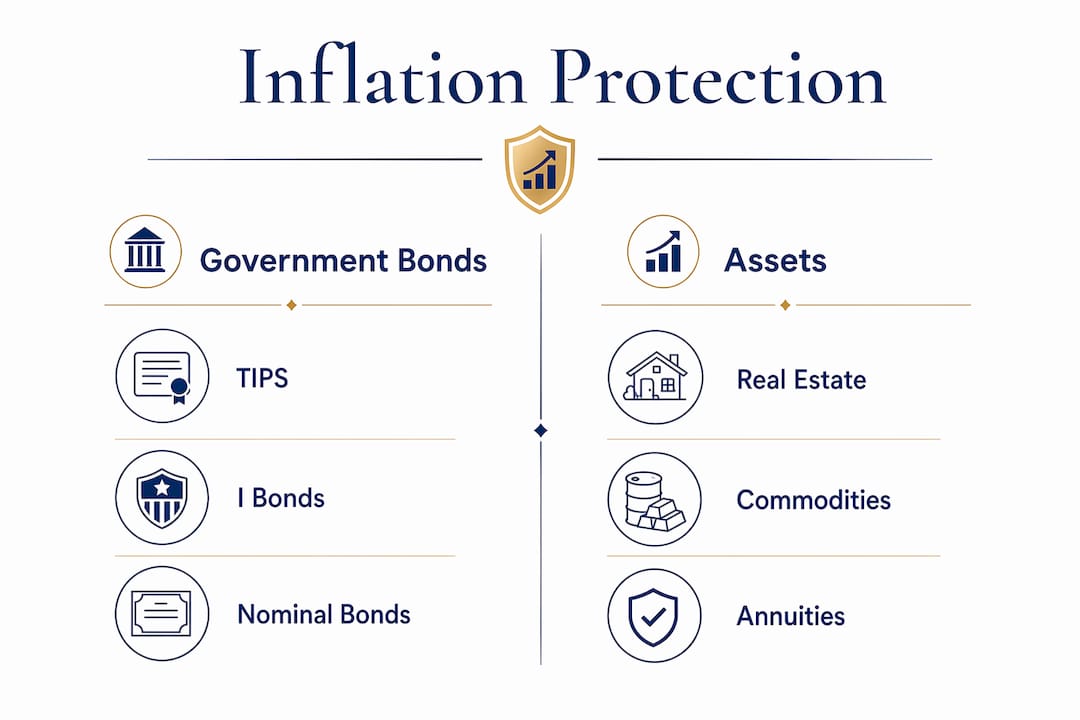
Investing in inflation-protected assets: TIPS and I Bonds
Treasury Inflation-Protected Securities (TIPS) and Series I Savings Bonds (I Bonds) are the two U.S. government instruments designed specifically to preserve purchasing power. Both adjust their value based on the Consumer Price Index, but they work differently and suit different situations.

TIPS are marketable securities issued by the U.S. Treasury. Their principal rises with CPI-U, and the coupon is paid on that adjusted principal. TIPS provide a real return above inflation that varies over time, depending on market conditions. Allocating $200,000 to TIPS yields roughly $3,800 in guaranteed real purchasing power annually, regardless of where inflation goes.
I Bonds are non-marketable savings bonds with a composite rate tied to CPI. They cannot be sold on the secondary market, and annual purchase limits apply ($10,000 per person through TreasuryDirect, with an additional $5,000 via tax refund). They are best used as a cash-equivalent inflation hedge for money you will not need for at least one year.
| Feature | TIPS | I Bonds | Nominal Bonds |
|---|---|---|---|
| Inflation adjustment | Principal adjusts with CPI-U | Composite rate adjusts with CPI | None |
| Marketable | Yes | No | Yes |
| Annual purchase limit | None (via broker or auction) | $10,000 per person | None |
| Real return (approx.) | — | Varies with CPI | Negative in high-inflation periods |
| Liquidity | High (secondary market) | Low (1-year lockup minimum) | High |
| Price volatility | Yes (real rate changes) | None (held to maturity) | Yes |
One important limitation: TIPS use a roughly three-month lag for CPI indexation. During a sudden inflation spike, TIPS will not adjust immediately. They also carry real interest rate risk, meaning their market price can fall when real yields rise, even if inflation is climbing. I Bonds avoid that price volatility since they are held to maturity, but the purchase cap limits how much you can hold.
A common recommendation for retirees includes a meaningful allocation of the fixed-income portion in TIPS to help manage inflation risk, with I Bonds serving as a supplemental cash reserve. Neither instrument replaces equities or real assets; they work best as part of a broader mix.
Real estate and commodities as inflation hedges
Real estate has one of the strongest long-term records as an inflation hedge because rents and property values tend to rise with prices. For retirees who do not want the headaches of direct ownership, Real Estate Investment Trusts (REITs) offer property-linked returns with stock-market liquidity. REITs have historically delivered returns that generally outpace inflation over the long term, offering income and growth potential. They are generally required to distribute a large majority of taxable income to shareholders, producing a yield attractive for income-focused investors.

Not all REIT sectors respond equally to inflation. Healthcare REITs benefit from rising medical costs. Industrial REITs tied to logistics and warehousing see rent escalations built into long-term leases. Apartment REITs capture rent increases directly as leases renew. These sectors tend to hold up better during inflationary periods than office or retail REITs, which face demand headwinds. For retirees weighing real estate as a hedge, sector selection matters as much as the asset class itself.
Commodities, including gold, oil, and agricultural products, respond directly to price increases because they are the inputs driving inflation. Gold has appreciated significantly over recent years and is priced in the thousands of dollars per ounce as of 2026. The catch is that gold and most commodities produce no income. They are a store of value, not an income source, which limits their role in a retirement portfolio that needs regular cash flow.
Practical allocation guidance:
- Real estate (REITs): 10–15% of total portfolio, focused on healthcare, industrial, and apartment sectors
- Commodities/gold: 5–10%, used as a hedge rather than a core holding
- Prioritize income: Favor REITs over physical commodities when you need distributions
- Liquidity check: Physical real estate is illiquid; REITs and commodity ETFs trade daily
How to adjust your budget and emergency fund for rising costs
Inflation does not hit every budget line equally. Healthcare and housing, the two largest expenses for most retirees, have consistently outpaced headline inflation. Revisiting your budget at least twice a year, not just annually, gives you a clearer picture of where your purchasing power is actually slipping.
Emergency savings need to grow with inflation too. A fund that covered six months of expenses three years ago may cover only four months today. Retirees should target 12–18 months of essential expenses in liquid, accessible accounts, larger than the standard guidance for working-age adults, because retirees face less flexibility to increase income quickly.
Practical steps to protect spending power:
- Audit fixed vs. variable expenses: Fixed costs like insurance premiums and property taxes are harder to cut; variable ones like travel and dining offer more flexibility.
- Trim discretionary spending first: Reducing non-essential expenses during high-inflation periods preserves the budget for healthcare and housing.
- Consider part-time income: Even modest earned income during the early retirement years reduces portfolio withdrawals and extends the life of savings.
- Negotiate recurring bills: Insurance premiums, subscription services, and utility plans often have lower-cost alternatives that most retirees never shop for.
- Delay large purchases: Waiting 6–12 months on major discretionary expenses during inflation spikes can save meaningfully when prices stabilize.
The goal is not to cut everything but to build enough flexibility that a 3–4% inflation year does not force you to sell investments at the wrong time.
Tax efficiency and estate planning to reduce financial drag
Taxes are a second form of erosion that compounds alongside inflation. A retiree paying unnecessary taxes on withdrawals is losing purchasing power twice: once to rising prices, once to the IRS. Withdrawal sequencing is the most direct fix. Drawing from taxable accounts first, then tax-deferred accounts like traditional IRAs, and finally Roth accounts last preserves tax-free growth the longest.
Roth conversions are worth considering in years when your taxable income is lower than usual, typically in the early retirement years before Social Security and required minimum distributions begin. Converting a portion of a traditional IRA to a Roth IRA in those years locks in a lower tax rate and creates a tax-free income stream for later, when inflation may have pushed you into a higher bracket.
Tax-aware strategies that reduce financial drag:
- Tax-loss harvesting: Selling underperforming assets to offset capital gains, reducing the tax bill in volatile years
- Qualified charitable distributions: Retirees over 70½ can donate directly from an IRA, satisfying required minimum distributions without adding to taxable income
- Strategic Social Security timing: Delaying benefits until age 70 increases the base payment, and delaying to age 70 magnifies the dollar value of each annual Cost-of-Living Adjustment
- Estate planning tools: Trusts, beneficiary designations, and stepped-up cost basis rules can reduce the tax burden on heirs and preserve more of the portfolio's real value across generations
Lowering your effective tax rate by even 2–3 percentage points has the same effect as earning a higher return on your investments. It is one of the most overlooked levers in retirement income planning.
How annuities and insurance products can complement your inflation strategy
Annuities with inflation riders offer something that no investment portfolio can guarantee: income that cannot be outlived and that grows with prices. For retirees worried about both longevity risk and inflation, a well-structured annuity can anchor the income floor while the investment portfolio handles growth.
The most relevant product types for inflation protection:
- Inflation-adjusted immediate annuities: Pay a fixed income stream that increases by a set percentage (typically 2–3%) or by CPI each year. The starting payment is lower than a flat annuity, but the income catches up and eventually surpasses it.
- Variable annuities with living benefit riders: Allow investment in subaccounts with market exposure while guaranteeing a minimum withdrawal amount, which can increase if the account value grows.
- Fixed indexed annuities: Link returns to a market index with a floor of zero, protecting against loss while capturing some upside during inflationary growth periods.
The trade-off is liquidity. Annuities typically lock up capital, and surrender charges can apply for years after purchase. They also vary widely in cost and structure, so comparing products carefully before committing is worth the time.
For retirees in states where Familyguardlh is licensed, including Florida, Texas, Georgia, and 19 others, annuity and insurance options can be reviewed alongside your broader retirement income plan. Pairing an annuity income floor with a diversified portfolio is often more effective than relying on either alone.
Considerations before adding an annuity:
- Inflation rider cost: Riders that adjust for CPI reduce the initial payout; model the break-even point before buying
- Carrier financial strength: Check the insurer's ratings from AM Best or Moody's before committing
- Liquidity needs: Keep enough outside the annuity to cover unexpected expenses
- Tax treatment: Annuity income is typically taxed as ordinary income, which matters for withdrawal sequencing
Pro Tip: A financial services advisor familiar with annuity products can help you compare the net present value of different payout structures, including inflation-adjusted versus flat income streams, before you commit.
Key Takeaways
Protecting retirement savings from inflation requires combining inflation-linked securities, diversified real assets, tax-efficient withdrawals, and income products that grow with prices over time.
| Point | Details |
|---|---|
| TIPS and I Bonds anchor purchasing power | TIPS provide roughly 1.9% real return above inflation; portfolios with 20–25% TIPS preserved 94% of purchasing power over 30 years. |
| Dividend-growth stocks outpace inflation | Payouts have grown an average of 7.3% annually over the past decade, well above typical inflation rates. |
| REITs deliver income and inflation linkage | REITs have averaged annual returns above 10% over 25 years and distribute at least 90% of taxable income, with an average yield around 4.1%. |
| Social Security COLA is a built-in hedge | Social Security Cost-of-Living Adjustments (COLA) increase benefits periodically, providing a partial inflation hedge over time; delaying benefits can increase the base payment and subsequent adjustments. |
| Tax efficiency compounds protection | Roth conversions, loss harvesting, and smart withdrawal sequencing reduce the tax drag that compounds alongside inflation. |
The inflation risk most retirees underestimate
Most retirement planning conversations focus on market risk. Inflation risk gets treated as a footnote, something to address with a small TIPS allocation and a vague plan to "adjust spending if needed." That framing is backwards.
Inflation is the one risk that is always present, even in years when markets are calm. A 2.5% annual erosion does not feel urgent in any single year, but the 40% cumulative loss over 20 years is the kind of number that quietly ends retirement plans. The retirees who get this wrong are usually the ones who built a portfolio that looked fine on paper in their early 60s and never revisited it as inflation shifted.
The other underestimated issue is the mismatch between headline CPI and what retirees actually spend. Healthcare inflation has consistently run hotter than the general index. A retiree spending heavily on prescriptions, specialist visits, and long-term care is experiencing a personal inflation rate that may be 1–2 percentage points above what the official number shows. TIPS and I Bonds adjust to CPI-U, which is a national average. Your actual cost increases may be worse.
What I find most useful to tell people near retirement is this: do not build a single inflation strategy. Build a layered one. TIPS and I Bonds for the fixed-income portion. Dividend-growth stocks and REITs for the equity portion. An annuity with an inflation rider for the income floor. Budget flexibility for the years when everything spikes at once. No single asset class provides a permanent hedge against unexpected inflation, as the research consistently shows. The combination is what holds.
The retirees who come through inflationary periods with their purchasing power intact are not the ones who found the perfect hedge. They are the ones who diversified across multiple inflation-response mechanisms and reviewed their plan regularly enough to catch drift before it became damage.