

A pension risk transfer (PRT) is defined as the process by which a company shifts its defined benefit pension payment obligations to a life insurance company, which then guarantees retirees their promised income. The insurer steps in as the new payer, but your monthly benefit amount, payment schedule, and any cost-of-living adjustments stay exactly the same. No retiree has lost benefits after a PRT to a life insurer in nearly 30 years, according to ACLI data as of march 2026. That record matters if you are approaching retirement and wondering whether a transfer puts your income at risk. Understanding how PRT works, what types exist, and what protections apply gives you the clarity to plan with confidence.
What is a pension risk transfer and how does it work?
A pension risk transfer moves the legal responsibility for paying your pension from your former employer to a regulated life insurance company. The employer pays the insurer a lump sum to take on that obligation permanently. From that point forward, the insurer sends your monthly checks and manages all benefit administration.
The term "pension risk transfer" is the widely used industry shorthand. The formal industry term is "pension risk transfer transaction" or, in the context of full plan termination, a "group annuity purchase." Both phrases describe the same core event: a company buying a group annuity contract that covers its retirees and deferred participants.
PRT strategies fall into three main categories: buyouts, buy-ins, and lump-sum windows. Each structure carries different legal and administrative features for both the plan sponsor and the participant. Knowing which type applies to you shapes what you should expect during the transition.

What are the main types of pension risk transfer transactions?
The three dominant PRT structures differ in who holds the contract, who administers the plan, and how much liability moves to the insurer.
Pension buyout
A buyout is a full transfer. The insurer assumes all pension liabilities and takes over plan administration entirely. The employer's pension plan typically terminates after a buyout. Retirees receive individual annuity certificates from the insurer, which become their new legal contracts replacing former employer plan documents.
Pension buy-in
A buy-in is a partial transfer. The insurer assumes the financial liability, but the employer keeps plan administration. The plan sponsor still sends benefit payments to retirees, using funds received from the insurer. Buy-in PRTs allow sponsors to hedge pension risks and gain insurer pricing benefits without full administration transfer, offering strategic flexibility for companies not ready for a full termination.
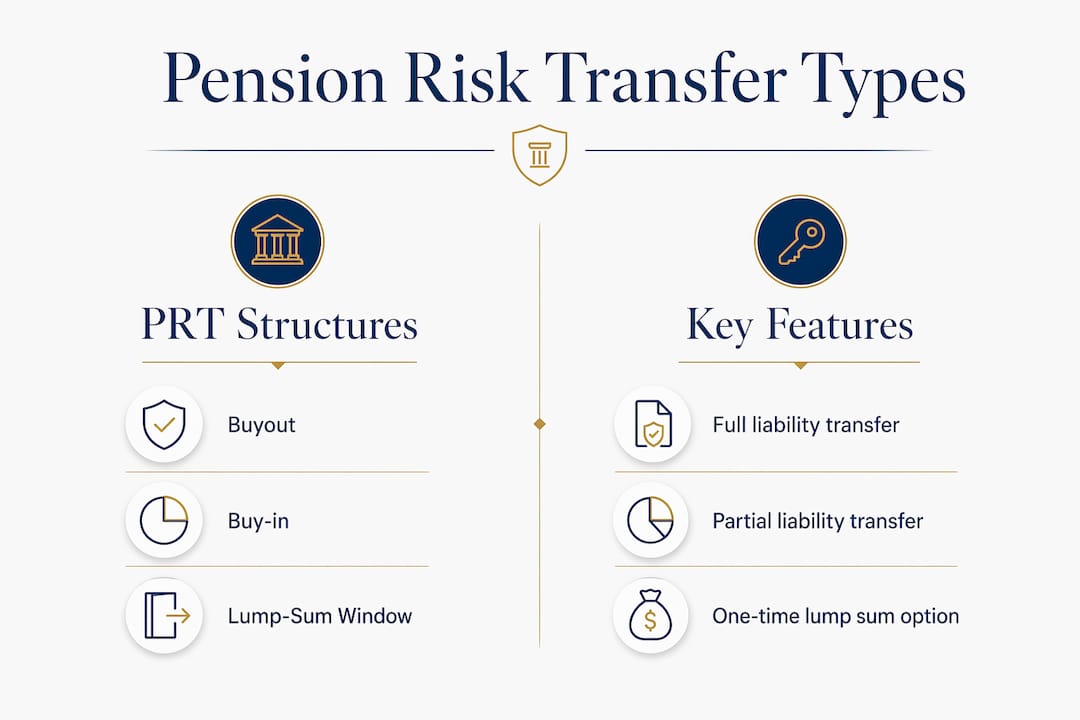
Lump-sum window
A lump-sum window gives eligible participants a one-time option to receive the present value of their future pension as a single cash payment. The participant gives up the monthly annuity in exchange for a lump sum they manage themselves. This option transfers risk to the individual, not to an insurer.
The table below compares the three structures at a glance.
| PRT Type | Who pays retirees | Plan terminates? | Retiree receives |
|---|---|---|---|
| Buyout | Life insurer | Yes | Annuity certificate |
| Buy-in | Employer (funded by insurer) | No | Continued plan statements |
| Lump-sum window | Participant manages funds | Partially | One-time cash payment |
Each type suits different sponsor goals and participant situations. A buyout provides the cleanest break. A buy-in hedges risk while preserving flexibility. A lump-sum window shifts responsibility to the retiree, which carries its own financial planning demands.
How does a pension risk transfer affect your benefits and protections?
Your benefit amount does not change after a PRT. Monthly payment amounts, schedules, and COLAs remain consistent after a buyout, with only the payer shifting to the insurer. The benefit formula your employer used to calculate your pension carries over exactly.
What does change is the regulatory framework protecting your income. Before a PRT, your pension falls under the federal Employee Retirement Income Security Act (ERISA) and the Pension Benefit Guaranty Corporation (PBGC). After a buyout, protection shifts from PBGC to state insurance regulations and state guaranty associations. The National Organization of Life and Health Insurance Guaranty Associations (NOLHGA) coordinates those state-level safety nets.
This shift is the most misunderstood part of a PRT. PBGC coverage has specific dollar limits and applies to plan participants. State guaranty associations also have coverage limits, which vary by state. The key point is that both systems exist to protect you. The change is in which system applies, not in whether protection exists.
Here is what stays the same and what changes after a buyout:
- Stays the same: Monthly benefit amount, payment date, cost-of-living adjustments, and survivor benefit terms
- Changes: The entity sending your payment, the legal document governing your benefit, and the regulatory body overseeing your protection
- New document: You receive an individual annuity certificate from the insurer
"Retirees frequently mistake the change in payor as a change in benefits. Effective communication from plan sponsors and insurers reduces anxiety and helps participants understand that their income is secure under a new, regulated framework."
Pro Tip: Store your annuity certificate in a secure location alongside your other retirement documents. This certificate is your legal proof of benefits after a PRT and replaces all former employer plan statements as the governing contract.
Retirees must keep their annuity certificates as legal proof of their benefits, since these replace former employer documents after a PRT. Losing this document does not eliminate your rights, but having it on hand simplifies any future benefit inquiries or disputes.
Why do companies pursue pension risk transfers?
Companies use PRTs as tools to reduce long-term pension burdens and refocus resources on core operations. Defined benefit pension plans create ongoing financial volatility on a company's balance sheet. Interest rate changes, investment returns, and longer retiree lifespans all affect how much a company must hold in reserve. A PRT eliminates that uncertainty permanently.
The financial case for a buyout is straightforward, but the cost is significant. Full plan termination PRTs often require funding at 102–110% of liabilities, because the insurer prices in its own risk margin and administrative costs. Companies typically pursue a full buyout only when the plan is well-funded and the sponsor wants a clean exit from pension obligations.
The administrative case is equally compelling. Running a pension plan requires actuaries, legal counsel, investment managers, and compliance staff. Transferring that burden to a life insurer, which specializes in exactly this work, frees the company to concentrate on its business.
Here is why plan sponsors choose each PRT structure:
- Reduce balance sheet volatility. Pension liabilities fluctuate with interest rates and market returns. A buyout removes that line item entirely.
- Cut administrative costs. Ongoing plan management is expensive. Transferring administration to an insurer eliminates those recurring costs.
- Manage risk incrementally. A buy-in lets a sponsor reduce exposure without committing to full termination, which suits companies still evaluating their options.
- Improve data quality before transition. Sponsors must reconcile participant records before any PRT closes. This process often uncovers errors that, if left uncorrected, would create payment problems later.
Pro Tip: If your employer announces a PRT, ask HR for a copy of the transition timeline and the name of the receiving insurer. Knowing the insurer early lets you verify its financial strength rating through agencies like A.M. Best before the transfer closes.
Successful PRTs depend heavily on data quality, requiring extensive review of individual participant records and benefit consistency before the transition. This pre-transfer work happens months before retirees receive any communication, which is why the process can feel sudden even when it has been underway for a long time.
What should retirees expect during a pension risk transfer?
The PRT process is largely invisible to retirees until it is nearly complete. Months of data reconciliation, insurer selection, regulatory filings, and contract negotiations happen before any announcement reaches participants. By the time you receive a letter, the deal is typically finalized or very close to it.
Here is the typical sequence retirees experience:
- Initial notice: Your employer or plan administrator sends a written notice explaining the transfer, naming the receiving insurer, and confirming your benefit terms.
- Annuity certificate delivery: The insurer sends your individual annuity certificate, which details your benefit amount, payment schedule, and contact information for future inquiries.
- Payment transition: Your first payment from the insurer arrives on the same schedule as your previous payments. No gap in income should occur.
- Contact update: Update your records to reflect the insurer's contact information for all future benefit questions.
The most common misconception retirees hold is that a change in payer means a change in benefits. It does not. Your benefit calculation is locked in by the original plan formula and carried over to the insurer's contract. The insurer has no authority to reduce your benefit unilaterally.
A second misconception involves the regulatory shift. Moving from PBGC to state guaranty association coverage feels like a downgrade to many retirees. The reality is more nuanced. State guaranty associations cover annuity contracts up to state-specific limits, and most retirees fall well within those limits. NOLHGA coordinates across states when an insurer faces financial difficulty, adding another layer of protection.
Keep records of every communication you receive during the transition. If a payment is late or incorrect after the transfer, your annuity certificate and transition notices are the documents that resolve the issue fastest.
Key Takeaways
Pension risk transfers protect retirees' income by moving payment obligations to regulated life insurers, with no benefit reductions and a flawless safety record spanning nearly 30 years.
| Point | Details |
|---|---|
| Benefits stay the same | Monthly amount, payment date, and COLAs carry over unchanged after a PRT buyout. |
| Regulatory protection shifts | Coverage moves from PBGC to state guaranty associations, which also protect retirees. |
| Three PRT types exist | Buyouts, buy-ins, and lump-sum windows each serve different sponsor and participant needs. |
| Annuity certificate is critical | Keep this document as your legal proof of benefits after the employer plan terminates. |
| Safety record is strong | No retiree has lost benefits after a PRT to a life insurer in nearly 30 years per ACLI. |
Why pension risk transfers matter more than most retirees realize
I have spent years helping people near retirement sort through income questions, and pension risk transfers come up more often than most people expect. The reaction I see most is anxiety. Someone gets a letter saying their pension is moving to an insurance company, and they assume something bad is happening.
The anxiety is understandable. Your pension represents decades of work. Any change to who controls it feels threatening. But the facts tell a different story. Life insurers are specialists in exactly this kind of long-term income obligation. They price these contracts carefully, hold substantial reserves, and operate under state regulatory oversight designed to keep them solvent.
What I find most interesting about PRTs is the alignment of incentives. The employer wants off the hook financially. The insurer wants a profitable, well-priced contract. The retiree wants guaranteed income for life. A well-structured PRT delivers all three outcomes simultaneously. That is rare in financial services.
The part of this process that needs the most improvement is communication. Retirees deserve plain-language explanations of what is changing, what is not, and who to call with questions. The technical details of PBGC versus state guaranty associations matter, but what retirees really need to hear first is: "Your check is not changing."
Pension risk management strategies are evolving. Buy-ins are growing in popularity because they give sponsors flexibility without requiring full plan termination. That trend means more retirees will experience partial transfers where the employer still sends the check but an insurer backs the liability. Understanding that distinction helps you ask the right questions when your plan communicates a change.
— Shereka
Retirement income planning support from Familyguardlh
Pension risk transfers are one piece of a larger retirement income picture. Whether your pension is staying with your employer, moving to an insurer, or you are weighing a lump-sum option, the decisions you make around that income affect everything else in your retirement plan.

Familyguardlh specializes in retirement income planning for individuals across 22 states, including annuities, life insurance, Medicare, and supplemental coverage. If you are navigating a PRT transition or simply want to understand how your pension fits into your broader financial picture, Familyguardlh can help you build a plan that accounts for every income source. Reach out to connect with a licensed specialist who understands the details that matter most at this stage of life.
FAQ
What is a pension risk transfer in simple terms?
A pension risk transfer is when a company pays a life insurance company to take over its pension payment obligations. Your benefit amount and payment schedule stay the same. Only the entity sending your check changes.
Does a pension risk transfer reduce my monthly benefit?
No. Your monthly benefit amount, payment date, and cost-of-living adjustments remain unchanged after a PRT. The benefit formula from your original plan carries over to the insurer's contract without reduction.
What happens to PBGC protection after a pension risk transfer?
PBGC coverage ends after a buyout PRT. Protection shifts to state insurance guaranty associations, which cover annuity contracts up to state-specific limits. NOLHGA coordinates these state-level safety nets nationally.
What is an annuity certificate and why does it matter?
An annuity certificate is the legal document the insurer sends you after a PRT buyout. It replaces your former employer plan statements and serves as your official proof of benefit terms. Keep it in a secure location permanently.
Is a pension risk transfer good or bad for retirees?
A PRT is generally neutral to positive for retirees. Benefits stay the same, the insurer is regulated and financially supervised, and the nearly 30-year safety record shows no retiree has lost benefits after a transfer to a life insurer.