

The ACA out-of-pocket maximum caps what you pay for covered in-network care in a plan year at amounts set annually under the 2026 federal PAPI parameters that CMS sets each year, currently around $10,150 for an individual and $20,300 for a family. That's the entire concept in one sentence. Healthcare defines it the same way: the most you'll pay before your insurer takes over completely.
Here's the quick version before we get into the details:
- Individual cap for 2026: approximately $10,150
- Family cap for 2026: approximately $20,300
- These numbers apply to in-network deductibles, copays, and coinsurance combined
- Premiums, out-of-network care, and non-covered services do not count toward this limit
- Insurers can set a lower cap for their plans but never a higher one than the federal ceiling
Think of it as a financial airbag. You might never need it, but if a bad year happens, a surgery, a cancer diagnosis, a car accident, this number is what keeps a health crisis from becoming a bankruptcy filing.
Key Takeaways
| Point | Details |
|---|---|
| Know the 2026 caps | Individual maximum is $10,150 and family maximum is $20,300 under CMS's federal parameters. |
| Understand what counts | Deductibles, copays, and coinsurance for in-network care count; premiums and most out-of-network bills don't. |
| Check family embedded limits | No single family member can be forced past the individual cap, even under a family plan. |
| Watch for accumulator programs | Some copay assistance dollars may not count toward your cap, so verify with your insurer directly. |
| Get a real comparison | Familyguardlh helps you weigh premium against out-of-pocket exposure across plans in 22 licensed states. |
Table of Contents
- What Is an Out-Of-Pocket Maximum?
- What Counts Toward the Out-Of-Pocket Maximum, and What Doesn't?
- What Are the Current Federal ACA Maximum Out-Of-Pocket Limits?
- How Does Family Coverage Work Under the Out-Of-Pocket Maximum?
- Does Insurance Pay 100% After You Hit the Out-Of-Pocket Maximum?
- Are HSA and Medicare Out-Of-Pocket Limits Different From ACA Caps?
- How Do You Find Your Plan's Out-Of-Pocket Maximum?
- How Does the Federal Government Set These Annual Limits?
- How Can an Independent Agent Help Lower Your Out-Of-Pocket Exposure?
- Why the Out-Of-Pocket Maximum Deserves More Attention Than the Premium
- How Familyguardlh Helps You Compare Out-Of-Pocket Exposure
- Where Can You Verify the Current Official ACA Out-Of-Pocket Numbers?
- Sources
What Is an Out-Of-Pocket Maximum?
An out-of-pocket maximum is the dollar ceiling on what you pay for covered, in-network medical care during a single plan year. It's not your premium, and it's not a vague estimate. It's a hard stop written into every ACA-compliant plan.
Three types of cost-sharing typically build toward that ceiling:
- Deductible: what you pay before insurance starts sharing costs
- Copays: flat fees for visits or prescriptions
- Coinsurance: the percentage you owe after the deductible is met
You break your wrist in March and rack up $6,000 in bills. Total so far: $4,400. In August, a follow-up surgery bills out at $30,000.
What Counts Toward the Out-Of-Pocket Maximum, and What Doesn't?
Covered, in-network services generally count toward your cap. Premiums, non-covered services, and most out-of-network charges do not, and that distinction trips up more people than any other part of ACA coverage.
Counts toward your maximum:
- Deductible payments for in-network care
- Copays for doctor visits, urgent care, and prescriptions
- Coinsurance on covered procedures
- Certain cost-sharing amounts protected under surprise-billing rules, even for some out-of-network emergency care
Doesn't count toward your maximum:
- Monthly premiums
- Services your plan doesn't cover at all
- Most out-of-network provider bills
- Balance-billed amounts outside the No Surprises Act protections
Pro Tip: Check whether your plan uses a copay accumulator program. Some insurers no longer count manufacturer prescription assistance dollars toward your deductible or out-of-pocket max, which means that free coupon covering your specialty medication might not be shrinking your cap as fast as you think. Call your insurer or read your Summary of Benefits and Coverage to confirm.
What Are the Current Federal ACA Maximum Out-Of-Pocket Limits?
For the 2026 plan year, CMS set the federal Marketplace out-of-pocket maximum at $10,150 for self-only coverage and $20,300 for family coverage. That's a ceiling, not a mandate. Insurers can build plans with lower caps, and plenty do, especially at the Gold and Platinum tiers where you pay more in premium for less exposure later.
| Plan year | Individual maximum | Family maximum | Source |
|---|---|---|---|
| 2025 | approximately $10,150 | approximately $20,300 | 2026 federal PAPI parameters |
| 2026 | approximately $10,150 | approximately $20,300 | CMS 2026 PAPI parameters |
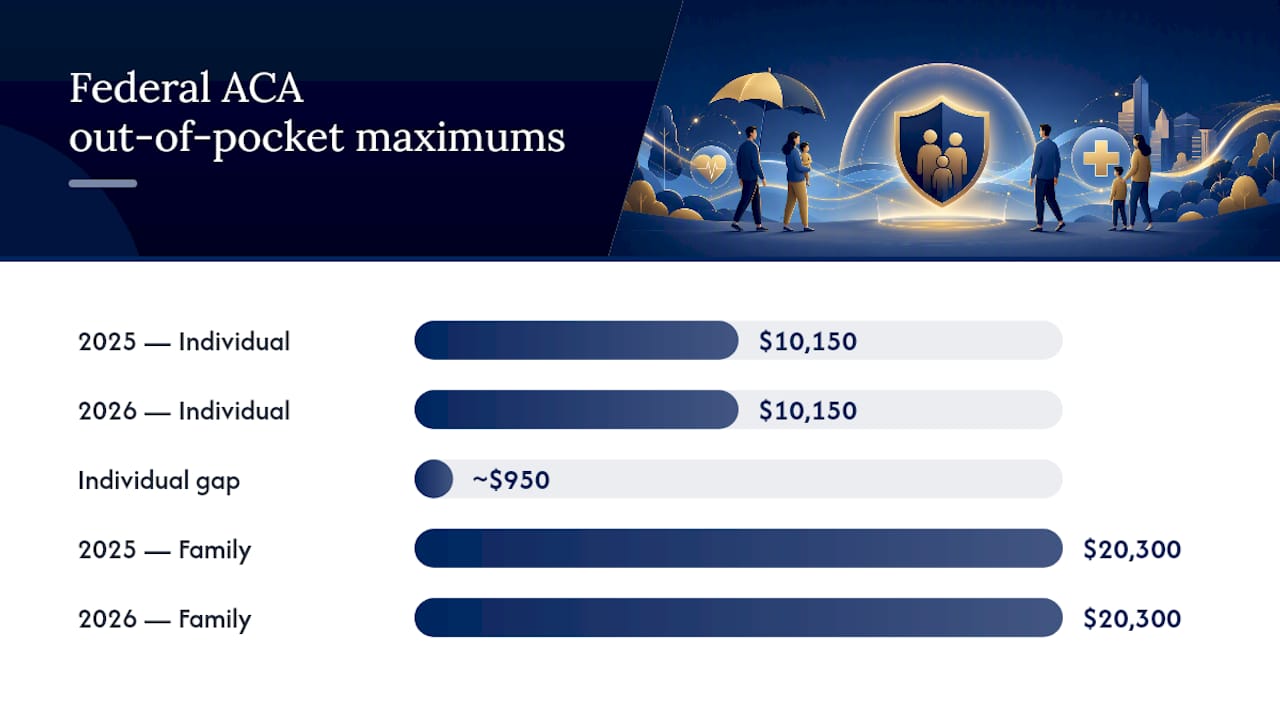
The gap between those two years, roughly $950 for individuals, reflects the premium adjustment percentage CMS applies annually rather than a flat inflation rate. If you're comparing a Bronze plan's rock-bottom premium against a Gold plan's steeper monthly cost, this table is the number that should decide it, not the sticker price on the premium alone.
How Does Family Coverage Work Under the Out-Of-Pocket Maximum?

Family plans embed an individual limit inside the family cap, so no single person in a household plan can be forced to pay more than the individual maximum, even if the rest of the family hasn't hit their combined limit yet. HealthCare.gov confirms this embedded structure is standard for ACA-compliant family plans, and it surprises a lot of shoppers who assume the family number is the only one that matters.
The rules break down like this:
- No individual's out-of-pocket costs can exceed the individual cap, even under family coverage
- The family cap is generally around double the individual cap, though insurers can set both lower
- Once any one family member hits their individual limit, that person's cost-sharing stops, even if other family members haven't reached theirs
- The family cap is met once the household's combined spending crosses that total, regardless of how it's distributed among members
Here's how that plays out for a family of four on a plan with a $10,150 individual limit and $20,300 family limit in 2026:
- One child needs an appendectomy in February, and the family pays $10,150 in cost-sharing for that child alone
- That child's costs are done for the year. No more copays, no more coinsurance, for that person
- The other three family members keep accumulating costs separately
- Once their combined spending plus the $10,150 already paid reaches $20,300 total, the entire family stops paying cost-sharing for the rest of the year
That's $10,150 more in combined spending needed from the rest of the household after the first claim, not another $10,150 from scratch.
Does Insurance Pay 100% After You Hit the Out-Of-Pocket Maximum?
Yes, for covered in-network essential health benefits, your plan pays the full cost once you cross the out-of-pocket maximum for the rest of that plan year. This is the mechanism HealthCare.gov describes directly: after you hit the cap, your plan covers 100% of remaining covered benefits.
- Premiums keep coming due regardless of how much cost-sharing you've paid
- Services your plan never covered in the first place stay your responsibility
- Out-of-network care, outside emergency protections under the No Surprises Act, usually isn't included
- Balance billing can still show up in non-surprise situations, particularly with certain specialists
- If your plan uses a copay accumulator, some payments you thought counted toward your cap might not have
If you believe you've already hit your maximum and a provider bills you cost-sharing anyway, check your Explanation of Benefits (EOB) first. It shows exactly what's been applied to your deductible and out-of-pocket totals. If the numbers don't match, call the provider's billing office and ask them to re-verify with your insurer before you pay anything.
Are HSA and Medicare Out-Of-Pocket Limits Different From ACA Caps?
Yes. IRS-set limits for HSA-eligible high-deductible health plans (HDHPs) are lower than ACA Marketplace caps, and Original Medicare carries no annual out-of-pocket maximum at all. These are two entirely separate systems, and confusing them leads to real financial surprises.
- For 2026, the IRS caps HDHP out-of-pocket costs at levels that are generally lower than the ACA Marketplace ceiling, since HDHP limits determine HSA eligibility, not general ACA compliance
- A plan with an out-of-pocket max above the IRS threshold disqualifies you from contributing to an HSA, even if it's a perfectly valid ACA Marketplace plan
- Original Medicare (Parts A and B) has no built-in annual out-of-pocket maximum, meaning costs can technically keep accumulating without a federal ceiling
- Medicare Advantage plans, by contrast, are required to include an annual out-of-pocket maximum, which is one of the biggest structural differences between the two paths
If you're turning 65 soon and weighing Original Medicare plus a Medigap policy against a Medicare Advantage plan, this gap matters more than almost anything else in the decision.
How Do You Find Your Plan's Out-Of-Pocket Maximum?
Check three places: your plan's Summary of Benefits and Coverage, your Marketplace plan listing on HealthCare.gov, and your insurer's member portal or EOBs. All three should show the same number, and if they don't, that's worth a phone call before you need the coverage.
- Pull up your Summary of Benefits and Coverage (SBC), a standardized document every ACA plan must provide, and look for "out-of-pocket limit for this plan"
- Log into HealthCare.gov or your state marketplace account and review your specific plan's details page, which lists the individual and family maximum
- Check your insurer's member portal for a running total of what's applied toward your deductible and out-of-pocket max so far this year
- Review each EOB as claims process, confirming the amount applied matches what you actually paid
Here's a simple walkthrough: say your plan has a $7,000 individual out-of-pocket max. You pay $3,000 toward a knee surgery in January, $1,500 for physical therapy sessions through the spring, and $2,000 for an MRI and specialist visits in July. That's $6,500 accumulated. One more $500 copay and you've hit your cap for the year, with every remaining covered claim paid in full by your insurer.
Pro Tip: Keep a simple spreadsheet or folder of every EOB as it arrives. Insurers occasionally miscount, especially with copay accumulator programs muddying what actually applies, and having your own paper trail makes disputing an error far faster than starting from scratch.
How Does the Federal Government Set These Annual Limits?
HHS and CMS set the annual ACA out-of-pocket maximum through a formal rulemaking process, publishing updated parameters, known as PAPI, Premium Adjustment Percentage Index, each year based on national health spending trends. This isn't a number pulled from thin air. It's tied to a documented formula and published through the Federal Register's Notice of Benefit and Payment Parameters.
- CMS calculates the premium adjustment percentage using average private health insurance premium growth
- The CMS-9884-F rule package documents the legal basis, rounding conventions, and methodology behind the final figures
- Public comment periods happen before the Federal Register finalizes each year's notice
The reason ACA caps and IRS HDHP/HSA caps diverge, sometimes by thousands of dollars, comes down to using different indexing bases entirely.
| Feature | ACA Marketplace cap | IRS HDHP/HSA cap |
|---|---|---|
| Set by | HHS/CMS via PAPI rulemaking | IRS via annual Revenue Procedure |
| Basis | Premium adjustment percentage | Cost-of-living adjustment formula |
| Purpose | Caps cost-sharing for ACA-compliant plans | Determines HSA contribution eligibility |
| 2026 individual figure | approximately $10,150 | Typically lower, per IRS Rev. Proc. 2026-24 |
How Can an Independent Agent Help Lower Your Out-Of-Pocket Exposure?
A licensed independent agent can run side-by-side comparisons that surface plans with lower out-of-pocket maximums for a similar premium, something the bare Marketplace filters often miss. This is where the tradeoff between monthly premium and annual cap actually gets weighed against your real medical history, not just a generic search filter.
Concrete tasks a good agent handles:
- Comparing net annual cost (premium plus expected out-of-pocket spending) across Bronze, Silver, and Gold tiers
- Verifying whether a plan uses copay accumulator programs before you enroll, not after a surprise bill
- Reviewing prescription formularies against your actual medications
- Checking that your current doctors and specialists are in-network before you switch
Before your next agent conversation, bring these questions:
- What's the exact out-of-pocket maximum for this specific plan, individual and family?
- Is the family limit embedded or aggregate?
- Does this plan use a copay accumulator or maximizer program?
- Are my current prescriptions and providers in-network?
Pro Tip: Bring last year's EOBs and a list of current prescriptions to your agent appointment. Real numbers from your own claims history let an agent compare plans against your actual spending pattern instead of guessing.
Why the Out-Of-Pocket Maximum Deserves More Attention Than the Premium
The out-of-pocket maximum is usually the single most important number in your entire policy, more consequential than the monthly premium most shoppers fixate on first. A lower premium plan with a sky-high cap can cost you dramatically more in a bad year than a higher-premium plan with tighter cost-sharing limits.
Most people compare plans backward. They anchor on the monthly bill because it's the number they'll feel every month, then treat the out-of-pocket maximum as fine print. But the premium is a certainty and the out-of-pocket max is your exposure to an uncertain event, a diagnosis, an accident, a surgery you didn't see coming. Weighing those two risks against each other is exactly the kind of math that belongs in a retirement and health planning conversation, not a solo click through Marketplace listings at midnight.
At Familyguardlh, we walk clients through that math directly: what does this plan actually cost you if nothing happens this year, and what does it cost you if everything happens? Retirement-age clients in particular need that second scenario modeled honestly, because a bad health year in your early 60s, before Medicare eligibility, can undo years of careful savings if the out-of-pocket max isn't sized to your risk tolerance. Insurance decisions made without that lens tend to look fine on paper and fall apart the moment a real claim hits, a pattern echoed in broader financial risk analyses of rising insurance costs and household financial exposure.
How Familyguardlh Helps You Compare Out-Of-Pocket Exposure
Familyguardlh compares Marketplace and employer plan options side by side so you know your real exposure before you enroll, not after a claim arrives. We're licensed across 22 states, including Florida, Texas, Ohio, and Pennsylvania, and we work specifically with people 45 and older who are approaching or navigating retirement, where the stakes on a wrong health insurance pick run higher than a bad year of premiums.

Our services relevant to what you just read include:
- Side-by-side plan comparisons weighing premium against out-of-pocket maximum
- Medicare counseling in applicable states for those transitioning off Marketplace coverage
- Enrollment support during open enrollment and special enrollment periods
- Ongoing plan reviews as your health needs or retirement timeline shift
If you're staring down a Bronze, Silver, and Gold plan comparison and can't tell which out-of-pocket maximum actually fits your situation, talk to a licensed agent at Familyguardlh and get a real comparison built around your numbers, not a generic filter.
Where Can You Verify the Current Official ACA Out-Of-Pocket Numbers?
Confirm current-year figures directly through HealthCare.gov, CMS, and the IRS rather than relying on secondhand summaries, since these agencies update parameters annually and older articles go stale fast.
- Healthcare gives the plain-language consumer definition of out-of-pocket maximum and what counts toward it
- IRS Revenue Procedure 2026-24 lists the separate HDHP and HSA contribution limits for anyone comparing high-deductible plans
- The Federal Register's Notice of Benefit and Payment Parameters publishes the full regulatory text behind each year's update
- CMS's marketplace oversight page lists resources for consumers working with agents and brokers
The PAPI parameter PDFs read like technical filings, dense and formula-heavy, but the dollar figures you actually need usually appear in the first few pages under "maximum annual limitation on cost sharing." Skip straight there if you just want the number, and save the methodology sections for when you want to understand why it changed from last year.
This article is for general informational purposes and isn't a substitute for personalized advice from a licensed insurance professional. Confirm current limits and plan-specific rules with HealthCare.gov, CMS, or a licensed agent before making enrollment decisions.
This article is general information, not a substitute for advice from a qualified financial advisor. Consult a qualified financial professional about your own circumstances before acting on anything here.
Sources
- Out-of-pocket maximum/limit - Glossary
- IRS Rev. Proc. 2026-24
- Patient Protection and Affordable Care Act; HHS Notice of Benefit and Payment Parameters for 2027
- CMS-9884-F-2025 rule package