

Withdrawals and loans from a Modified Endowment Contract (MEC) are taxed as ordinary income on a gain-first basis, and if you take money out before age 59½, a 10% additional tax under IRC §72(v) typically applies on top of that. The death benefit, however, remains income-tax-free under §101(a) regardless of MEC status.
Three things to do right now:
- Check your Form 1099-R to see if your insurer reported a taxable distribution.
- Ask your insurer directly whether your policy failed the seven-pay test under §7702A.
- Contact a CPA before taking any distributions, especially if you are under 59½.
Key Takeaways
| Point | Details |
|---|---|
| LIFO taxation applies | Gains come out first; your cost basis is only recovered after all gain is distributed. |
| Three penalty exceptions | Age 59½ or older, disability under §72(m)(7), and SEPP arrangements avoid the 10% tax. |
| Death benefit stays tax-free | MEC status does not affect the income-tax exclusion under §101(a) for the death benefit. |
| Correction window is narrow | Carriers typically offer roughly 60 days to refund excess premiums; after that, only the IRS revenue procedure applies. |
| Familyguardlh policy review | Licensed in 22 states, Familyguardlh reviews policies for MEC risk and coordinates retirement income planning. |
Table of Contents
- What is a Modified Endowment Contract and how does the seven-pay test work?
- How distributions, loans, and pledges from an MEC are taxed
- When does the 10% additional tax under §72(v) apply?
- How the IRS aggregates multiple MECs from the same company
- If your policy became an MEC by mistake: correction procedures
- Numeric worked examples: how the tax and penalty actually calculate
- How retirees should plan around MEC risk
- Immediate next steps if you suspect your policy is or became an MEC
- Why retirees should be cautious but not alarmed
- Familyguardlh offers policy reviews and retirement income planning
- Sources
What is a Modified Endowment Contract and how does the seven-pay test work?
Congress created the MEC classification through the Technical and Miscellaneous Revenue Act of 1988 (TAMRA) specifically to stop high-income earners from overfunding life insurance policies and then pulling out cash tax-free. Before TAMRA, a policy could be stuffed with premiums far beyond what was needed to sustain the death benefit, effectively turning it into a tax-sheltered investment account.
The trigger is the seven-pay test under IRC §7702A. The IRS calculates a theoretical level annual premium that would fully pay up the policy in exactly seven years. If the cumulative premiums you actually pay during any of the first seven contract years exceed that cumulative theoretical limit, the policy becomes an MEC permanently.
Key threshold: Once cumulative premiums exceed the seven-pay limit at any point during the first seven contract years, MEC status is locked in for the life of the contract.
Policies issued before June 21, 1988 are generally grandfathered and not subject to these rules. That protection disappears, though, if a "material change" occurs after that date, such as a significant increase in the death benefit or a policy exchange. A material change effectively restarts the seven-pay clock on the modified contract.
How distributions, loans, and pledges from an MEC are taxed
The core mechanics come from §72(e)(10), which applies last-in, first-out (LIFO) treatment to MEC distributions. That is the opposite of how a standard non-MEC life insurance policy works. With a regular policy, you recover your cost basis (premiums paid) first under FIFO rules before any gain becomes taxable. With an MEC, gains come out first, and your basis is only accessible after every dollar of gain has been distributed.
Loans and assignments are treated the same way. Under §72(e)(4)(A), a policy loan from an MEC is treated as a distribution to the extent of gain. Pledging the policy as collateral for a loan outside the contract carries the same consequence. One narrow exception: a loan taken solely to pay premiums to the same insurer generally is not treated as an amount received and may avoid immediate taxation.
Your insurer reports all of this on Form 1099-R, showing the gross distribution, the taxable portion, and a distribution code. If you owe the penalty, you typically report it separately on Form 5329.
Pro Tip: Request an annual policy statement from your insurer showing your current cost basis (investment in the contract). Tracking this number prevents surprises when you eventually take distributions and need to know how much gain is sitting in the policy.
| Statutory reference | What it governs | Key threshold or rate |
|---|---|---|
| IRC §7702A | Seven-pay test / MEC classification | Cumulative premiums vs. seven-pay limit |
| IRC §72(e)(10) | LIFO gain-first taxation of MEC distributions | Gains taxed as ordinary income first |
| IRC §72(v) | 10% additional tax on early distributions | Applies before age 59½ |
| IRC §72(e)(11) | Aggregation of same-issuer MECs | Same issuer, same calendar year |
| IRC §101(a) | Death benefit income-tax exclusion | Full death benefit remains tax-free |
When does the 10% additional tax under §72(v) apply?
It is not a withholding; it is an additional tax you owe on your return, calculated on whatever amount of gain you received.
Three exceptions eliminate the penalty:
- Age 59½ or older. Once you cross that threshold, the 10% tax no longer applies, though the distribution is still ordinary income to the extent of gain.
- Disability. Under §72(m)(7), a distribution made because you are disabled (as defined by the IRS) avoids the penalty.
- Substantially equal periodic payments (SEPP). Distributions made at least annually over your life or life expectancy under a SEPP arrangement qualify for the exception.
A common misconception: the medical expense exception that applies to IRAs and qualified plans does not generally carry over to MEC distributions under §72(v). If you are counting on that exception, verify it with a CPA before taking money out.
How the IRS aggregates multiple MECs from the same company
Under §72(e)(11), all MECs issued by the same insurer to the same contract holder in the same calendar year are treated as a single MEC for income inclusion purposes. The practical effect can catch policyholders off guard.
- Buying two whole life policies from the same carrier in the same year means distributions from either policy draw down the combined gain pool.
- Policies from different carriers, or from the same carrier in different calendar years, are tested and taxed separately.
- Funding multiple same-issuer policies heavily within a single year can trigger MEC status on contracts that would each pass the seven-pay test individually, because the aggregated premiums exceed the combined theoretical limit.
If your policy became an MEC by mistake: correction procedures
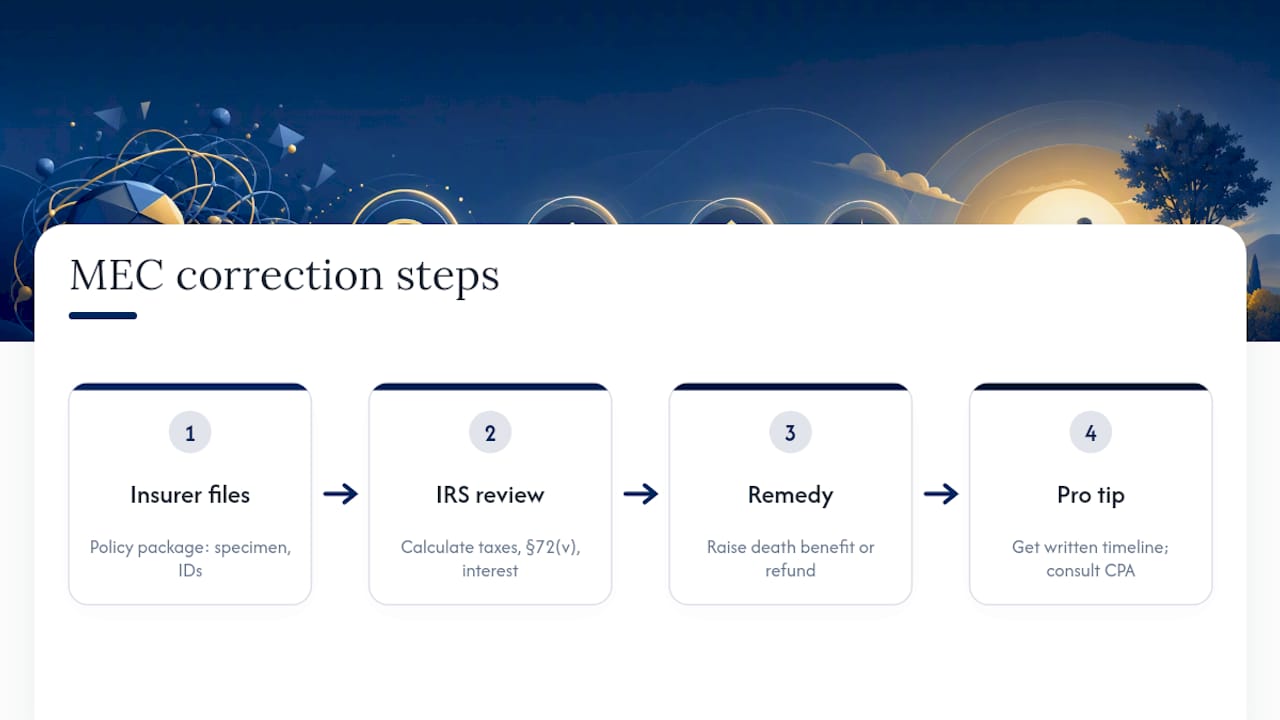
The IRS created a formal correction path for inadvertent MEC failures through Revenue Procedure RP-01-42. This procedure is available to issuers, not directly to policyholders, and it covers non-egregious failures where the MEC status resulted from an honest mistake rather than deliberate overfunding.
The insurer must submit a package to the IRS that typically includes: the policy specimen, affected policy numbers, taxpayer identification numbers, death benefit amounts, the seven-pay assumptions used, cash surrender values at relevant dates, a description of the defect, and a record of any distributions already taken.
The IRS then calculates amounts owed, which can include income tax on gain already distributed, the §72(v) additional tax, interest on those amounts, and any corrective premium refunds or death benefit adjustments needed to bring the policy back into compliance. The two main remedies are increasing the death benefit (to make the premiums no longer excessive relative to the coverage) or refunding the excess premiums plus earnings to the policyholder.
Pro Tip: If your insurer tells you a corrective request is pending, ask them for a written timeline and ask your CPA whether any distributions you already took need to be reported differently on an amended return. Correction does not automatically undo prior-year tax filings.
Carriers often have a narrow window from a policy anniversary to refund excess premiums and prevent MEC status from locking in. Once that window closes, the revenue procedure route is the only path, and it is the insurer's petition to file, not yours.
Numeric worked examples: how the tax and penalty actually calculate
Example 1: Partial withdrawal at age 55
Step-by-step:
- Under LIFO, the first $40,000 out is gain. The $15,000 withdrawal is entirely within the gain layer.
- The full $15,000 is ordinary income in the year of distribution.
- The 10% additional tax under §72(v) applies: $15,000 × 10% = $1,500 penalty.
- Total tax cost: ordinary income tax on $15,000 plus $1,500 additional tax.
Example 2: Same withdrawal at age 62
Steps 1 and 2 are identical. At age 62, the §72(v) penalty does not apply. The $15,000 is still ordinary income, but the $1,500 additional tax disappears.
Example 3: Correction calculation (simplified)
If the insurer refunds $10,000 in excess premiums plus $2,000 in earnings to correct an inadvertent MEC failure, the $2,000 in earnings is generally includable as ordinary income in the year of refund, and interest may be owed on any tax that was underpaid during the period the policy was incorrectly treated as non-MEC.
How retirees should plan around MEC risk
Avoiding MEC status comes down to premium discipline. Stagger large contributions across calendar years rather than front-loading. Watch how dividend allocations are applied inside the policy, since some dividend options can push cumulative premiums over the seven-pay limit without an obvious cash outflow. Before making any large additional premium payment, ask your insurer for a written seven-pay test calculation showing how much room remains.
If you are considering a 1035 exchange into a new policy, understand that the exchange can restart the seven-pay test on the new contract. Coordinate that timing carefully with your agent and CPA.
Deliberate MEC funding is a legitimate strategy for some retirees. If your goal is wealth transfer at death and you have no intention of accessing cash values during your lifetime, accepting MEC status can make sense. The death benefit remains fully income-tax-free, tax-deferred growth continues inside the contract, and some overfunded policies offer higher crediting rates precisely because of the larger premium base. For retirees with estate-tax exposure or those placing policies inside an irrevocable life insurance trust (ILIT), this tradeoff is worth a conversation with an estate attorney.
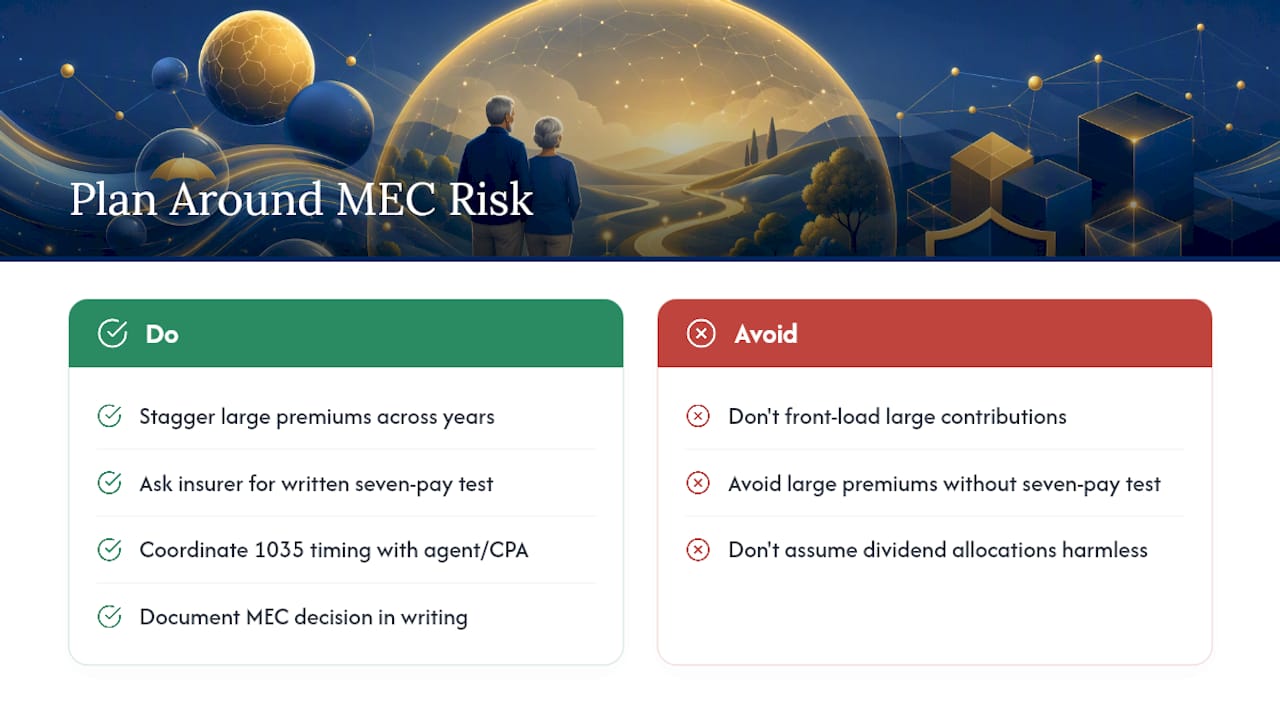
Pro Tip: If estate planning is the goal and MEC status is intentional, document that decision in writing with your agent and CPA. That paper trail matters if heirs or a trustee later question why distributions were never taken.
Immediate next steps if you suspect your policy is or became an MEC
- Locate your original policy contract and the most recent annual statement.
- Check whether you received a Form 1099-R from the insurer for any year you took a distribution or loan.
- Verify the policy issue date. If it was issued after June 21, 1988, the seven-pay test applies.
- Review premium payments in the first seven policy years for any large lump-sum contributions.
- Request a written MEC status letter from your insurer confirming whether the policy has or has not failed the seven-pay test.
- Ask the insurer whether a correction window is still open and whether they have a formal corrective request process.
- Bring your policy documents, Form 1099-R copies, and premium history to a CPA with retirement and insurance taxation experience before filing or amending any return.
A licensed agent at Familyguardlh can help you read the policy documents and frame the right questions for your CPA.
Why retirees should be cautious but not alarmed
MEC status is genuinely harmful in one scenario: you need liquidity before age 59½ and assumed the cash value was accessible tax-free.
Outside that scenario, MEC status is manageable. The death benefit stays tax-free. Growth inside the contract remains tax-deferred. And for retirees focused on passing wealth to heirs rather than drawing income, the MEC rules are largely irrelevant to their actual financial outcome. The key risk, as LegalClarity notes, is unexpected withdrawals taken under the mistaken assumption of tax-free treatment.
At Familyguardlh, licensed across 22 states, the practical guidance is straightforward: know your policy's status before you need the money, not after. Document every communication with your insurer, keep copies of any corrective premium refunds or closing agreements, and loop in a CPA whenever a distribution is on the table.
Pro Tip: Keep a dedicated folder, physical or digital, for every piece of insurer correspondence about your policy's MEC status. If a correction is ever filed, that documentation is what your CPA needs to reconcile your tax filings.
Familyguardlh offers policy reviews and retirement income planning
Understanding MEC taxation rules is one thing. Knowing whether your specific policy is at risk, and what to do about it, requires a policy review by someone licensed to read the contract and run the numbers.

Familyguardlh provides policy reviews focused on MEC risk, retirement income planning that coordinates your insurance, Social Security, and annuity income, and warm referrals to CPAs and estate attorneys when the situation calls for it. When you request a review, have your policy contract, recent annual statements, and any Form 1099-R copies ready. Familyguardlh is licensed in 22 states, including AZ, CO, FL, GA, TX, PA, NC, and VA, among others. Schedule a policy review to find out exactly where your policy stands before your next distribution.
Sources
Give these links to your CPA or agent when you ask for a policy review.
- Revenue Procedure RP-01-42 (IRS)
- How are distributions from modified endowment contracts (MECs) taxed? — ThinkAdvisor
- Tax Code 7702A: Modified Endowment Contracts Explained — LegalClarity
This article is general information, not a substitute for advice from a qualified financial advisor. Consult a qualified financial professional about your own circumstances before acting on anything here.