

Longevity risk in retirement is defined as the possibility of outliving your savings and income sources before the end of your life. Average US life expectancy recently reached about 79 years, but many retirees live well into their 80s and 90s. That gap between what you plan for and how long you actually live is where financial security breaks down. The Society of Actuaries distinguishes longevity risk from general life expectancy because population averages mask the real probability that you, personally, will live longer than the median. Understanding this distinction is the first step toward building a retirement plan that does not run dry.
What is longevity risk in retirement, and why does it matter?
Longevity risk is the financial threat that arises when your retirement savings are exhausted before your life ends. It is not a fringe concern. Planning for average life expectancy means roughly half the population will outlive their money by definition, because half of all people live longer than the average.

The distinction between life expectancy and individual longevity probability is critical. Life expectancy is a population statistic. Your personal longevity depends on your health, genetics, lifestyle, and access to healthcare. A 65-year-old woman in good health today has a meaningful chance of reaching 90. That is a 25-year retirement to fund.
Longevity risk affects not just individual retirees but also pension funds, insurers, and government programs. When millions of people live longer than projected, every institution that promised lifetime income faces solvency pressure. That pressure eventually shifts back to individuals who cannot rely on those institutions as heavily as prior generations did.
What factors contribute to longevity risk in retirement?
Several forces combine to make longevity risk more serious than most retirees expect.
Rising life expectancy and demographic pressure
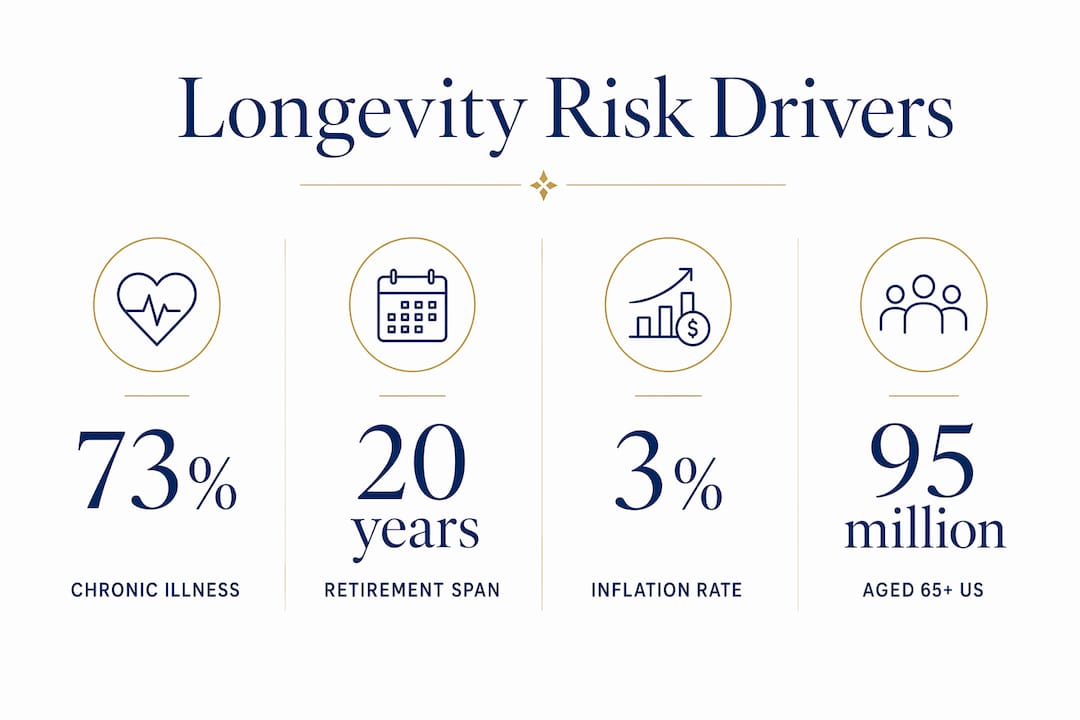
The US population is aging rapidly. Americans aged 65 or older are projected to grow from 56 million in 2020 to 95 million by 2060. That demographic shift puts enormous pressure on pension systems and Social Security, while simultaneously extending the average retirement period that individuals must fund.
Healthcare costs as hidden inflation
73% of seniors aged 65 and older live with at least one chronic health condition. Managing those conditions costs money every year, and the costs accelerate in the 80s and 90s. This creates what financial planners call an "inflation trap": your spending does not decrease in late retirement as many people assume. It often increases, driven by prescription costs, specialist visits, and long-term care needs.
Market volatility and inflation
Inflation erodes purchasing power steadily over a long retirement. A 3% annual inflation rate cuts the real value of a fixed income stream roughly in half over 25 years. Market downturns early in retirement, a phenomenon called sequence-of-returns risk, can permanently reduce the portfolio a retiree draws from for decades.
| Longevity risk factor | Key data point | Retirement impact |
|---|---|---|
| US life expectancy | ~79 years average | Retirements routinely extend 20+ years |
| Population aged 65+ | 56M in 2020, 95M by 2060 | Pressure on Social Security and pensions |
| Chronic conditions | 73% of seniors 65+ affected | Healthcare costs spike in later decades |
| Inflation rate | Compounds annually over decades | Fixed incomes lose real value over time |
Pro Tip: Do not plan to age 79 just because that is the average. Use a longevity calculator from the American Academy of Actuaries to estimate your personal probability of reaching 85, 90, or 95.
How does longevity risk affect your retirement savings and income?
A longer life is a gift, but it is also a financial variable that most retirement plans underestimate. The core problem is simple: the longer you live, the more money you need, and the less time your investments have to recover from losses.
The impact shows up in several specific ways:
- Portfolio depletion. A retiree drawing $60,000 per year from a $1 million portfolio faces a real risk of exhaustion if markets underperform and the retirement lasts 30 years.
- Inflation erosion. Fixed pension payments and non-indexed annuities lose purchasing power every year. What covers your expenses at 65 may cover far less at 85.
- Late-life spending spikes. Healthcare and long-term care costs tend to surge in the final years of life, precisely when savings are most depleted.
- Social Security limitations. Social Security provides inflation-adjusted income, but it was designed as a supplement, not a complete retirement income solution. It does not eliminate longevity risk on its own.
- Pension gaps. Traditional defined-benefit pensions are increasingly rare. Most retirees today rely on defined-contribution plans like 401(k)s, which shift the longevity risk entirely onto the individual.
The combination of these factors means that a retirement plan built on conservative assumptions can fail even when everything else goes right. Living longer is the variable that breaks otherwise solid plans.
Pro Tip: Build your retirement income plan around two scenarios: one where you live to 85, and one where you live to 95. The gap between those two plans reveals exactly how much longevity risk you are carrying.
What strategies and tools can help manage or mitigate longevity risk?
Managing longevity risk requires a combination of income protection, spending discipline, and investment structure. No single tool eliminates the risk entirely, but the right combination reduces it significantly.
Delay Social Security benefits
Delaying Social Security past full retirement age increases your monthly benefit permanently. Each year you delay past full retirement age adds roughly 8% to your benefit. For someone who lives into their late 80s or 90s, delaying from 62 to 70 can mean tens of thousands of dollars more in lifetime income.
Use annuities for guaranteed income
Annuities transfer longevity risk from you to an insurance company. A lifetime income annuity pays a fixed or inflation-adjusted amount for as long as you live, regardless of how long that is. This makes annuities one of the most direct tools for addressing the core problem of longevity risk.
Apply sustainable withdrawal strategies
The 4% rule is a widely cited guideline suggesting that withdrawing 4% of your portfolio annually gives it a strong probability of lasting 30 years. The rule has real limitations in low-return environments and for retirements that extend beyond 30 years. Flexible withdrawal strategies that adjust based on market performance and spending needs work better over the long run.
Diversify with inflation-protected assets
Treasury Inflation-Protected Securities (TIPS) and I-bonds adjust their value with inflation, preserving purchasing power over time. Including these alongside equities and fixed income gives a portfolio more resilience against the slow erosion that inflation causes over a 25-year retirement.
Plan for healthcare and long-term care costs
Long-term care insurance, Medicare supplement plans, and health savings accounts (HSAs) all reduce the financial shock of late-life medical expenses. Healthcare planning is not optional for managing longevity risk. It is the part most retirees underestimate until costs arrive.
| Strategy | Longevity risk reduction | Liquidity | Complexity |
|---|---|---|---|
| Delay Social Security | High | N/A | Low |
| Lifetime income annuity | High | Low | Medium |
| 4% withdrawal rule | Moderate | High | Low |
| TIPS and I-bonds | Moderate | Medium | Medium |
| Long-term care insurance | High (healthcare costs) | Low | Medium |
How to realistically plan for longevity risk in your retirement preparation
Planning for longevity risk is not a one-time exercise. It requires honest assumptions, regular updates, and tools that reflect your personal situation rather than population averages.
-
Estimate your personal longevity. Use the Actuaries Longevity Illustrator, a free tool from the Society of Actuaries and American Academy of Actuaries, to model your probability of reaching specific ages based on your health and lifestyle. This replaces guesswork with data.
-
Build a contingency fund. Set aside a dedicated reserve for unexpected healthcare costs and long-term care needs. This fund sits outside your regular retirement portfolio and absorbs shocks without forcing you to sell investments at the wrong time.
-
Revisit your plan every two to three years. Life changes. Health changes. Markets change. A plan built at 60 may need significant adjustment at 68. Financial advisors who specialize in retirement income planning can help you quantify your current longevity risk exposure and adjust your strategy accordingly.
-
Account for lifestyle factors. Nonsmokers, people with healthy body weight, and those with strong social connections statistically live longer than average. If those factors describe you, plan for a longer retirement. Your longevity risk is higher than the average person's, which means your financial plan needs to be stronger too.
-
Layer your income sources. Combine Social Security, annuities, and portfolio withdrawals so that no single source carries the full burden. Layered income is more resilient than any single strategy because it does not depend on one thing going right.
-
Coordinate healthcare coverage carefully. Medicare begins at 65, but gaps in coverage, particularly for dental, vision, and long-term care, can create significant out-of-pocket costs. Supplemental policies fill those gaps and protect your savings from being consumed by medical bills.
Key Takeaways
Longevity risk in retirement is best managed through layered income sources, realistic lifespan planning, and proactive healthcare coverage that protects savings from late-life cost spikes.
| Point | Details |
|---|---|
| Define longevity risk correctly | It is the risk of outliving savings, not simply living a long life. |
| Plan beyond the average | Half the population lives longer than the median; plan for 90 or 95. |
| Healthcare costs accelerate late | 73% of seniors have chronic conditions; budget for rising medical costs. |
| Layer your income sources | Combine Social Security, annuities, and portfolio withdrawals for resilience. |
| Revisit your plan regularly | Update assumptions every two to three years as health and markets shift. |
Why I think most retirees underestimate longevity risk until it's too late
Working with retirees across multiple states, I have seen the same pattern repeat: people plan carefully for the first 10 years of retirement and then assume the rest will take care of itself. It rarely does.
The most common misconception I encounter is that longevity risk is a problem for the very old. Retirees in their early 60s dismiss it because 90 feels abstract. But the financial decisions you make at 62 determine whether you have options at 82. Waiting until longevity risk becomes visible means the tools to address it, like annuities and long-term care insurance, become more expensive or unavailable.
What I have seen work is a combination of honest lifespan estimation and income layering. Clients who build guaranteed income floors through Social Security delay and annuities sleep better. They spend more freely in their 70s because they know the floor holds regardless of what markets do. That psychological benefit is real and undervalued in most retirement planning conversations.
Longevity risk is not a reason to be afraid of a long life. It is a reason to plan for one.
— Shereka
How Familyguardlh supports your retirement income protection
Retirement income planning is one of the most complex financial challenges you will face, and longevity risk sits at the center of it.

Familyguardlh specializes in helping retirees and pre-retirees across 22 states build income strategies that hold up over long retirements. From annuities that provide guaranteed lifetime income to Medicare supplement and long-term care policies that protect your savings from healthcare costs, Familyguardlh offers the coverage types that directly address longevity risk. If you are preparing for retirement and want a clear picture of your exposure, the team at Familyguardlh can help you build a plan designed to last as long as you do.
FAQ
What is longevity risk in simple terms?
Longevity risk is the chance that you will live longer than your retirement savings can support. It is the financial consequence of a longer-than-expected lifespan.
How is longevity risk different from life expectancy?
Life expectancy is a population average. Longevity risk accounts for the personal probability that you will live beyond that average, which is a real possibility for roughly half the population.
What is the biggest hidden driver of longevity risk?
Healthcare costs are the most underestimated factor. With 73% of seniors managing at least one chronic condition, medical expenses tend to accelerate precisely when savings are most depleted.
Does Social Security eliminate longevity risk?
Social Security reduces longevity risk by providing inflation-adjusted lifetime income, but it does not eliminate it. Most retirees need additional income sources, such as annuities or portfolio withdrawals, to cover full retirement expenses.
When should I start planning for longevity risk?
The earlier the better, but the most critical window is the five to ten years before retirement. Decisions made in that period, including when to claim Social Security and whether to purchase annuities or long-term care insurance, have the largest impact on your long-term financial security.