

Life insurance cash value is defined as the savings component built inside permanent life insurance policies that grows tax-deferred during your lifetime and can be accessed through loans or withdrawals. This feature makes permanent life insurance fundamentally different from term coverage, which pays a death benefit only. Under Internal Revenue Code §101 and §7702, the IRS governs how cash value accumulates and how policyholders access it without triggering taxes. For anyone aged 30–60 building a retirement strategy, understanding cash value life insurance is not optional. It is a financial tool with real advantages and real risks, and knowing both separates informed buyers from expensive mistakes.
How does cash value accumulate in life insurance policies?
Cash value builds because a portion of every premium you pay goes into a savings account inside the policy, separate from the death benefit. The rest of your premium covers the cost of insurance and the insurer's fees. The savings portion grows tax-deferred, meaning you owe no taxes on gains while the money stays inside the policy.
The type of policy you own determines how that savings portion grows. Whole life insurance credits a guaranteed rate set by the insurer. Universal life insurance ties growth to current interest rates, giving you more flexibility but less certainty. Indexed universal life (IUL) links growth to a stock market index like the S&P 500, with a floor that protects against losses. Variable universal life (VUL) invests directly in sub-accounts similar to mutual funds, carrying the highest growth potential and the highest risk.

Long-term internal rates of return on cash value policies typically range from 2%–4%, which is comparable to bond returns rather than stock market gains. That modest return reflects the cost of insurance coverage embedded in the policy. Cash value growth is not as liquid or fast-growing as traditional investments, so setting realistic expectations from day one matters.
| Policy type | Growth mechanism | Risk level | Typical return range |
|---|---|---|---|
| Whole life | Guaranteed crediting rate | Low | 2%–3% |
| Universal life | Current interest rates | Low to medium | 2%–4% |
| Indexed universal life | Market index with floor/cap | Medium | 3%–6% (not guaranteed) |
| Variable universal life | Sub-account investments | High | Market-dependent |
Pro Tip: Request a policy illustration showing both the guaranteed and non-guaranteed columns side by side. The gap between those two columns tells you exactly how much risk you are taking on.
Breaking even against total premiums paid typically takes 10–15 years or longer. That timeline is the single most important number to understand before you buy.
What are the tax rules for accessing cash value?
Cash value grows tax-deferred under IRS §7702, meaning the IRS does not tax annual gains as ordinary income. That deferral is one of the strongest arguments for cash value policies in a retirement plan.
When you take money out, the tax treatment depends on how you access it and whether your policy qualifies as a Modified Endowment Contract (MEC). For non-MEC policies, withdrawals use the FIFO (first in, first out) method. You withdraw your basis, meaning the premiums you already paid with after-tax dollars, completely tax-free before any gains become taxable.
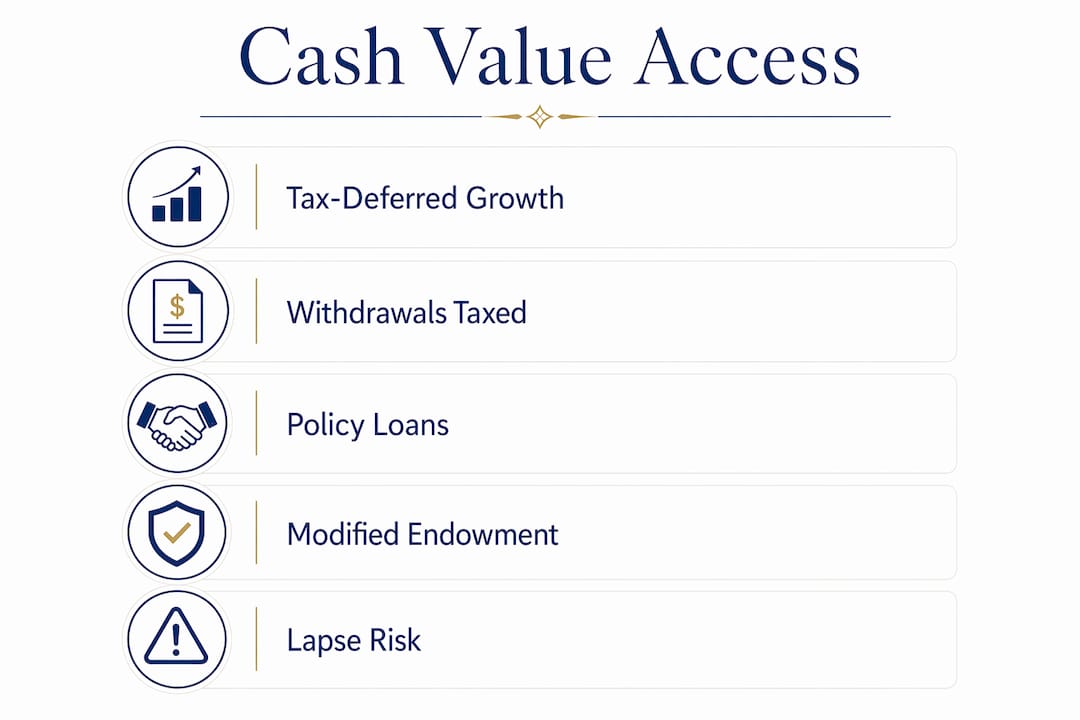
Policy loans work differently. Policy loans are generally tax-free as long as the policy stays in force. The insurer lends you money against your cash value, and because it is technically a loan, the IRS does not count it as income. The catch is that loan balances plus accrued interest reduce the death benefit dollar for dollar at death.
The MEC classification is the tax trap most policyholders never see coming. A policy becomes a MEC when it fails the 7-pay test, which limits how much premium you can pay in the first seven years. If a policy fails the 7-pay test, withdrawals shift to LIFO (last in, first out) taxation, meaning gains come out first and are fully taxable. A 10% penalty also applies to withdrawals taken before age 59½, identical to the penalty on early IRA distributions.
The most dangerous scenario is a policy lapse with an outstanding loan. Outstanding loans that cause a policy lapse create a taxable event on the full loan balance, even if you received none of that money recently. The IRS calls this phantom income, and the tax bill can far exceed what you actually received.
Key rules to keep your policy tax-efficient:
- Never overfund a policy beyond IRS limits without confirming it passes the Cash Value Accumulation Test (CVAT) or Guideline Premium Test (GPT).
- Track your cost basis carefully so you know exactly when withdrawals become taxable.
- Pay loan interest annually to prevent compounding balances from eroding your policy.
- Review your policy annually with your agent if you carry any outstanding loan balance.
Pro Tip: Ask your agent to run a "lapse test" showing what happens to your policy if you stop paying premiums while carrying a loan. That single scenario reveals more about your policy's health than any sales illustration.
What are the common pitfalls with cash value life insurance?
The biggest misconception about cash value is that it grows quickly. Early years of cash value policies carry heavy fees and commissions, which means the actual savings account inside your policy may be worth far less than your total premiums for the first several years. Policyholders who surrender early almost always walk away with less than they paid in.
Surrender charges compound this problem. Surrender charges can range from 5%–15% of the policy value and typically decrease over a 10–15 year period. Buying a cash value policy with a five-year time horizon is a financial mistake, not a strategy.
Cash value drift is a less discussed but equally serious risk. Policy illustrations often overestimate cash value growth, and actual performance can fall short of projections due to changing interest rates, higher-than-expected mortality charges, or policy fees. When actual values underperform projections, the policy may require higher premiums to stay in force or risk lapsing entirely. Regular in-force illustration reviews are the only reliable way to catch drift before it becomes a crisis.
Treating policy loans as free money is the third major pitfall. Loans feel free because no repayment schedule exists, but unpaid interest compounds and quietly shrinks both your cash value and your death benefit. Policyholders who borrow heavily in their 60s and then experience a market downturn in a variable or indexed policy can find their coverage collapsing exactly when they need it most.
How can cash value support your retirement plan?
Cash value life insurance fits retirement planning in specific, well-defined ways. It is not a replacement for a 401(k) or IRA, but it fills gaps those accounts cannot.
-
Supplement retirement income with tax-free loans. You can take policy loans in retirement and receive cash without triggering income taxes, as long as the policy stays in force. This strategy works especially well for retirees who need to manage their taxable income to stay below Medicare premium thresholds.
-
Withdraw your basis for short-term needs. If you need cash and your policy is non-MEC, you can withdraw up to your total premiums paid completely tax-free. This gives you a predictable, penalty-free liquidity source that a Roth IRA also provides but with different contribution limits.
-
Use cash value as an asset protection tool. Many states protect life insurance cash value from creditors. Florida and Texas, for example, offer broad creditor protection on life insurance policies. If you are a business owner or professional with liability exposure, this protection has real financial value.
-
Transfer wealth tax-efficiently. Cash value inside a policy passes income-tax-free to heirs under IRC §101. The death benefit is also generally excluded from the beneficiary's gross income. That combination makes permanent life insurance one of the most tax-efficient wealth transfer tools available.
-
Coordinate with other retirement accounts. Cash value works best as a complement to tax-deferred accounts like a 401(k) and tax-free accounts like a Roth IRA. It adds a third bucket of tax-advantaged money with no contribution limits tied to earned income, which is a meaningful advantage for high earners who have maxed out other accounts.
The honest answer to "is life insurance cash value worth it" depends entirely on your time horizon, income level, and how well the policy is structured. For a 35-year-old with a 30-year runway, a well-designed whole life or IUL policy can become a meaningful retirement asset. For someone who needs the money in five years, it is the wrong tool.
Key Takeaways
Cash value life insurance is a long-term tax-deferred savings vehicle inside permanent policies that rewards patience, active management, and a clear retirement strategy.
| Point | Details |
|---|---|
| Growth is slow early on | Cash value typically takes 10–15 years to break even against premiums paid. |
| Tax treatment depends on policy status | Non-MEC policies allow tax-free withdrawals of basis; MEC status triggers LIFO taxation and penalties. |
| Loans are not free money | Unpaid policy loans reduce the death benefit and can trigger phantom income taxes if the policy lapses. |
| Cash value drift is a real risk | Actual growth often falls short of illustrations; annual in-force reviews prevent surprises. |
| Best used as a retirement complement | Cash value works alongside 401(k) and Roth IRA accounts, not as a replacement for them. |
What I have learned from watching clients misuse cash value policies
People come to me after buying a cash value policy with high hopes and, too often, low information. The sales illustration looked great. The projected values at age 65 looked even better. Then life happened. They borrowed against the policy, skipped a few premium payments, and never asked for an updated in-force illustration. By the time they called me, the policy was on the verge of lapsing and the tax bill waiting on the other side was larger than anything they had planned for.
My honest view is that cash value life insurance is one of the most misunderstood products in personal finance, and that misunderstanding cuts both ways. Critics dismiss it as overpriced and inefficient. Enthusiasts oversell it as a magic retirement account. The truth is more specific. A well-structured policy, bought at the right age, funded consistently, and reviewed every year, can do things no other financial product can. It can provide tax-free income in retirement, protect assets from creditors, and transfer wealth to heirs without income tax. That is a real value proposition.
The problem is that most people treat it like a savings account they can dip into whenever they want. Cash value is not a savings account. It is a financial contract with rules, timelines, and consequences for breaking those rules. The policyholders who benefit most are the ones who treat it with the same discipline they bring to their 401(k). They fund it consistently, they borrow carefully, and they review it annually. That discipline is not exciting, but it is what separates a policy that performs from one that becomes a liability.
My advice is simple. If you are considering a cash value policy, get a second opinion on the illustration from someone who is not selling it to you. And if you already own one, pull your in-force illustration today. Do not wait until the numbers surprise you.
— Shereka
Retirement income planning with Familyguardlh

Familyguardlh specializes in retirement income planning for individuals who want to use life insurance as part of a broader financial strategy. Whether you are evaluating a new policy or trying to understand what your existing cash value policy is actually doing for you, the team at Familyguardlh provides clear, personalized analysis without the sales pressure. Licensed in 22 states including Florida, Texas, Georgia, and Ohio, Familyguardlh works with clients across a wide range of income levels and retirement timelines. A one-on-one consultation can clarify whether a cash value policy fits your specific goals or whether a different approach makes more sense for your situation.
FAQ
What is life insurance cash value in simple terms?
Cash value is a savings account built inside a permanent life insurance policy that grows tax-deferred and can be accessed through loans or withdrawals during your lifetime.
How long does it take for cash value to grow significantly?
Cash value typically takes 10–15 years to break even against total premiums paid, with long-term internal rates of return generally ranging from 2%–4%.
Are policy loans from life insurance tax-free?
Policy loans are tax-free as long as the policy stays in force. If the policy lapses with an outstanding loan, the IRS treats the loan balance as taxable income, creating a phantom income tax event.
What is a Modified Endowment Contract and why does it matter?
A Modified Endowment Contract (MEC) is a policy that fails the IRS 7-pay test by receiving too much premium too quickly. MEC status removes the tax-free withdrawal advantage and adds a 10% penalty on gains withdrawn before age 59½.
Is cash value life insurance a good retirement strategy?
Cash value life insurance works best as a complement to a 401(k) and Roth IRA, not a replacement. It offers tax-free loan income, creditor protection in many states, and income-tax-free wealth transfer to heirs under IRC §101.