

Life insurance business succession planning is the strategic use of insurance policies to fund ownership transfers and protect business continuity when an owner dies, becomes disabled, or retires. Without a funded plan, a business faces forced liquidation, family disputes, or a fire-sale buyout that destroys years of built value. Only 30% of family-owned enterprises survive to the second generation, and just 12% reach the third. That survival gap exists largely because most owners never create a funded, legally binding succession structure. The industry term for this discipline is "funded buy-sell planning," and it requires coordination among life insurance, legal agreements, and business valuation to work.
What are the main types of life insurance structures used in business succession planning?
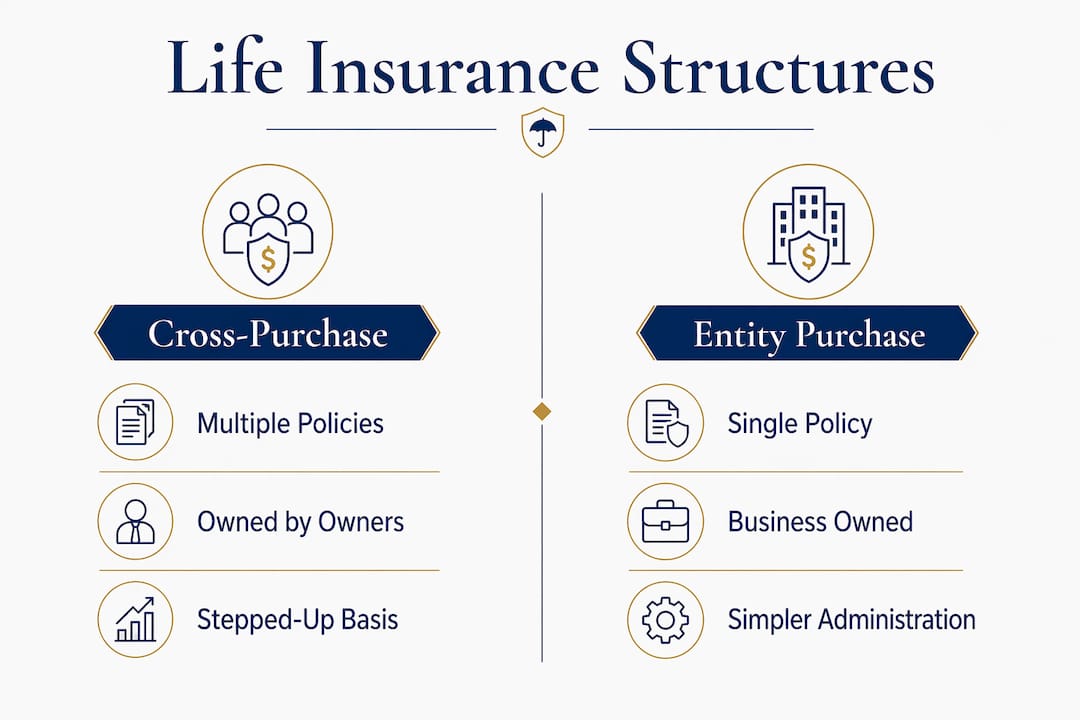
The two foundational structures in life insurance business succession planning are the cross-purchase agreement and the entity purchase agreement. Each one determines who owns the policy, who pays the premiums, and who collects the death benefit when a triggering event occurs.
Cross-purchase agreements
In a cross-purchase agreement, each business owner buys a life insurance policy on every other owner. When one owner dies, the surviving owners collect the death benefit and use it to buy the deceased owner's shares directly from the estate. The key tax advantage is significant: surviving owners receive a stepped-up cost basis in the purchased shares, which reduces future capital gains taxes when they eventually sell. The trade-off is administrative complexity. With five owners, a cross-purchase structure requires 20 separate policies. That number grows fast and creates real management burdens.

Entity purchase agreements
In an entity purchase agreement, the business itself owns and pays for the policies. The company collects the death benefit and buys back the deceased owner's shares directly. Administration is far simpler: five owners require only five policies under this model. The downside is that surviving owners do not receive a stepped-up basis, which can mean a larger capital gains bill later. A third option, the wait-and-see agreement, lets the parties decide at the time of the triggering event which structure to use. This hybrid model adds flexibility but requires careful legal drafting.
Pro Tip: For businesses with three or fewer owners, a cross-purchase agreement usually delivers better long-term tax outcomes. For larger ownership groups, an entity purchase structure cuts administrative costs significantly.
| Structure | Policy count (5 owners) | Tax basis benefit | Who owns the policy |
|---|---|---|---|
| Cross-purchase | 20 policies | Stepped-up basis for survivors | Each owner individually |
| Entity purchase | 5 policies | No stepped-up basis | The business entity |
| Wait-and-see hybrid | Varies | Determined at trigger event | Flexible at time of event |
How to align life insurance coverage with business valuation
Coverage amounts must match the current value of the business. A policy written five years ago for a business worth $2 million is dangerously inadequate if that business is now worth $6 million. Business valuations should be reviewed annually and policies updated on the same schedule to prevent coverage gaps.
The buy-sell agreement itself controls how the business is valued at the time of a triggering event. Owners can choose from several valuation methodologies: fixed price, formula-based valuation, or independent appraisal. Each method has different implications for price certainty and fairness. A fixed price set years ago often understates current value. A formula tied to earnings or book value can produce more accurate results but requires a well-drafted formula clause.
The Internal Revenue Code imposes specific requirements for buy-sell agreements to be respected for estate tax purposes. The agreement must be a bona fide business arrangement, not a device to transfer value to family members at below-market prices. Meeting these standards requires legal counsel familiar with both corporate law and estate planning.
- Get a formal business valuation from a certified valuation analyst before drafting or updating the buy-sell agreement.
- Review the valuation and insurance coverage amounts every one to two years, or after any major change in revenue, ownership, or business structure.
- Confirm that the buy-sell agreement's valuation method aligns with the Internal Revenue Code requirements for estate tax purposes.
- Coordinate with your attorney, CPA, and insurance advisor in the same review meeting to catch gaps across legal, tax, and coverage dimensions.
- Update policy beneficiary designations and ownership records every time the agreement changes.
Pro Tip: Schedule your annual valuation review in the same quarter as your business tax filing. Your CPA already has the financial data needed to support the valuation, which cuts time and cost.
How does life insurance address succession triggers beyond death?
Standard life insurance covers only one succession trigger: death. A complete business succession plan must also address disability and retirement, which require entirely different financial tools.
Disability is statistically more likely to interrupt a business than death during an owner's working years. Yet most buy-sell agreements are funded only for death. Disability buyout insurance fills this gap. It is a separate product from life insurance and typically carries a 12–24 month elimination period before the buyout funding activates. That elimination period must align precisely with the terms written into the buy-sell agreement. If the agreement triggers a buyout after 12 months of disability but the insurance policy has a 24-month elimination period, the business faces a 12-month funding gap with no solution.
Retirement exits require yet another approach. Life insurance does not fund a retirement buyout because no death benefit is paid when an owner simply steps away. A hybrid funding approach combining life insurance for death triggers with annuities or installment sale structures for retirement exits is increasingly recommended by financial planners. Annuities can provide a guaranteed income stream to the retiring owner while the remaining partners pay down the buyout over time.
- Life insurance: funds death-triggered buyouts with an immediate lump-sum benefit.
- Disability buyout insurance: funds disability-triggered buyouts after the elimination period, typically 12–24 months.
- Annuities and installment sales: fund retirement-triggered buyouts through structured payments over time.
- Coordinated coverage: all three tools must align with the specific trigger language in the buy-sell agreement.
Common mistakes and tax pitfalls in business succession insurance
The most costly mistakes in business succession insurance are not about choosing the wrong policy. They are about ignoring how policy ownership, legal structure, and tax law interact.
The 2024 Supreme Court ruling in Connelly v. United States changed the estate tax calculus for entity purchase plans. The Court held that life insurance proceeds owned by the corporation increase the fair market value of the deceased owner's shares for estate tax purposes, without any offsetting liability reduction. The result is a larger estate tax bill than most owners anticipated. Alternatives like an Irrevocable Life Insurance Trust (ILIT) or a cross-purchase structure can avoid this outcome, but they require restructuring before a triggering event occurs.
Treating insurance policies and legal buy-sell agreements as separate silos undermines tax efficiency and can incur unexpected estate tax exposure. The Connelly ruling made this coordination not just advisable but financially necessary for any entity-owned policy structure.
Switching from an entity purchase to a cross-purchase structure after policies are already in force creates another risk. Transferring policy ownership can trigger the transfer-for-value rule under the Internal Revenue Code, which makes a portion of the death benefit taxable as ordinary income. This rule catches many business owners off guard when they try to restructure without proper legal guidance.
- Outdated valuations: Coverage amounts that lag behind business growth leave surviving owners short of funds to complete a buyout.
- Policy ownership misalignment: Corporate-owned policies can inflate estate tax values under the Connelly ruling.
- Transfer-for-value violations: Restructuring policy ownership without legal review can make death benefits partially taxable.
- Disability funding gaps: Buy-sell agreements that trigger buyouts before the disability insurance elimination period expires leave the business without liquidity.
- No periodic review: Legal, tax, and insurance structures that are never updated become misaligned as the business grows and tax law changes.
Key Takeaways
A funded buy-sell agreement backed by life insurance, disability buyout coverage, and regular valuation reviews is the most reliable structure for protecting business continuity across all succession triggers.
| Point | Details |
|---|---|
| Structure determines tax outcome | Cross-purchase gives survivors a stepped-up basis; entity purchase does not. |
| Coverage must match current value | Review business valuations and policy amounts every one to two years. |
| Disability requires separate coverage | Disability buyout insurance has a 12–24 month elimination period that must align with the buy-sell agreement. |
| Connelly changed entity plan risks | Corporate-owned policies now inflate estate tax values; consider ILITs or cross-purchase as alternatives. |
| Multi-trigger plans need multiple tools | Life insurance, disability buyout insurance, and annuities each cover different succession exits. |
What I've learned from watching succession plans succeed and fail
Over years of working with business owners across multiple states, the pattern is consistent. Owners who treat succession planning as a one-time legal task almost always end up with a plan that is outdated, underfunded, or misaligned with current tax law. The ones who build resilient outcomes treat it as an ongoing process, not a document they sign and file away.
The Connelly ruling is a perfect example of why this matters. Many business owners set up entity purchase plans years ago because they were simpler to administer. That was a reasonable decision at the time. After Connelly, those same plans now carry estate tax exposure that did not exist before. Owners who review their structures regularly caught this early. Those who did not may face a tax bill their estates cannot absorb.
The other pattern I see constantly is the disability gap. Owners buy life insurance, feel covered, and never ask what happens if a partner becomes incapacitated for two years. The business still needs to function. The disabled owner still needs income. The remaining partners still need a clear path to ownership. Life insurance answers none of those questions. Only a coordinated plan with disability buyout coverage and a properly drafted agreement does.
The most effective succession plans I have seen involve a three-way conversation: the insurance advisor, the business attorney, and the CPA, all reviewing the same documents at the same time. That coordination catches the gaps that each professional would miss working alone.
— Shereka
Familyguardlh helps business owners build funded succession plans
Business owners who want to protect what they have built need more than a policy. They need coverage that fits their legal structure, their valuation, and their specific exit timeline.

Familyguardlh specializes in life insurance and retirement income solutions for business owners across 22 states, including TX, FL, GA, PA, NC, and OH. The team works with owners to match policy structures to buy-sell agreements, identify disability coverage gaps, and coordinate with legal and tax advisors. Whether the plan involves a cross-purchase structure, an ILIT, or a hybrid approach with annuities, Familyguardlh can help identify the right coverage for the right trigger. Reach out to schedule a consultation and get a clear picture of where your current plan stands.
FAQ
What is business succession life insurance?
Business succession life insurance is a policy used to fund a buy-sell agreement when a business owner dies, becomes disabled, or retires. It provides the liquidity needed to transfer ownership without forcing a sale of business assets.
How many policies does a cross-purchase plan require?
The number of policies grows with the number of owners. Five owners require 20 separate policies under a cross-purchase structure, compared to five policies under an entity purchase plan.
Does life insurance cover disability in a succession plan?
Standard life insurance does not cover disability. A separate disability buyout insurance policy is required, and it typically carries a 12–24 month elimination period before benefits activate.
What did the Connelly ruling change for business succession plans?
The Connelly v. United States ruling established that corporate-owned life insurance proceeds increase the fair market value of a deceased owner's shares for estate tax purposes. This inflates estate tax liability for entity purchase plans and makes policy ownership structure a critical planning decision.
How often should business owners update their succession insurance?
Valuations and coverage amounts should be reviewed every one to two years, or immediately after any significant change in business revenue, ownership structure, or applicable tax law.