

Key person life insurance is a policy a business owns on its most critical employee, with the company named as both the policy owner and the beneficiary. Also called key man insurance in older industry usage, this coverage protects a business from the financial fallout of losing a founder, top salesperson, lead engineer, or any individual whose absence would threaten operations. The business absorbs the loss as a going concern, not the employee's family. Familyguardlh works with business owners across 22 states to structure these policies correctly from the start, because the mechanics matter as much as the coverage amount.
What types of coverage are available under key person insurance?
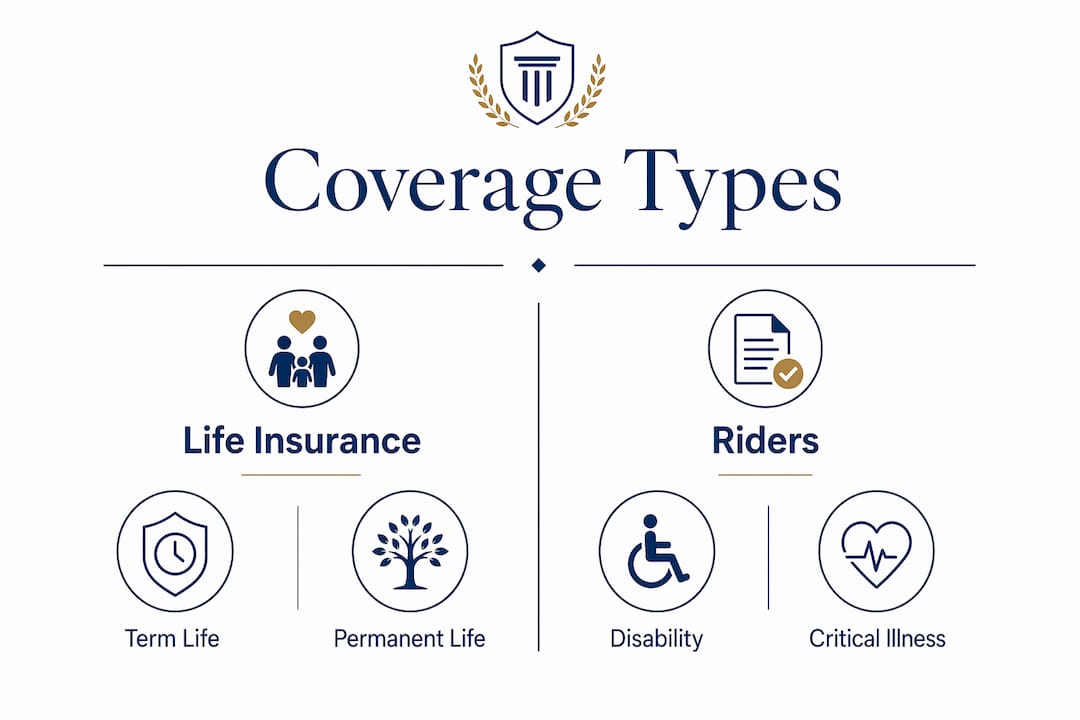
Key person insurance falls into three main categories: term life, permanent life, and disability coverage. Each serves a different financial purpose, and the right mix depends on your business structure, budget, and risk profile.

Term life insurance
Term life is the most common starting point for businesses. It provides a fixed death benefit for a set period, typically 10, 20, or 30 years, at a lower premium than permanent coverage. A startup protecting its founding CEO during the first decade of growth is a textbook use case. If the key person outlives the term, the policy expires with no payout and no cash value.
Permanent life insurance
Permanent policies, including whole life and universal life, cover the insured for their entire lifetime. The premium cost runs higher, but permanent policies build cash value that the business can access or transfer. That cash value can be assigned to the insured as a benefit upon retirement or sold during a business acquisition. This dual function makes permanent coverage attractive for businesses that also want to use the policy as a retention tool for senior talent.
Disability and critical illness riders
A disability rider pays a monthly benefit if the key person becomes unable to work due to illness or injury. Elimination periods generally range from 90 to 180 days before benefits begin, so the business must have reserves to cover that gap. Critical illness riders extend coverage to diagnoses like cancer, stroke, or heart attack, triggering a lump-sum payment even if the insured survives. These riders convert a death-only policy into a broader business continuity tool.
| Coverage type | Duration | Cash value | Best for |
|---|---|---|---|
| Term life | Fixed period | None | Cost-conscious businesses, early-stage companies |
| Permanent life | Lifetime | Yes | Established firms, retention strategies |
| Disability rider | Until recovery or policy end | None | Businesses with high operational dependency on one person |
| Critical illness rider | Per diagnosis event | None | Businesses in high-stress or physically demanding industries |
Pro Tip: Start with term life if budget is tight, but add a disability rider from day one. A key person is statistically more likely to become disabled during their working years than to die, so skipping disability coverage leaves the largest gap unaddressed.
How does key person insurance protect a business financially?
Key person insurance provides a tax-free cash cushion at the exact moment a business is most financially vulnerable. Death benefit payouts are generally received tax-free by the business, giving leadership immediate liquidity to respond without taking on debt or selling assets.
The proceeds can be directed toward several recovery priorities:
- Lost revenue replacement: A top salesperson generating $2 million annually leaves a measurable gap. Proceeds can fund operations while the business rebuilds that revenue stream.
- Recruitment and training costs: Replacing a senior executive costs an average of one to two times their annual salary when you factor in search fees, onboarding, and productivity ramp-up time.
- Debt repayment: Lenders often accelerate loan terms when a key person dies. Proceeds can retire that debt before it becomes a crisis.
- Share buyouts: If the key person was also a shareholder, proceeds can fund a buy-sell agreement, keeping ownership within the intended group.
- Day-to-day operating expenses: Payouts serve as a financial cushion for payroll, vendor payments, and overhead during the transition period.
Key person insurance also strengthens a business's position with outside capital sources. Investors and lenders often require key person coverage as a condition of funding or credit extension. A policy in place signals that the business has planned for its own vulnerability, which reduces perceived risk for the financier.
One boundary matters: coverage ceases if the key person leaves through resignation or termination. The policy only pays out on death or qualifying disability while the insured is actively employed. This is a meaningful operational limit that businesses often overlook when structuring their continuity plans.
How to determine coverage amount and policy cost
Coverage amount is the most consequential decision in the key person insurance process. Get it wrong in either direction and the policy either fails to protect the business or drains the budget unnecessarily.
Calculating the right coverage amount
The most widely used method is the salary multiple approach. Recommended coverage is 8 to 10 times the key person's annual salary or estimated financial impact on the business. A CFO earning $300,000 annually would warrant a policy between $2.4 million and $3 million under this framework. A second method calculates the direct financial value the person generates, including revenue attributed to their relationships, intellectual contributions, or operational output. A third method estimates replacement costs: recruiting fees, training time, and the productivity gap during transition.
| Calculation method | Formula | Best use case |
|---|---|---|
| Salary multiple | Annual salary × 8–10 | Most businesses as a baseline |
| Revenue contribution | Attributed annual revenue × 3–5 | Sales-driven organizations |
| Replacement cost | Recruitment + training + productivity loss | Highly specialized technical roles |
What drives premium costs
Premium cost depends on four primary factors: the type of policy selected, the insured's age and health at the time of application, the coverage amount, and any riders added to the base policy. A 45-year-old in good health purchasing a $2 million 20-year term policy will pay significantly less than a 55-year-old purchasing the same coverage. Adding a disability rider increases the premium but also closes the most likely gap in coverage. Industry risk factors, such as whether the key person works in a physically hazardous environment, also affect underwriting decisions.
Pro Tip: Run the coverage calculation using all three methods and take the highest result. Businesses consistently underestimate replacement costs, especially for roles that require years of institutional knowledge and client relationship development.
What are practical steps for implementing key person insurance?
Getting a key person policy in place requires more than selecting a coverage amount. Several legal, tax, and operational considerations shape how the policy functions over time.
-
Obtain written consent from the insured. Written consent is a legal requirement before any policy can be issued. The key person must sign documentation acknowledging that the business will own the policy and receive the benefit. Skipping this step voids the policy.
-
Understand the tax treatment. Premiums paid on key person life insurance are generally not tax-deductible as a business expense. The tradeoff is that the death benefit arrives tax-free. Plan your cash flow around non-deductible premiums from the start.
-
Align the policy with your succession plan. A key person policy works best when it connects directly to a buy-sell agreement or a documented succession plan. The payout should have a designated use before the policy is issued, not after a loss occurs.
-
Review the policy when the business changes. A coverage amount set three years ago may be inadequate today if the key person's role has expanded, the business has grown, or new debt has been taken on. Annual reviews prevent coverage gaps from developing silently.
-
Update the policy when personnel change. If the key person leaves and a new critical hire takes their place, the business needs a new policy. Coverage ends upon departure of the original insured, so there is no automatic transfer to a successor.
-
Avoid naming the key person's family as beneficiary. The business must be the beneficiary. Naming a family member converts the policy into personal life insurance, which eliminates the business protection purpose and creates tax complications.
Key Takeaways
Key person life insurance protects a business's financial stability by providing a tax-free payout when a critical employee dies or becomes disabled, with coverage amounts typically set at 8 to 10 times the key person's annual salary.
| Point | Details |
|---|---|
| Business owns the policy | The company is both the policy owner and the beneficiary, not the employee's family. |
| Disability coverage is critical | Disability riders address the more statistically common disruption and should not be skipped. |
| Coverage amount matters | Use salary multiples of 8–10 times or replacement cost calculations to set the right benefit. |
| Tax treatment is asymmetric | Premiums are not deductible, but death benefit proceeds arrive tax-free to the business. |
| Policy ends when employment ends | Coverage does not transfer if the key person resigns or is terminated. |
Why disability coverage deserves equal attention
Most business owners I speak with have heard of key person life insurance. Far fewer have seriously considered what happens if their most critical person becomes disabled for six months, a year, or longer. Death is final and forces a decision. Disability is open-ended, and that ambiguity is operationally harder to manage.
Disability risk may exceed mortality risk across a typical working career, yet disability coverage gets treated as an optional add-on rather than a core component of the policy. I've seen businesses hold a $3 million death benefit with no disability rider, which means they're protected against the less likely event and exposed to the more likely one.
The other thing I'd push back on is the tendency to treat key person insurance as a one-time purchase. A policy written when a company had 10 employees and $1 million in revenue is almost certainly inadequate for a company with 80 employees and $12 million in revenue. The key person's financial impact on the business has grown, and the coverage should reflect that. Build a calendar reminder for an annual policy review the same way you would for a financial audit.
Transparency with the insured person also matters more than most owners realize. Telling a key employee that the company has taken out a policy on their life, explaining why, and involving them in the process builds trust rather than creating suspicion. The consent requirement exists for a reason, and treating it as a legal formality rather than a conversation is a missed opportunity.
— Shereka
Familyguardlh's approach to business insurance planning
Protecting a business from the loss of its most valuable people requires coverage that fits the company's actual structure, not a generic policy pulled off a shelf.

Familyguardlh works with business owners and executives across 22 states to build life and disability coverage that aligns with real business continuity goals. Whether you need a straightforward term policy on a founding partner or a permanent policy with a disability rider for a senior executive, Familyguardlh can help you identify the right structure and coverage amount. The agency specializes in life, health, and supplemental insurance products designed for individuals and businesses that need coverage they can count on when it matters most.
FAQ
What is key person life insurance?
Key person life insurance is a policy a business purchases on a critical employee, with the company as the owner and beneficiary. The death benefit provides the business with tax-free funds to cover financial losses caused by that person's death.
Who needs key person insurance?
Any business that depends heavily on one or a few individuals for revenue, client relationships, or specialized expertise needs key person coverage. Startups, professional service firms, and closely held companies are the most common candidates.
How much key person insurance should a business carry?
Coverage of 8 to 10 times the key person's annual salary is the standard starting point, though replacement cost calculations may indicate a higher amount for specialized roles.
Are key person insurance premiums tax-deductible?
Premiums are generally not tax-deductible as a business expense. The offsetting benefit is that the death benefit arrives tax-free to the business when a claim is paid.
Does key person insurance cover disability?
A base life policy does not cover disability, but a disability rider can be added. Elimination periods of 90 to 180 days apply before monthly benefits begin, so businesses should maintain reserves to cover that waiting period.