

IRD life insurance explained is not a product you buy. It is a set of tax rules from New Zealand's Inland Revenue Department (IRD) that governs how life insurance premiums and payouts are treated for tax purposes. The IRD does not sell insurance or endorse any policy. Understanding these rules matters because the tax treatment of your premiums and death benefits directly shapes your retirement planning decisions. Familyguardlh helps clients across 22 states navigate life insurance choices with this kind of tax clarity in mind.
What does IRD life insurance explained actually mean?
"IRD life insurance" is widely misunderstood as a government product. It is not. The term refers to how New Zealand's Inland Revenue Department classifies and taxes private life insurance policies. The IRD sets the rules. Private insurers sell the products. Your job is to understand which rules apply to your situation.
The core principle is straightforward. Personal life insurance premiums are not tax deductible in New Zealand. The IRD treats them as private expenses, not income-generating costs. In return, death benefit payouts are generally tax-free to beneficiaries. This symmetry is deliberate and consistent.
Two named entities anchor this framework: the Fringe Benefit Tax (FBT) system for employer-paid policies and the standard personal premium rules for individuals. Both flow from the same IRD logic. Knowing which category applies to you determines your tax exposure and your planning options.

How do IRD tax rules affect personal premiums and death benefits?
Personal life insurance sits firmly in the private expense category under IRD rules. That classification has two direct consequences.
First, you cannot deduct your premiums from your taxable income. The IRD views personal life insurance as a lifestyle choice, not a business cost. No tax credits apply either.
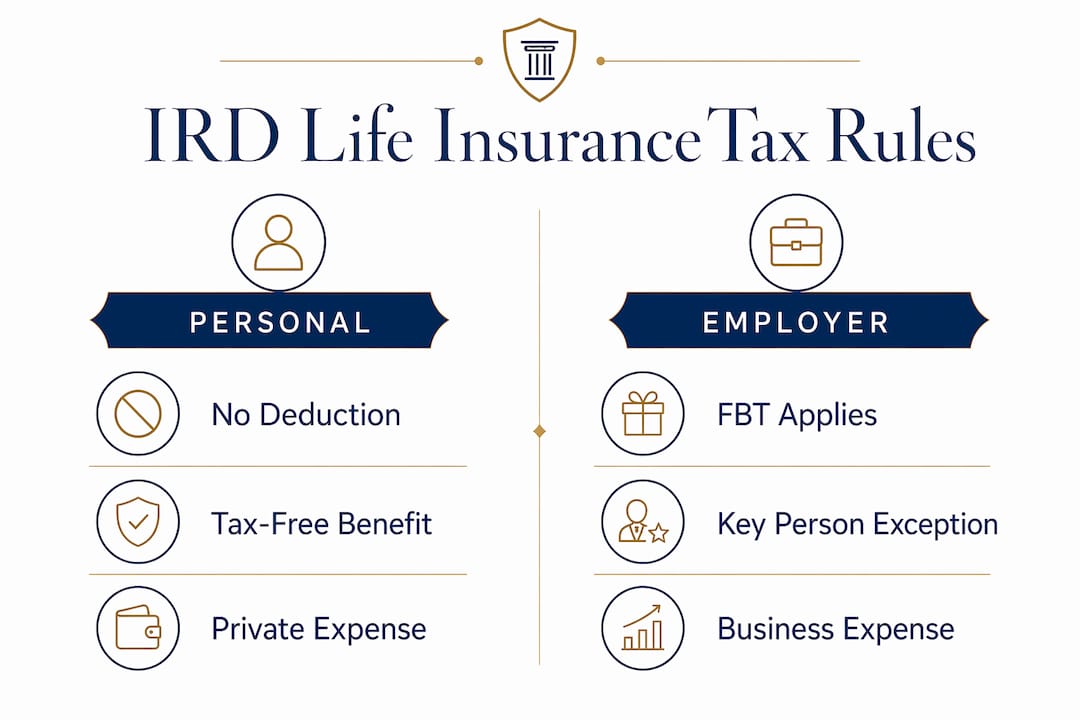
Second, your beneficiaries receive the death benefit free of income tax. The IRD treats the payout as a capital transfer, not earned income. This means a $500,000 policy pays out $500,000 to your family with no tax withheld.
The key benefits of this structure for personal policyholders include:
- No tax on the death benefit. Beneficiaries receive the full payout.
- No IRD filing required for the benefit. The payout does not appear in the beneficiary's income tax return.
- Predictable planning. You know exactly what your family will receive.
- No clawback risk. The IRD does not revisit personal death benefits after payment.
Pro Tip: Think of personal premiums and tax-free benefits as a trade. You give up the deduction now so your family keeps every dollar later. For most individuals, that trade is worth it.
The IRD's tax principle is explicit: if you cannot deduct the premium, the benefit is tax-free. If you can deduct the premium, the benefit becomes taxable income. This is the single most important rule to internalize before structuring any policy.
How does FBT apply to employer-paid life insurance?
Employers who pay life insurance premiums for their staff face a different set of IRD rules. The Fringe Benefit Tax applies to those premiums because the benefit flows to the employee, not the business.
FBT applies to employer-paid premiums unless the policy is structured as key person insurance. Key person insurance protects the business against the financial loss of a critical employee. Because the employer is the beneficiary, not the employee, no FBT applies.
From april 1, 2026, employers can pool benefits for FBT calculation purposes when all employees receive similar benefits. This pooling option simplifies payroll tax management for businesses with uniform group life cover.
Key points for employers structuring life insurance:
- Employee benefit policies trigger FBT. Budget for this cost when designing staff packages.
- Key person policies are FBT-exempt. The employer must be the named beneficiary.
- Pooling is available from 2026. Uniform employee benefits qualify for simplified FBT calculation.
- Deductible premiums produce taxable benefits. If the business deducts the key person premium, any payout is taxable business income.
Pro Tip: Structure key person insurance with the business as the sole beneficiary and document the business purpose clearly. This protects the FBT exemption and reduces IRD audit risk.
What are the IRD rules for self-employed individuals?
Self-employed people face the most complex IRD life insurance situation. They operate as both an individual and a business, which means the line between personal and business policies matters enormously.
Self-employed individuals often carry greater life insurance needs than salaried employees. Business debts, personal guarantees on loans, and income replacement all factor into the calculation. Yet personal premiums remain non-deductible under IRD rules, just as they are for employees.
A self-employed person can structure a business-owned policy and deduct the premiums as a business expense. The trade-off is direct: if premiums are deductible, the benefit payout becomes taxable income. Improper structuring of these policies can trigger unexpected tax liabilities and IRD scrutiny.
One commonly missed item is personal guarantees on business loans. If you have personally guaranteed a $300,000 business loan, that liability does not disappear when you die. Your estate carries it. Life insurance sized to cover that guarantee protects your family from inheriting business debt.
Key considerations for self-employed policyholders:
- Separate personal and business policies clearly. Mixed structures invite IRD challenges.
- Review coverage annually. Business income and debt levels change, and your cover should match.
- Account for personal guarantees. These are often overlooked in standard coverage calculations.
- Document business purpose for any deductible premium. Clear records reduce audit risk.
Pro Tip: Self-employed people should treat their annual insurance review the same way they treat their annual tax filing. Both reflect the current state of your financial obligations.
How do you calculate the right coverage for retirement planning?
Getting the coverage amount right is as important as understanding the tax treatment. Underinsurance is the most common and most damaging mistake in retirement life insurance planning.
The standard calculation method used by financial advisers is 10 times your annual income or your mortgage balance plus five years of income replacement, whichever is larger. Add outstanding debts and funeral costs on top of that base figure. Funeral costs in New Zealand currently range between $8,000 and $15,000. That figure alone justifies including a funeral cost buffer in every policy calculation.
| Coverage component | Calculation method |
|---|---|
| Income replacement | 10× annual income or 5 years of salary |
| Mortgage balance | Full outstanding balance at time of death |
| Other debts | Credit cards, personal loans, business guarantees |
| Funeral costs | $8,000–$15,000 estimated |
| Total recommended cover | Sum of all components above |
Term life insurance covers a fixed period, typically 10–30 years, and costs less than whole-of-life policies. Financial advisers generally favor term life combined with separate investment accounts over whole-of-life policies. Whole-of-life products carry higher premiums and lower investment returns, making them a poor fit for most retirement planning strategies.
Policy ownership also affects tax treatment. A personally owned policy produces non-deductible premiums and a tax-free benefit. A business-owned policy may allow premium deductions but produces a taxable benefit. The right choice depends on your income structure and retirement goals.
Pro Tip: Work with a licensed financial adviser before choosing policy ownership. A one-hour consultation can prevent a tax bill that costs far more than the adviser's fee.
Key Takeaways
IRD life insurance is a tax classification, not a product. The structure of your policy determines whether your premiums are deductible and whether your beneficiaries pay tax on the payout.
| Point | Details |
|---|---|
| IRD is a tax authority, not an insurer | The term "IRD life insurance" refers to tax rules, not a government product. |
| Personal premiums are not deductible | Individuals cannot claim life insurance premiums as a tax deduction in New Zealand. |
| Death benefits are usually tax-free | Beneficiaries of personally owned policies receive payouts free of income tax. |
| Employer-paid premiums trigger FBT | Businesses pay Fringe Benefit Tax on staff life insurance unless it is key person cover. |
| Coverage should include all liabilities | Add mortgage, debts, personal guarantees, and funeral costs to your coverage calculation. |
What I have learned after years of watching people get this wrong
The most common mistake I see is people assuming "IRD life insurance" is something they can buy directly from the government. That confusion leads them to delay purchasing real coverage while they search for a product that does not exist. By the time they realize their error, their health has changed and their premiums have increased.
The second mistake is underestimating how much the tax structure matters at claim time. A family expecting a $400,000 tax-free payout can face a very different outcome if the policy was improperly structured as a business expense. The IRD's rule is consistent: deductible premiums produce taxable benefits. That rule does not bend at claim time.
What I tell every client is this: the tax treatment of your policy is a planning decision, not an afterthought. You make it when you buy the policy, not when you file the claim. Reviewing your coverage annually, especially after major life events like a new business loan or a change in income, is the only way to stay protected. The retirement income planning conversation and the life insurance conversation belong in the same meeting.
— Shereka
How Familyguardlh can help you plan with confidence
Life insurance planning that accounts for tax treatment is not a one-size-fits-all exercise. The right coverage amount, policy type, and ownership structure depend on your income, your debts, and your retirement timeline.

Familyguardlh specializes in retirement income planning and life insurance across 22 states, including AZ, CO, FL, GA, TX, and VA. The team helps individuals and self-employed clients align their coverage with their actual financial obligations, including debts, personal guarantees, and income replacement needs. Whether you are reviewing an existing policy or starting from scratch, Familyguardlh provides guidance that connects your insurance choices to your long-term financial goals.
FAQ
What does IRD stand for in life insurance?
IRD stands for Inland Revenue Department, New Zealand's tax authority. The term "IRD life insurance" refers to the tax rules that govern how life insurance premiums and benefits are treated, not a specific insurance product.
Are life insurance premiums tax deductible under IRD rules?
Personal life insurance premiums are not tax deductible in New Zealand. The IRD classifies them as private expenses, which means no deduction is available and the death benefit is generally tax-free to beneficiaries.
Does FBT apply to all employer-paid life insurance?
FBT applies to employer-paid life insurance premiums when the benefit flows to the employee. Key person insurance is exempt from FBT because the employer, not the employee, is the policy beneficiary.
How much life insurance cover do I actually need?
The standard calculation is 10 times your annual income or your mortgage balance plus five years of income replacement, plus outstanding debts and funeral costs estimated at $8,000–$15,000.
Can self-employed people deduct life insurance premiums?
Self-employed individuals cannot deduct personal life insurance premiums. A business-owned policy may allow premium deductions, but the benefit payout then becomes taxable income under IRD rules.