

Insurance coverage is a direct financial signal that shapes how buyers, lenders, and appraisers assess a company's worth. The role of insurance in business valuation goes beyond simple risk protection. It influences discount rates, funding mechanisms for ownership transitions, and the premium costs that affect cash flow. Business owners and investors who treat insurance as a separate line item, disconnected from valuation work, routinely pay for that mistake during a sale, a partner buyout, or a financing event.
How does insurance coverage affect risk assessment and company valuation?
Insurers and appraisers both read valuation as a risk signal. Proper valuation alignment reduces unnecessary premiums and strengthens investor confidence, because a higher valuation tells underwriters the business carries more exposure and more replacement cost. That logic runs in both directions. A business with strong, current coverage signals to buyers that management has quantified its risks and funded them properly.
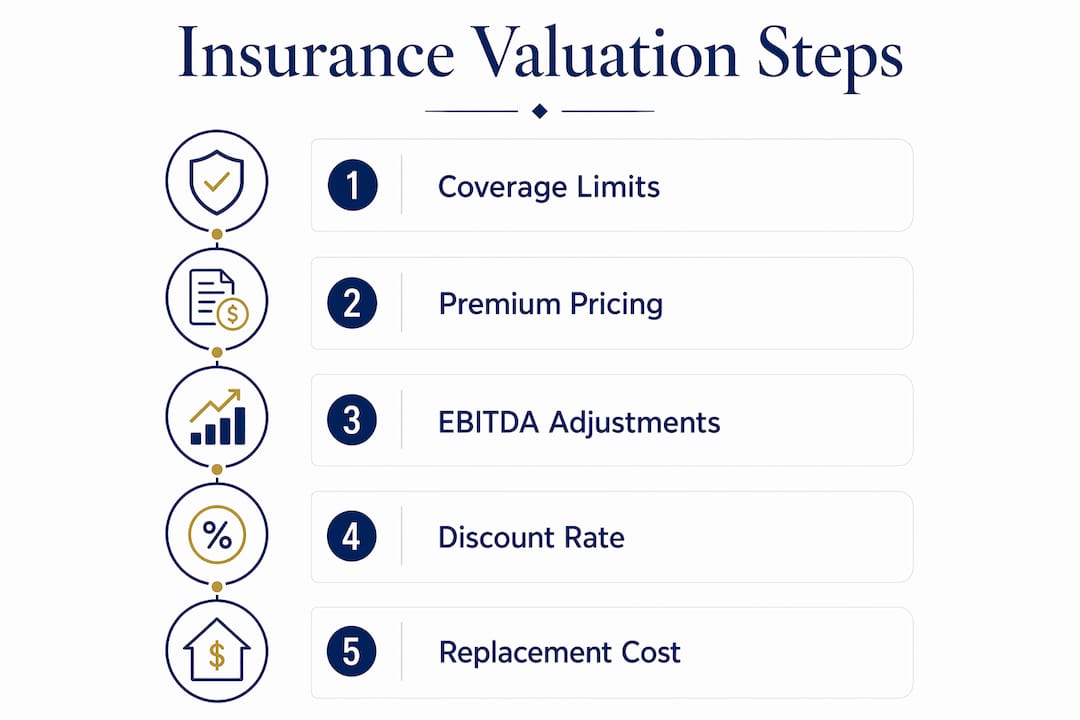
The mechanics work through three levers: coverage limits, premium pricing, and EBITDA adjustments. Insurers use valuation metrics to set coverage limits. When those limits fall out of step with current market value, the business faces either overinsurance, which inflates premiums with no added benefit, or underinsurance, which leaves a financial gap at exactly the wrong moment.

For insurance agencies specifically, EBITDA multiples in 2026 average around 11.8x for firms with $1M or more in EBITDA, with specialty books reaching 9x–12x. That range matters because even a half-turn shift in multiple, driven by perceived risk, translates to hundreds of thousands of dollars in enterprise value. Buyers price in uninsured risk as a discount.
Pro Tip: Ask your appraiser to flag any insurance gap as a line item in the valuation report. Buyers will find it anyway. Surfacing it early gives you time to close the gap before it becomes a negotiating point.
- Coverage limits must match current replacement cost, not the figure from three years ago.
- Premium costs flow directly into operating expenses, which affects EBITDA and therefore valuation multiples.
- Uninsured liabilities appear as contingent risks in due diligence and reduce buyer confidence.
- Retention rates above 90% drive premium EBITDA multiples in agency valuations; below 80%, multiples drop sharply.
How do insurance policies interact with buy-sell agreement valuations?
A buy-sell agreement without a current valuation is a funding plan built on guesswork. The valuation clause inside the agreement sets the price at which a departing owner's interest transfers. The insurance policy funds that price. When the two numbers diverge, surviving owners face a shortfall they must cover from personal assets or business reserves.
Buy-sell agreements and insurance coverage should be reviewed and updated at least every 24 months. A 40% revenue increase, a new product line, or a significant equipment acquisition can each push market value well above the insured amount. Appraisal costs less than the annual premium difference created by a stale valuation.
Representation and Warranty Insurance, known as RWI, plays a distinct role in transaction contexts. RWI policies cover roughly 10% of enterprise value, carry premiums between 2% and 3%, and allow sellers to access 99.5% of the deal price at closing by shifting indemnification risk to the insurer. That structure reduces escrow holdbacks and accelerates deal certainty for both parties.
Pro Tip: When updating your buy-sell agreement, run the insurance funding analysis alongside the appraisal, not after it. The two documents need to match at the same point in time to be useful.
- Commission a formal appraisal before renewing or increasing life insurance tied to a buy-sell agreement.
- Confirm that the policy ownership structure and beneficiary designations align with the agreement's funding intent.
- Review trigger events covered by the agreement, including disability and voluntary exit, not just death.
- Confirm that insurance serves as a funding bridge alongside reserves and financing tools, not as the sole funding source.
What valuation methods incorporate insurance, and how do they work in practice?
Three methods dominate formal business appraisal: the income approach, the market approach, and the asset approach. Insurance affects each one differently.
Income approach and discount rate adjustments
The Discounted Cash Flow method, the core income approach tool, projects future cash flows and discounts them to present value. The discount rate reflects risk. A business with comprehensive coverage, including key person insurance, general liability, and business interruption coverage, carries a lower risk profile. That lower risk justifies a tighter discount rate, which produces a higher present value. Key person insurance provides liquidity and mitigates risk, but it does not automatically eliminate valuation discounts tied to owner dependence. The appraiser still evaluates policy ownership, coverage amount, tax treatment, and beneficiary designations before adjusting the discount.
Market approach and EBITDA normalization
The market approach compares the subject business to recent transactions using multiples, most commonly EBITDA multiples. Insurance premiums are an operating expense. Abnormally high premiums, caused by overinsurance or poor claims history, reduce reported EBITDA and therefore reduce the indicated value. Normalizing adjustments can add back excess premiums, but only when the appraiser can document that the coverage exceeds what a hypothetical buyer would maintain.
| Valuation method | Insurance impact | Key adjustment |
|---|---|---|
| Discounted Cash Flow | Affects discount rate through risk profile | Lower risk from coverage reduces discount rate |
| EBITDA multiple | Premiums reduce EBITDA directly | Normalize excess premiums with documentation |
| Asset approach | Replacement cost coverage aligns with asset values | Confirm coverage matches current asset appraisals |
| Buy-sell funding analysis | Insurance proceeds fund ownership transfer | Match policy face value to current enterprise value |
Asset approach and replacement cost alignment
The asset approach values a business by summing its net assets at fair market value. Property and casualty coverage should match the replacement cost figures used in this method. When coverage limits reflect original purchase price rather than current replacement cost, the asset approach and the insurance schedule tell two different stories. Appraisers and buyers notice that gap.
What are the risks of misaligned insurance and business valuation?
Misalignment between insurance coverage and current business value creates two distinct failure modes. Both are expensive. Treating valuation and insurance as identical leads to severe underfunding or overfunding. Informed planning keeps them coordinated but separate.
- Underinsurance at a triggering event. If a partner dies and the life insurance policy covers $2M but the current valuation is $3.5M, surviving owners must fund the $1.5M gap from business cash or personal assets. That shortfall can force a distressed sale.
- Overinsurance inflating operating costs. Carrying $5M in coverage on a $2M business raises premiums without adding protection. Those excess premiums reduce EBITDA, which reduces the valuation multiple a buyer will pay.
- Stale valuations in active markets. A business that grew 40% in two years but never updated its coverage is underinsured by definition. Revenue growth, new contracts, and asset additions all increase exposure.
- Owner-dependence discounts not addressed. Appraisers apply owner-dependence discounts when one person drives most of the revenue. Key person insurance reduces the financial impact of losing that person, but it does not remove the discount unless the appraiser confirms the policy terms actually transfer value to the business.
- Tax and ownership structure errors. A key person policy owned by the wrong entity, or with the wrong beneficiary, may not produce the intended tax outcome. That error shows up in the valuation when the appraiser models after-tax cash flows.
How can you align insurance policies with business valuation for financial planning?
Alignment is a process, not a one-time event. Business value changes as revenue grows, assets are acquired, and market conditions shift. Insurance coverage must track those changes to remain useful.
Pro Tip: Build your insurance review into the same calendar cycle as your annual financial close. When you have current financials in hand, you have the inputs needed to check whether coverage still matches value.
- Schedule a formal appraisal every 24 months, or immediately after any event that materially changes revenue or assets.
- Engage a valuation specialist and an insurance advisor in the same planning conversation. They rarely talk to each other by default, and the gap between their outputs is where problems hide.
- Use insurance as one layer in a funding stack for buy-sell agreements. Combine it with a sinking fund, a line of credit, or installment payment terms to cover trigger events that insurance does not reach, such as voluntary retirement.
- Coordinate legal and tax considerations with your CPA and attorney when structuring key person or buy-sell policies. Policy ownership and beneficiary structure determine whether the proceeds reach the right place at the right time.
- Document every coverage decision in writing, tied to the valuation that supported it. That paper trail protects you in due diligence and in disputes with surviving partners.
Key Takeaways
Insurance and business valuation must be treated as coordinated disciplines, not separate functions, because misalignment creates measurable financial gaps at every ownership transition, financing event, and sale.
| Point | Details |
|---|---|
| Insurance signals risk to appraisers | Coverage gaps appear as contingent liabilities and reduce enterprise value in buyer due diligence. |
| Review every 24 months | Buy-sell agreements and insurance coverage both need updating after significant revenue or asset changes. |
| Key person insurance reduces but does not eliminate discounts | Appraisers still evaluate policy ownership, beneficiary, and tax treatment before adjusting valuation. |
| RWI accelerates deal certainty | Representation and Warranty Insurance shifts indemnification risk to the insurer, freeing up to 99.5% of deal proceeds at closing. |
| Align methods with coverage types | DCF, EBITDA multiples, and asset approaches each require different insurance adjustments to produce accurate valuations. |
What I've learned about insurance and valuation that most advisors skip
By Shereka
After working with business owners across multiple states, the pattern I see most often is not ignorance. It is compartmentalization. The CPA handles the valuation. The insurance agent handles the policy. Neither one reads the other's work. The result is a buy-sell agreement funded at a number that was accurate four years ago, backed by a policy that has not been reviewed since it was signed.
The uncomfortable truth is that a stale valuation inside a buy-sell agreement is not a minor administrative oversight. It is a financial trap that springs at the worst possible moment, when a partner dies or becomes disabled and the surviving owners are already under stress. I have seen businesses survive the loss of a founder only to nearly collapse under the weight of a funding shortfall that a $3,000 appraisal would have prevented.
Insurance is a planning tool. It works when it is connected to a current number. The businesses that handle ownership transitions cleanly are the ones where the valuation and the insurance schedule were updated together, reviewed by the same advisor team, and documented in writing. That coordination is not complicated. It just requires treating the two as parts of one plan instead of two separate line items.
— Shereka
Familyguardlh: insurance planning built for business owners
Business owners need insurance coverage that keeps pace with their company's value, not a policy that was right once and has been sitting untouched ever since.

Familyguardlh works with business owners and investors across 22 states to structure life insurance, supplemental coverage, and annuity products that fit within a real valuation and succession plan. Whether you are funding a buy-sell agreement, protecting a key employee, or building a retirement income layer alongside your business exit, the right coverage starts with the right conversation. Visit Familyguardlh to connect with a licensed advisor who understands both sides of the planning equation.
FAQ
What is the role of insurance in business valuation?
Insurance reduces a company's perceived risk profile, which directly affects discount rates, EBITDA normalization, and buyer confidence during due diligence. Proper coverage alignment supports a higher, more defensible valuation.
How often should insurance coverage be updated to match business value?
Buy-sell agreements and insurance coverage should be reviewed at least every 24 months, or immediately after any event that materially increases revenue or assets.
Does key person insurance eliminate owner-dependence discounts in a valuation?
Key person insurance provides liquidity and reduces financial risk, but it does not automatically remove owner-dependence discounts. Appraisers evaluate policy ownership, coverage amount, and beneficiary structure before making any adjustment.
What is Representation and Warranty Insurance and how does it affect valuation?
RWI covers roughly 10% of enterprise value and shifts indemnification risk from the seller to the insurer, allowing sellers to receive up to 99.5% of the deal price at closing and reducing escrow holdbacks.
What happens when insurance coverage and business valuation are misaligned?
Underinsurance creates a funding gap that surviving owners must cover from personal or business assets. Overinsurance inflates operating costs, reduces EBITDA, and lowers the valuation multiple a buyer will pay.