

Inflation risk for retirees is defined as the threat that rising prices will erode purchasing power faster than retirement income grows, leaving you unable to maintain your standard of living. This is not a theoretical concern. The Consumer Price Index rose 3.5% year-over-year as of june 2026, and categories that dominate retiree budgets climbed even faster. Understanding what is inflation risk for retirees means recognizing that your personal inflation rate is almost certainly higher than the headline number you see in the news. The good news is that specific, proven strategies exist to protect your retirement income against it.
What is inflation risk for retirees, and why does it hit harder?
Inflation risk is the formal term financial planners use to describe purchasing power erosion. For retirees, it carries more weight than for working adults because you cannot simply earn more to compensate. Your income is largely fixed, and your expenses are concentrated in categories that inflate faster than average.
Retirees experience a personal inflation rate roughly 0.5% to 1.0% higher than headline CPI. That gap compounds over a 20 to 30 year retirement. A retiree spending $60,000 per year today needs meaningfully more in a decade just to buy the same things.
The spending categories driving this gap are predictable:
- Healthcare: Premiums, prescriptions, and out-of-pocket costs rise faster than general inflation for most retirees.
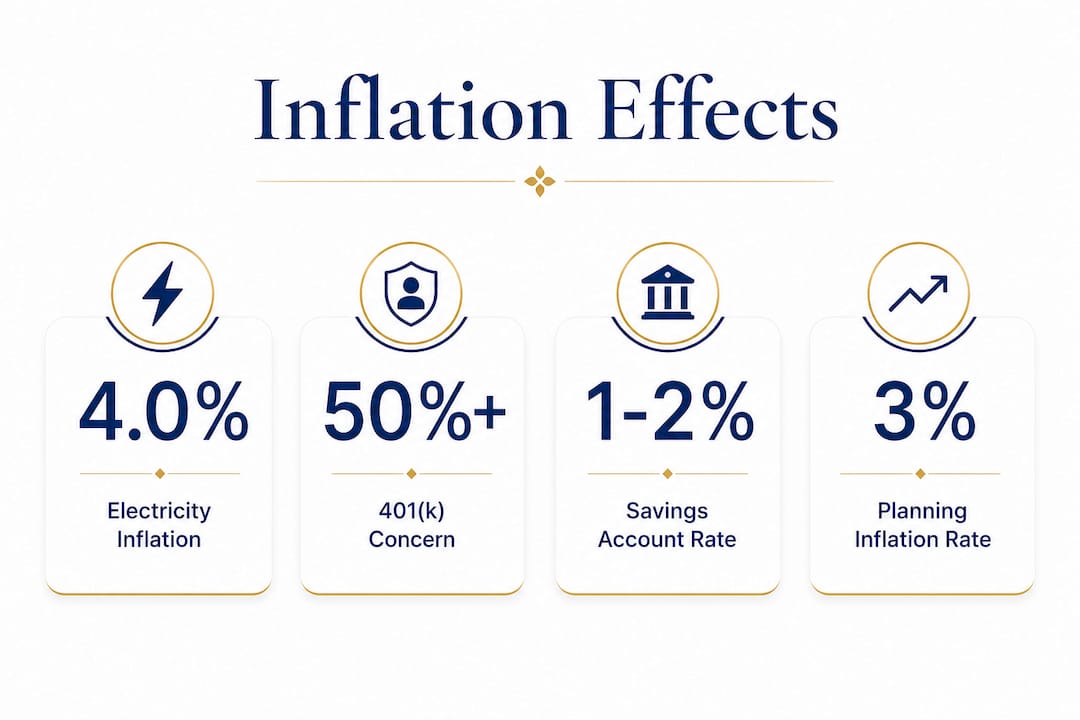
- Utilities: Electricity prices rose 4.0% year-over-year as of june 2026, well above the headline CPI rate.
- Food: Dining out costs climbed 3.4% in the same period, a real burden for retirees who eat out regularly.
- Housing: Property taxes and maintenance costs tend to rise steadily regardless of market conditions.
Economists have developed the R-CPI-E (Experimental Consumer Price Index for Americans 62 and Older) specifically to track retiree spending patterns. It consistently runs above the standard CPI-W, which is the index the Social Security Administration uses to calculate annual cost-of-living adjustments (COLAs). That mismatch matters. Social Security COLAs are calculated using CPI-W, which may lag the actual inflation retirees experience. The result is a slow, steady purchasing power gap that widens every year.
| Expense category | 2026 inflation rate | Why it matters for retirees |
|---|---|---|
| Electricity | 4.0% | Retirees spend more time at home, driving higher utility use |
| Food away from home | 3.4% | A common social and convenience expense for retirees |
| Overall CPI | 3.5% | The baseline most income adjustments are tied to |
| Healthcare (general) | Rising faster than CPI | The single largest long-term cost risk for retirees |
How does inflation affect retirement savings and portfolio longevity?
The financial impact of inflation on retirement savings goes beyond rising grocery bills. It creates what financial analyst Jay Sharifi calls the "triple threat" for retirees: rising costs force larger withdrawals, larger withdrawals increase taxable income, and higher taxes accelerate portfolio depletion. Each step makes the next one worse.
Here is how that cycle plays out in practice:
- You need $5,000 more per year to cover rising costs.
- You withdraw an extra $5,000 from a traditional IRA or 401(k).
- That withdrawal is taxable income, potentially pushing you into a higher bracket.
- You now need to withdraw even more to cover the tax bill.
- Your portfolio shrinks faster than your withdrawal plan assumed.
Over 50% of 401(k) participants identify inflation as the single biggest obstacle to retirement savings. That concern is well-founded. A retirement plan built around 2% inflation assumptions can fall apart when actual inflation runs at 3.5% or higher for several consecutive years.
Cash holdings make this worse, not better. Cash often produces negative real returns during inflationary periods because interest rates on savings accounts rarely keep pace with rising prices. Retirees who move heavily into cash for safety can actually accelerate their purchasing power loss.

Stocks, by contrast, have historically outpaced inflation over long periods. Corporate earnings tend to grow alongside prices because companies pass higher costs to consumers. That pricing power supports stock returns even when inflation is elevated.
Pro Tip: Do not let a single bad market year push you into an all-cash position. A diversified portfolio with equity exposure is your best long-term defense against purchasing power erosion.
What investment and income strategies manage inflation risk effectively?
Protecting retirement income from inflation requires a mix of growth assets, inflation-linked instruments, and tax-efficient income sources. No single product solves the problem. The strongest plans combine several approaches.
-
Maintain equity exposure. Stocks are the most reliable long-term inflation hedge available to retirees. Fidelity experts note that corporate pricing power supports earnings growth even in high-inflation environments. A portfolio with zero equity exposure is a portfolio that will lose ground to inflation over time.
-
Use Treasury Inflation-Protected Securities (TIPS). TIPS are U.S. government bonds whose principal adjusts with CPI. They provide a guaranteed real return and protect the fixed-income portion of your portfolio from inflation erosion. They work best as a complement to equities, not a replacement.
-
Consider Real Estate Investment Trusts (REITs). REITs own income-producing properties and are required to distribute most of their earnings to shareholders. Property values and rents tend to rise with inflation, making REITs a practical inflation hedge within a diversified portfolio.
-
Evaluate annuities with cost-of-living adjustments. A fixed annuity provides predictable income but loses real value over time. An annuity with a built-in COLA rider adjusts payments annually, preserving purchasing power. The trade-off is a lower starting payment, so the math depends on your expected retirement length and inflation assumptions.
-
Execute Roth IRA conversions before Required Minimum Distributions begin. Roth conversions before RMDs reduce future taxable income, which directly counters the triple threat cycle. Converting in lower-income years locks in today's tax rate and reduces the forced withdrawals that inflation pushes upward.
Pro Tip: Certified financial planner Marc Shaffer recommends planning for 3% inflation over a 20 to 30 year retirement horizon, even though the 10-year average has been closer to 2%. That extra margin of safety can be the difference between a plan that holds and one that runs short.
How can retirees adjust spending and withdrawals to stretch retirement income?
Investment strategy addresses the supply side of the problem. Spending and withdrawal discipline addresses the demand side. Both matter equally for long-term financial security.
Start by building your personal budget around your actual inflation rate, not the headline CPI. If you spend heavily on healthcare and utilities, your effective inflation rate is likely 0.5% to 1.0% higher than the national average. Budget accordingly, and revisit those assumptions every year.
Withdrawal order also has a significant impact on how long your money lasts:
- Taxable accounts first: Withdrawing from brokerage accounts before tax-deferred accounts allows your IRA and 401(k) balances to keep growing tax-deferred.
- Tax-deferred accounts second: Traditional IRAs and 401(k)s are subject to RMDs starting at age 73, so plan withdrawals to manage bracket exposure.
- Roth accounts last: Roth IRAs have no RMDs and grow tax-free, making them the most valuable long-term asset to preserve.
Liquidity matters more than most retirees expect. Keeping 12 to 24 months of living expenses in accessible accounts prevents you from being forced to sell investments at a loss during a market downturn. That buffer protects your portfolio from sequence-of-returns risk, which is the danger of large early losses that permanently reduce your account balance.
Annual portfolio reviews and rebalancing prevent drift toward low-return assets. A portfolio that started at 60% equities can drift to 45% after a strong bond year, leaving you underexposed to growth. Rebalancing restores your intended allocation and keeps your plan on track.
Key Takeaways
Inflation risk for retirees is a compounding threat that requires both investment discipline and spending awareness to manage effectively over a long retirement horizon.
| Point | Details |
|---|---|
| Personal inflation rate is higher | Retirees face 0.5%–1.0% more inflation than headline CPI due to healthcare and utility spending. |
| The triple threat accelerates depletion | Rising costs force larger withdrawals, which raise taxes, which drain portfolios faster. |
| Cash is not a safe haven | Cash loses real value during inflation; maintaining equity exposure is the stronger long-term defense. |
| TIPS and REITs provide direct hedges | These instruments link returns to inflation or real asset values, protecting purchasing power directly. |
| Roth conversions reduce future tax exposure | Converting before RMDs lowers taxable income and breaks the withdrawal-tax cycle inflation creates. |
What I have learned about inflation risk after years of working with retirees
Retirees tend to fall into one of two camps when inflation spikes. The first group panics and moves everything into cash or CDs. The second group ignores it entirely and keeps withdrawing at the same rate as if nothing changed. Both approaches cause real damage.
The retirees who navigate inflation best treat it the way a good pilot treats turbulence: they acknowledge it, adjust their course slightly, and keep flying. They do not abandon their investment plan, but they do review it. They check whether their withdrawal rate still makes sense. They ask whether their income sources, including Social Security, annuities, and portfolio distributions, are keeping pace with their actual spending.
What surprises most people I work with is how much the spending side matters. A retiree who trims discretionary expenses by even a modest amount during a high-inflation year can avoid selling investments at a bad time. That discipline compounds over decades.
The other thing I push back on is the assumption that inflation is always the emergency it feels like in the news cycle. The 10-year average inflation rate has been closer to 2%. Planning for 3% gives you a real margin of safety without requiring you to take on excessive risk. Fear-driven decisions, like abandoning equities entirely or hoarding cash, tend to create the very shortfall retirees are trying to avoid.
The right approach is steady, deliberate, and reviewed annually. That is not exciting. But it works.
— Shereka
How Familyguardlh helps retirees protect their financial security
Inflation risk does not have a single fix. It requires the right combination of income sources, insurance products, and portfolio structure working together. Familyguardlh specializes in helping retirees and near-retirees in 22 states build that combination, with access to annuities, Medicare plans, life insurance, and supplemental coverage designed to support long-term financial stability.

If you are concerned about how rising prices will affect your retirement income, Familyguardlh can help you evaluate your options. The team at Familyguardlh works with retirees across Arizona, Florida, Texas, Georgia, and 18 additional states to match the right products to each person's income needs and risk profile. A conversation costs nothing, and the clarity it provides is worth a great deal.
FAQ
What is inflation risk for retirees in simple terms?
Inflation risk for retirees is the danger that rising prices will reduce what your retirement income can actually buy over time. Because most retirement income is fixed or grows slowly, even moderate inflation can significantly reduce your purchasing power over a 20 to 30 year retirement.
Why do retirees face a higher inflation rate than the general population?
Retirees spend a larger share of their budget on healthcare, utilities, and food, all of which tend to rise faster than overall CPI. This means their personal inflation rate typically runs 0.5% to 1.0% above the headline number used to calculate Social Security COLAs.
Does Social Security protect retirees from inflation?
Social Security includes annual cost-of-living adjustments, but these are based on the CPI-W index, which does not fully reflect retiree spending patterns. The result is a gradual purchasing power gap that widens over time, particularly as healthcare costs rise faster than the CPI-W tracks.
Is holding cash a good strategy during high inflation?
Cash is one of the weakest inflation hedges available. When inflation runs at 3.5% and a savings account pays 1% to 2%, the real value of that cash shrinks every year. Maintaining equity exposure through stocks, TIPS, or REITs provides stronger long-term protection against purchasing power loss.
How often should retirees review their portfolio for inflation risk?
Annual portfolio reviews are the standard recommendation from certified financial planners. Rebalancing once per year prevents drift toward low-return assets and keeps your withdrawal strategy aligned with your actual spending needs and current inflation conditions.